This series highlights the modern malandro in urban society, focusing on their resourcefulness and charm while addressing economic disparity and social justice. It showcases their resilience and clever tactics in navigating city challenges, emphasizing their dual role as outliers and contributors to urban culture. Through personal narratives and societal themes, it portrays the malandro as influential figures in the conversation about equity and belonging. By weaving together individual stories and broader societal issues, the series delves deeper into the complexities of life as a malandro, revealing not only their struggles but also their triumphs. These characters are depicted as savvy navigators of an often harsh urban landscape, using their wits and creativity to carve out niches in a world that frequently marginalizes them. As the series unfolds, it invites viewers to reconsider preconceived notions about success and morality, ultimately celebrating the unique contributions of the malandro to the tapestry of urban life, where acts of defiance can also be acts of solidarity.
In Today’s installment, We follow Conor Woodman in a show named scam city, a series where he gets scammed, so we don’t have to.
In Bangkok, a host revisits a notorious gem scam and uncovers another shocking scheme that preys on unsuspecting tourists. Using advanced hidden cameras, they delve deep into the city’s underbelly, investigating the labyrinth of deceit intertwined with the vibrant backdrop of the bustling metropolis. As they explore various well-known tourist traps, they uncover a web of manipulation that often leaves visitors disillusioned and cheated out of their hard-earned money.
Through careful interactions with locals, both victims and willing participants in these scams, the documentary sheds light on the intricate network behind these schemes, revealing not only the tactics employed by scammers but also the cultural and socioeconomic factors that enable such exploitation. By delving into personal stories and firsthand accounts, it becomes evident how deeply these scams are woven into the fabric of society, often leading to devastating consequences for the individuals involved.
The host’s journey serves as both an eye-opening exploration of the darker side of tourism, uncovering the hidden dangers that tourists unwittingly face, and a compelling narrative of resilience and awareness in the face of deception, highlighting the importance of education and advocacy in empowering victims and raising awareness among potential tourists. This journey not only emphasizes the ethical implications of engaging in such tourism but also encourages viewers to reflect on their own roles in perpetuating these cycles, ultimately fostering a deeper understanding of global interconnectedness and responsibility.
Welcome to MALICIA AS A GAME OF POWER, a blog series that explores the strategies of human interactions, including communication, conflict resolution, negotiation, and manipulation. It discusses leadership, personal branding, and online reputation management, providing practical strategies for influence and relationship-building. Through analysis and examples, the series aims to help readers navigate interpersonal relationships successfully.
In this installment, we will explore the 34th law of power in the book, the 48 laws of power by Robert Greene. You can buy a copy by clicking HERE.
LAW 34: BE ROYAL IN YOUR OWN FASHION. ACT LIKE A KING TO BE TREATED LIKE ONE.
This philosophy encourages individuals to embrace their unique identities and strengths with confidence, reminding us that true royalty comes from within. By cultivating a mindset of self-worth and dignity, you not only elevate yourself but also inspire those around you to recognize their own innate value. In a world often filled with comparisons and societal pressures, it’s vital to celebrate our individual journeys and the distinct qualities that make us who we are.
When we honor ourselves authentically, we create a ripple effect, encouraging others to shed their insecurities and fully express their true selves as well. This shared journey of empowerment fosters a stronger, more connected community where everyone feels valued and appreciated for their contributions. As we uplift each other, we collectively build a space that honors diversity and individuality, illustrating that self-acceptance is a powerful catalyst for positive change in our lives and the lives of those we touch.
Surround yourself with positivity, make decisions that reflect your principles, and carry yourself with grace. Remember, the way you present yourself to the world will often dictate how the world responds to you, so wear your crown proudly and let your actions set the standard for how others should treat you. By embodying kindness and confidence, you not only uplift yourself but also inspire those around you to rise to the same level of respect and dignity.
Each interaction is an opportunity to reinforce your values; therefore, choose your words and actions carefully, ensuring they align with the legacy you wish to leave behind. In moments of challenge, stand firm in your beliefs, knowing that your authenticity shines through even in the face of adversity. Embrace the journey of self-improvement, as every step forward brings you closer to becoming the best version of yourself.
How to Navigate the 34th Law of Power with an Ethical Compass
The 34th Law of Power, often summarized as “Be Royal in Your Own Fashion: Act Like a King to Be Treated Like One,” is a principle rooted in presenting an image of self-assurance, confidence, and inherent value. This law suggests that by embodying the outward characteristics of royalty—dignity, generosity, and an unshakeable belief in one’s own worth—others will naturally respond by granting you respect, deference, and the resources associated with high status. It is a psychological tool for influencing perception and, consequently, reality.
However, the pursuit of power and influence must be tempered by a strong ethical framework. Applying the 34th Law ethically means leveraging its psychological mechanisms without resorting to deceit, exploitation, or arrogance. It transforms the law from a tool of manipulation into a principle of genuine, value-driven leadership.Ethical Pillars for Implementing the 34th Law
To ensure an ethical application, one must focus on the substance behind the royal facade:
1. Authentic Self-Possession, Not Arrogance:
The Ethical Approach: The “royal” demeanor should stem from deep, authentic self-respect and competence, not from a manufactured superiority complex. Ethically, this means putting in the work to earn the confidence you project. True self-possession is quiet, grounded, and secure, recognizing the value in oneself while respecting the value in others.
The Unethical Pitfall: Using a show of arrogance, entitlement, or contempt for others to mask insecurity or a lack of substance. This damages relationships and is ultimately unsustainable.
2. Generosity and Reciprocity (The Royal Patron):
The Ethical Approach: Historical royalty often maintained their status through calculated acts of generosity—patronage, providing protection, and bestowing honors. Ethically, this translates to being a leader who genuinely supports their team, shares credit, mentors subordinates, and contributes value far beyond what is strictly required. The power you accrue is used to lift others up.
The Unethical Pitfall: Being a “tyrant” who hoards resources, demands service without offering commensurate value, or acts purely out of self-interest. This may grant short-term obedience but breeds resentment and instability.
3. Maintaining Dignity Through Integrity:
The Ethical Approach: The royal image is preserved through consistency, transparency (where appropriate), and a commitment to one’s stated values. Ethical application of the 34th Law means avoiding petty disputes, refraining from gossip, and always honoring one’s word. A king’s word is his bond; an ethical leader’s word is their reputation.
The Unethical Pitfall: Engaging in duplicitous behavior, making false promises, or allowing your actions to be inconsistent with your projected image. This quickly erodes trust, and without trust, the projected image of “royalty” collapses into farce.
4. Focusing on Service and Purpose:
The Ethical Approach: The most ethical expression of the 34th Law is when the projected image of competence and authority serves a higher, positive purpose—leading a successful initiative, advocating for a just cause, or creating genuine value for a community or organization. The power is not an end in itself but a means to achieve constructive goals.
The Unethical Pitfall: Adopting the “royal” persona solely for personal gain, luxury, or to dominate others, leading to a focus on superficial status rather than meaningful contribution.
Practical Ethical Application Steps
Define Your True Value: Identify the unique skills, expertise, and positive influence you bring to a situation. This is the foundation of your legitimate claim to a “royal” status.
Project Confidence, Not Conceit: Use body language, clear communication, and decisive action to project competence. Ensure your confidence is always paired with humility—a willingness to listen, learn, and admit mistakes.
Invest in Your Appearance and Environment: Presenting a professional, thoughtful image is an ethical signal that you respect your role, your time, and the people you are engaging with. This is not about extravagance but about care and quality.
Practice Strategic Generosity: Be liberal with praise, mentorship, and opportunities for others. Make deposits into your relational capital by being a reliable source of support and fair treatment.
By focusing on these ethical underpinnings, the 34th Law of Power becomes a framework for powerful, yet principled, leadership, ensuring that the influence you gain is both lasting and morally sound.
The 34th law of power, through the eyes of an Angoleiro:
For those who walk the path of Capoeira Angola, the 34th Law of Power—Be Royal in Your Own Fashion: Act Like a King to Be Treated Like One—takes on a profound, almost spiritual significance. It is not about ostentatious wealth or inherited titles, but about the postura (posture), the inherent dignity, and the self-respect that define a true master, or Mestre.
In the roda (the circle where Capoeira is played), the Angoleiro learns to carry themselves with an internal regality, a quiet confidence that commands respect without demanding it. This “royalty” is earned through:
Mastery of the Jogo (Game): A Mestre’s authority is rooted in their deep, fluid knowledge of the movements, the songs (quadras and corridos), the rhythms of the berimbau, and the history of the art. Their every move—slow, deliberate, and efficient—is the expression of a cultivated mind and body. They don’t have to boast; their jogo speaks for them.
The Axé (Life Force/Energy): Royalty in Angola is synonymous with a strong axé. It’s the powerful, positive energy and presence they bring into the roda. When they enter, the energy shifts. They are the anchor, the one who sustains the fire and depth of the game. They hold the wisdom and the spirit of the lineage.
Self-Control and Patience: Acting like a king means never showing desperation, fear, or petty anger. A true Angoleiro maintains a calm, almost impenetrable demeanor. They are deliberate, observing the flow, waiting for the perfect moment to execute a dangerous rasteira (takedown) or a clever malandragem (trickery). Their patience is their power; they rule the space by not rushing the interaction.
Humildade(Humility) as a Crown: Paradoxically, the highest form of Capoeira “royalty” is not arrogance, but profound humility. A Mestre understands that the art is bigger than any single person. They serve the roda and the tradition. This genuine humility—the willingness to always be a student—is what makes their authority magnetic and legitimate, rather than tyrannical.
To be “royal in your own fashion” as an Angoleiro is to embody the legacy of the enslaved Africans who created this art as a form of cultural and physical resistance. It means carrying the weight of that history with dignity, showing that even without physical chains, one possesses an unbreakable spirit—the spirit of a sovereign within their own skin. Their postura is a statement: “I am worthy of respect because I respect the art, my ancestors, and myself.” They are treated like a king because they act like the living embodiment of the Rei da Capoeira (King of Capoeira).
This series highlights the modern malandro in urban society, focusing on their resourcefulness and charm while addressing economic disparity and social justice. It showcases their resilience and clever tactics in navigating city challenges, emphasizing their dual role as outliers and contributors to urban culture. Through personal narratives and societal themes, it portrays the malandro as influential figures in the conversation about equity and belonging. By weaving together individual stories and broader societal issues, the series delves deeper into the complexities of life as a malandro, revealing not only their struggles but also their triumphs. These characters are depicted as savvy navigators of an often harsh urban landscape, using their wits and creativity to carve out niches in a world that frequently marginalizes them. As the series unfolds, it invites viewers to reconsider preconceived notions about success and morality, ultimately celebrating the unique contributions of the malandro to the tapestry of urban life, where acts of defiance can also be acts of solidarity.
In Today’s installment, We follow Conor Woodman in a show named scam city, a series where he gets scammed, so we don’t have to.
Conor Woodman discovers the paradox that is Mexico City, a vibrant metropolis teeming with life yet shadowed by the lurking dangers that can catch the unwary traveler off guard. From the moment he takes a taxi from the airport, navigating through the sprawling urban landscape filled with towering skyscrapers and historic architecture, he is on a mission to find out about the kidnapping scam of the city’s taxis, which has garnered the attention of both locals and international tourists alike. As he maneuvers through congested streets pulsing with the rhythm of street vendors and the aroma of tantalizing street food, he notes the palpable energy that characterizes this city. With every kilometer traveled, he becomes increasingly aware of the contrasting elements that define this enchanting yet chaotic city, prompting him to delve deeper into its hidden truths while remaining vigilant about the risks that accompany his exploration.
Welcome to MALICIA AS A GAME OF POWER, a blog series that explores the strategies of human interactions, including communication, conflict resolution, negotiation, and manipulation. It discusses leadership, personal branding, and online reputation management, providing practical strategies for influence and relationship-building. Through analysis and examples, the series aims to help readers navigate interpersonal relationships successfully.
In this installment, we will explore the 33nd law of power in the book, the 48 laws of power by Robert Greene. You can buy a copy by clicking HERE.
LAW 33 DISCOVER EACH MANS THUMBSCREW
Discover each man’s thumbscrew, which emphasizes the importance of understanding what drives and motivates individuals, highlights the necessity of recognizing the unique pressures and vulnerabilities that each person holds. By engaging deeply with others, we unveil their personal strengths and weaknesses, allowing us to navigate our interactions more effectively.
This principle suggests that by identifying the metaphorical “thumbscrew” of a person—be it their desires, fears, or insecurities—we can influence them in a manner that is beneficial for both parties. By gaining a deeper understanding of what motivates them, we create pathways for meaningful engagement, allowing us to tailor our interactions to resonate more profoundly. This nuanced approach not only enables us to respond better to their needs but also encourages open dialogues, where both sides can share their perspectives without fear of judgment. U
ltimately, this knowledge cultivates empathy and fosters stronger relationships, as we learn to align our approaches to accommodate their needs and aspirations. This, in turn, enhances collaboration and fosters trust, allowing for a communal environment where ideas can flourish and individuals feel valued, leading to a more cohesive and constructive relationship dynamic.
How to use The 33rd Law of Power in an ethical way: The Art of Strategic Discretion
The 33rd Law of Power, often interpreted as “Discover Each Man’s Thumbscrew,” speaks to the human tendency to focus on an individual’s specific weaknesses, insecurities, or desires—the leverage point that, when pressed, can be used to control or manipulate them. While this law, in its rawest form, is a tool for calculated influence and sometimes ruthless power, it is possible and necessary to reinterpret and apply its core principle—strategic understanding of human nature—in an ethical framework.
To utilize the essence of this law ethically, one must shift the focus from exploitation to empathy, effective communication, and collaboration.1. Shift the Focus: From “Thumbscrew” to “Motivator”
Instead of seeking a “weakness” to exploit, an ethical application involves identifying a person’s core motivator, driver, or aspiration. This requires deep, empathetic listening and observation, aimed at understanding what truly matters to them.
Ethical Goal: To understand the individual’s deepest needs and professional/personal goals to better align your shared objectives, creating a mutually beneficial partnership.
The Approach: Ask thoughtful, open-ended questions. Pay attention to what frustrates them (their pain points) and what excites them (their passions). These are not vulnerabilities to be exploited, but keys to effective, ethical collaboration.
2. Strategic Discretion and Respect for Privacy
The original law encourages probing and revealing secrets. The ethical corollary demands extreme discretion and respect for privacy. The knowledge gained about a person’s “motivator” is a sacred trust, never to be weaponized or shared.
Ethical Goal: To build trust through reliability and confidentiality. When people know you understand them deeply but respect their boundaries, they are more willing to open up and commit to shared goals.
The Approach: Use the knowledge only to tailor your communication style, provide appropriate support, or delegate tasks that align with their strengths and motivations. Never introduce their personal “pain points” into a professional or public discussion.
3. Application: Influence Through Mutual Benefit
The power derived from this ethical interpretation is not coercive; it is influential. Instead of forcing action, you structure proposals and tasks in a way that naturally aligns with the individual’s self-interest and sense of purpose.
Unethical Application (Manipulation)
Ethical Application (Influence)
Exploitation: Find a flaw and threaten to expose it unless demands are met.
Alignment: Identify a personal ambition and show how the current task is a direct stepping stone toward it.
Coercion: Pressure a person by targeting their greatest insecurity (e.g., fear of failure).
Empowerment: Delegate a task that is a stretch goal, appealing to their desire for growth and recognition.
Self-Serving: Use the knowledge solely to advance your own position at their expense.
Collaborative: Use the knowledge to structure a deal that genuinely benefits both parties, ensuring they feel valued.
Conclusion
The 33rd Law of Power can be ethically redeemed by reframing its central tenet. The goal is not to gain leverage over others, but to gain insight into them. By replacing the cold search for a “thumbscrew” with the warm effort of understanding a person’s genuine “motivator,” the law transforms from a cynical tool of control into a powerful mechanism for building strong, productive, and respectful relationships. The ethical use of this knowledge is a foundation for true, sustainable leadership built on mutual respect and genuine human connection.
The 33rd Law of Power, as seen through the eyes of an Angoleiro, is not merely a set of strategic rules, but a deep philosophical reflection on survival, adaptation, and the subtle art of influence within a complex, often adversarial, world.
The Angoleiro, a practitioner of Capoeira Angola—the older, more traditional, and less overtly acrobatic form of the Afro-Brazilian martial art—embodies this law in every roda (the circle where Capoeira is played) and every move (jogo). The 33rd Law of Power, often summarized as “Discover Each Man’s Thumbscrew,” resonates with the core Angoleiro principle: Know your opponent (and yourself) better than they know themselves.
Elaboration on the Angoleiro’s Interpretation:
The “Thumbscrew” as Vulnerabilidade (Vulnerability) and Abertura (Opening):
In Capoeira Angola, the “thumbscrew” is not solely a psychological weakness or a secret desire, but a physical or rhythmic abertura—an opening in the opponent’s defense. This abertura is rooted in their natural movement pattern, their preferred stance, or their internal rhythm (ginga).
The Angoleiro does not rush the attack. They spend the initial phase of the jogo in deep, low, and deceptive ginga, observing the opponent’s “signature” movement. They look for the moment when the opponent’s weight is momentarily misplaced, when they commit too heavily to one side, or when their breathing changes—this is the physical thumbscrew, the point of maximum vulnerabilidade.
The Malandragem of Psychological Leverage:
Beyond the physical, the Angoleiro utilizes malandragem—a term encompassing street smarts, cleverness, and cunning deception. This is the psychological aspect of the law. The Angoleiro seeks to disrupt the opponent’s emotional and mental balance.
This is achieved through:
Deception (Disimulação): Feigning fatigue, boredom, or distraction to lull the opponent into overconfidence.
Musical Manipulation: Using the berimbau and accompanying instruments to slow down the pace, inviting the opponent to relax, only to strike with sudden, explosive speed (axé). Conversely, speeding up the music to push a naturally slow player into making a panicked mistake. The rhythm controls the mind.
Emotional Taunting (Provocação): Using a look, a subtle smile, or a perfectly timed chamada (call-out) to incite anger, fear, or a desire for reckless, flashy moves, pulling the opponent away from their center and discipline. The thumbscrew here is the opponent’s ego.
The Saber (Knowledge) of Context:
An Angoleiro understands that the “thumbscrew” is context-dependent. A move that worked in one roda against one person will not work in another. The law is not about finding a universal weakness, but a momentary one.
The true power lies in the constant, active research into the opponent’s style:
Does he favor a high defense? Attack low.
Is he afraid of getting close? Use the jogo de dentro (inside game), forcing intimacy and discomfort.
Does he rely on a single, powerful move? Lead him to commit to that move, then evade and counter.
Conclusion: For the Angoleiro, the 33rd Law is about mastering the art of observation and patience (Paciência). Power is not seized through brute force, but carefully extracted through knowledge. By discovering the opponent’s “thumbscrew”—be it a misplaced foot, a hurried breath, or a fragile ego—the Angoleiro can control the entire jogo without ever appearing to struggle, turning the opponent’s own nature into their ultimate undoing. The path to power is the path of subtle insight.
I came accross this video, and I thought it was a good way to handle such a situation, without becoming violent, as so many people do.
Tamo, a popular TikToker well-known for his engaging livestreams focused on Pokémon cards and various video games, found himself facing a distressing racist insult during one of his streams. This incident ignited an important discussion among noted commentators Dr. Rashad Richey and Jackson White on their show Indisputable, where they examined the implications of such hateful remarks in online gaming communities. They emphasized the need for greater awareness and accountability in digital spaces, as well as the importance of supporting content creators like Tamo who bravely confront such negativity.
I ran across this video, and I thought I’d post it here.
Katt Williams criticizes Jillian Michaels for her comments on CNN about slavery, questioning why black people are expected to “forget” their historical trauma while other groups receive recognition and support. He points out the inconsistency in how historical injustices are acknowledged, highlighting that despite Michaels’ claim that only 2% of white Americans owned slaves—which is inaccurate—she faces no repercussions for trivializing slavery. This claim not only simplifies a complex history but also undermines the lived experiences of countless individuals affected by the ramifications of slavery.
Williams emphasizes that his commentary goes beyond humor, as he provides evidence to challenge and dismantle Michaels’ views, citing historical data and personal narratives that illustrate the deep and lingering effects of slavery on African American communities. He argues that it’s crucial for society to confront these uncomfortable truths rather than dismiss them, advocating for a greater understanding and dialogue about racial injustice and its impact on contemporary life. Through his passionate advocacy, Williams seeks to inspire others to engage in conversations that honor the past while pushing for a more equitable future.
Welcome to NAMED AND SHAMED, a platform exposing abuse in martial arts through personal accounts and expert interviews. We aim to raise awareness about the need for safe environments for affected individuals, empowering victims with a voice and community. Inspired by McDojo Life, our mission promotes transparency and accountability in the martial arts community, fostering discussions that prioritize safety and respect, allowing individuals to train without fear and grow in their martial arts journey.
Today, we cover the Zuma Martial Arts Scandal, delving into the details surrounding the events that shook the martial arts community.
The Zuma Martial Arts scandal involves multiple allegations of sexual harassment and misconduct against the owner and head coach of Zuma Martial Arts, Adam Zugec, in Victoria, British Columbia. Multiple women have come forward with accusations detailing inappropriate behavior, including unwanted advances and coercive tactics that created a hostile training environment. These revelations have sparked outrage within the local community and beyond, leading to calls for accountability and justice for the victims. In response to these serious claims, the Victoria Police Department is conducting a thorough investigation into the matter, examining the evidence and testimonies presented by the accusers. The outcome of this inquiry could have significant implications not only for Zugec but also for the broader culture within martial arts organizations.
The martial arts community should prioritize empowerment and confidence by addressing negative behaviors and providing education on misbehavior in a comprehensive manner. This includes not only recognizing and correcting such behaviors but also instilling a culture of respect and accountability among members. Open discussions and mentorship foster trust, unity, and collaboration, creating a supportive environment where members inspire each other and build strong relationships to face challenges and celebrate successes together. By encouraging personal growth and development, we enhance the collective strength of our community, allowing every individual to flourish while learning valuable lessons in discipline, perseverance, and compassion. This holistic approach not only cultivates skilled martial artists but also responsible citizens who uplift one another in and out of the dojo.
Welcome to another addition to the “ROOTS OF CAPOEIRA” blog series, which explores the importance of Afro-Brazilian culture in Capoeira, highlighting the connection with the heritage of the AFRO-BRAZILIAN PEOPLE who express their creativity and resilience through art forms like dance, music, and storytelling. This rich cultural tapestry weaves together historical narratives and personal experiences, emphasizing how each element of Capoeira serves not only as a means of self-defense but also as a vital expression of identity and heritage. By understanding these cultural roots, I hope that you can appreciate Capoeira as both a self-defense practice and a unifying cultural expression celebrating shared heritage, where every movement and song embodies a story and every encounter reinforces the legacy of Afro-Brazilian culture. In delving into the interplay between tradition and innovation, we invite our audience to recognize Capoeira not only as a martial art but also as a living tradition, continuously evolving while remaining anchored in its historical significance.
In today’s installment…
What you see in the above video, is a festival called, Nego Fugido, which loosley translated means, Runaway Negro.
The nego fugido is an annual ritual performance in Acupe, Brazil, that reenacts the dehumanization of slavery and the struggle for emancipation. It serves as a form of memorial mediation where the Quilombola community reappropriates its history through a counter-narrative of oppression and resistance, linking art, politics, spirituality, and collective memory. The performance powerfully portrays the history of subjugated people and their tireless struggle for freedom from slavery, shedding light on the cultural richness and resilience often overshadowed by narratives of oppression. Participants create living images (tableaux vivants) that embody the memory of oppression and the resistance of those who were enslaved, communicating not just a story, but an experience etched in the hearts and minds of generations. In contrast to dominant historical accounts, Nego Fugido creates a sovereign counter-narrative from the perspective of those whose history has been suppressed or erased, serving as a radical assertion of identity and dignity. This ritual stands as a testament that the past is not a distant memory but a living influence on the present.
The ritual is a way for the Quilombola community to reclaim its past, reinterpreting its colonial heritage in the context of the present, imbuing contemporary culture with historical significance that resonates with today’s struggles for justice. It operates at the intersection of art, politics, spirituality, and the transmission of knowledge, fostering solidarity and common purpose among participants and the audience. The collective act prompts questions about whose voices shape historical memory and who determines the narratives that form a nation, inviting reflection on the nature of truth, memory, and the continual journey towards liberation. Through this performance, the Quilombola community not only honors the ancestors but also challenges prevailing injustices, forging a path towards a more inclusive future grounded in recognition and respect for all histories.
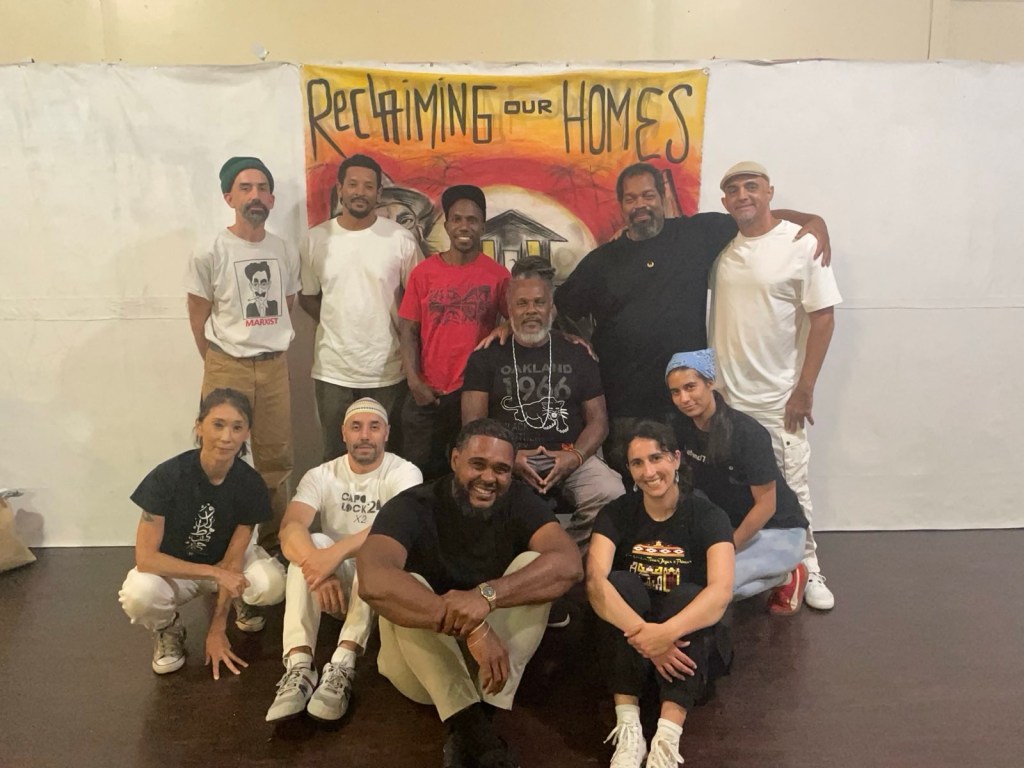
On the permanent section of this website, I referred to the musical side of Capoeira as the HEART of capoeira, a fitting title that encapsulates its essence. Last night, as the sun set and the atmosphere filled with vibrant energy, I embarked on a Journey into the heart of capoeira, immersing myself in its rhythm and soul. During this exploration, I encountered something truly special, a blend of sound and movement that resonated deeply with me. The melodies and beats seemed to tell stories of tradition, struggle, and celebration, offering insights that I believe are essential for anyone looking to understand this beautiful art form. It’s an experience I feel compelled to share with you, as the insights I gained shed light on the profound connections that unite us all through the music and movements of capoeira.
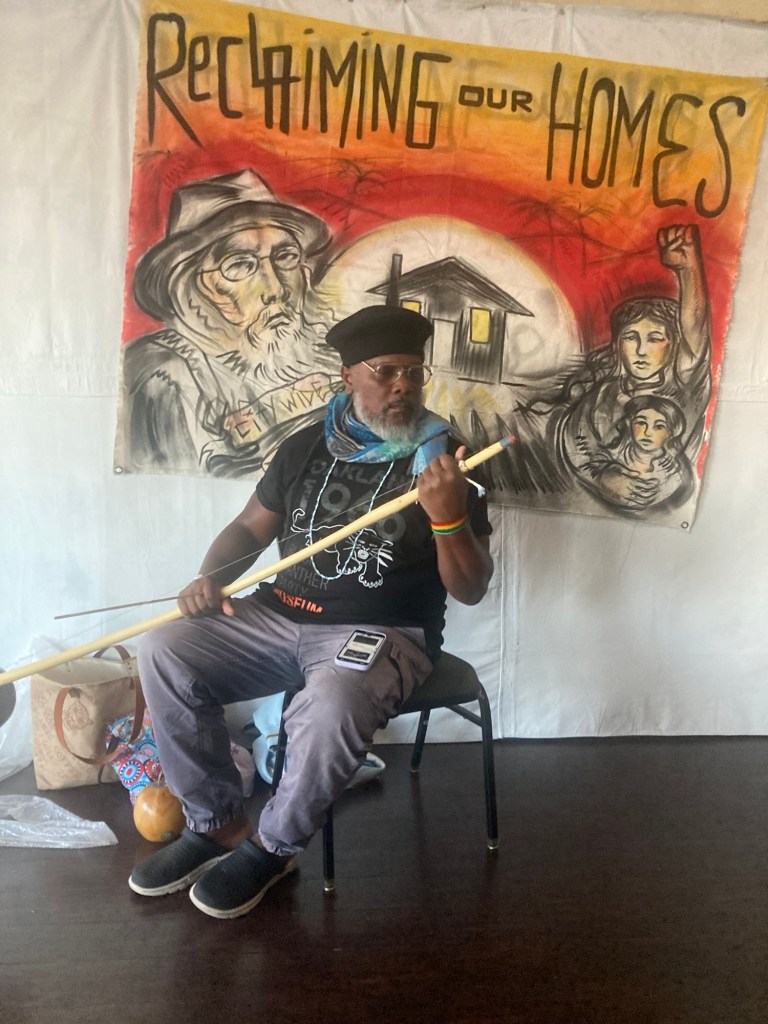
And below, is the conductor of that amazing journey, MESTRE NEGOATIVO.
Mestre Negoativo, a renowned Cultural Activist and Researcher of Afro-Mineira traditions, has dedicated his life to preserving and promoting the rich tapestry of Bantu and Vissungo heritage in Bela Horizonte, a city that pulses with cultural diversity. His unwavering commitment to this cause is vividly showcased in his deeply insightful book “Capoeiragem no País das Gerais”, where he explores the intricate history and significance of capoeira as a form of cultural expression and resistance. Beyond his literary contributions, he founded the Lamparina Cultural Center, a vibrant hub for the community, where workshops, performances, and discussions are held to educate and inspire future generations. Through his passionate efforts, Mestre Negoativo not only honors the legacy of his ancestors but also fosters a renewed sense of identity and pride among those who share these traditions.
And the journey he took us on was a journey of the iconic berimbau, an instrument deeply rooted in the cultural landscape of Brazil, where its rhythmic melodies echo the struggles and triumphs of capoeira’s history.
As we explored the origins of this unique musical tool, we delved into the rich traditions of the African diaspora, revealing the deep cultural heritage that informs the music and practices surrounding the berimbau. The craftsmanship involved in creating each berimbau is not merely a technical process but a profound art form passed down through generations, showcasing the skill and dedication of artisans who honor their ancestors through their work. Each berimbau, with its distinctive sound, serves as a bridge that unites communities in celebration and resistance, resonating with the struggles and triumphs of those who have come before and those who continue the fight for their rights.
Through engaging storytelling and captivating demonstrations, we came to appreciate the berimbau not just as a musical instrument, but as a vibrant symbol of resilience, artistry, and the powerful connection between past and present, illuminating the path of those who have played it for generations. We focused on 2 toques (rhythms) and their variations, intricately crafted and played by the revered Mestres of capoeira from the early 20th century, Mestres such as WALDEMAR, GATO, and TRAIRA, among others. These rhythms are essential to the art form, each carrying its unique stories and significance, creating a musical dialogue that captivates both the body and spirit.
And NO, I’m not gonna tell you what those toques were; you should have attended the class to uncover their mysteries, like we did.
But in case you want to listen to them, click on the video below.
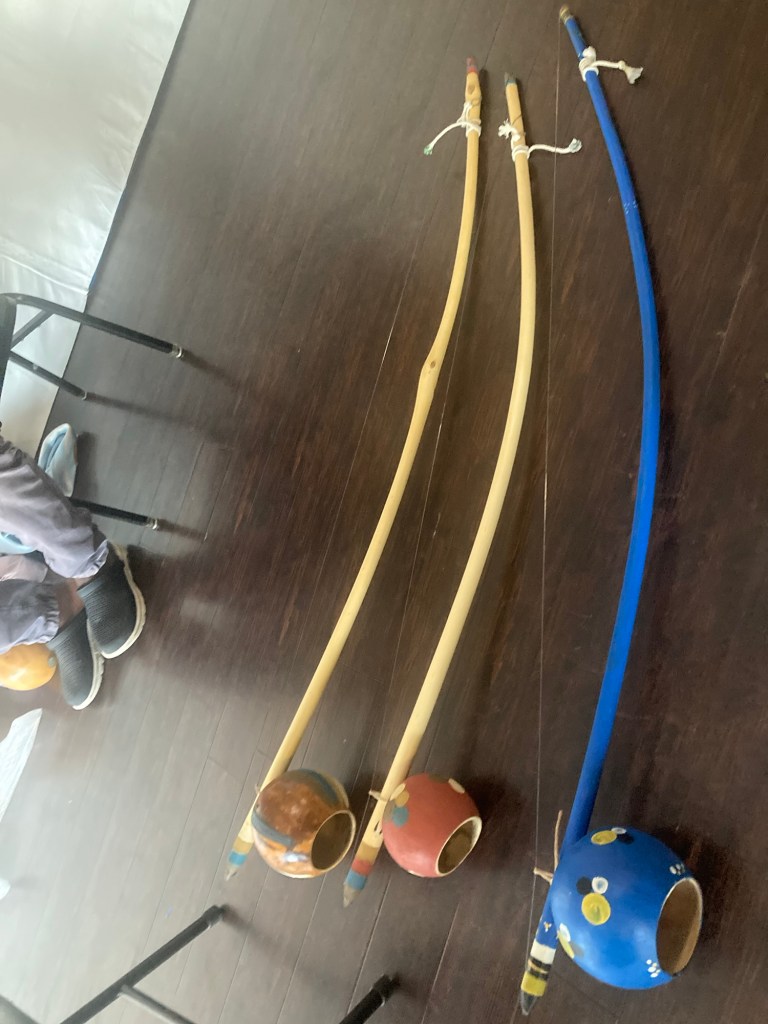
Sidenote: In the picture below, you see 3 berimbaus, each with its own unique story and significance. The 2 on the left are new and belonged to my friend Gigante of Capoeira Batuque. (Shout out to you, Gigante, for translating Mestre Negoativo’s insightful words during our musical journey). These impressive instruments were brought here from Brazil about a month ago, carefully chosen for their resonance and craftsmanship, but they weren’t armed (strung up) until that evening to allow them time to acclimate to the local weather conditions, ensuring they would produce the best sound possible.
The blue berimbau on the right is mine, a cherished part of my capoeira practice. I bought it from Mestre Negoativo a few years ago, and from then until now, it still had a good sound—a strong, rich tone that filled the space around me. A GOOD sound, indeed. However, after Mestre took it and made a couple of adjustments, now it sounds AMAZING, with a clarity and volume that exceed anything I’ve experienced before, resonating in a way that captivates everyone who hears it. It’s incredible to see how a few tweaks from a master can elevate an already beautiful instrument to new heights.
Whenever I take a class with Mestre Negoativo, I am reminded that Capoeira is a profound expression of culture and nature, embodying fluidity and harmony in every movement. The intricate motions reflect animal grace, each gesture teaching a connection to our bodies and the environment that surrounds us. This connection not only fosters community energy but also cultivates a deep appreciation for the diverse elements of nature, helping to understand better our role in the larger tapestry of life. The rhythm of Capoeira serves as a reminder of the importance of balance and unity, resonating with the heartbeat of the earth.
The berimbau is also a manifestation of nature, embodying the rich cultural heritage that is profoundly intertwined with the natural elements surrounding it. Its sound resonates with the rhythm of the earth, evoking feelings of harmony and balance that invite introspection and contemplation. Traditionally crafted from materials such as wood and steel wire, the berimbau showcases the beauty of sustainability and resourcefulness in utilizing what nature provides, highlighting the importance of preserving these traditions while respecting the earth. As it echoes through the air, each note tells a story of community, spirituality, and the age-old connection between humanity and the environment, inviting us to reflect on our shared responsibilities toward the planet and each other while celebrating the art that brings us together in joy and solidarity.
The movements, infused with powerful ancestral narratives, bridge generations, weaving a complex history that honors the struggles and triumphs of those who came before us. Each session becomes a gathering, a ritual where individuals from diverse backgrounds unite, breaking the barriers created by modern society, and reinforcing the idea that our differences are what enrich our collective experience. Moreover, Capoeira transcends mere physicality, evolving into a philosophical journey that urges participants to seek deeper meanings in both practice and life. As we dance and create music, we are reminded of our innate connection to the natural world, celebrating not just the skills we develop, but the wisdom we gain through our ongoing relationship with both Capoeira and the environment.
As I said before, human beings, like various animal species, can be domesticated through societal norms from an early age, which suppress intrinsic qualities that embody our humanity. These norms often mold our behaviors, preferences, and aspirations, leading us to conform rather than explore our true selves. However, Capoeira serves as an antidote to this domestication; it is not merely a martial art but a vibrant cultural expression that encourages individuals to break free from societal constraints and rediscover their authentic selves. By engaging in its rhythmic movements and music, practitioners are given the opportunity to tap into their innate awareness, passion, and joy, ultimately leading to profound personal growth that transcends the boundaries of conventional self-expression. Through the dynamic interplay of dance, acrobatics, and music in Capoeira, individuals are invited to foster a deep connection not only with themselves but also with others around them, cultivating a supportive community that celebrates creativity and individuality. In this rich environment, practitioners learn to embrace their uniqueness and build resilience against societal pressures, allowing them to reconnect with their essence and pursue their dreams with renewed vigor and authenticity. As they immerse themselves in the history and philosophy of Capoeira, they also gain valuable life skills, such as adaptability and collaboration, which empower them to navigate the complexities of modern life with confidence and joy.
To all capoeiristas out there, if you get the opportunity to take one of Mestre Negoativo’s classes, take it! It will be one of the best decisions you ever make, as his teaching style is not only profound but also deeply rooted in the authentic traditions of capoeira. His ability to connect with students, whether you’re a beginner or an experienced practitioner, creates an environment that fosters growth and exploration. Don’t miss out on the chance to absorb his incredible wisdom and passion for capoeira.
Now, I want to switch gears a bit and tell you about a place that is special to Mestre Negoativo’s heart, and the hearts of the community of MARIA GORETTI… LAMPARINA.
LAMPARINA is a meaningful symbol for Mestre Negoativo and the MARIA GORETTI community, representing their collective memories and shared history that spans generations. It evokes deep emotions and connections through traditions and stories passed down over time, highlighting its vital role in their lives and the cherished significance it holds for everyone in the community. This emblem serves not only as a reminder of their past struggles and triumphs but also as a beacon of hope for the future, fostering a sense of unity and belonging among the members. Each flicker of its light resonates with the laughter, tears, and aspirations of the community, reminding them of their resilience and the enduring spirit that binds them together. The stories woven around LAMPARINA nurture a rich tapestry of identity, pride, and cultural heritage, making it an irreplaceable part of their everyday life and celebrations.
If you would like to learn more about Lamparina, and/or would like to donate, please check out the links below.



 Jogo Corpo Fechado