The WARRIOR CLASS podcast is your essential, unique resource for mastering self-protection and self-defense. Designed to equip every listener—regardless of background, experience level, or physical ability—with the vital skills and profound knowledge necessary for personal safety and empowerment, we go beyond simple techniques.
We believe that true self-defense begins with a “Warrior Mindset,” focusing on situational awareness, threat recognition, de-escalation tactics, and the legal and ethical considerations of using force. Our episodes feature in-depth interviews with world-class experts: tactical trainers, martial arts masters, security professionals, and legal analysts.
Tune in to explore practical strategies for:
Physical Self-Defense: Practical, high-percentage techniques for escaping grabs, defending against common assaults, and utilizing everyday objects for protection.
Situational Awareness: Developing the mindset to identify and avoid danger before it escalates.
Home Security and Personal Safety Technology: Reviews and best practices for securing your environment and leveraging modern tools.
Psychology of Conflict: Understanding fear, managing adrenaline, and maintaining control under pressure.
Join the WARRIOR CLASS community today and take charge of your personal safety journey. Your empowerment starts now!
This week…
Warrior Class: How to Spot Government Agents and Informants
The modern landscape of activism, political movements, and even certain social circles requires a heightened level of awareness regarding infiltration. The presence of both confidential informants (CIs) and government agents poses a significant threat to the security and integrity of any group dedicated to activities that might challenge or circumvent established authorities. Understanding the fundamental differences and, more importantly, the tell-tale signs of each is a critical component of personal and organizational security.Understanding the Enemy Within: The Confidential Informant (CI)
A confidential informant (CI)—pejoratively and often accurately referred to as a “snitch” or “rat”—is an individual who operates from within a community or group, providing detailed, often sensitive, information to law enforcement agencies. This information typically pertains to so-called criminal activities, plans for activism, or preparations for revolutionary acts.
Key Characteristics of a CI:
Disguised Identity: The core function of a CI is to gather intelligence without revealing their alliance with law enforcement. They are often trusted members of the group, known figures in the community, or individuals who have successfully integrated themselves over time.
Motivation: The motivations for CIs vary widely but usually fall into several categories:
Plea Bargain/Reduced Sentence: They are often facing charges themselves and are cooperating to secure leniency from prosecutors or a judge.
Financial Gain: Some CIs are paid for the information they provide, acting as professional spies for the government.
Coercion/Blackmail: Authorities may exploit personal vulnerabilities, past indiscretions, or immigration status to force cooperation.
Focus: CIs specialize in gathering detailed intelligence on internal discussions, private plans, names of participants, and the location of assets or resources. They are the eyes and ears inside the inner circle.
The Official Hand: The Government Agent
A government agent, particularly a law enforcement agent (LEA), operates in an official capacity on behalf of a federal, state, or local government agency. These individuals are salaried, sworn personnel of agencies such as the FBI, ATF, DEA, Homeland Security, or state/local police departments.
Key Characteristics of a Government Agent:
Official Authority: They act under the color of law, meaning they have the legal authority to execute search warrants, make arrests, and use force as prescribed by their jurisdiction.
Role in Infiltration: While sometimes operating undercover, a sworn agent’s presence is often more direct. They may be the ones managing and directing a team of CIs, or they might be used to initiate contact, introduce new operational concepts, or provide resources to a target group—all with the goal of entrapment or gathering probable cause.
Focus: The agent’s focus is typically on building a prosecutable case. This involves recording conversations, documenting physical evidence, and establishing the necessary legal predicate for an eventual raid or arrest.
Warrior Class: Spotting the Infiltrators
On this critical episode of Warrior Class, the Instructors will delve into advanced methodologies and practical fieldcraft to show you how to spot both the subtle manipulations of the CI and the more overt, though often masked, actions of the government agent. The ability to distinguish the two and respond appropriately is the ultimate lesson in securing your operational integrity.
Every Friday morning, PROFESSOR BLACK TRUTH hosts “The Friday Crime Report,” a compelling program that delves into the complex issues of systemic racism, economic inequality, and police brutality that persist in the black community. Through a combination of expert interviews, insightful analysis, and powerful personal narratives, the show aims to raise awareness and promote advocacy for meaningful change. Each episode serves as a platform where not only are the facts presented, but also where the lived experiences of individuals are shared, ultimately fostering a deeper understanding of these critical societal challenges. It encourages dialogue and community engagement, empowering listeners to recognize, confront, and address these societal issues with a collective mindset while fostering solidarity for a more equitable society. The program also highlights actionable steps that can be taken by individuals and communities alike, inspiring listeners to become advocates for reform and change in their own neighborhoods.
In Today’s installment…
The highly contentious trial of Gary Edwards has reached its dramatic conclusion, resulting in a full acquittal by a Portland jury. Mr. Edwards was on trial for the stabbing of Gregory Howard, an act he steadfastly maintained was carried out entirely in self-defense. Despite this core claim, prosecutors mounted an aggressive campaign, with many observers suggesting their approach was designed to “railroad” Mr. Edwards into a conviction and a lengthy prison sentence.
However, the jury, composed entirely of white Portland residents, ultimately sided with Mr. Edwards’s narrative. Their decision to acquit has sent shockwaves through the local media landscape, particularly among outlets that had characterized the case in a specific light.
Following the verdict, the “white privilege press,” as critics are now labeling it, has erupted in fury. Editorials and opinion pieces are seething with outrage, questioning the jury’s judgment and implying that the verdict itself is a travesty of justice. The intensity of the media’s reaction suggests that they are profoundly unhappy with an outcome that defied their expected narrative, implying a significant double standard in how such cases are reported and adjudicated based on the parties involved. The palpable anger emanating from these established media voices highlights a deep, ongoing rift concerning issues of justice, self-defense, and racial dynamics within the city of Portland.
Shoutout to the professor for creating and posting this video.
The meticulous and groundbreaking work conducted by the professor constitutes a foundational resource for anyone seeking a true mastery of this complex subject. Their contribution is not merely a summary but a detailed and rigorous examination, offering incisive expert commentary that illuminates the nuances and subtleties of the topic. Crucially, the professor has ensured the presentation of a broad spectrum of scholarly perspectives, which is absolutely essential for a complete and unbiased grasp of the material and its implications. We extend our highest commendation and credit the professor for this exceptional, indispensable contribution to the ongoing scholarly discourse.
For those dedicated to a comprehensive understanding, we have provided direct access to the professor’s official digital platform. We strongly encourage you to click HERE to be taken to their official YouTube channel. This link will allow you to view the primary, comprehensive video, which serves as a cornerstone of their research, along with other related academic works that further expand on these critical themes. This multimedia resource is invaluable, not just as a supplementary tool, but as a core component of study for undergraduate and graduate students, seasoned researchers who are deepening their knowledge in the field, and any professional or inquisitive individual seeking a well-informed, critical, and authoritative perspective on the inherent challenges, ethical dilemmas, and practical implications that define this essential area of study. The depth of analysis offered provides a critical lens through which to evaluate current practices and future directions.
The WARRIOR CLASS podcast is your essential, unique resource for mastering self-protection and self-defense. Designed to equip every listener—regardless of background, experience level, or physical ability—with the vital skills and profound knowledge necessary for personal safety and empowerment, we go beyond simple techniques.
We believe that true self-defense begins with a “Warrior Mindset,” focusing on situational awareness, threat recognition, de-escalation tactics, and the legal and ethical considerations of using force. Our episodes feature in-depth interviews with world-class experts: tactical trainers, martial arts masters, security professionals, and legal analysts.
Tune in to explore practical strategies for:
Physical Self-Defense: Practical, high-percentage techniques for escaping grabs, defending against common assaults, and utilizing everyday objects for protection.
Situational Awareness: Developing the mindset to identify and avoid danger before it escalates.
Home Security and Personal Safety Technology: Reviews and best practices for securing your environment and leveraging modern tools.
Psychology of Conflict: Understanding fear, managing adrenaline, and maintaining control under pressure.
Join the WARRIOR CLASS community today and take charge of your personal safety journey. Your empowerment starts now!
This week…
This episode: Beyond the Veil of Visibility: Examining the Depth of Black Imagery in Media
It is an undeniable truth that Black actors today enjoy a greater quantitative presence in films and television shows than in decades past. However, this sheer increase in visibility should not be mistaken for meaningful or authentic representation. The true measure of progress lies not in the volume of appearances, but in the quality and complexity of the roles being offered.
When the characters written for Black talent are disproportionately confined to narrow, often harmful archetypes—such as criminals, servants, comedic relief, sidekicks, the emotionally detached “magical negro,” or characters whose narratives are solely defined by trauma—then representation has not genuinely progressed. It has merely diversified in the most superficial of ways, creating a false sense of inclusion.
These limiting roles frequently serve to reinforce damaging, long-standing cultural narratives, regardless of the exceptional skill and artistry of the actors embodying them. This perpetuation of tropes, even in contemporary media, normalizes a restricted and distorted view of Black humanity.
The problem extends beyond the screen and into the realm of printed media, including books, magazines, and comic books. While some Black tropes may have had historical or contextual roots, their continuous and uncritical deployment becomes fundamentally harmful. They operate by flattening the experiences of millions of people into one or two simplistic, overused personality types. This practice effectively erases the vast cultural, regional, class, and personal diversity that exists within the global Black community.
Ultimately, mere visibility is not enough. Representation that lacks authenticity, depth, and complexity is, in effect, a form of misrepresentation. It fails to honor the rich tapestry of Black life and instead promotes an easily digestible, often prejudiced caricature.
In this essential episode of Warrior Class, the Instructors will lead a rigorous and timely exploration and discussion of Black imagery, examining its evolution, impact, and authenticity across various media, including books, television, and film.
The Valentões (bully/tough-guys) represent a crucial and often controversial aspect of Capoeira’s early history, particularly in the urban centers of 19th and early 20th century Brazil, such as Rio de Janeiro and Salvador.
Context and Role:
Originally, the term valentão referred to a specific and notorious type of individual in Brazilian society, often directly associated with the practice of Capoeira. These were not merely skilled martial artists, but figures known for their exceptional fighting prowess, striking fearlessness, and, crucially, their readiness to engage in public disorder or violent conflict. They were, in essence, the quintessential street fighters of their time.
The valentão‘s reputation was entirely predicated on their combat ability. Their deep proficiency in Capoeira was not just a hobby or a sport; it was the primary tool that established and maintained their local power, dominance, and a fearsome reputation within their community or neighborhood. This mastery of Capoeira allowed them to enforce their own will, settle disputes—often violently—and command respect, or more accurately, fear, from the surrounding population. They operated on the fringes of society’s established laws, with the agility, deception, and striking power of Capoeira making them incredibly formidable and difficult for authorities to manage.
The Valentões of Capoeira: Criminality and Combat in 19th Century Brazil
The Capoeira valentões (meaning “bullies” or “tough guys”) were central, yet controversial, figures in the urban landscape of post-abolition Brazil, particularly in major cities like Rio de Janeiro and Salvador during the late 19th century. Their existence fundamentally shaped the perception and subsequent criminalization of Capoeira.
Characteristics and Activities of the Valentões
The valentões were not benign practitioners of a cultural dance; they were highly skilled, feared, and often ruthless street fighters. Their use of Capoeira transcended mere sport or performance, placing it squarely in the domain of clandestine, effective urban combat:
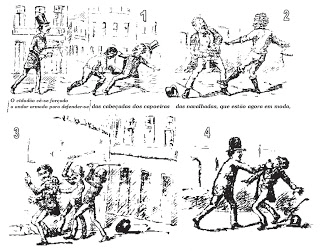
Capoeira as a Weapon: For these fighters, the art was purely a combative system. They mastered the rapid, deceptive movements of Capoeira to gain the upper hand in street confrontations. Their arsenal included low, sweeping attacks like the rasteira (a leg sweep) and powerful headbutts (cabeçadas), which were devastating at close range. Crucially, they integrated weapons into their practice, often concealing small, sharp blades—knives or straight razors—which could be hidden in clothing or, famously, wedged between the toes and used during a low kick, adding a lethal dimension to the fight. This integration of blades and unarmed combat made them exceptionally dangerous adversaries.
Affiliation with Gangs (Malandragem): The power of the valentões was amplified by their organization into territorial street gangs, known as maltas. This gang structure, deeply interwoven with the culture of malandragem (a term encompassing cunning, street smarts, and often a disregard for the law), provided them with community, protection, and a source of income. Infamous examples in Rio de Janeiro included the rival Guaiamús (Crabs) and Nagôs (a term referring to Yoruba descendants), who fiercely competed for control over specific neighborhoods and illicit activities. Beyond simple street brawls and running protection rackets, these maltas became politically significant, often acting as enforcers or mercenaries for hire by political factions during the turbulent election periods of the First Brazilian Republic. Their ability to mobilize violence made them a critical, if unofficial, tool of political control.
Social Status and Marginalization: The valentões predominantly emerged from the poorer, marginalized classes, especially the newly freed Afro-Brazilian population who faced systemic racism and severe lack of economic opportunity after the abolition of slavery in 1888. In a society that offered them little official recognition or mobility, becoming a valentão offered a perverse form of social status—a reputation of fear and respect within their communities. They were simultaneous figures of awe for their strength and skill, and figures of intense scrutiny and contempt from the governing authorities.
Historical Significance and Lasting Impact
The activities of the valentões were not merely a footnote in Capoeira’s history; they were the direct cause of the art’s official suppression and near destruction:
Criminalization of Capoeira (1890 Penal Code): The state’s inability to control the powerful and disruptive maltas led to a drastic legislative response. The actions and reputation of the valentões were the primary justification for the inclusion of a specific ban on Capoeira in the new Brazilian Penal Code of 1890. The authorities consciously moved to de-legitimize the practice, viewing it not as a unique cultural expression but as a dangerous technique intrinsically linked to organized crime and political destabilization. The law stipulated severe punishments for anyone caught practicing Capoeira, including prolonged jail time, forced labor, and even internal exile, effectively treating Capoeira practice as an act of sedition or felony.
Evolution and Transformation of the Art: The period defined by the valentões serves as a stark reminder of Capoeira’s raw, survival-based combat roots. This dangerous legacy necessitated a profound transformation in the 20th century to ensure the art’s survival. Figures like Mestre Bimba (Manuel dos Reis Machado) in Salvador were instrumental in this shift. Bimba consciously sought to legitimize and institutionalize Capoeira, stripping away its toxic association with criminality and urban violence. He did this by creating structured academies, introducing formal rules, emphasizing its educational and physical fitness aspects, and rebranding it as a respected martial art and sport, thereby steering it away from its fearsome valentão past and securing its future as a global cultural phenomenon.
The Power of the Patuá/Amulets: Spiritual Armor of the Valentão
Within the world of Capoeira, particularly among the historical figures known as valentões (tough guys or bullies) and early practitioners in the 19th and early 20th centuries, the belief in supernatural protection was a deeply ingrained and vital cultural element. This spiritual belief system, which blended African, Indigenous, and European folk Catholicism, was essential for surviving a harsh, unforgiving existence.
The patuá was the physical manifestation of this spiritual armor. It was not merely a decorative charm but a powerful, consecrated amulet, typically a small, tightly sewn cloth bag. The power resided in its contents: a potent collection of sacred and symbolic items—such as dried herbs known for their protective or healing properties, pieces of animal bone, prayers written on scraps of paper, salt (a powerful purifying agent), coins, or sometimes even small stones. Crucially, these materials were consecrated and blessed by a spiritual specialist, such as a rezadeira (a prayer woman, skilled in folk remedies and blessings) or an African-Brazilian religious figure, often from the Candomblé or Umbanda traditions. This ritualistic blessing infused the object with axé—the living force, energy, and power that allows things to happen—rendering it genuinely potent.The Patuá‘s Essential Functions
For the valentão, who often lived a life of extreme precariousness, conflict, and frequent confrontations in the crowded, dangerous streets of cities like Rio de Janeiro and Salvador, the patuá served multiple critical and interconnected functions:
Psychological Invulnerability (Confidence): Above all, the patuá provided an indispensable sense of invulnerability and psychological assurance. Knowing they carried an object blessed with spiritual power allowed the valentão to step into a fight with supreme confidence, an emotional state that was often half the battle in the highly ritualized confrontations of Capoeira. This belief alone could intimidate an opponent.
Spiritual Shield (Defense): It was believed to offer a spiritual shield against physical harm. In a time when disputes were often settled with razor blades (navalhas), straight-edge razors, knives, or the powerful, deceptive kicks of rival Capoeiristas, the patuá was thought to deflect blows, cause weapons to misfire, or prevent the blade from penetrating the skin. A common belief was that a true patuá made the wearer “fechado” (closed or sealed) against all harm.
Offensive Weapon (Offense): More than just defense, some patuás were thought to possess offensive capabilities. These charms were believed to subtly—or dramatically—affect the opponent’s spiritual and physical state. They could weaken an opponent’s spirit, confuse their movements, cause them to lose their footing or rhythm (malandragem), or even cause their own protective charms to fail. The true Capoeirista fought not just with their body, but with their feitiço (sorcery or charm).
The power attributed to these amulets speaks volumes about the synthesis of [This sentence fragment connects directly to the original file content and is where the elaboration concludes, transitioning back to the original text’s final point.]cultures—Indigenous, African, and European—that shaped early Capoeira. They represent the influence of Candomblé, Umbanda, and other Afro-Brazilian spiritual practices, where objects are imbued with axé (life force or spiritual power). The presence and power of a patuá could be as much a factor in a fight’s outcome as the physical skill of the Capoeirista, making the spiritual dimension an inseparable part of the fight itself. To be defeated, therefore, was not just a failure of technique, but often an indication that one’s own spiritual protection had been momentarily—or permanently—overcome.
The Spiritual Powers of the Valentões
The term valentões (roughly translating to “tough guys” or “bully-type fighters”) in the context of early Capoeira carries a depth far beyond mere physical prowess. These figures, prominent in the streets and communities of 19th and early 20th century Brazil, particularly Rio de Janeiro and Salvador, were not simply street fighters. They were often viewed—and sometimes feared—as possessing a potent connection to the spiritual world, lending their fighting ability an almost supernatural dimension.
This spiritual power was rooted in the Afro-Brazilian religious traditions, such as Candomblé and Umbanda. A valentão was often believed to be under the direct protection, or even possession, of powerful Orixás (deities) or Exus (powerful, often trickster, spirits). It was thought that their extraordinary resilience, speed, and ability to evade police or rivals stemmed not just from training, but from this spiritual guardianship. Before a conflict or a demonstration, many valentões would perform rituals, offer sacrifices, or consult a spiritual guide to ensure the favor of these entities.
The power was not just protective; it was also believed to be offensive. Stories abound of valentões who could render opponents immobile with a glance, disappear from the sight of the police, or shrug off severe wounds—all attributed to their mastery of, or alliance with, the spiritual realm. This belief system added a layer of mystique and fear to their reputation, making them formidable opponents not only in the physical fight but in the psychological battle as well. Their capoeira movements, therefore, were seen as a blend of martial art, dance, and spiritual invocation, making them key—though often marginalized and persecuted
—figures in the preservation and evolution of Capoeira.
In essence, the valentões (literally, “tough guys” or “bully-boys”) were far more than simple street fighters; they were a complex and often intimidating manifestation of the power, danger, and profound subversion inherent in Capoeira. During the late 19th and early 20th centuries, when Capoeira was frequently a prohibited and clandestine practice, it was a vital tool for survival, self-defense, and assertion for marginalized populations, particularly formerly enslaved people and the urban poor in cities like Rio de Janeiro and Salvador.
The valentões became the feared and respected icons of this era. They used their mastery of Capoeira’s acrobatic and deceptive movements not merely for sport, but as a genuine fighting system to control territory, protect their communities, and often, to engage in criminal activities or act as muscle for political figures and competing gangs. Their existence underscored the profound threat Capoeira posed to the established social order, as it represented an autonomous source of physical power and resistance among the oppressed. This period, characterized by police repression and social stigma, stands in stark contrast to the martial art’s current status as a globally recognized, respected, and often commercialized Afro-Brazilian cultural and martial art form. The valentões, therefore, embody the raw, untamed, and rebellious genesis of Capoeira—a legacy of defiance and street-smart mastery forged in the fires of social injustice.
Every Friday morning, PROFESSOR BLACK TRUTH hosts “The Friday Crime Report,” a program addressing systemic racism, economic inequality, and police brutality in the black community. The show features expert interviews, analysis, and personal narratives to raise awareness and promote advocacy for change. It encourages dialogue and community engagement, empowering listeners to understand and address these societal issues while fostering solidarity for a more equitable society.
In Today’s installment…
The disturbing pattern of racially motivated incidents in Florida found another reprehensible example this week. The latest incident involved a man at a local club whose aggressive and hateful behavior escalated to the point where law enforcement intervention was required. Witnesses reported that the individual began repeatedly and loudly using the racial slur, the n-word, targeting multiple patrons within the establishment. This unprovoked barrage of hate speech created a hostile and volatile environment, leaving the police with no choice but to physically subdue the man to bring the situation under control and ensure public safety.
However, the full extent of this individual’s prejudice became alarmingly clear upon examining his online presence. His various social media accounts reveal a deeply entrenched pattern of racist and extremist viewpoints, extending far beyond a singular incident of intoxication or poor judgment. The content discovered online adds a much more sinister layer to the event, suggesting the club outburst was not an isolated occurrence but rather a public manifestation of his underlying white supremacist ideology. The details uncovered through his digital footprint emphasize the persistent and systemic nature of such bigotry, making the entire situation considerably worse than a simple public disturbance.
For a deeper and more comprehensive understanding of this complex issue, which touches upon crucial theoretical and practical aspects, we highly recommend consulting a particularly insightful and thorough critical analysis. This valuable resource was produced by a leading professor in the field who has created an extensive video dedicated to exploring the nuances of the subject matter.
The professor’s work provides a detailed examination, offering expert commentary and presenting various perspectives that are essential for a complete grasp of the topic. We credit the professor for this exceptional contribution to the scholarly discourse. To directly access their official YouTube channel and view this important, comprehensive video and other related works, please click HERE. This resource is invaluable for students, researchers, and anyone seeking a well-informed, critical perspective on the challenges and implications inherent in this area.
What happens when Indigenous Peoples get their stolen land back
The question of “land back” is one of the most critical and transformative conversations happening globally, representing a powerful movement for fundamental justice, reparations, and environmental stewardship. When Indigenous Peoples successfully reclaim their ancestral territories—a process often undertaken after centuries of dispossession, forced removal, cultural genocide, and colonial violence—the resulting impact is profound and multi-layered, extending far beyond a simple change in property ownership to reshape ecological, governmental, and social landscapes.—–Ecological Restoration and Climate Resilience: A Return to Stewardship
One of the most immediate and significantly positive outcomes of the Land Back movement is the revitalizing effect on the environment. Indigenous communities, drawing on thousands of years of traditional ecological knowledge (TEK), have consistently proven to be the most effective stewards of the land. When management authority is returned, it marks a crucial shift from historically extractive industrial practices (such as unregulated logging, intensive mining, and destructive monoculture farming) to regenerative methods that prioritize biodiversity, ecosystem health, and sustainable resource use.
This fundamental shift in management paradigm results in:
Restoring Biodiversity: Reintroducing crucial native plant species, actively managing and removing invasive species introduced by colonial practices, and strategically supporting local wildlife populations to re-establish natural ecological balances. Indigenous-led conservation often focuses on protecting keystone species vital to the entire ecosystem.
Climate Change Mitigation: Protecting and expanding natural carbon sinks, particularly crucial old-growth forests, coastal mangroves, and essential wetlands. Numerous independent studies have demonstrated that Indigenous-managed lands consistently have superior conservation outcomes—including lower deforestation rates and greater species density—than state-run or private protected areas.
Revitalizing Fire Management: Implementing cultural burning practices, a sophisticated form of applied TEK, to systematically reduce hazardous fuel load, enhance the health of fire-adapted ecosystems, and actively prevent the catastrophic, high-intensity wildfires that have become increasingly common under colonial land management regimes.
Water and Soil Health: Employing traditional agricultural and forestry techniques that focus on soil regeneration, natural water filtration, and the protection of headwaters, leading to purer water sources and more resilient agricultural lanSovereignty, Self-Determination, and Governance: Reclaiming Power
The physical return of land is inextricably linked to the restoration of Indigenous sovereignty and political authority. Land provides the essential physical, spiritual, and economic foundation necessary for true self-determination. With land back, Indigenous Nations regain the capacity to govern themselves in accordance with their own laws and values:
Re-establishing Traditional Governance: Nations can fully implement and enforce their own systems of laws, cultural protocols, and resource management free from external colonial or state oversight. This can involve restoring traditional court systems, creating Indigenous-led education systems, and establishing unique forms of participatory democracy.
Creating Sustainable Economic Stability: Land enables the development of sustainable, community-controlled economies. These often move away from resource depletion and focus instead on culturally-informed ventures such as ecotourism, traditional arts and crafts, small-scale sustainable agriculture, and responsible resource development that ensures all benefits remain within the community.
Ensuring Cultural and Linguistic Continuity: The land is the literal and philosophical center of Indigenous identity, language, and spiritual practice. Reclaiming ancestral lands allows for the immediate revitalization of core cultural ceremonies, the establishment of language immersion camps on traditional territories, and the effective transmission of complex traditional knowledge from elders to younger generations.
Exercising Inherent Treaty Rights: The return of land often facilitates the ability of Indigenous Nations to exercise rights guaranteed in historical treaties, such as hunting, fishing, and gathering rights, which are often contingent upon access to and control over their traditional territories.
Social, Health, and Spiritual Improvements: Healing Historical Trauma
The devastating historical trauma inflicted by land dispossession—a process that directly led to the erosion of traditional food systems, the breakdown of community structures, cultural suppression, and severe physical and mental health crises—begins a profound process of healing with land back. Access to and control over ancestral territories immediately results in tangible improvements:
Improved Food Security and Health: Reconnecting with traditional hunting, fishing, gathering, and growing practices restores culturally appropriate diets, which are typically richer in nutrients and more sustainable, directly addressing diet-related diseases often exacerbated by colonial food systems.
Mental and Spiritual Healing: The ability to freely practice culture, conduct ceremonies, and reconnect with sacred sites that were previously inaccessible or desecrated acts as a powerful, collective antidote to intergenerational trauma, leading to measurable improvements in community mental health outcomes and reduced rates of addiction.
Enhanced Community Cohesion and Political Agency: The shared, collaborative process of managing, protecting, and governing the returned land strengthens community bonds, reinforces internal political structures, and restores a collective sense of purpose and self-worth that had been undermined by centuries of external control.
Better Housing and Infrastructure: With sovereignty and a land base, Nations can direct their own development, creating community-appropriate housing, infrastructure, and services that reflect cultural needs rather than having inadequate, state-mandated solutions imposed upon them.
A Path Toward True Reconciliation and a Just Future
For non-Indigenous societies, the concept of “land back” represents the single most concrete, substantive, and necessary form of justice and the prerequisite for genuine reconciliation. It moves the discourse beyond performative apologies and symbolic gestures to tangible, irreversible acts of restitution and structural change.
This process, while inherently complex and involving intricate legal, legislative, and grassroots efforts across different jurisdictions, is an essential step toward a post-colonial future. The ultimate outcome is the creation of a more just, equitable, and ecologically balanced world where Indigenous rights, self-determination, and their unparalleled expertise in environmental stewardship are prioritized for the benefit of all inhabitants of the planet.
From Wisconsin’s lush forests to California’s sun-drenched coastlines, a profound shift is occurring as Indigenous nations actively work to reacquire ancestral territories. This vital movement is a localized manifestation of the larger, global “Landback” initiative, which is fundamentally dedicated to the repatriation of Native lands that were unjustly seized and placed under external control. The “Landback” movement aims to restore these stolen territories to the direct stewardship and sovereign control of the rightful tribal governments and communities.
This widespread restoration raises critical questions about its true impact and significance. Is the return of land merely a symbolic gesture—an acknowledgment of historical injustice that offers limited practical change? Or, more profoundly, does it represent a concrete and essential step forward on the arduous path toward healing, the full restoration of Native cultures, and the robust reestablishment of tribal sovereignty?
Proponents argue that the Landback movement constitutes more than mere symbolism; it is a fundamental and transformative act of justice that provides the necessary physical, legal, and economic foundation for authentic Indigenous self-determination.The Foundations of Sovereignty
The material and legal return of ancestral lands, they contend, is the single most vital component for empowering tribal nations to manage their territories, resources, and affairs with genuine sovereignty. This restoration is not simply about property transfer; it is a rectification of historical injustices—specifically the illegal seizure of lands—and a renewal of inherent sovereign rights. Without a secure, recognized land base, true self-governance remains perpetually hindered by external jurisdictions and economic dependency. Landback provides the physical territory where governmental authority can be fully exercised, free from the interference of state or federal bureaucracies that have historically undermined tribal power.Ecological and Cultural Revitalization
The empowerment provided by land return enables tribes to manage natural resources according to Traditional Ecological Knowledge (TEK). This holistic, centuries-old approach contrasts sharply with conventional, often extractive, resource management practices. By applying TEK, tribes can implement sustainable forestry, fisheries, and agricultural practices that prioritize biodiversity, ecosystem health, and long-term vitality, thereby benefiting not just the tribal nation but the broader environment.
Furthermore, the revitalization of cultural practices is inextricably linked to specific landscapes and ecosystems. The return of land facilitates the revival of ceremonies, languages, and traditional ways of life that are geographically specific and often impossible to practice without access to sacred sites, traditional gathering areas, and ancestral homelands. This material restoration of the land is, therefore, seen as essential to the revitalization of Indigenous identity, language transmission, and a deep connection to place.Economic Independence and Future Building
Beyond justice and culture, Landback is viewed as a pathway to crucial economic independence. With control over their lands and resources, tribal governments can establish tribally-owned enterprises, develop sustainable housing, and create infrastructure tailored to the needs of their communities. This economic base reduces reliance on federal funding and supports nation-building efforts, allowing tribes to invest in education, healthcare, and social services autonomously. Providing this vital grounding is critical for ensuring true, meaningful, and self-sufficient sovereignty in the 21st century.
The Trump administration has frequently championed itself as a stalwart defender of free speech, yet this commitment appears to be contradicted by a concerning pattern of event cancellations at the National Archives. This institution, which serves as the nation’s record keeper and a vital venue for public discourse, recently faced scrutiny following the abrupt pulling of several scheduled programs.
One of the most notable cancellations was an event intended to celebrate the work of the award-winning journalist and historian Elaine Weiss. Her recently published book, Spell Freedom, is a critically acclaimed exploration of four pivotal activists whose groundwork was essential to the successful launch of the Civil Rights Movement. The decision to cancel her book event, which promised a discussion highly relevant to contemporary issues of justice and equality, immediately raised alarm bells among historians and free-speech advocates.
The cancellations, however, were not limited to a single topic. Programs focusing on climate change—a subject often targeted for political opposition—and events centered on the pressing national crisis of homelessness were also conspicuously removed from the National Archives’ programming schedule.
Elaine Weiss herself has publicly weighed in on the cancellations, expressing a belief that the move is not simply a matter of content censorship but possibly a consequence of both new administrative leadership and significant budget cuts within the National Archives. These two factors, working in tandem, could be creating an environment where programming is more easily subject to political scrutiny or where resources for robust public events are being systematically diminished.
The author is scheduled to join Michel Martin for an in-depth conversation to dissect the relevance of her work in the context of today’s America. This discussion is anticipated to address the broader implications of these cancellations, particularly what they signal about the state of historical and political discourse in public institutions under the current administration. The core question remains whether these acts are a necessary administrative trimming or a subtle, yet effective, form of ideological censorship impacting the very institutions charged with preserving the nation’s history and fostering open dialogue.
The recent Black Friday period saw a powerful demonstration of consumer influence, suggesting a significant shift in the balance of power from large corporations back to the people. Reports indicated that major retailers, including giants like Target and Walmart, experienced notably empty stores on what is traditionally the busiest shopping day of the year. This visible lack of foot traffic served as compelling evidence that organized black market boycotts and coordinated consumer action were effective.
The successful execution of these boycotts suggests a growing trend where consumers are leveraging their collective purchasing power—or lack thereof—to send a clear message to corporate entities about their values and expectations. Rather than simply being passive recipients of advertising and retail promotions, the public is choosing to be an active, unified force in the marketplace, voicing their concerns over issues such as environmental sustainability, social justice, and ethical labor practices.
This newfound awareness has galvanized individuals to participate in boycotts and campaigns that align with their beliefs, urging corporations to take responsibility for their actions and reconsider their approaches. The image of deserted aisles and sparse parking lots on Black Friday stands as a stark, indisputable proof point: The people hold power, not corporations. Now, empowered consumers are not only rejecting products but also demanding transparency and accountability, signaling that their choices stem from a place of informed action and ethical consideration.
This event, which saw a significant mobilization of consumers, serves as a profound case study in modern economic power dynamics. It emphatically signifies a turning point, illustrating the formidable potential for widespread, decentralized consumer movements to critically impact the financial performance and public image of even the world’s largest retail and corporate organizations. The collective action demonstrated a sophisticated and coordinated leveraging of consumer choice, moving beyond traditional forms of protest to a direct economic intervention.
The success of this movement shows that when consumers unite with a common, clearly defined purpose—often facilitated and amplified by digital communication platforms—their collective decision to withhold spending can create immediate, measurable, and often dramatic economic consequences. These consequences are not merely abstract; they manifest as tangible declines in sales revenue, stock performance volatility, and a necessity for costly public relations campaigns to mitigate brand damage.
Crucially, this episode affirms a fundamental principle of market economics: that true, ultimate economic leverage resides not with the corporate entities that control production and distribution, but fundamentally with the masses of consumers. This collective purchasing power, when intentionally and strategically withdrawn, acts as a powerful corrective force, capable of compelling large organizations to reassess their operational ethics, pricing strategies, or corporate social responsibility policies. The event underscores a paradigm shift where organized consumer solidarity can translate directly into significant market influence, redefining the accountability structure between multinational corporations and the global public they serve.
Every Friday morning, PROFESSOR BLACK TRUTH hosts “The Friday Crime Report,” a program addressing systemic racism, economic inequality, and police brutality in the black community. The show features expert interviews, analysis, and personal narratives to raise awareness and promote advocacy for change. It encourages dialogue and community engagement, empowering listeners to understand and address these societal issues while fostering solidarity for a more equitable society.
In Today’s installment…
In a shocking incident that underscores the persistent dangers of extremist thought, two white men from Texas conceived a bizarre and deeply disturbing plot last year. Their self-styled “invasion” targeted the tranquil island of Île de la Gonâve, a Haitian dependency situated in the Gulf of Gonâve. The sheer depravity of their plan was matched only by its utter delusion: they intended to violently seize control of the island, killing the male population and then enslaving the women and children for the purposes of sexual exploitation.
The question that immediately arises is not just how such a horrific idea could be hatched, but why two individuals, seemingly living in modern society, could believe such a reckless and morally bankrupt endeavor had any remote chance of success. This is where the true context of the event is laid bare. The answer to their staggering miscalculation may be found in a complex and disturbing confluence of factors: a complete detachment from reality, a profound sense of racial superiority, and an immersion in online echo chambers that normalize and encourage violent, anti-social fantasies.
Their belief in the feasibility of this invasion was likely rooted in a distorted perception of the world—one where their own power was vastly overstated and the resilience of a sovereign people was catastrophically underestimated. The plot stands as a chilling example of how dangerous ideology, when combined with severe detachment from reality, can mutate from mere thought into an actionable, if utterly stupid, threat. The full extent of the psychological and sociological drivers behind this plan is a complex inquiry that often leads to a conclusion that may surprise and deeply unsettle many observers.
A Deep Appreciation for Scholarly Contribution and an Invitation to Explore Further
We wish to express our sincerest and most heartfelt appreciation to the esteemed professor responsible for creating and generously uploading this profoundly insightful video. Their commitment to the free sharing of knowledge, and their tireless effort in fostering a deeper public understanding of critical subjects, is truly exemplary and worthy of the highest commendation. In an age often characterized by fragmented information, this dedication to comprehensive, accessible education serves as an invaluable resource.
This video is more than just a lecture; it is a meticulously researched piece of educational content that sheds vital light on its chosen subject matter. It is a testament to the professor’s expertise, pedagogical skill, and deep commitment to intellectual rigor.
For those whose curiosity has been piqued and who are eager to delve into the broader scope of the professor’s scholarly pursuits, we extend a warm and enthusiastic invitation to explore their dedicated digital platform. By clickingHERE, you will be directed to their official YouTube channel.
This channel is an extensive repository—a veritable archive—of high-quality, educational content. Visitors will discover a wealth of material that provides essential historical context, offers nuanced analytical frameworks, and encourages critical thinking on a wide array of complex social issues, historical narratives, and contemporary political discourse. Engaging with the channel’s collection promises to significantly enrich one’s understanding, moving beyond surface-level information to a deeper, more comprehensive grasp of challenging topics. We encourage viewers to subscribe and utilize this remarkable educational library for continued learning and intellectual growth.




 Jogo Corpo Fechado