Today, April 1st, marks the beginning of Black Media Appreciation Month! We at Jogo Fechado are excited to invite you to join us in celebrating the vital role that independent, Black-led media plays in our community and in the broader world. This month is dedicated to recognizing the pioneers, the platforms, and the content creators who provide authentic, unfiltered perspectives for the Black grassroots.
To kick off this important month, we have a special message from The Professor to all of us gathered here in cyberspace.
Why New Black Media Appreciation Matters: A Foundation for Empowerment and Self-Determination
The establishment and sustained appreciation of independent Black media is far more than a cultural preference; it represents a foundational necessity driven by the unwavering principle of Black grassroots self-determination.
As the Black grassroots, we think and act for ourselves. This core, inalienable right to self-governance in thought and action is the very reason why we have diligently established, supported, and continue to evolve our own robust media ecosystems. For generations, the landscape of traditional and mainstream media has proven insufficient—and often actively detrimental—to the well-being of the Black community. These dominant narratives frequently fail to represent the full spectrum of our nuanced experiences, complex priorities, and diverse voices. Worse still, they often engage in misrepresentation, stereotyping, or the outright erasure of issues vital to our survival and prosperity.
New Black Media steps into this critical void, serving a dual, essential function: it acts as a truthful mirror for our community to see itself reflected with dignity and accuracy, and it operates as a powerful megaphone to project our lived truths, demands, and achievements into the wider public discourse.
This media infrastructure provides a platform for essential dialogue, allowing for internal community conversations that prioritize Black liberation and development. It moves beyond simply reporting on events to providing deep analysis rooted in a historical and cultural context that the mainstream either ignores or cannot comprehend. By controlling the narrative, New Black Media empowers the community to define its own agenda, celebrate its own heroes, critique its own challenges, and mobilize for collective action without external filters, ultimately strengthening the foundation for social, political, and economic empowerment.
This appreciation month is our opportunity to honor and celebrate:
The People: The independent journalists, content creators, podcasters, writers, producers, and community activists who dedicate their time, resources, and passion to building these platforms. They are the intellectual architects and the truth-tellers of our generation.
The Events: The critical discussions, organizing efforts, and community-building initiatives that are amplified and facilitated through this media. Black media is the essential infrastructure for grassroots thought and action.
The Empowerment: The direct impact this media has on our collective consciousness, providing education, fostering critical thinking, promoting economic self-sufficiency, and driving political engagement. By having our own narratives, we are better equipped to challenge systemic injustice and build a stronger future.
Supporting these platforms is an act of communal investment. It ensures the longevity and independence of the voices that truly speak for us.
Support The Professor’s Work
The work of The Professor and the community he serves relies on the direct support of those who value independent Black thought and analysis. If you appreciate the commitment to truth, the critical insight, and the educational content provided, please consider supporting the mission through the following platforms:
The Enduring Legacy of Capoeira Angola: More Than Just a Game
Online videos of Capoeira Angola offer a captivating and vital window into this rich cultural tradition, serving as both indispensable archives and dynamic educational resources. These visual records are crucial for preserving and transmitting the intricate blend of music, movement, self-defense, and profound history that defines the art. They capture the astounding agility, technical prowess, and strategic depth found within every choreographed movement and spontaneous interaction.
Crucially, these documented moments explore Capoeira’s deep historical roots and immense cultural significance, emphasizing its role not just as a physical discipline, but as a unifying social force. Within the roda (the circle where the game is played), Capoeira strengthens community connections, fosters mutual respect, and serves as a powerful expression of collective identity. Beyond the sheer performance of the jogo (game), the preserved footage inspires and educates future generations by embodying core Capoeira values: resilience in the face of adversity, boundless creativity, and unwavering cultural pride.
A significant element of the video archive is the inclusion of interviews and testimonials from esteemed mestres (masters) and high-ranking students. These personal narratives provide essential context, offering deep insights into the transformative impact and discipline that Capoeira instills in its practitioners. They bridge the gap between the historical origins of the art and its contemporary, living practice.
Ultimately, the visual record of Capoeira Angola—in every filmed jogo and roda—stands as a comprehensive and invaluable resource. It is foundational for anyone seeking a deep appreciation for the art, essential for understanding its historical roots, and key to recognizing its sociological complexity. Capoeira Angola is a powerful, living form of cultural expression, a profound act of historical preservation, and a testament to the enduring power of human unity and resistance.
A Tribute to the Axé: Celebrating Contra Mestra Rita Angoleira
Today, my focus shifts from the general body of work to a specific, luminous individual who embodies the axé (life force, energy) of Capoeira Angola: Contra Mestra Rita Angoleira.
She is more than just a highly skilled angoleira (a female practitioner of Capoeira Angola); she is a lovely soul, a dedicated mother, and a vital sister within the wider Capoeira community. Her presence brings not only technical skill but also warmth and spirit—the dendê (a term referencing the powerful, fiery energy derived from the Afro-Brazilian palm oil, often used to signify vigor and spirit in the game).
I first had the distinct pleasure of meeting Contra Mestra Rita and watching her play at an unforgettable open Roda in Los Angeles State Historic Park. It was on the evening of December 27th, 2025—fittingly dubbed the “Last Roda” of the year. I had brought a friend of mine, who had only started her journey with Capoeira Angola a few months prior. My intention was for her to witness the vibrant, diverse spirit of the Los Angeles Capoeira scene and see how practitioners of all styles “get down” in this community.
Contra Mestra Rita played one of the very first games that evening, and her performance was nothing short of incredible. Her movement was fluid, powerful, and deeply rooted in the tradition. I was instantly amazed, and profoundly happy that her game was the introduction my friend saw in Capoeira Angola from an accomplished leader outside of her immediate school. It was a moment of pure inspiration, showcasing the art at its highest level.
This video wasn’t from that day, but it does show what an amazing player Contra Mestre Rita is.
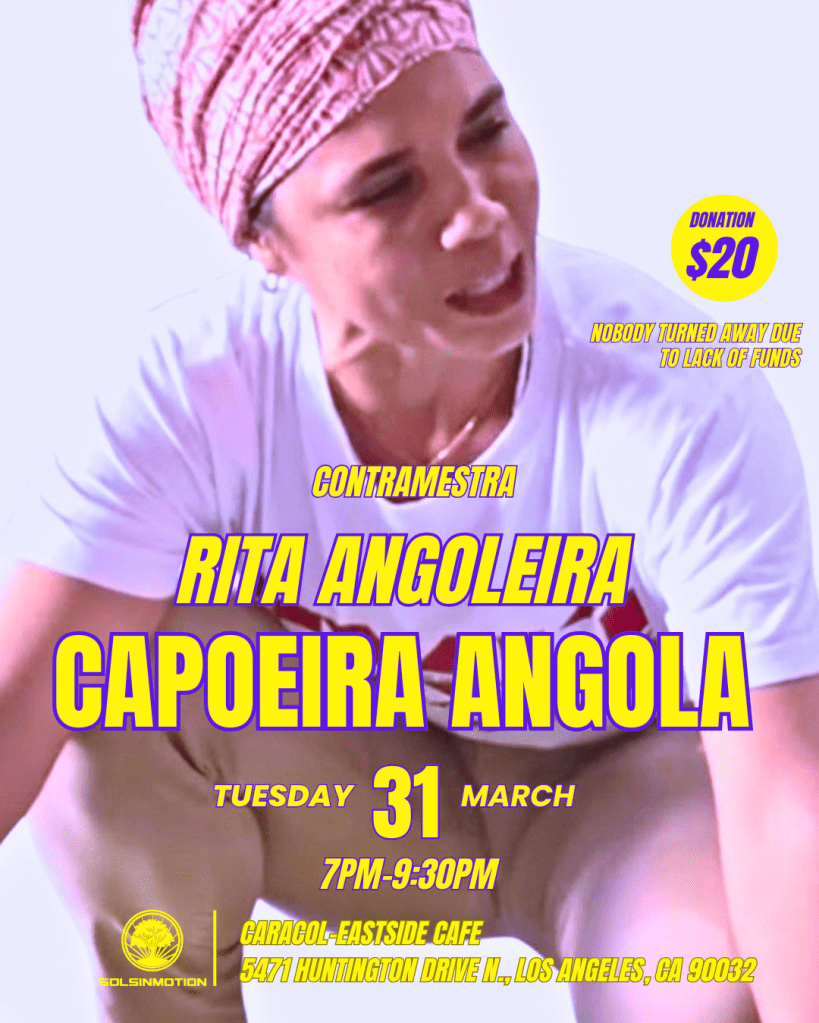
Building on that inspiration, I am incredibly proud and excited to announce a fantastic opportunity for our local community. This coming Tuesday night, March 31st, Contra Mestra Rita Angoleira will be sharing her knowledge and spirit by teaching a special class and workshop at my teacher’s school.
The event is scheduled to run from 7:00 PM until approximately 9:30 PM. This is a chance to learn directly from a master, to absorb her unique perspective on the jogo, music, and philosophy of Capoeira Angola.
Therefore, this entire post serves as a dedicated tribute to Contra Mestra Rita Angoleira, and by extension, to every Angoleira who sustains this powerful tradition. These remarkable individuals embody the essence of the culture, dedicating their lives to the art form and ensuring its vitality for future generations. To those who step into the roda, holding it up with their skill and spirit, they create a vibrant tapestry of movement and sound that resonates with the history and struggles of their ancestors. They connect deeply with the roots of their art, managing to blend the past and present while fostering a sense of community and belonging among practitioners and admirers alike. In every beat of the berimbau, they bring dendê and axé into every song and every movement, infusing their performance with energy that captivates the audience and honors the legacy of those who came before them in this beautiful, transformative journey.
The Indispensable Voice: “The Moment of Truth’s Friday Crime Report” with Professor Black Truth
“The Moment of Truth’s Friday Crime Report,” a program of paramount importance and consistently powerful insight, is a cornerstone of critical media commentary. Broadcast reliably every Friday morning—a timing that tacitly suggests profound truth is worth the anticipation—the show is expertly hosted by the respected and unflinching voice of PROFESSOR BLACK TRUTH.
The program is not merely a summary of weekly events; it stands as an essential, critical platform dedicated to a deep, analytical, and uncompromising exploration of the intricate societal, judicial, and economic forces that disproportionately and often devastatingly impact the Black community. It serves as a necessary corrective to mainstream narratives, offering a perspective often marginalized or intentionally obscured by dominant media structures.Today’s Essential Installment: Unmasking Vicious Racial Hatred
In today’s compelling installment, the report delves into a recent, harrowing incident that starkly illustrates the persistence and brazenness of racial hatred in America. The segment focuses on a shocking act of violence and racial terrorism in New York:
A few weeks ago, a pair of individuals, identified as racists and conspicuously wearing MAGA hats, accosted a Black woman on the street. The encounter quickly escalated from verbal assault—in which they subjected her to vile racial slurs—to an act of physical violence and symbolic destruction. Appallingly, the assailants then set her shoes on fire while they were still on her feet, a malicious and terrifying attack.A Dedication to Unfiltered Truth
This segment, and the entire program, is a profound “shoutout to the professor for creating and posting this video.” It serves as a crucial, documented testament, demonstrating that the forces which harm the Black community extend far beyond the narrow scope and selective focus of the white-dominated media landscape. Professor Black Truth consistently illuminates the deep-seated systemic and overt racist threats that many mainstream outlets choose to ignore, downplay, or misrepresent.
His work provides an invaluable, unvarnished look at the realities of racial injustice, demanding accountability and offering a space for genuine dialogue and community support.
Support the Essential Work of Professor Black Truth:
To ensure the continued production of this critical reporting, the Professor accepts support through the following platforms:
The foundation of public safety rests on the integrity of its law enforcement. The vast majority of police officers, worldwide, are dedicated men and women who fulfill their duties with a profound sense of honor, commitment, and dignity, serving as vital protectors of their communities. They are the first line of defense, often risking their lives to uphold the law and maintain civil order.
Unfortunately, this crucial profession is occasionally marred by the actions of a few bad actors. These officers abuse the power entrusted to them, violate the very laws they swore to enforce, and inflict harm on the communities they are meant to protect. Such behavior not only causes direct injury but also erodes the indispensable public trust necessary for effective policing.
The disparities in conduct among law enforcement personnel are not random; they are the result of multiple, interwoven factors. These contributing elements include inadequate or biased training protocols, systemic issues within police department cultures, lack of sufficient mental health and stress management support, ineffective internal accountability mechanisms, and societal pressures that disproportionately affect officers. Addressing these complex factors is not merely an optional reform; it is an absolute imperative to ensure the safety, well-being, and constitutional rights of all individuals within society. Comprehensive reform must focus on enhanced screening, continuous ethical and de-escalation training, robust oversight, and fostering a culture of transparency and accountability from the top down.
The following accounts delve into the darker side of law enforcement, where the protectors become the perpetrators.
These are their stories—tales of officers who crossed the line and betrayed their badge.
In this installment, we shine a spotlight on officers whose gender did not exempt them from accountability:
When FEMALE Cops Get CAUGHT Breaking The Law!
The public holds police officers, regardless of gender, to an exceptionally high standard. They are entrusted with upholding the law, ensuring public safety, and embodying justice. When female officers—or any officer—are caught on camera or through internal investigations engaging in criminal activity, the breach of trust is profound and the public’s reaction is often intense.The Double Standard and Media Scrutiny
The Double Standard and Media Scrutiny
Instances of female law enforcement officers being arrested, investigated, or convicted for offenses like theft, excessive force, drug offenses, misuse of power, or even violent crimes tend to draw significant media attention. This disproportionate focus can be attributed to several factors:
Breach of Trust: The uniform is a symbol of authority. When the person wearing it is the one violating the very laws they swore to protect, it creates a deep sense of betrayal.
Novelty Factor: While police misconduct is a recurring news topic, the arrest of a female officer can be perceived as less common, leading to greater sensationalism.
Erosion of Confidence: These incidents not only damage the reputation of the individual officer but can also contribute to a broader distrust in the police department, particularly around issues of accountability and internal oversight.
The Scope of Misconduct
The offenses committed by female officers can span a wide range, often reflecting the same types of crimes committed by officers of any gender, but are compounded by the power of their position:
Abuse of Authority: This can include planting evidence, making false arrests, misusing police databases for personal reasons, or coercing citizens.
Financial Crimes: Theft from crime scenes, embezzlement from police funds or unions, and fraudulent activities are not uncommon.
Substance Abuse and Related Offenses: Being caught with illegal drugs or driving under the influence (DUI) while off-duty can immediately end a career.
Crimes of Passion/Domestic Issues: High-stress jobs can sometimes lead to officers being involved in domestic violence or other violent crimes that cross into their professional lives.
Accountability and Aftermath
When female cops are caught breaking the law, the immediate actions taken by the department are crucial for maintaining public confidence. These steps typically include:
Administrative Leave: The officer is usually placed on immediate paid or unpaid leave pending the outcome of the investigation.
Internal Affairs Investigation (IA): The department’s IA division launches a thorough internal inquiry to determine if department policies were violated.
Criminal Prosecution: Depending on the severity of the offense, the officer faces criminal charges brought by the District Attorney’s office.
Disciplinary Action: If found guilty internally, the officer faces a range of penalties, from suspension and demotion to, most often, termination of employment and decertification, which bars them from working in law enforcement again.
The consequences are not merely professional; they are intensely personal, leading to public shaming, legal penalties, and the destruction of a career built on public service.
The Crucial Platform: The Friday Crime Report with Professor Black Truth
The “Friday Crime Report,” typically airing on Friday mornings, is far more than a routine news broadcast; it is a vital, unflinching academic and activist platform dedicated to the deep exploration of the structural and societal forces that disproportionately impact the Black community. Hosted by the insightful Professor Black Truth, the program serves as an essential counter-narrative to mainstream reporting, which often sensationalizes crime while neglecting its systemic roots.Dissecting Systemic Injustice
The core mission of the Report is the meticulous dissection of fundamental structural injustices. This includes a robust examination of:
Systemic Racism: Moving beyond individual prejudice, the program analyzes how policies, institutions, and cultural practices—from housing to healthcare to education—are fundamentally skewed against Black people, generating cycles of disadvantage that manifest in crime statistics.
Economic Inequality: The broadcast links the wealth gap and chronic underinvestment in Black communities to the environment of desperation and limited opportunity. It meticulously traces the line from historical disenfranchisement to contemporary economic precarity.
Police Brutality and Injustice: The “Friday Crime Report” moves past surface-level incident reports to offer a profound examination of the failures within the criminal justice system. It highlights discriminatory policing practices, prosecutorial biases, and sentencing disparities, positioning these issues not as isolated events but as hallmarks of a broken system.
A Catalyst for Engagement and Reform
The ultimate objective of the “Friday Crime Report” transcends mere awareness or critique; it is designed to be a catalyst for engagement and reform. Professor Black Truth provides listeners with facts and analysis, but the program’s true power lies in its focus on practical, tangible solutions.
Fostering Active Community Engagement: The Report is a forum for discussion, debate, and mobilization, actively encouraging listeners to participate in local governance and advocacy efforts.
Highlighting Actionable Steps: Crucially, the program does not leave listeners feeling helpless. It emphasizes actionable steps—practical, grassroots measures that individuals and communities can implement immediately. This focus on grassroots advocacy is designed to empower listeners, equipping them to become effective agents of positive change and to confront injustices directly in their neighborhoods and local institutions.
Today’s Critical Installment
The current episode underscores the persistent failures of the justice system:
Last month, a deeply troubling incident occurred where a career criminal violently attacked a Black citizen without any discernible provocation. This assault was captured on video, providing clear evidence of the unprovoked violence. Following the attack, police recommended a serious charge of 2nd Degree Assault. However, in a decision that is sadly illustrative of broader systemic leniency towards certain offenders, the District Attorney intervened. The DA determined that the police’s recommended charge was “too harsh” for this racist thug, signaling a profound miscarriage of justice and a devaluation of the Black victim’s experience.
This case is presented as a crucial example of how the system fails to deliver justice, even when the facts are undeniable, reinforcing the necessity of the “Friday Crime Report” platform.
Support Prof Black Truth’s Work:
Your support ensures this vital independent analysis can continue to expose systemic injustices and promote community empowerment.
The insidious, pervasive narrative often whispered, sometimes shouted, within and about Black communities—the “Ghetto Lie”—is not merely a social construct; it is a complex, multi-generational affliction actively undermining progress and leading to catastrophic outcomes. This “lie” is the toxic amalgamation of historical trauma, systemic disenfranchisement, and a dangerous cycle of self-fulfilling prophecy, tragically masquerading as an unavoidable, innate cultural reality. It is the sophisticated mechanism by which external oppression is converted into internal surrender.
This destructive ideology posits that the pathology associated with deeply impoverished, inner-city neighborhoods—characterized by high rates of single-parent households, poor educational outcomes, joblessness, and violence—is an inherent part of Black identity, rather than the symptom of socio-economic and structural oppression. By internalizing this lie, the focus shifts disastrously from demanding systemic change and equitable resources to merely managing the “symptoms” or, worse, accepting them as the natural order. The structural architects of disadvantage are thus absolved, and the victims are made to blame themselves for the conditions imposed upon them.
Before I go on with this post, we at Jogo de Corpo Fechado would like to to take a moment to give a huge, well-deserved shoutout to Black Stories Untold. They are the incredible creators and dedicated historians responsible for the powerful and insightful video that we’ve featured or linked to within this post. Their commitment to uncovering, documenting, and sharing marginalized narratives is truly invaluable.
Their work, and the specific video you’ve just engaged with, provides essential context and a critical perspective that often goes overlooked. We strongly encourage you to explore their channel further.
If you found the video as compelling and necessary as we did, we know that your support would mean a great deal to the team at Black Stories Untold. Producing high-quality, deeply researched content takes a considerable amount of time, effort, and resources.
There are many ways to show your appreciation and help them continue this vital work:
Contribute Directly:If you are in a position to do so, a direct financial contribution to their efforts is the most impactful way to support their production and research costs.
Engage with Their Content:If contributing financially isn’t possible right now, your engagement is still incredibly valuable. A simple “Like” on their videos and hitting the “Subscribe” button on their channel are crucial ways to support them. It helps increase their visibility, ensures their content reaches a wider audience, and provides them with the motivation to keep producing excellent material.
Thank you for watching and thank you for considering supporting Black Stories Untold!
Now, let’s continue.
The Core Components of the Ghetto Lie: An Anatomy of Deception
The Ghetto Lie is not a monolithic myth; it is composed of several reinforcing pillars, each designed to chip away at Black agency and potential:
1. The Myth of Innate Pathology: The Denial of Historical Context
This component falsely asserts that issues like academic disengagement, casual violence, and disdain for authority are cultural norms passed down through generations, rather than coping mechanisms developed in hostile, resource-starved environments. This fatalistic view systematically ignores the robust history of Black intellectualism, family structure, and community resilience that existed prior to and outside of concentrated poverty created by redlining, discriminatory housing covenants, and the brutal economic shock of deindustrialization.
The truth is that concentrated urban poverty—the geographical space the “ghetto” describes—was engineered through policy and prejudice. By framing the resulting behaviors as inherent “pathology,” the Lie distracts from the poverty and lack of opportunity that are the true root causes. This intellectual sleight of hand transforms a political and economic problem into a cultural and moral failing.
2. The Attack on the Black Family: Normalizing Instability
The most damaging facet is the normalization of fractured family units. While acknowledging the historical impact of slavery and Jim Crow on family separation, the Ghetto Lie elevates the single-parent, often matriarchal, structure from a necessity born of economic struggle and male incarceration to the accepted standard. This minimizes the critical, measurable role of present fathers and stable nuclear or extended families in providing economic stability, emotional security, and effective socialization for children. The consequence is a vicious cycle of poverty replication, where the very structure needed to escape generational poverty is systematically undermined and pathologized. The message becomes: your family is broken by design, not by external pressure.
3. The Culture of Anti-Intellectualism and Anti-Achievement: The Internal Censor
This lie creates a crushing societal pressure that often labels educational excellence, articulate speech, and professional ambition as “acting white.” This phenomenon, deeply rooted in the historical reality that Black success was often met with white violence, economic exclusion, or institutional sabotage, now functions as an internal mechanism of suppression. The fear of social ostracization or the desire to maintain community credibility limits educational attainment and upward mobility, creating a self-imposed ceiling on ambition. It is a defense mechanism turned destructive, leading to the tragic waste of millions of bright minds whose potential is sacrificed on the altar of manufactured authenticity.
4. The Normalization of Interpersonal Violence: Absolving External Responsibility
By accepting the high murder and crime rates within concentrated Black communities as simply “how things are,” the Ghetto Lie drains the collective will to fight for safer streets, better policing, and adequate mental health resources. It frames the violence exclusively as Black-on-Black crime—a self-inflicted wound—thereby absolving external institutions (government, education, law enforcement, healthcare) of their foundational responsibility to protect and serve these citizens equitably. This narrative weaponizes tragedy, using the symptoms of systemic neglect as justification for further neglect and punitive control (e.g., mass incarceration), rather than investment and restoration.
The Killing Mechanism: The Slow, Systemic Loss of Potential
The consequence of this internalized narrative is nothing less than the slow, systemic killing of potential. The Ghetto Lie kills:
Educational Opportunity: By lowering expectations in schools, fostering environments where academic rigor is mocked, and pushing students out of the classroom and into the school-to-prison pipeline.
Economic Mobility: By discouraging the disciplined effort, networking, and cultural code-switching often required to navigate professional, largely white-dominated, corporate spaces.
Physical Safety and Well-being: By allowing endemic violence and unchecked mental health crises to persist without the unified community and political action needed to stop them.
The Black Soul: By convincing individuals that their highest aspiration should be to merely survive their hostile environment, rather than to master it, transform their world, and realize their full, inherent brilliance.
The Economy of Dysfunction: Profit and Perception
Today, we are ripping the mask off the lie that has been insidiously poisoning our community’s soul for decades—the systemic fiction that has defined our struggle and obscured our brilliance. This is the harrowing story of how power structures meticulously convinced the world, and disturbingly, segments of our own people, that the term “ghetto” is synonymous with “Black.” This dangerous conflation is a masterful piece of social engineering, designed to erase the rich, complex tapestry of our culture and replace it with a single, devastating stereotype of deprivation and despair.
This narrative of pathology is not organic; it is meticulously cultivated because it is profitable. We must confront the uncomfortable truth: billion-dollar corporations and entrenched institutions are not merely observing our dysfunction—they are actively feeding off it. From predatory lending practices, exploitative housing markets, and the booming private prison and surveillance industries to the targeted marketing of harmful, addictive products (alcohol, tobacco, high-fat foods), a vast, complex economy thrives on keeping our communities marginalized, fragmented, and in a state of perpetual crisis. Our perceived dysfunction is their quarterly dividend; our instability is their investment opportunity.
The ultimate tragedy is the internal toll this constant assault has taken. We have, consciously or unconsciously, allowed the relentless, sensationalized media focus on our worst moments—the crime, the poverty, the division—to drown out the soaring symphony of our greatest achievements. The brilliance of our scientists, the passion of our artists, the resilience of our families, the political victories won through generations of struggle—these foundational truths are constantly obscured by a spotlight fixed only on our failures. We are allowing their narrative, the one that defines us by our deficits rather than our potential, to become the loudest voice in the room, threatening to silence the historical chorus of Black excellence and achievement forever.
The Path Forward: Refuting the Lie with Truth and Action
To save Black America and truly unlock its potential, the Ghetto Lie must be confronted and refuted with a forceful and uncompromising embrace of high standards, educational rigor, family stability, and an insistence on equitable societal investment in these communities.
The path forward requires replacing the lie of innate pathology with the truth of unfulfilled potential. This demands a dual approach: demanding external structural reform while simultaneously fostering internal cultural strength. We must aggressively dismantle the systems of inequity (housing, education, justice) while nurturing the values of excellence, scholarship, entrepreneurship, and stable family formation within our own communities, not as an appeal to external validation, but as the inherent, historical standard of Black life. The lie has been told long enough. The time for truth, potential, and collective action is now.
“Never interrupt your enemy when they are making a mistake” is a profound and enduring piece of strategic wisdom, most famously attributed to Napoleon Bonaparte. This maxim underscores the immense value of patience and observation in any competitive environment, whether military, political, or business-related.
The Core Principle: Capitalizing on Self-Inflicted Error
The fundamental idea is simple: an opponent’s error is often the most potent weapon one can possess, and interrupting that process risks alerting them to their blunder, thereby giving them a chance to correct it. When an adversary is acting based on flawed information, poor judgment, or an incorrect assessment of the situation, their actions are inherently self-destructive. By allowing the mistake to fully unfold and compound, the observing party ensures the maximum possible negative impact on the enemy’s position.
Strategic Implications:
Magnification of Damage: Every step taken based on the initial error deepens the trap. An interruption might merely negate the first mistake, but silent observation allows the opponent to commit successive, reinforcing mistakes (the “snowball effect”). The goal is not just to see an error, but to see it leveraged into a significant strategic or tactical disadvantage.
Information Advantage: The act of observing an ongoing mistake yields critical intelligence. It reveals the opponent’s underlying assumptions, their current mental model, and their operational weaknesses. This knowledge is far more valuable than the temporary tactical gain of an immediate counter-move, as it can be used to plan future, more decisive attacks.
Preserving Resources: Reacting prematurely to an error may force the observer to commit resources unnecessarily. By waiting, the observer can conserve their strength until the optimal moment to strike, which is typically after the opponent has fully committed to their flawed course of action and is too deeply entangled to easily withdraw.
Maintaining Concealment: A well-timed interruption may expose the observer’s own intentions or tactical position. Silence and patience maintain the element of surprise, ensuring the eventual counter-move is both unexpected and devastating.
Application Across Domains:
Military Strategy: Allowing a poorly executed flanking maneuver to continue, or permitting an enemy to commit forces to a terrain they have misjudged, only to cut them off once they are fully engaged.
Negotiations and Politics: Remaining quiet while a rival makes an unreasonable or overconfident demand, thereby exposing their true bargaining floor or alienating their potential allies.
Business and Competition: Watching a competitor sink massive capital into a product or market based on faulty research, and only then launching a superior, well-timed alternative, knowing the competitor is now financially and operationally overextended.
In essence, this maxim is a call for disciplined restraint. It is a caution against the impulsive satisfaction of immediate engagement, arguing instead for the strategic patience required to secure a decisive, long-term victory by letting the enemy orchestrate their own downfall.
“The Friday Crime Report,” an essential and consistently powerful program usually broadcast every Friday morning (with the understanding that profound truth is worth the wait), is expertly hosted by the respected voice ofPROFESSOR BLACK TRUTH. This program stands as a critical platform dedicated to a deep and unflinching exploration of the societal forces that disproportionately impact the Black community.
The show meticulously dissects the complex and intertwined issues of systemic racism, pervasive economic inequality, and the reality of police brutality. It moves far beyond surface-level reporting to offer a robust, thought-provoking examination of how these structural injustices manifest in daily life and in the legal system.
A Commitment to Comprehensive Dialogue and Authentic Voices:
Compelling Expert Interviews: Each episode features leading sociologists, legal scholars, activists, and community leaders whose insights provide a structured, evidence-based understanding of the issues at hand.
Heartfelt Personal Narratives: Crucially, the program is anchored by the lived experiences of those directly affected. These narratives are integrated to provide depth and emotional resonance, transforming cold data into relatable human stories that resonate profoundly with the audience.
Fostering Vibrant Dialogue: By presenting both rigorous facts and personal accounts, “The Friday Crime Report” seeks not just to inform but to actively stimulate open and honest public conversation aimed at inspiring and driving meaningful, sustainable change.
Beyond Awareness: A Call to Collective Action:
The program’s ultimate goal extends beyond raising awareness; it is a catalyst for engagement and reform. It meticulously presents the cold, hard facts while simultaneously fostering active community engagement. Listeners are encouraged to collectively confront societal challenges and understand their role in challenging the status quo.
Furthermore, “The Friday Crime Report” goes the vital step further by highlighting actionable steps—practical, tangible measures that individuals and communities can implement in their daily lives. This focus on grassroots advocacy is designed to inspire local reform efforts and empower listeners to become agents of positive change in their own neighborhoods. By addressing the complexities of these social justice topics, the program seeks to empower its audience, motivating a united front against injustices and equipping them with the necessary tools to impact their communities positively.
In Today’s Critical Installment: Confronting Domestic Extremism
Today’s episode brings to light a profoundly disturbing case that underscores the media’s often-selective coverage of violent extremism. The program discusses the heinous actions of a domestic extremist who utilized the social media platform Discord to groom a child, starting when she was just 12 years old. This grooming culminated in him luring her to a hotel, where he committed acts of unspeakable violence: mutilation, rape, and choking her near unconsciousness, with a stated plan to ultimately commit murder-suicide.
The gravity of this case is amplified by the fact that Federal authorities have officially identified the perpetrator as a member of a recognized extremist movement. However, the host points out a significant pattern of media failure: the lack of comprehensive coverage from the mainstream, or “white media,” which consistently downplays or ignores the threat posed by domestic, ideologically-driven violence when the perpetrators fit a certain profile. This selective omission prevents a crucial public discussion about the nature of this particular extremist threat.
A Word of Appreciation and Support for the Mission:
Shoutout to the professor for his courage in creating and sharing this essential, often difficult, content. His dedication to uncovering ignored truths is a vital service to the public.
Support the Work of Professor Black Truth:
The continued operation of this critical platform relies on community support. If you value the integrity and depth of this reporting, you can contribute through:
The Dual Mandate of Policing: Community Trust and the Corrosion of Corruption
The bedrock of effective law enforcement is fundamentally rooted in a dual mandate: community protection and trust-building. The vast majority of police officers diligently fulfill this mission, recognizing that positive community relations are not an optional extra but the essential foundation upon which safety is built. These dedicated professionals regularly engage in proactive outreach programs, including organizing local community events, conducting educational workshops, and participating in neighborhood watch initiatives. These efforts are crucial, serving to demystify police work, foster open dialogue, and educate citizens on vital topics like safety protocols and effective crime prevention strategies. The result is a mutual enhancement: police gain crucial intelligence and community cooperation, while citizens develop a greater understanding of and respect for the law enforcement role, strengthening the overall fabric of community ties.
The Shadow of Misconduct:
However, this vital foundation is perpetually at risk from the corrosive actions of a very small number of officers. When those sworn to uphold the law choose instead to misuse their power, engage in misconduct, or succumb to corruption, the damage is immediate and devastating. Such acts not only constitute a profound betrayal of public trust but also sow deep seeds of skepticism, fear, and hostility toward the entire institution. A single act of police criminality can undo years of positive community engagement, creating a hostile environment where citizens are hesitant to cooperate with law enforcement, ultimately hindering the ability of good officers to protect the public.
When the Badge Betrays: Stories of Police Corruption
The following is an unflinching look into the lives and crimes of individuals who crossed the line, becoming the very criminals they were sworn to combat. These are not isolated incidents but real-world cases that expose the vulnerability of the law enforcement system to exploitation and the devastating consequences that follow when power is abused for greed, violence, and personal gain.
This investigative focus seeks to pull back the curtain on how corruption can take root and thrive inside ostensibly disciplined law enforcement agencies.Featured Cases of Infamy and Betrayal:
Sgt. Wayne Jenkins – The Apex of Corruption
Wayne Jenkins served as the leader of the Baltimore Police Department’s infamous Gun Trace Task Force (GTTF). This specialized unit, intended to get illegal guns off the streets, morphed into a sophisticated criminal enterprise. Jenkins and his subordinates operated with impunity, routinely engaging in home invasions, robbing citizens and drug dealers, reselling confiscated drugs, filing fraudulent overtime, and even planting evidence. His leadership demonstrated a systematic betrayal of public trust, turning an elite police unit into a crew of organized criminals who used their badges as licenses for felony
.Daniel Hersl – Abuse of Authority and Criminal Misconduct
As a member of the GTTF under Jenkins, Daniel Hersl’s case epitomizes the abuse of power for personal enrichment. His actions involved the systematic theft of money and property from citizens, often targeting individuals they suspected of criminal activity, knowing their victims were less likely to report the crimes. His conviction, alongside his fellow GTTF members, sent a clear message about the federal commitment to prosecuting police criminality
.Marcus Taylor – The Betrayal of the Oath
Another key figure in the GTTF scandal, Marcus Taylor’s story is a profound example of the betrayal of the public’s implicit trust. The very oath taken to protect and serve was systematically violated through repeated acts of robbery and conspiracy. His participation solidified the public perception of the GTTF as a criminal organization disguised in uniform.
David Mack – From LAPD Officer to Convicted Criminal
David Mack’s career took a dark turn that shocked the nation. As an officer in the Los Angeles Police Department (LAPD), Mack used his position to facilitate a major bank robbery. His case was a central element in exposing broader issues of corruption and misconduct within the LAPD in the 1990s, particularly in the Rampart Division, highlighting how a respected officer could transition into a high-level criminal.
Jose Tejada – Corruption That Shocked the System
Jose Tejada represents cases where an officer’s corruption is so profound it reverberates across the entire system. While specific details vary by jurisdiction, cases like Tejada’s typically involve schemes like drug trafficking, accepting bribes to look the other way, or running protection rackets. Such deep-seated corruption damages the integrity of the courts and the investigative process, demanding systemic reform and external oversight.The Documentary-Style Breakdown
This in-depth, documentary-style exploration moves beyond simple reporting to dissect the anatomy of these crimes. It investigates the modus operandi of these corrupt officers—how they exploited loopholes, leveraged their authority to intimidate victims, and evaded internal affairs for as long as they did. Crucially, it details how they were ultimately caught, often through the painstaking work of federal investigators, internal whistleblowers, or the accumulation of evidence from marginalized communities. Finally, the analysis confronts the lasting impact of these betrayals on their communities, exploring the resulting civil litigation, policy changes, and the long, difficult road toward rebuilding a damaged trust. Viewer discretion is strongly advised due to the nature of the criminal activities and the emotional impact of the victims’ stories.—–For those seeking more true crime cases, detailed breakdowns of historical police corruption stories, and in-depth true crime documentaries, please subscribe to the channelhuman and crime.
The Friday Crime Report: Unpacking Systemic Injustice and the Fight for Equality
PROFESSOR BLACK TRUTH and “The Friday Crime Report”: An Essential Voice for Unflinching Justice
Every Friday morning, PROFESSOR BLACK TRUTH—a compelling and critical voice available on YouTube—unveils the latest installment of “The Friday Crime Report.” This program is far more than a simple digest of weekly events; it is an essential, powerful, and utterly unflinching deep dive into the complex web of systemic issues plaguing the Black community across the nation. It is a necessary and high-impact platform that dedicates itself not merely to documenting tragic events, but to fiercely dissecting the root causes and the widespread, devastating societal impacts of institutional failures.
The show confronts deeply entrenched and uncomfortable truths with academic rigor and moral clarity. These truths include the pervasive and persistent scourge of systemic racism, the crushing weight of structural economic inequality that stifles opportunity, and the critical, life-and-death issue of police brutality that continues to erode community trust and safety. Professor Black Truth forces viewers and listeners to look beyond the headlines and into the deeper machinery of injustice.
A Mission to Inform, Inspire, and Incite Action
“The Friday Crime Report” is meticulously designed to be far more than just a news broadcast or a simple commentary show; it operates as a profound call to sustained awareness and a resolute demand for corrective action.
Its core objective is singular and urgent: to spark an essential, often uncomfortable, yet ultimately productive public dialogue and inspire genuine, meaningful, boots-on-the-ground community engagement. The program’s foundational philosophy is the unwavering belief that informed discussion, backed by facts and analysis, is the indispensable precursor to meaningful, measurable, and enduring societal change.
Professor Black Truth expertly weaves together factual evidence, rigorous academic analysis, and relatable, often heartbreaking human experiences. This potent and accessible blend is crucial, as it makes the seemingly complex and often painful issues of racial and economic injustice accessible and profoundly understandable to a broad, diverse audience—from those in academic circles to everyday community members.
Ultimately, Professor Black Truth’s enduring mission is to move every single listener and viewer from the role of a passive observer into a passionate, educated, and effective advocate. The goal is to motivate individuals to fight for genuine equality and justice within their own neighborhoods, cities, and spheres of influence, transforming knowledge into power.This Week’s Focus: A Horrifying Incident and Unsettling Aftermath
The latest episode of “The Friday Crime Report” grapples with a particularly shocking and complex event that has shaken the nation: a recent mass murder at a school-related event in Rhode Island. The facts presented by the Professor are chilling, noting specifically that the perpetrator was unequivocally identified as a “mouth-frothing anti-black racist.”
However, the report makes it clear that the full story did not conclude with the initial tragedy and the identification of the killer. As the host states, following the initial horrific details, “then things got REALLY weird!” This evocative statement signals the show’s signature move: its commitment to investigating the strange, the overlooked, and the potentially conspiratorial elements that often surround acts of racially motivated violence. This approach prompts a deeper, more critical look into the societal reactions, the shifting media narratives, and the official handling of the case—all of which may, intentionally or unintentionally, obscure a full and honest accounting of the facts and motivations.
—–Support and Connect with Professor Black Truth:
To support the continuation of this essential and uncompromising work, you can connect with Professor Black Truth via the following platforms:

 Jogo Corpo Fechado