The return of successful rappers to the very environments they strove so hard to escape—specifically, their former, high-crime neighborhoods—represents a deeply perplexing and often self-destructive trend within contemporary hip-hop culture. Despite having amassed significant wealth, global fame, and a clear pathway to a safer existence, a substantial number of these artists appear to be under an intense internal and external pressure to re-engage with the perilous realities of “street life” or “the hood.” This compulsion frequently leads them into unnecessarily dangerous and confrontational situations, a pattern that is visible across diverse major musical hubs, from the influential trap heartlands of Atlanta and the raw, drill-music-fueled energy of Chicago, to the historically significant and complex streets of Los Angeles.
The highly regarded documentary-style project, Trap University, takes on the ambitious task of a critical and penetrating examination of this complex and often tragic behavior. Its central objective is to move past superficial explanations and truly understand the deep-seated psychological, cultural, and sociological drivers compelling these highly visible, multimillionaire artists to continuously revisit their old neighborhoods.
The documentary’s video content is structured around a compelling series of high-profile, real-world examples and case studies, meticulously showcasing various rappers as they navigate their impromptu, and sometimes highly calculated and staged, visits to different cities and communities. These raw, unscripted encounters serve to starkly illuminate the massive, often irreconcilable contrast between the glamorous, meticulously controlled environment of a modern celebrity’s life—complete with security, entourages, and private jets—and the unpredictable, volatile, and often harsh reality of the streets they left behind. This collision of worlds frequently culminates in unexpected, tense, and sometimes outright confrontational situations, challenging the very notion of a safe return.
This insightful commentary provided by Trap University delves far beyond the simple, surface-level explanation of “keeping it real,” which is often offered as a facile justification. Instead, the analysis explores the intricate and often manipulative interplay between the pressures of mega-fame, the meticulously crafted and commercially viable public image of a rapper (often predicated on a struggle-to-success narrative), and the deeply held cultural value of perceived authenticity tied directly to their street roots.
Trap University posits several complex theories, suggesting that this dangerous return may be fundamentally driven by a deeply ingrained perceived need to validate their initial narrative for their core audience, to explicitly prove their unwavering loyalty to their origins and the community that birthed them, or perhaps, most potently, to counteract the “softening” or “selling out” effect of mainstream, commercial success and acceptance. The fear of being viewed as disconnected or inauthentic appears to be a powerful psychological anchor, dragging them back into the fray.
Ultimately, the work is a profound effort to dissect the dangerous, contradictory, and often self-destructive complexities inherent in attempting to maintain a genuine, boots-on-the-ground connection to street life long after fame and fortune should have provided a clear, safe, and definitive exit. It serves as a powerful and sobering revelation of the high personal and professional cost of this perceived and required connection to “the struggle,” highlighting the severe risks taken for the sake of an image.
(Shoutout to TRAP University for creating and posting this important and critical video project.)
Welcome to MARTIAL ARTS THEATER, a vibrant community hub for martial arts enthusiasts that focuses on personal growth, discipline, and camaraderie. Here, you can access a wealth of resources, including expert interviews that delve into the philosophies behind various martial arts, instructional videos tailored for all skill levels, and engaging events that bring people together in the spirit of collaboration. Explore a diverse array of styles such as karate, judo, taekwondo, and Brazilian jiu-jitsu in an inclusive and supportive environment designed to cultivate both skill and character. Whether you’re a seasoned practitioner with years of experience or a curious beginner taking your first steps into the world of martial arts, you will find a welcoming community that fosters meaningful connections and encourages self-discovery, resilience, and empowerment through martial arts. Join us in this journey of transformation where each kick and kata not only builds physical strength but also instills confidence and fortitude to face life’s challenges.
In today’s installment…
Michael Jai White: The Action Star Hollywood Couldn’t Handle
Before the current era of superhero blockbusters, where meticulously rendered CGI and wirework often eclipse genuine physical performance, Michael Jai White was operating on an altogether different echelon of action stardom. He was not merely an actor portraying a martial artist; he was, and remains, a legitimate, high-level master of multiple fighting disciplines. His credentials are staggering: black belts in seven different styles, including Shotokan, Taekwondo, Kobudo, Kyokushin, Wushu, Tang Soo Do, and Goju-Ryu. This depth of authentic martial arts mastery provided the foundation for his screen presence, translating into fight choreography that was leagues ahead of the often-staged, overtly telegraphed combat sequences common in Hollywood films of the time.
White’s cinematic fighting style was characterized by its blinding speed, surgical precision, and a brutal, yet elegant, authenticity. His on-screen persona was a powerful, magnetic synthesis of physical grace, an imposing physical stature, and the easy charisma that defines a true leading man. Crucially, White rarely, if ever, required a stunt double for his most complex and demanding martial arts sequences. This unparalleled self-sufficiency and dedication to his craft made him the complete package: the skill, the look, and the commanding screen presence.
The logical, almost inevitable, trajectory for an actor with such a unique and formidable skill set should have been a clear path to major A-list superstardom. He possessed the raw material for a career in the mold of an Arnold Schwarzenegger or a Sylvester Stallone, yet with a layer of authentic martial arts credibility and skill that neither of those action giants could genuinely claim. Yet, this destiny of global franchise lead status never fully materialized, leading to one of the industry’s most frustrating case studies.The Problem of Being “Too Real”
The central, and perhaps tragic, irony of Michael Jai White’s career is that the very authenticity and superior skill that set him apart from his peers became, paradoxically, his greatest professional obstacle. In a profound sense, he was “too real” for a Hollywood studio system that historically prefers control, easily marketed archetypes, and actors who are content to rely heavily on special effects, camera tricks, and dedicated stunt teams to manufacture action credibility. White was a self-contained action powerhouse, a characteristic the system seemed ill-equipped to handle.
In 1977, amidst a period of political and cultural ferment in Brazil, a band hailing from Rio de Janeiro released a seminal work that would irrevocably alter the landscape of Brazilian popular music. That band was Banda Black Rio, and the album was the legendary Maria Fumaça (meaning “Smoke Train”). Far from a simple musical release, Maria Fumaça became a manifesto, a vibrant and complex sonic tapestry that captured the energy of an emerging Afro-Brazilian cultural movement.
A Groundbreaking Fusion: Samba, Soul, Funk, and Jazz
The genius of Banda Black Rio lay in their revolutionary approach to genre. Under the leadership of the brilliant multi-instrumentalist and arranger Oberdan Magalhães, the band forged a completely new style. They masterfully blended the foundational Brazilian rhythms of samba and its modern evolution, samba-funk, with the powerful, syncopated grooves of American funk, the soulful depth of soul music, and the harmonic sophistication of jazz. The result was a sound that was intensely Brazilian yet utterly global, creating a sophisticated musical conversation between the streets of Rio and the sounds emerging from Philadelphia and New York.
This potent musical hybrid was more than just an aesthetic choice; it was a cultural statement. Banda Black Rio successfully channeled the raw, celebratory energy of the bailes black—the black dances or parties that were vital social and cultural hubs in Rio’s suburbs—and brought that energy, that sense of self-celebration and identity, to the national and international stage. The music became a powerful expression of Afro-Brazilian identity and pride during a time when such expressions were highly significant.
Diving Deep into the Album’s Legacy
This video essay embarks on an extensive journey to uncover the story behind this landmark record. We will trace the rise of Banda Black Rio, examining the core philosophy behind their unique sonic experiment: the seamless fusion of deep Brazilian rhythms with the powerful structures of American funk and jazz.
Maria Fumaça is revered as one of the most important instrumental albums in Brazilian history. Its tracks—from the titular, driving funk anthem to the jazzy, sophisticated arrangements—serve as a masterclass in ensemble performance and arrangement. We will analyze how Oberdan Magalhães and the band, featuring an incredible lineup of musicians, constructed these complex pieces.
The Black Rio Movement and Enduring Influence
Crucially, the band’s rise cannot be separated from the broader cultural and social phenomenon of the 1970s known as the Black Rio movement. This movement was a cultural renaissance centered on embracing black aesthetics, music, and identity, heavily influenced by figures like James Brown and the emerging hip-hop scene, yet rooted firmly in Brazilian context. Banda Black Rio was the instrumental voice of this movement, connecting the dots between global black culture and local Brazilian reality.
Their influence did not end in the 70s; it established a profound and lasting legacy that permeates Brazil’s music scene today. The foundation they laid can be clearly heard in subsequent genres, including:
Samba-Rock: The vibrant dance-oriented fusion that directly built upon their initial mix.
Pagode: The soulful, highly rhythmic sub-genre of samba.
Contemporary Brazilian R&B and Hip-Hop: The current generation of Brazilian artists in these genres continually cite Banda Black Rio as a primary inspiration, recognizing their pioneering role in bridging the gap between funk/soul and Brazilian popular music.
Join us on a deep dive into the making and enduring impact of a truly seminal album. We will meticulously discover how this extraordinary collection of music came into existence, tracing the creative lineage, the innovative recording process, and the cultural forces that shaped its sound. The album wasn’t just a collection of songs; it was a vibrant cultural touchstone that perfectly captured the restless, hopeful, and revolutionary spirit of a generation, providing an essential soundtrack to a pivotal moment in history.
More than four decades later, the groundbreaking musical fusion pioneered by Oberdan Magalhães and his legendary collective, Banda Black Rio, continues to be a powerful and essential reference point. We will explore in detail why their legacy—a unique blend of funk, soul, and distinctively Brazilian rhythms like samba and baião—not only persists but continues to resonate as loudly, inspirationally, and relevantly as ever within the global music landscape, influencing contemporary artists and captivating new listeners with its timeless energy.
A heartfelt shoutout and sincere appreciation go out to Black Brazil Today for the creation and posting of this insightful and crucial video. Their dedication to presenting a more accurate and nuanced view of Brazil is commendable.
To delve deeper and gain more comprehensive information on the important work they are doing, we strongly encourage you to visit their official, amazing website:
Black Brazil Today serves as an essential platform dedicated to exploring and sharing the true narrative of Brazil, one that often goes unacknowledged in mainstream media. By subscribing to their channels and following their content, you will gain access to:
Insightful Discussions on Race: Unpacking the complexities of race relations, history, and the lived experiences of Black Brazilians.
Deep Dives into Culture: Celebrating the profound and often uncredited contributions of Afro-Brazilian culture to the national identity.
Critical Media Analysis: Providing a necessary counter-narrative to how Blackness and Brazilian society are typically represented in various media.
We urge you to explore the rich, multifaceted, and often-untold history and contemporary reality of Brazil through their lens. Your support helps amplify vital voices and perspectives.
Okay, before I get into this post, I need to post this.
⚠️ Disclaimer: This video is a dramatized documentary-style story inspired by real events, created for educational, informational, and entertainment purposes. Any resemblance to actual persons or events is coincidental unless explicitly stated. Viewer discretion is advised due to potentially sensitive themes. The use of public figure imagery is representational only and does not imply endorsement or affiliation. The video is for informational and commentary purposes only. The use of public figure imagery is purely representational and does not imply endorsement or affiliation.
Now, I can deeply relate to the sentiment expressed in this story, as I am personally immersed in the study of Capoeira Angola, a martial art that frequently encounters skepticism, often leading to dismissal or outright ridicule when the topic of its combat practicality arises. It’s a common misconception that its flowing, dance-like movements equate to ineffectiveness in a real confrontation. However, to truly understand Capoeira, one must appreciate its historical context as a disguised fight and resistance art developed by enslaved Africans. Its deceptive nature is its strength.
Furthermore, I am also a devoted student of FMA, the Filipino Martial Arts, which is a vast and intricate system encompassing a wide array of skills, including stick fighting (Eskrima/Arnis/Kali), blade work, empty-hand techniques, and grappling. From my personal experience and training, I can emphatically attest that to label FMA as “basic” is a profound understatement. FMA is anything but simple; it is a complex, principles-based martial system that demands deep understanding, adaptability, and high-level motor skills, often transitioning seamlessly between weapons and unarmed combat. The depth, speed, and sophistication of its techniques—especially its footwork and angles of attack—are testaments to its sophistication and combat provenience.
Anyway, enjoy the story.
The martial arts hall in Beijing fell silent, the oppressive weight of expectation settling over the gathered masters. It was September 2017, and the air was thick with palpable tension and the scent of polished wood. China’s most respected and highly decorated Kung Fu master, Liu Chen, stood opposite his challenger, his expression a mixture of amusement and arrogance. The challenger was Rafael Cortez, a Filipino martial artist who had traveled thousands of miles for this very confrontation.
Liu Chen’s laughter, sharp and dismissive, echoed in the vast space as he addressed Cortez and the assembly of esteemed martial arts experts. “Filipino martial arts?” he scoffed, waving a hand with casual disdain. “Just basic weapon techniques, not true martial arts. It’s a crude system for street brawlers, useful perhaps for farmers protecting their chickens, but hardly a sophisticated fighting discipline.” His gaze was condescending, fixed on the simple rattan sticks Cortez carried. “Kung Fu has three thousand years of history, a profound philosophy, and countless intricate forms passed down through generations of disciplined study. We have depth, tradition, and spiritual enlightenment woven into every movement. What do you have? Stick patterns. No sophistication. No inner truth.”
The insult, delivered with such open contempt for an entire cultural fighting heritage, hung heavy in the air. The other Chinese masters in the room, initially polite but skeptical of the foreign art, now nodded in agreement, their faces mirroring Liu Chen’s haughty confidence. This was a spectacle of cultural supremacy, and they expected nothing less than a quick, embarrassing defeat for the upstart Filipino.
Unfazed by the ridicule and the hostile atmosphere, Rafael Cortez remained calm, his eyes holding a quiet intensity. He stepped forward and, with unhurried precision, began to demonstrate the core principles of Filipino martial arts—specifically, the concepts of flow, economy of motion, and simultaneous attack and defense. He didn’t execute flashy forms but showcased practical applications. He used the “live hand” to check, trap, and manipulate an opponent’s body while the weapon hand delivered strikes. He demonstrated how a stick, blade, or even an empty hand worked on the same fundamental framework of angles and footwork.
What followed shocked every master in the room. Cortez didn’t just show techniques; he demonstrated principles that transcended the weapon itself. His movements were fluid, deceptively simple, yet devastatingly efficient. When he invited one of Liu Chen’s top students to engage him in a mock exchange, Cortez adapted instantly, effortlessly countering a powerful Kung Fu block with a simultaneous disarm and joint lock, transitioning from a long-range stick strike to a close-range elbow attack in the blink of an eye. The speed, practicality, and seamless integration of defense and offense—often using the opponent’s own force against them—was breathtaking. It was martial artistry stripped down to its brutal, elegant essence. The masters, witnessing a system that valued immediate combat effectiveness over stylized form, exchanged looks of bewildered respect. The silence returned, but this time, it was the respectful hush of profound revelation.
This story is a powerful tribute to the rich and sophisticated heritage of Filipino martial arts, a tradition often underappreciated on the global stage. It is a chronicle that elevates the concept of principle-based fighting systems, illustrating their profound, timeless efficacy beyond mere complex choreography or brute force. The narrative centers on a singular, pivotal demonstration—a moment where the essence of this ancient art was distilled and put on stark display.
Long before the raw, confrontational narratives of gangsta rap or the macabre theatricality of horrorcore ever found a voice, the American musical landscape was stalked by a bluesman who audaciously claimed the moniker, The Devil’s Son-in-Law. This enigmatic figure, whose life story was woven with themes of struggle and redemption, wielded his guitar like a sorcerer’s wand, conjuring emotions that mirrored the turbulent times in which he lived. With haunting melodies and profound lyrics, he captured the essence of heartbreak, betrayal, and the search for salvation, leaving a profound mark on generations of musicians who followed. His performances were not merely concerts; they were transformative experiences, drawing audiences into a world where the shadows of despair danced alongside flickers of hope, making it clear that the roots of American music run deep and are intertwined with the very fabric of the human experience.
This figure was William Bunch, immortalized on shellac records as Peetie Wheatstraw—a towering, yet deeply mysterious artist who deliberately constructed his entire public career around themes of the sinister, the inevitable finality of death, and a defiant, almost anarchic rejection of moral authority. In the shadowy corners of blues history, Wheatstraw is often cited as the prototypical ‘Faustian’ artist, one of the first to weave the legend of “making a deal” with the Devil directly into his musical identity. His profound and unsettling influence still resonates today, perceptible in the dark storytelling and larger-than-life personas embraced by contemporary rap artists.
Peetie Wheatstraw’s enduring and distinctly audacious niche was carved out in the turbulent landscape of pre-war blues, spanning the 1930s. This was an era defined by the crushing economic hardship of the Great Depression and the deep, often contradictory, cultural and spiritual currents flowing through the American South and Midwest. Amidst this turmoil, Wheatstraw didn’t just play music; he forged a spectacular and unforgettable public identity that seamlessly merged the roles of a highly-skilled musician, a carefree rogue or “bad man,” and a supernatural figurehead.
He was bestowed with a collection of formidable aliases, including the chilling “The High Sheriff from Hell” and, most famously, “The Devil’s Son-in-Law.” Wheatstraw’s carefully cultivated persona was steeped in the dark, mystical folklore that was a vital part of the African American experience and the bedrock of the blues tradition. His music and lyrical themes frequently and explicitly invoked the ominous concept of the crossroads—a location laden with powerful symbolism in African American and hoodoo belief. This was the legendary, desolate spot where, according to the lore, a person could allegedly barter their mortal soul, their earthly life, or their spiritual freedom in exchange for exceptional earthly talents or fortunes, with the pact typically being struck directly with the Devil or a powerful demon.The Persona of Impunity: A Faustian Bargain with a Twist
Wheatstraw’s adoption of the “Devil’s Son-in-Law” title was not just a clever marketing ploy; it was a fundamental component of his artistic identity. The designation afforded him a kind of lyrical and moral impunity. By claiming such a kinship, he positioned himself not as a mere supplicant who sold his soul, but as someone who was related to the source of all earthly vice and power. This twist on the classic Faustian bargain meant he didn’t just sing about sin and defiance; he embodied it. His lyrics were often characterized by a boastful confidence, a world-weary cynicism, and an almost gleeful embrace of the consequences of a life lived without conventional restraint, frequently dealing with heavy subjects like drinking, gambling, infidelity, and death with a casual, knowing authority.
Wheatstraw’s stage name and meticulous self-mythologizing aligned him directly with this profound Faustian bargain, yet his interpretation was revolutionary. Unlike the deeply troubled, intensely personal, and often tormented blues of contemporaries like Robert Johnson, Wheatstraw’s engagement with the demonic was often delivered with a sophisticated, swaggering sardonic humor. He reframed the narrative of the “soul-selling” pact not merely as a source of tragedy or desperation, but as a defiant badge of honor and the explicit source of his potent, piano-based musical prowess.
His most famous moniker, “The Devil’s Son-in-Law,” suggested a relationship far more intimate and controlling than that of a mere victim of a demonic pact. It implied a direct, almost familial, connection to the Prince of Darkness, suggesting a level of power, impunity, and executive authority over infernal matters that was unparalleled among his peers. He was not a supplicant; he was a relative by marriage, a figure who could command respect in both the mortal and supernatural realms. This audacious claim was a brilliant, subversive stroke of marketing in a segregated society where Black men often possessed little social power.A Distinctive Sound for the Juke Joint
Wheatstraw’s immense popularity among Black audiences in the 1930s was built on more than just his provocative image. His musical signature was instantly recognizable: a smooth, slightly slurred vocal delivery, combined with his characteristic, infectious rolling piano style. This piano accompaniment (often backed by an acoustic guitar and a stand-up bass) anchored a sound perfectly suited for the juke joints and house parties of the era.
Songs like “The Devil’s Son-in-Law,” “The High Sheriff from Hell,” and “Peetie Wheatstraw Stomp” cemented his identity, presenting a character who was the quintessential charming rogue: a relentless ladies’ man, a hard drinker, a man of few regrets, and a figure who treated the supernatural with a casual, confident familiarity. His music frequently featured a spoken “sermon” or monologue, delivered in a high-pitched, mocking drawl, a direct address to the audience where he would reinforce his outlandish claims and his devilish lineage.The Crossroads Reimagined: Power Over Pity
The legend of the crossroads—the mythic meeting point where mortal desire confronts infernal power—is a cornerstone of American blues folklore. While Robert Johnson is the figure most frequently associated with the myth, the theme of a pact with the Devil for musical mastery was embraced, embodied, and marketed perhaps most famously and effectively by William Bunch.
Unlike Johnson, whose legend is shrouded in personal mystery and intense, raw emotion, Wheatstraw actively cultivated the persona of a man who had made a deal and thrived on it. He was not just singing about the Devil; he was claiming a literal family tie and an executive role in the underworld. This deliberate, pervasive self-mythologizing was an astute and compelling marketing strategy in the segregated and often superstitious world of the time, providing his audience with a thrilling, rebellious fantasy. In Wheatstraw’s hands, the crossroads was transformed. It was no longer a place of fear, dread, or eventual regret, but a deliberate site of power exchange—a business transaction that elevated a simple musician to a figure of untouchable, almost supernatural cool. The implication was clear: his unique talent and commercial success were not merely the result of human practice or luck, but a direct endowment from the Devil himself, a soul-for-skill bargain struck at the fabled, desolate junction of two roads, usually at midnight. This narrative gave his music an indelible edge of danger and forbidden knowledge that few other bluesmen could match. Peetie Wheatstraw didn’t just sing the blues; he wore the legend of the crossroads like a badge of honor, ensuring that the saga of the man who married the Devil’s daughter endures long after his tragic and untimely death in 1941. His influence lives on in subsequent blues and R&B artists who adopted similar themes of hedonism, defiance, and supernatural affiliation.
On the permanent section of this website, I referred to the musical side of Capoeira as the HEART of capoeira, a fitting title that encapsulates its essence. Last night, as the sun set and the atmosphere filled with vibrant energy, I embarked on a Journey into the heart of capoeira, immersing myself in its rhythm and soul. During this exploration, I encountered something truly special, a blend of sound and movement that resonated deeply with me. The melodies and beats seemed to tell stories of tradition, struggle, and celebration, offering insights that I believe are essential for anyone looking to understand this beautiful art form. It’s an experience I feel compelled to share with you, as the insights I gained shed light on the profound connections that unite us all through the music and movements of capoeira.
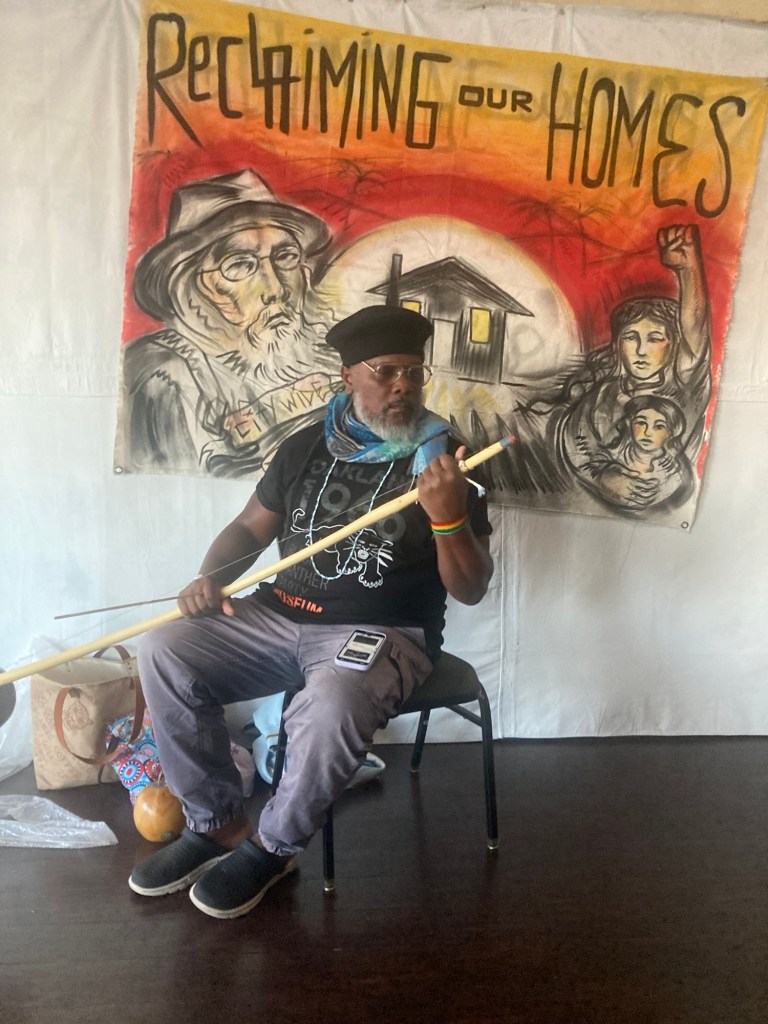
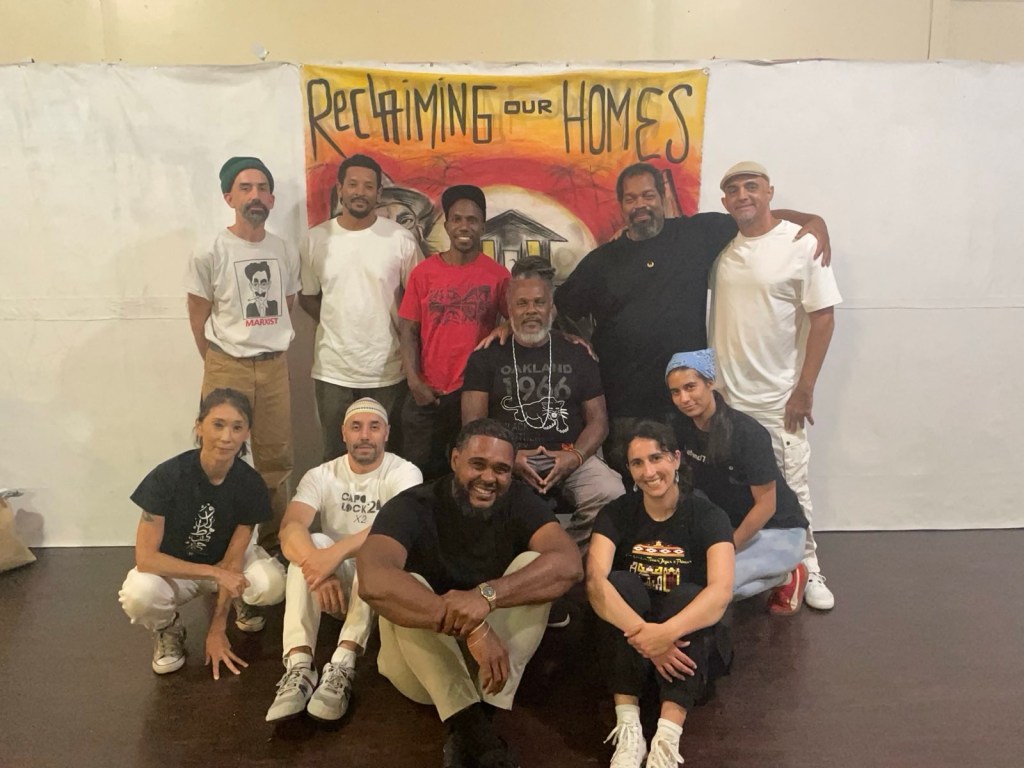
And below, is the conductor of that amazing journey, MESTRE NEGOATIVO.
Mestre Negoativo, a renowned Cultural Activist and Researcher of Afro-Mineira traditions, has dedicated his life to preserving and promoting the rich tapestry of Bantu and Vissungo heritage in Bela Horizonte, a city that pulses with cultural diversity. His unwavering commitment to this cause is vividly showcased in his deeply insightful book “Capoeiragem no País das Gerais”, where he explores the intricate history and significance of capoeira as a form of cultural expression and resistance. Beyond his literary contributions, he founded the Lamparina Cultural Center, a vibrant hub for the community, where workshops, performances, and discussions are held to educate and inspire future generations. Through his passionate efforts, Mestre Negoativo not only honors the legacy of his ancestors but also fosters a renewed sense of identity and pride among those who share these traditions.
And the journey he took us on was a journey of the iconic berimbau, an instrument deeply rooted in the cultural landscape of Brazil, where its rhythmic melodies echo the struggles and triumphs of capoeira’s history.
As we explored the origins of this unique musical tool, we delved into the rich traditions of the African diaspora, revealing the deep cultural heritage that informs the music and practices surrounding the berimbau. The craftsmanship involved in creating each berimbau is not merely a technical process but a profound art form passed down through generations, showcasing the skill and dedication of artisans who honor their ancestors through their work. Each berimbau, with its distinctive sound, serves as a bridge that unites communities in celebration and resistance, resonating with the struggles and triumphs of those who have come before and those who continue the fight for their rights.
Through engaging storytelling and captivating demonstrations, we came to appreciate the berimbau not just as a musical instrument, but as a vibrant symbol of resilience, artistry, and the powerful connection between past and present, illuminating the path of those who have played it for generations. We focused on 2 toques (rhythms) and their variations, intricately crafted and played by the revered Mestres of capoeira from the early 20th century, Mestres such as WALDEMAR, GATO, and TRAIRA, among others. These rhythms are essential to the art form, each carrying its unique stories and significance, creating a musical dialogue that captivates both the body and spirit.
And NO, I’m not gonna tell you what those toques were; you should have attended the class to uncover their mysteries, like we did.
But in case you want to listen to them, click on the video below.
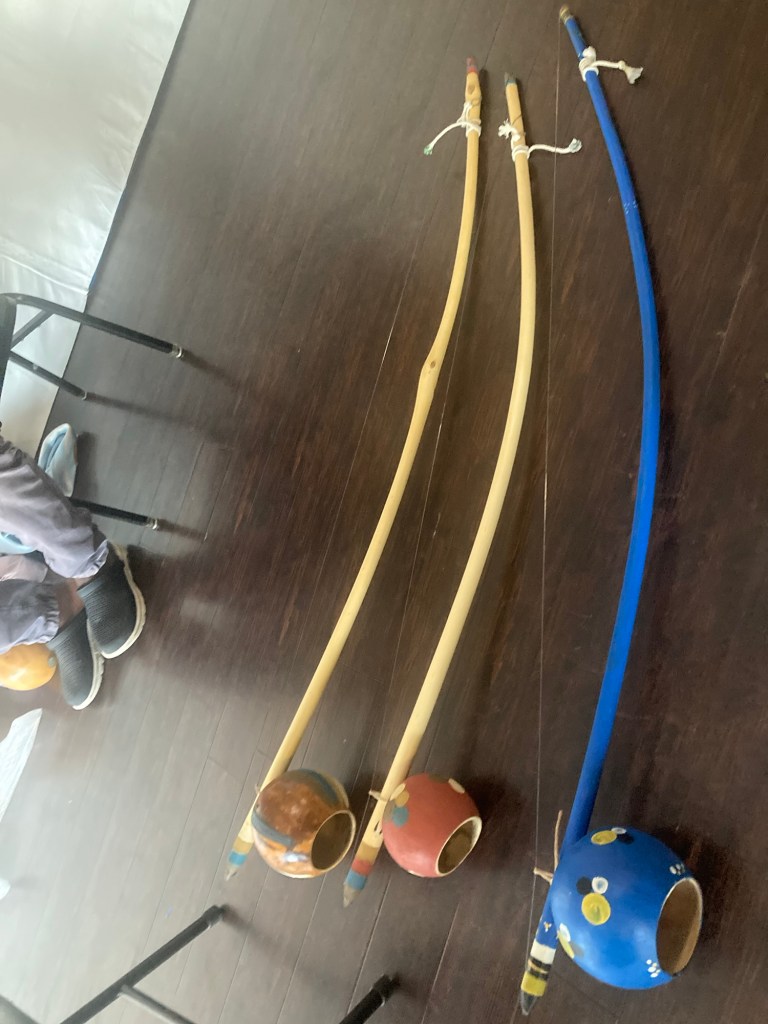
Sidenote: In the picture below, you see 3 berimbaus, each with its own unique story and significance. The 2 on the left are new and belonged to my friend Gigante of Capoeira Batuque. (Shout out to you, Gigante, for translating Mestre Negoativo’s insightful words during our musical journey). These impressive instruments were brought here from Brazil about a month ago, carefully chosen for their resonance and craftsmanship, but they weren’t armed (strung up) until that evening to allow them time to acclimate to the local weather conditions, ensuring they would produce the best sound possible.
The blue berimbau on the right is mine, a cherished part of my capoeira practice. I bought it from Mestre Negoativo a few years ago, and from then until now, it still had a good sound—a strong, rich tone that filled the space around me. A GOOD sound, indeed. However, after Mestre took it and made a couple of adjustments, now it sounds AMAZING, with a clarity and volume that exceed anything I’ve experienced before, resonating in a way that captivates everyone who hears it. It’s incredible to see how a few tweaks from a master can elevate an already beautiful instrument to new heights.
Whenever I take a class with Mestre Negoativo, I am reminded that Capoeira is a profound expression of culture and nature, embodying fluidity and harmony in every movement. The intricate motions reflect animal grace, each gesture teaching a connection to our bodies and the environment that surrounds us. This connection not only fosters community energy but also cultivates a deep appreciation for the diverse elements of nature, helping to understand better our role in the larger tapestry of life. The rhythm of Capoeira serves as a reminder of the importance of balance and unity, resonating with the heartbeat of the earth.
The berimbau is also a manifestation of nature, embodying the rich cultural heritage that is profoundly intertwined with the natural elements surrounding it. Its sound resonates with the rhythm of the earth, evoking feelings of harmony and balance that invite introspection and contemplation. Traditionally crafted from materials such as wood and steel wire, the berimbau showcases the beauty of sustainability and resourcefulness in utilizing what nature provides, highlighting the importance of preserving these traditions while respecting the earth. As it echoes through the air, each note tells a story of community, spirituality, and the age-old connection between humanity and the environment, inviting us to reflect on our shared responsibilities toward the planet and each other while celebrating the art that brings us together in joy and solidarity.
The movements, infused with powerful ancestral narratives, bridge generations, weaving a complex history that honors the struggles and triumphs of those who came before us. Each session becomes a gathering, a ritual where individuals from diverse backgrounds unite, breaking the barriers created by modern society, and reinforcing the idea that our differences are what enrich our collective experience. Moreover, Capoeira transcends mere physicality, evolving into a philosophical journey that urges participants to seek deeper meanings in both practice and life. As we dance and create music, we are reminded of our innate connection to the natural world, celebrating not just the skills we develop, but the wisdom we gain through our ongoing relationship with both Capoeira and the environment.
As I said before, human beings, like various animal species, can be domesticated through societal norms from an early age, which suppress intrinsic qualities that embody our humanity. These norms often mold our behaviors, preferences, and aspirations, leading us to conform rather than explore our true selves. However, Capoeira serves as an antidote to this domestication; it is not merely a martial art but a vibrant cultural expression that encourages individuals to break free from societal constraints and rediscover their authentic selves. By engaging in its rhythmic movements and music, practitioners are given the opportunity to tap into their innate awareness, passion, and joy, ultimately leading to profound personal growth that transcends the boundaries of conventional self-expression. Through the dynamic interplay of dance, acrobatics, and music in Capoeira, individuals are invited to foster a deep connection not only with themselves but also with others around them, cultivating a supportive community that celebrates creativity and individuality. In this rich environment, practitioners learn to embrace their uniqueness and build resilience against societal pressures, allowing them to reconnect with their essence and pursue their dreams with renewed vigor and authenticity. As they immerse themselves in the history and philosophy of Capoeira, they also gain valuable life skills, such as adaptability and collaboration, which empower them to navigate the complexities of modern life with confidence and joy.
To all capoeiristas out there, if you get the opportunity to take one of Mestre Negoativo’s classes, take it! It will be one of the best decisions you ever make, as his teaching style is not only profound but also deeply rooted in the authentic traditions of capoeira. His ability to connect with students, whether you’re a beginner or an experienced practitioner, creates an environment that fosters growth and exploration. Don’t miss out on the chance to absorb his incredible wisdom and passion for capoeira.
Now, I want to switch gears a bit and tell you about a place that is special to Mestre Negoativo’s heart, and the hearts of the community of MARIA GORETTI… LAMPARINA.
LAMPARINA is a meaningful symbol for Mestre Negoativo and the MARIA GORETTI community, representing their collective memories and shared history that spans generations. It evokes deep emotions and connections through traditions and stories passed down over time, highlighting its vital role in their lives and the cherished significance it holds for everyone in the community. This emblem serves not only as a reminder of their past struggles and triumphs but also as a beacon of hope for the future, fostering a sense of unity and belonging among the members. Each flicker of its light resonates with the laughter, tears, and aspirations of the community, reminding them of their resilience and the enduring spirit that binds them together. The stories woven around LAMPARINA nurture a rich tapestry of identity, pride, and cultural heritage, making it an irreplaceable part of their everyday life and celebrations.
If you would like to learn more about Lamparina, and/or would like to donate, please check out the links below.
Capoeira Angola videos available online showcase its vibrant culture through music and movement, highlighting intricate footwork and acrobatics while celebrating Brazilian heritage and its historical context. These performances reveal the art form’s evolution as both self-defense and expression, emphasizing its legacy of beauty and resilience. They illustrate communal aspects, fostering connections among diverse individuals and demonstrating the power of art to unite across cultural barriers. Ultimately, these videos educate audiences about Capoeira as a living tradition, inspiring future generations to embrace its spirit.
In today’s installment, we have this game between Mestre Negoativo and Guaxini do Mar.
However, as good as that game is, Mestre Negoativo is more renowned for his musicality, which transcends mere entertainment to touch the depths of cultural expression. His unique blend of rhythms and melodies captivates audiences, often transforming traditional sounds into a modern masterpiece.
The intricacy of his compositions reflects a deep respect for his heritage, as he weaves together influences from various genres, creating an auditory experience that resonates with people of all ages. As he performs, it’s not just music that fills the air, but a rich narrative that tells stories of resilience and joy, which further enhances the emotional connection between the performer and his listeners.
This dynamic transformation serves as a bridge, linking generations and reminding us of the powerful role music plays in shaping community and identity. In every note and beat, Mestre Negoativo showcases not only his talent but also his passion for cultural storytelling, thereby leaving an indelible mark on the hearts of those fortunate enough to witness his artistry.
The kora produces some of the most beautiful sounds I’ve ever heard, with its resonant strings creating a rich tapestry of melodies that can evoke deep emotions. The gentle plucking of the strings, combined with the intricate rhythms, has a way of transporting listeners to a tranquil state, making it a truly captivating experience.
Each note seems to dance through the air, shimmering like sunlight on water, as the musician skillfully navigates the instrument’s complex musical landscape.
I first learned about the Kora from the book and TV mini-series “ROOTS” by Alex Haley, where Kunta Kinte was trying to describe this amazing instrument to his daughter, who didn’t totally understand him, calling a guitar a “ko.” The moment when I first heard this instrument, played by the amazing TOUMANI DIABATE, was an experience I would never forget.
the melodious sounds lifted my spirit and transported me to the heart of West Africa, where the Kora has deep cultural significance. This remarkable instrument, with its 21 strings stretching across a large calabash resonator, represents a rich musical tradition that has survived through generations. However, I never thought I would get an opportunity to learn to play it, as its intricate strings and unique structure seemed daunting to a novice like me, filled with uncertainty and self-doubt… Until the opportunity literally fell into my lap earlier today.
It started ordinarily enough; I had an early morning Filipino Martial Arts lesson at KAILUKUAN, followed by a delightful lunch with my teacher Virgil at TOKYO CENTRAL. You know, just another Saturday filled with physical activity and culinary enjoyment.
Then, out of nowhere, I learned that KIN Unified Healing, the place next door to KAILUKUAN, was having a workshop on how to play the KORA, about 15 minutes before it started! The excitement rushed through me, prompting an immediate decision to attend this unexpected event. LUNDEN KORA from Motherland Music taught an introductory course on how to play the KORA, where he eloquently shared insights about its history and significance in West African heritage, while engaging us with captivating stories of master players. He led us through some basic skills, guiding our fingers to navigate the strings, and started teaching us a traditional song from Mali, Bani le.
The experience was truly eye-opening, igniting a newfound passion within me to explore this beautiful instrument and embrace the rich cultural depths it represents. As I delved deeper into the intricacies of its creation and the craftsmanship behind it, I found myself captivated by the stories woven into its strings. The sounds it produces resonate not only with my ears but also deep within my soul, sparking an insatiable curiosity about its history and significance in various traditions around the world, revealing the diverse ways in which different cultures connect through music. Hopefully, Lunden will hold more workshops at KIN, or at MOTHERLAND MUSIC, settings that create a vibrant and welcoming atmosphere, where we’ll get to learn more about this amazing instrument, given to us by the angels, allowing us not only to hone our skills but also to forge connections with fellow enthusiasts who share this profound love for music and its ability to transcend barriers.
This Is Not America” is a powerful song by Puerto Rican rapper Residente featuring the French-Cuban duo Ibeyi, released on March 17, 2022, as the second single from Residente’s much-anticipated album Las Letras Ya No Importan. Through its evocative lyrics, the song delves into a rich tapestry of various Latin American cultures, illuminating the struggles and triumphs of their peoples.
A music video was released on the same day, graphically portraying several of the lyrics in the song, as well as events that occurred on the continents during its history, such as the protests that occurred in various countries of the region.
It explores colonialism, slavery, and imperialism, highlighting historical injustices and referencing key events that encourage reflection on ongoing struggles faced by various communities around the world. Through a deep examination of these themes, it underscores the far-reaching impacts of oppressive systems that resonate in contemporary society.
It also compares with Childish Gambino’s “THIS IS AMERICA,” urging listeners to examine the contrasts between nations and the fight for identity among marginalized groups, emphasizing how art can serve as a powerful medium for social commentary and a catalyst for change, ultimately prompting a collective reckoning with the past and a vision for a more equitable future.
Residente sat down with Genius to discuss his latest hit “This is Not America,” which has been streamed over four million times on Spotify to date. The song features twin act Ibeyi, known for their unique blend of Afro-Cuban and electronic music, and is produced by Residente himself, highlighting his multifaceted talent as both a lyricist and producer. On today’s episode of Verified, find out Residente’s motivation behind the song, as he delves into the lyrical themes that resonate with social and political issues impacting today’s world. This collaboration not only showcases Residente’s commitment to artistry but also aims to inspire listeners to reflect on their own experiences.
Read all the lyrics to “This is Not America” on Genius: https://genius.com/Residente-this-is-not-america-lyrics, where you’ll find a thorough breakdown of the song’s context, lyrical nuances, and the cultural significance it holds within the current socio-political landscape, allowing for a richer understanding of the artist’s intent and the broader implications of his work.
And in this interview on GOOD MORNING AMERICA, Residente discusses why he feels now is the right time to release his new single, emphasizing the importance of timely expression in his artistry.
He shares his journey of collaboration, revealing how he has been creating beats with the help of scientists who study brain patterns, allowing him to explore the deeper connections between music and human emotion. This innovative approach not only enriches his sound but also enhances the listener’s experience, as he aims to bridge the gap between art and science in his creative process.



 Jogo Corpo Fechado