
Month: November 2025
Capoeira Angola: Unity in Resistance and Justice

Greetings,
I must first state a candid admission: I do not possess an exhaustive or scholarly background in the intricate and painful history of Palestine and Israel. My understanding, like that of many, is largely pieced together from the narratives and images that surface in my immediate environment—what I see, what I hear, and what I seek out in moments of reflection.
However, I am intimately connected to another world, another history, one rooted in resistance, community, and movement: the world of Capoeira Angola. I am an Angoleiro, a practitioner and inheritor of this profound Afro-Brazilian art form.
It was through this deep-seated community that I recently learned that a cherished irmã de capoeira—a sister in Capoeira Angola, and a new friend—is embarking on a journey to Palestine. This news stirred something within me.
Though the following article or reflection was drafted some time ago, and deals with themes of displacement, resistance, and the universal need for a homeland—themes that resonate deeply with the spirit of Capoeira Angola—I felt a powerful imperative to dust it off and share it now. The timing, catalyzed by my sister’s impending trip, feels more urgent and poignant than ever. It offers a context to process not only her journey but also the deeper connections between movements of the oppressed, whether their battlefield is physical, cultural, or spiritual.
Introduction: The Spirit of Capoeira and the Call for Justice
Capoeira Angola, a cultural and martial art form forged in the crucible of slavery and resistance in Brazil, carries within its movements and philosophy a profound commitment to freedom, community, and the fight against oppression. Its history is a testament to resilience, the power of art as a tool for liberation, and the universal aspiration for Axé—the vital life force and positive energy. For capoeiristas, particularly those dedicated to the historical depth and social consciousness of Capoeira Angola, the current situation in Israel and Palestine is a moral challenge that demands an active, principled response. This guide is intended to offer capoeiristas—whether based in Western Europe, Asia, North and South America (including the U.S.A. and Brazil), or even within Israel and Palestine—a framework for understanding and engaging in efforts to aid the people of Palestine and promote peace and justice for all in the region.
I. Understanding the Connection: Capoeira’s Ethos of Resistance
Capoeira Angola: A Framework for Solidarity and Action
The practice of Capoeira Angola is not merely a physical discipline; it is a philosophy and a living history that provides an ethical and moral compass for engaging with contemporary struggles for justice. The core values embedded within the art form directly inform the imperative for a capoeirista to act in moments of crisis and injustice, such as the ongoing situation in Israel and Palestine.
- Resistance and Resilience: The Legacy of Survival.
Capoeira’s genesis in the face of brutal enslavement and colonial attempts to eradicate African culture is its most profound lesson. It is a triumphant testament to the human spirit’s capacity for endurance and its refusal to be broken. This legacy is not a historical footnote; it is a present-day mandate. For a capoeirista, this historical victory compels an unwavering solidarity with all people whose fundamental rights, self-determination, and humanity are under siege. It demands a recognition that the struggle for dignity in any part of the world echoes the original resistance that birthed Capoeira, creating a moral obligation to amplify the voices of the oppressed and support non-violent movements for liberation. - Community and Axé: Extending the Spirit of the Roda.
The roda—the circle in which Capoeira is played—is a sacred space of mutual reliance, shared vulnerability, and communal energy (axé). In the roda, the well-being of the individual is inextricably linked to the well-being of the collective. Extending the spirit of the roda to the world means rejecting a partisan or zero-sum approach to conflict. It necessitates a deep recognition of the shared humanity of all people—Palestinians and Israelis alike—and an active commitment to working toward a just and sustainable solution where all parties can live in security, dignity, and with their inherent rights respected. The axé of the community must be channeled into constructive action that fosters dialogue, empathy, and a future free from systemic oppression. - The Jogo de Fora (The Game Outside): From Discipline to Direct Action.
The skills, discipline, critical thinking, and physical acuity learned inside the structured, protective environment of the roda are not intended to remain confined there. The concept of the Jogo de Fora posits that a true capoeirista must apply these cultivated traits to the world outside, transforming passive observation into active engagement in social justice. This means moving beyond intellectual or emotional acknowledgment of suffering to concrete, physical, and political action. For a capoeirista, this could translate into organizing educational events, participating in peaceful demonstrations, fundraising for humanitarian aid, advocating for ethical consumption, or using the art form itself as a tool for public awareness and consciousness-raising about global issues. The fluid, adaptive, and strategic nature of the jogo (the game) must inform a sophisticated strategy for social change.
II. Action Inside the Region: Capoeiristas in Israel and Palestine
For those who live in or near the conflict zone, the nature of aid is personal, complex, and potentially dangerous, yet profoundly impactful.
- Humanitarian Support: Working with established, non-political organizations that provide direct aid—food, water, medical supplies, and shelter—to all civilians affected, especially in Gaza and marginalized areas of the West Bank.
- Promoting Dialogue and Co-Existence: Utilizing the roda as a space for building trust and cross-cultural understanding. Some capoeira groups have historically brought together Israeli and Palestinian youth, offering a rare neutral ground for human connection. Supporting or forming such initiatives can be a powerful, grassroots act of peace-building.
- Advocacy for Human Rights: Speaking out against human rights violations, regardless of the perpetrator, and supporting local organizations that document and challenge occupation, displacement, and violence.
III. Action from Afar: The Global Capoeira Community
The global community of capoeiristas holds significant power through mobilization, education, and financial support.
- Financial Aid and Fundraising: Organize Rodas de Axé (Rounds of Energy) or workshops where proceeds are directed to vetted, secular, and reputable humanitarian organizations focused on aid and protection for Palestinians (e.g., Doctors Without Borders, UNRWA, specific human rights groups).
- Education and Awareness: Use your roda, your academy, and your social platforms to share factual, contextualized information about the history of the conflict and the current humanitarian crisis. Host talks, film screenings, or discussions to foster informed dialogue within the capoeira community.
- Ethical Consumption and Advocacy: Join broader movements that advocate for diplomatic pressure, adherence to international law, and a just resolution. This may include supporting boycotts, divestment, and sanctions efforts targeting entities that profit from the occupation, or lobbying elected officials in your home country (USA, Brazil, Western Europe, etc.) to adopt policies that prioritize human rights and peace.
- Solidarity with Local Communities: Partner with local Palestinian diaspora communities or advocacy groups in your city to offer support for their organizing efforts, using the principles of community building inherent in Capoeira Angola.
IV. The Capoeirista’s Commitment to Non-Violence and Dialogue
While Capoeira is a martial art, its highest expression is often in the jogo (the game) that avoids injury and celebrates mutual respect and strategy.
- Maintaining Focus on Humanity: The goal is aid and justice, not deepening division. Actions should be guided by empathy for all victims of the conflict.
- Dialogue and Decolonization: Frame discussions within the historical context of colonization, self-determination, and justice, using the Capoeira Angola narrative as a model for liberation from systemic oppression.
- Consistency and Persistence: True Axé requires sustained effort. The work of solidarity is not a single event but a continuous commitment to upholding the dignity of the oppressed, a core lesson learned from the decades-long survival of Capoeira itself.
By committing their energy, artistry, and ethical framework, capoeiristas around the world can transform their practice into a meaningful force for aid and justice in the pursuit of peace for the people of Palestine, Israel, and the entire region. This transformation moves beyond the roda and into tangible, constructive action.
The inherent values of Capoeira—respect, community, resilience, dialogue, and the non-violent resolution of conflict—provide a robust foundation for this endeavor. Capoeiristas are practitioners of diplomacy through movement, understanding how to navigate tension, maintain balance, and create a harmonious, if dynamic, space for interaction. This ethical framework can be applied to complex geopolitical realities, urging a commitment to human rights, mutual dignity, and equity for all people in the region.
Specifically, capoeiristas can channel their collective energy through several avenues:
- Fundraising and Humanitarian Aid: Utilizing the global network of the Capoeira community to organize rodas and events dedicated to raising funds for established, reputable humanitarian organizations providing essential aid (medical supplies, food, shelter) to civilians deeply affected by the conflict, regardless of their nationality or background.
- Peace Education and Cross-Cultural Dialogue: Developing and implementing workshops that use Capoeira’s philosophy and movements as tools to facilitate dialogue between diverse communities. These initiatives can focus on non-violent communication, empathy training, and shared cultural experience, fostering understanding between Israeli and Palestinian youth and adults, either locally or within the diaspora communities.
- Advocacy for Justice and Human Rights: Leveraging the discipline’s widespread presence to advocate for a just and lasting resolution based on international law, human rights principles, and self-determination for all affected populations. This includes organizing peaceful demonstrations, signing petitions, and using their voices to amplify calls for de-escalation and long-term peace-building initiatives.
- Healing and Trauma-Informed Practice: Offering specialized Capoeira classes and therapeutic movement sessions in communities affected by trauma. The physical and emotional expression inherent in Capoeira—the ginga as a metaphor for flexibility and persistence in the face of chaos—can serve as a powerful method for stress relief, resilience-building, and psychological healing.
In essence, the jogo (the game) is transformed into a global mutirão (a collective effort for a shared goal). Capoeira is not just an art of fighting; it is an art of living and uniting. By honoring their commitment to the core principles of their practice, capoeiristas can offer a unique, movement-based contribution to the complex, vital pursuit of peace and justice in the Middle East.
The global Capoeira community, bound by its shared values of mutual respect, disciplined creativity, and malandragem (a strategic cleverness and adaptability), possesses a powerful, often untapped, potential to act as a significant force for positive change. The roda—the circle where Capoeira is played—is a microcosm of a harmonious society, one built on listening, collaboration, non-violent dialogue, and the elevation of every participant. This deeply ingrained ethos provides a unique and potent framework for engaging with complex, protracted conflicts, such as the one in Israel and Palestine.
By translating the art’s core principles into tangible aid, educational outreach, and committed advocacy, capoeiristas can demonstrate that the pursuit of a just and peaceful future for the people of Palestine, Israel, and the wider region is a human endeavor that transcends national borders, cultural differences, and the dynamics of conflict.
Translating Principles into Action:
- Mutual Respect (A Respeito): The Capoeira concept of respecting one’s opponent in the game, treating them as a partner necessary for the game’s flow, can be translated into cross-cultural dialogue initiatives. Capoeiristas can facilitate workshops that bring Israelis and Palestinians together to share the art, focusing on the shared physical language and the necessity of partnership over adversarial competition. The physical act of playing together can dismantle preconceived notions and foster a sense of shared humanity.
- Disciplined Creativity (A Criatividade Disciplinada): This principle encourages innovative solutions within a strict framework. Applied to the conflict, it means developing and supporting creative, non-violent solutions—such as joint youth programs, digital storytelling initiatives, and cultural exchange festivals—that are disciplined by the goal of mutual understanding and respect for international law and human rights.
- Community and Solidarity (A Comunidade e Solidariedade): The global network of Capoeira academies, or academias, can mobilize resources effectively. This means moving beyond cultural exchange to provide direct, needs-based support. This could include fundraising for educational materials, psychological support for children affected by violence, or support for local organizations committed to peace-building efforts in both communities. The Aú (cartwheel) of Capoeira symbolizes an axis connecting heaven and earth; similarly, the community must act as an axis of support, connecting those in need with resources from the global community.
The intensifying crisis in Israel and Palestine has devolved into an immediate and urgent humanitarian catastrophe, demanding not only immediate attention but also the commitment of sustained and long-term support for all those impacted by the violence, with a particular focus on Palestinians enduring the harshest conditions on the ground. A genuinely comprehensive and effective approach to solidarity and action in this context must therefore be multifaceted, incorporating both the provision of crucial immediate aid to alleviate suffering and robust, unwavering long-term advocacy for justice, lasting peace, and human rights. This dual focus acknowledges the need to address both the symptoms of the conflict—the destruction, displacement, and death—and the underlying systemic causes that perpetuate it.
Immediate Humanitarian Aid for Palestinians:
To directly assist those affected by the conflict, a number of reputable organizations are actively providing critical, life-saving support. You can explore ways to help Palestinians on the ground by clicking HERE for a comprehensive list of actionable steps and resources.
Financial donations to established and trustworthy non-governmental organizations (NGOs) and international bodies are essential for delivering aid. Key organizations providing crucial support include:
- Palestine Children’s Relief Fund (PCRF): This organization is on the front lines, delivering essential support directly to those impacted by the conflict. Their work encompasses providing vital necessities such as food, safe shelter, clothing, clean water, and, most critically, emergency medical care and long-term surgical relief for children and families.
- UN Crisis Relief Fund for the Occupied Palestinian Territory (OCHA): This fund pools resources to address the most urgent needs identified by the United Nations and its partners on the ground. It ensures a coordinated, large-scale humanitarian response, covering emergency health services, water and sanitation projects, and the provision of non-food items.
- United Nations Children’s Fund (UNICEF): Focusing exclusively on the well-being of children, UNICEF works to protect children’s rights and provide critical supplies, including psychosocial support for trauma, educational materials, and nutrition programs, which are often the first services to collapse during intense conflict.
- International Committee of the Red Cross (ICRC): As a neutral and impartial organization, the ICRC is fundamental in ensuring access to healthcare, restoring family links, visiting detainees, and ensuring respect for international humanitarian law. Their work includes providing surgical teams, medical supplies, and support for hospitals strained by the crisis.
Further Avenues for Solidarity and Action:
Solidarity extends beyond financial contributions. Individuals can also take action by:
- Advocacy and Awareness: Educate yourself and your community on the historical context and ongoing developments of the conflict. Use your voice and social platforms responsibly to share accurate information, highlight the humanitarian plight, and advocate for human rights and a just, peaceful resolution.
- Support for Palestinian-led Organizations: Look for and support local, grassroots organizations working on community-building, documentation of human rights abuses, and cultural preservation within Palestine.
- Contacting Elected Officials: Encourage your representatives to support diplomatic efforts, press for humanitarian ceasefires, and ensure the continuous, unimpeded delivery of aid into the affected regions.
- Cultural and Economic Support: Engage with and support Palestinian artists, businesses, and cultural initiatives as a form of non-political support for their right to existence and self-determination.
In conclusion, the Capoeira community’s engagement with the conflict in Israel and Palestine must be holistic, sustained, and deeply rooted in the art’s ethical and philosophical foundations, treating the issue not as a fleeting political event but as a human imperative that demands consistent, compassionate action. This commitment goes beyond mere performative solidarity; it requires leveraging Capoeira’s foundational values—respect, reciprocity, dialogue, and non-violent resolution—to foster genuine understanding and build bridges across seemingly intractable divides.
By consciously embodying the principles of mandinga (cleverness and strategy), axé (life force and positive energy), and liberdade (freedom) both inside and outside the roda, capoeiristas are uniquely positioned to move the conversation from one of entrenched, zero-sum positions to one of shared movement, collaborative harmony, and mutual recognition of humanity. This can manifest through creating neutral spaces for dialogue, hosting workshops focused on conflict resolution through movement, and initiating aid projects that serve the most vulnerable populations regardless of their political or ethnic affiliation.
The power of the roda lies in its ability to contain and transform conflict through creative expression and disciplined interaction. The energy, trust, and physical dialogue forged in that circle can indeed be a potent strength for peace in the wider world, demonstrating that true mastery in Capoeira is measured not only by the skill of the game but by the impact of its practitioners in promoting justice and human dignity globally. The commitment is a long game, a relentless practice of empathy, much like the practice of Capoeira itself.
“I can’t save you from the fire, but I can save you from the pain.” That’s the power of friendship.
Anne Askew, a figure of extraordinary fortitude and conviction, remains a powerful symbol of resistance against religious persecution in Tudor England. A staunch Protestant during the reign of Henry VIII, a period marked by violent shifts in doctrine and political maneuvering, she refused to recant her beliefs or betray her co-religionists, even in the face of the most barbaric state-sanctioned cruelty.
Her steadfast refusal led to her being taken to the Tower of London. There, she was subjected to the rack—an agonizing instrument of torture that systematically pulled the victim’s joints from their sockets. This act of torturing a woman was itself a gross violation of English law, underscoring the desperation and brutality of her interrogators, led by Chancellor Thomas Wriothesley and Richard Rich, who were obsessed with uncovering a network of high-ranking Protestant sympathizers at court, including Queen Katherine Parr.
Despite the excruciating pain of having her limbs dislocated—a suffering few can comprehend, let alone endure—Askew remained utterly silent regarding the names of anyone else involved in the Protestant movement. Her refusal to yield stood in stark contrast to the response of many others, such as Guy Fawkes centuries later, who, under similar duress, often gave their captors whatever information was demanded merely to hasten the end of their torment. Askew’s physical and mental endurance was truly exceptional.
Having failed to break her spirit through the rack, the authorities condemned her for heresy. On July 16, 1546, a frail Anne Askew, unable to walk due to her injuries, was carried on a chair to her execution. She was burned at the stake in Smithfield, London, alongside three other Protestants. Her final moments were marked by the same incredible bravery and unwavering faith she displayed throughout her ordeal. Her testimony, later documented and smuggled out of the country, cemented her legacy as a courageous martyr and a woman of immense strength.
MALICIA AS A GAME OF POWER (11/23/25)
Welcome to MALICIA AS A GAME OF POWER, a blog series exploring human interactions through topics like communication, conflict resolution, negotiation, and manipulation. It covers leadership, personal branding, and online reputation management while providing strategies to enhance influence and build relationships. The series empowers readers to navigate interpersonal dynamics with tools for personal and professional growth, focusing on social influence, emotional intelligence, and strategic thinking to thrive in complex power dynamics.
In this installment, we will explore the 42nd law of power in the book, the 48 laws of power by Robert Greene. You can buy a copy by clicking HERE.
Law 42: STRIKE THE SHEPHERD & THE SHEEP WILL SCATTER
This Law speaks to the profound strategic importance of targeting the leader, the primary figure of authority, or the central nervous system of any group, organization, or resistance.
The Essence of the Law
Every cohesive group—be it a political movement, a business competitor, a military unit, or even a strong social clique—is held together by its leader, or “shepherd.” This figure provides direction, inspiration, stability, and a unifying symbol. They are the linchpin. The moment this leader is removed, discredited, or neutralized (“struck”), the group loses its cohesion, morale, and sense of purpose. The followers, the “sheep,” become disoriented, panicked, and rudderless, leading to internal conflict, fragmentation, and ultimately, the dissolution or scattering of the collective.
Application in Power Dynamics
- Destabilization Through Decapitation: The most effective way to dismantle a powerful opponent is often not to engage in a costly, attritional battle with the entire group, but to perform a precise, surgical strike against the leadership. Removing the head saves the effort of fighting the body.
- Symbolic Warfare: A successful strike against the shepherd delivers a powerful psychological blow to the remaining members. It shatters their confidence and proves the vulnerability of their shield, often leading to rapid capitulation or surrender.
- Exploiting Succession Crises: Even if a strong second-in-command exists, the disruption caused by the removal of the original leader invariably creates a power vacuum, breeding rivalry, suspicion, and infighting among potential successors. This internal conflict is often more destructive to the group than any external pressure.
Countermeasures
The shepherd must protect themselves by:
- Creating a Robust System, Not a Cult of Personality: Ensuring the group’s structure, rules, and mission are so deeply ingrained that they can function autonomously, even in the leader’s absence.
- Delegating Authority and Cultivating Multiple, Decentralized Leaders: Making it impossible for an opponent to cripple the entire organization by neutralizing one person.
- Maintaining a Low Profile When Necessary: Understanding that the most visible figure is the most obvious target, and occasionally obscuring the true center of power.
In Practice: In any structured organization, whether military, political, or corporate, there exists a critical point of gravity—a singular individual who embodies the group’s spiritual, strategic, or operational will. This is the source of strength, the true center of cohesion and direction. To achieve a decisive, often bloodless, victory, one must look past the rank-and-file and the immediate tactical opposition.
The strategic imperative is to target the source of strength, be it the charismatic spiritual commander who provides the ideological foundation and unshakeable resolve, or the operational commander who serves as the tactical mastermind and logistical nerve center. This is not merely about removing a leader; it is about severing the organizational brain stem.
When this vital link is neutralized—whether through isolation, discredit, removal, or capture—the effect is immediate and cascading. Watch as their followers lose their will and direction. The troops become a rudderless ship, their tactical aggressiveness dissipates, and their strategic objectives blur. The ideological certainty that propelled them forward collapses into confusion and doubt. Without the commander’s voice, the vision fades, morale plummets, and the cohesive fighting or operating force disintegrates into disconnected, easily managed fragments. This focused strike on the core leadership is the key to paralyzing an entire apparatus from the top down.
The Ethical Application of the 42nd Law of Power:
Striking the Shepherd and Scattering the Sheep involves understanding the delicate balance between influence and authority. This principle suggests that when a leader or a dominant figure is neutralized, the followers often lose their direction and cohesion, creating a vacuum that can lead to instability. This law can be applied ethically by focusing on strategically addressing toxic leadership, enabling positive change within communities or organizations. By recognizing manipulative behaviors and dismantling harmful hierarchies, individuals can empower those who have been suppressed, thus fostering a healthier environment where diverse voices can flourish. However, the execution of this strategy must be carried out with wisdom and compassion to avoid unnecessary chaos, ensuring that the ultimate goal is not merely to scatter the followers but to inspire them towards a more constructive path. In this context, one must tread carefully, weighing the moral implications and potential consequences of ‘striking the shepherd’ while keeping in mind the greater good that can emerge from such actions.
The 42nd Law of Power: A Perspective from an Angoleiro
The profound wisdom encapsulated in the 42nd Law of Power—Strike the Shepherd and the Sheep will Scatter—finds a compelling and unique interpretation when viewed through the lens of an Angoleiro, a practitioner and master of Capoeira Angola. This law, fundamentally about strategic disruption and the neutralization of leadership, resonates deeply with the core principles of the jogo (the game) and the philosophy of this Afro-Brazilian martial art.
In the context of power dynamics, the “shepherd” represents the central pillar of strength, authority, or morale—the leader, the dominant structure, or the key source of a group’s cohesion. The “sheep” are the followers, dependent on the shepherd for direction and confidence. To “strike” is not necessarily a physical act, but a strategic move designed to undermine, isolate, or neutralize that central figure.
The Angoleiro, through years of training, understands this concept implicitly. The roda (the circle where Capoeira is played) is a microcosm of society and conflict. The Angoleiro’s strategy in the jogo is often not to engage in a direct, forceful confrontation with every single opponent, but rather to disrupt the flow, the rhythm (o ritmo), and the emotional balance (o axé) of the roda itself.
- Disrupting the Axé (Spiritual Energy): The central figures in the roda are the Mestre (master) and the bateria (the orchestra), particularly the berimbau gunga (the lead instrument). In a strategic sense, these are the “shepherds.” If an Angoleiro can play in a way that breaks the concentration of the gunga, forces the Mestre to intervene, or shifts the communal energy (o axé) from harmony to confusion, they have effectively “struck the shepherd.” The cohesion of the roda—the “sheep”—is instantly compromised, leading to scattering, hesitation, or a temporary collapse of the collective will.
- The Art of Malícia (Mischief/Cunning): The 42nd Law is an exercise in malícia. It demands a cunning perception of where true power lies. The Angoleiro uses feints, concealed movements, and psychological warfare to make the opponent reveal their weaknesses or their leader’s dependency. The strike is subtle, often preemptive, aimed at the opponent’s confidence or their most critical support system, whether it is a highly skilled teammate or a psychological anchor.
- The Long Game of Influence: Unlike the swift, aggressive movements of Capoeira Regional, Capoeira Angola favors the low, slow, and deceptive approach. This aligns perfectly with the strategic patience required by the 42nd Law. The Angoleiro may spend time simply observing, calculating the psychological linchpin of the group before making a decisive, understated move that shatters the opposition’s morale, leaving the followers aimless and scattered without a clear directive.
Thus, for the Angoleiro, the 42nd Law of Power is not a theoretical concept but a practiced philosophy: neutralize the source of command and cohesion with precision and cunning, and the lesser elements of the structure will naturally dissipate.
THE MOMENT OF TRUTH FRIDAY CRIME REPORT (11/21/25)
Every Friday morning, PROFESSOR BLACK TRUTH hosts “The Friday Crime Report,” a critically acclaimed program addressing systemic racism, economic inequality, and police brutality in the black community. Through thoughtful exploration and comprehensive discussions, the show features expert interviews, in-depth analysis, and moving personal narratives, all aimed at raising awareness and promoting advocacy for meaningful change. It delves into historical contexts and contemporary issues that illustrate the enduring impact of these societal problems, encouraging an informed dialogue among listeners. The program also emphasizes the importance of community engagement, empowering listeners to understand, confront, and address these pressing societal issues while fostering solidarity and collaboration for a more equitable society. Each episode serves as a call to action, inspiring individuals to mobilize in support of justice and equality, making it an essential resource for anyone seeking to contribute to the fight against systemic oppression.
In Today’s installment…
Tushar Atre, a self-described “tech bro” with ambitions in the burgeoning California cannabis industry, found himself at the center of a volatile employment dispute in 2019. The conflict reportedly stemmed from a significant disagreement over compensation with two of his employees, eventually leading to their termination or resignation.
This professional falling out, fueled by the contentious pay dispute, simmered for a couple of months. However, the matter was far from settled. In a dramatic and ultimately tragic escalation, the two former employees allegedly arrived at Atre’s Santa Cruz County home in the early hours, intent on a final, violent confrontation to “collect” what they believed they were owed. This confrontation marked the terrifying climax of the pay dispute, transforming a workplace disagreement into a deadly home invasion.
A big thanks to the professor for sharing this helpful video. Their commitment to spreading knowledge is admirable. If you want to learn more about the professor’s work, click HERE to visit their YouTube channel. It features a lot of valuable information that can deepen your understanding of social issues and history.
JUSTICE IS SERVED!
In a significant legal development in the Philippines, a regional trial court delivered a guilty verdict against a former municipal official on Thursday, November 20, 2025. Ex-Bamban town mayor Alice Guo was convicted of qualified human trafficking and handed a sentence of life imprisonment. This severe ruling stems from her involvement in the establishment and operation of a massive scam centre that preyed on foreign victims.
The judgment was confirmed by the Presidential Anti-Organised Crime Commission (PAOCC). The case has garnered national attention due to Guo’s high-profile position and the shocking nature of the crime. The court found compelling evidence that Guo played a crucial role in enabling the illicit operations of the fraudulent enterprise, which was essentially a front for human trafficking and cybercrime activities.
The immediate reaction from the former mayor and her legal counsel was not forthcoming following the announcement of the verdict. This silence comes after months of intense media scrutiny and government investigations into her background and political ascent.
The revelation that a high-ranking public official could be implicated in such a heinous crime has deeply resonated with the public. To discover a public servant, sworn to uphold the law, is in fact a human trafficker, elicits a profound sense of disgust and betrayal. There is a strong feeling of satisfaction among many that justice has been served, and that Guo will finally be made to pay for the severe moral and legal transgressions committed under her watch. The life sentence is seen as a necessary and appropriate punishment for the magnitude of her crimes against humanity.
A Message from the spirit of Capoeira Angola
Watch. Just watch.
Realistic Capoeira Angola for violence and peace: An Examination of its Practical Applications and Philosophical Dichotomy

Capoeira Angola, often celebrated for its cultural richness, historical significance, and unique blend of movement, music, and ritual. However, a deeper, more ‘realistic’ examination reveals a complex and crucial duality in its practice: its direct applicability to both physical conflict (“violence”) and the cultivation of social harmony and personal well-being (“peace”). This dichotomy is not a contradiction but rather a reflection of the art form’s historical roots and its enduring relevance as a system of self-defense, resistance, and community building.
The Practical Reality of Capoeira Angola: From Clandestine Resistance to Modern Self-Defense
Historically, Capoeira was not merely a dance or an athletic pursuit; it was forged in the crucible of oppression. Developed as a clandestine form of combat by enslaved Africans in colonial Brazil, it served as an absolutely vital tool for survival and armed resistance against the brutal tyranny of their oppressors and the slave-catchers known as capitães do mato. The movements, cloaked in the guise of ritual and folklore, allowed practitioners to train lethal fighting techniques in plain sight, a masterful act of cultural and martial deception.
The Unflinching Reality: Capoeira Angola’s Combative Core

The designation of Capoeira Angola as “realistic” stems from its core philosophy: an unyielding recognition and dedicated mastery of its highly effective combative and tactical methodologies. This profound combat efficacy, however, is frequently veiled by the system’s characteristic, almost deceptive, aesthetics. At a superficial glance, a session of Capoeira Angola within the roda (the circle in which the art is performed) presents an image of fluid, low-to-the-ground grace, deliberate, almost near-meditative pacing, and an appearance that is often playful and non-contact. Yet, beneath this artistic facade, the fundamental movements and principles of the system are deeply rooted in practical, close-quarters fighting, strategically engineered to disable or effectively evade an opponent in a real-world confrontation.
The historical context of Capoeira Angola further cements its “realistic” dimension. Developed by enslaved Africans in Brazil, it was a necessary tool for survival, self-defense, and silent rebellion. It was designed to be inconspicuous—appearing as a dance or a ritualistic game to slave owners—while simultaneously functioning as a devastatingly effective martial art. This dual nature is the very essence of its deceptive power.
Combative Techniques and Strategic Deception
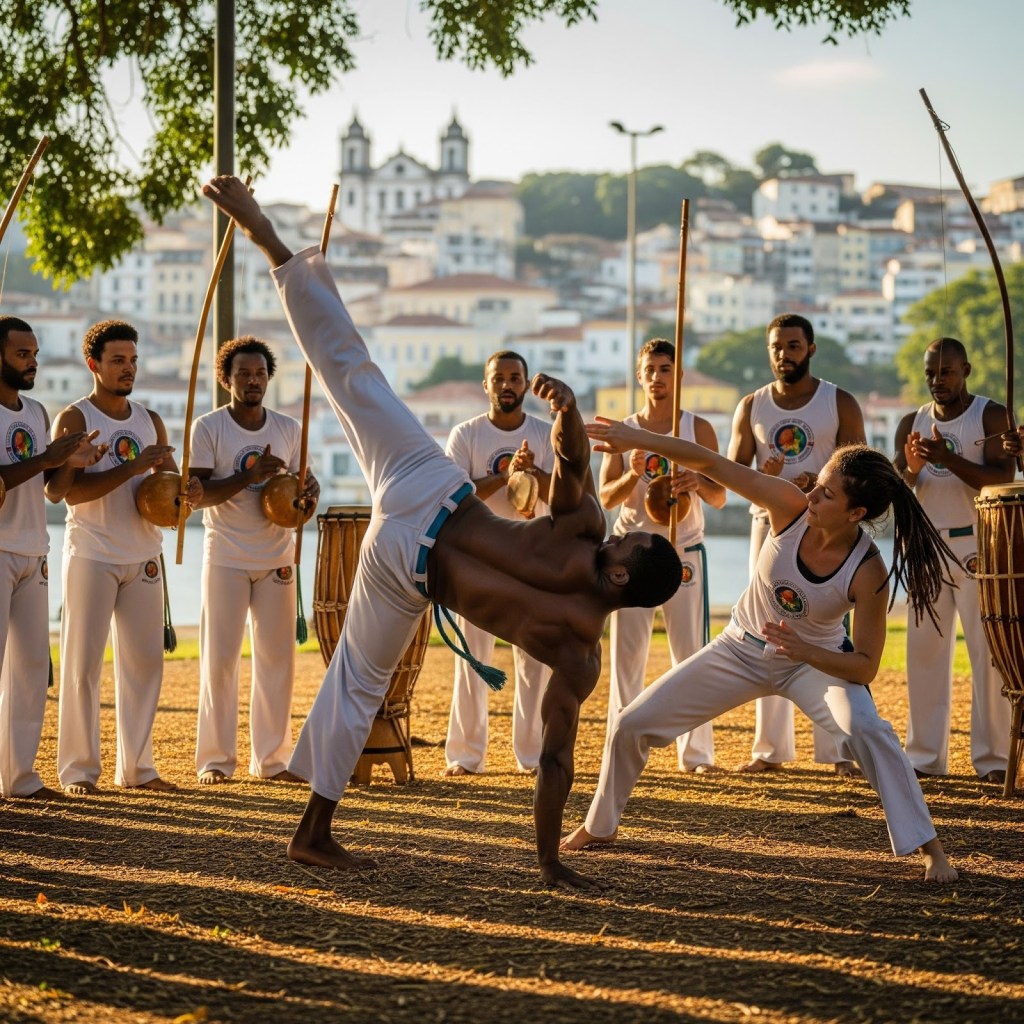
Key techniques within the Angola repertoire are explicitly and unapologetically combative, tailored for maximum disruption and force application.
- Sweeps and Takedowns (Rasteiras and Chapas): The swift, often unexpected sweeps (rasteiras) are not merely for show; they are precision strikes targeting an opponent’s lower body and base. Their goal is to instantly dismantle stability, sending the opponent crashing to the ground and making them vulnerable to follow-up strikes or disengagement. Similarly, the bênção (blessing), often misinterpreted as a simple push, is a powerful, straight-leg thrust kick used to create distance, break an opponent’s posture, or deliver a jarring impact to the midsection.
- Headbutts and Close-Range Strikes (Cabeçadas and Cotoveladas): The powerful headbutts (cabeçadas) are delivered with jarring, concussive force, often following a low dodge or a deceptive close-quarters movement. They are weapons of last resort or sudden opportunity, highly effective in clinching range. Various elbow strikes (cotoveladas) and knee strikes are integrated into the flow, exploiting openings created by the opponent’s overcommitment or momentary lapse in defense.
- Deceptive Ground Maneuvers: The low, ground-based movements—the signature of Angola—are fundamentally strategic. They allow the practitioner to evade high attacks, manage the distance, and transition into clinching, trapping, and finishing maneuvers with explosive speed. These ground movements hide the practitioner’s intent and position the body for powerful, upward-delivered attacks that an opponent may not anticipate.
The Power of Deliberate Pacing
Crucially, the slow, strategic pacing of Angola is not a reflection of weakness or a simple aesthetic choice; rather, it is a highly sophisticated method of psychological and physiological warfare. It functions on multiple levels:
- Energy Management: The slow movements conserve energy, allowing the practitioner to maintain a high level of physical engagement for an extended period, waiting for the perfect opportunity.
- Lulling the Opponent: This deliberate tempo is used to lull an opponent into a false sense of security, encouraging them to be careless, overcommit, or mistake the art for a mere dance. This is the core of the art’s deception (mandinga).
- Disguising Intent: The slow, fluid movements effectively mask the practitioner’s true intentions, making it nearly impossible for an adversary to predict the moment of attack. The transition from a graceful, low-speed motion to an attack is almost instantaneous.
This deliberate slowness allows for a split-second transition into the explosive power and surgical precision required to execute a disabling or fight-ending move. This capability—the seamless shift from passive deception to aggressive force—solidifies Capoeira Angola’s reputation not just as a cultural tradition, but as a formidably deceptive and profoundly effective fighting system.
A truly realistic approach to Capoeira Angola training emphasizes a deep, intuitive understanding of critical combative principles:
- Timing: The ability to move and strike precisely when the opponent is committed or off-balance.
- Distance Management (Jogo de Distância): The mastery of controlling the space between opponents, ensuring maximum defense and optimal offensive opportunity.
- Body Mechanics: The efficient and powerful use of the body as an integrated weapon system, where every movement has the potential for attack or defense.
By focusing on these principles, practitioners understand that the skills learned are potent tools for self-defense and conflict resolution. This combative realism acknowledges that, while Capoeira Angola promotes community, culture, and peace, its foundation is a highly effective fighting art that can and must be deployed for survival in dangerous, real-world scenarios.
The Foundation for Peace:
Conversely, the practice of Capoeira Angola is intrinsically linked to the pursuit of peace, both internal and communal. This aspect is manifested through several key elements:
- Ritual and Philosophy: The roda itself is a microcosm of society, where rules, respect, and mutual understanding are paramount. The art emphasizes malícia (cunning, street smarts) combined with mandinga (a mystical, almost magical quality of deception), which encourages outsmarting an opponent rather than simply overpowering them. This strategic, non-destructive engagement is a fundamental lesson in non-violent conflict resolution.
- Community and Respect: The highly structured nature of the classes, the mandatory use of Portuguese, the singing, and the playing of instruments foster discipline, cross-cultural communication, and deep mutual respect among practitioners (known as capoeiristas). The hierarchy of the school, headed by a Mestre, instills values of mentorship and humility.
- Physical and Mental Discipline: The rigorous training provides a positive outlet for aggression and frustration, channeling potential “violence” into constructive physical expression and artistic performance. The focus on rhythm, balance, and endurance cultivates inner peace, self-awareness, and mental fortitude.
In conclusion, the document titled “Realistic Capoeira Angola for violence and peace” argues compellingly that Capoeira Angola is far more than a mere dance or performance; it is a profound martial art that holds a unique, almost paradoxical, capacity for shaping its practitioners. It masterfully encapsulates the core duality of the human experience: the potential for effective violence and the aspiration for a peaceful existence.
The practice instills in its students the knowledge and physical skills necessary to defend themselves effectively, honoring its historical development as a clandestine, combative system created by enslaved Africans for survival and liberation. The realism of its application in a violent context is never dismissed but is instead embraced as a vital part of the art’s heritage and a foundation for personal security.
Simultaneously, however, Capoeira Angola transcends its combative roots by providing a comprehensive philosophical and cultural framework for living. Through its deeply embedded rituals, music, communal interaction, and respect for the Mestre (master), the art cultivates qualities essential for social harmony: discipline, which guides the relentless pursuit of skill; respect, which governs the relationship between players, the community, and the tradition; and an overarching commitment to a harmonious life, where conflict is minimized and human connection is valued.
Crucially, the art does not attempt to sanitize or ignore its violent lineage. Instead of repressing its potential for conflict, Capoeira Angola transmutes this raw energy—this potential for force—into a powerful, constructive, and culturally rich mechanism. The Roda (the circle in which Capoeira is played) becomes a controlled laboratory where the energies of conflict and cooperation are channeled through a dialogue of movement. This cultural mechanism ultimately promotes social cohesion, turning individual strength into collective resilience and self-defense into a tool for community building and peace. It is in this dynamic interplay—where the lessons of effective violence are used to frame a life dedicated to peace—that the art of Capoeira Angola truly finds its powerful and enduring significance.
HIDDEN SPIRITUALITY – From Spirit Science (11/16/25)
Welcome to HIDDEN SPIRITUALITY – From Spirit Science, where we explore spiritual practices in movies and games, revealing profound wisdom in cinematic narratives that often go unnoticed. We diligently examine various cultures and their unique stories to illuminate lessons that resonate with our lived experiences and collective consciousness. Our community fosters deep reflection on the interconnectedness of all beings through storytelling and rich symbolism, encouraging members to share their insights and interpretations. By cultivating engaging discussions, we bridge spirituality and entertainment, uncovering hidden messages and themes that promote personal growth and broaden our understanding of their impact on our quest for meaning and purpose in life. Together, we embark on a journey to uncover the universal truths that unite us, inviting exploration and dialogue around the spiritual dimensions embedded in the art of storytelling.
In today’s installment…
A Deep Dive into the Timeless Message of The Perks of Being a Wallflower
Join us as we embark on a profound exploration of Stephen Chbosky’s unforgettable novel, The Perks of Being a Wallflower. More than just a story, it is a powerful roadmap for the journey to self-discovery and a moving testament to the transformative power of genuine human connection.
The Journey Through Charlie’s Eyes:
We are invited to experience the world through the sensitive and acutely observant eyes of Charlie Kelmeckis, a high school freshman navigating the treacherous landscape of adolescence while simultaneously struggling with past trauma and the immense challenge of finding his own footing. His narrative serves as a candid and often heartbreaking exploration of the infinite and complex layers of the human psyche—the silent battles with anxiety, depression, and the universal need for belonging.
Embracing Uniqueness and Finding Your People:
The novel champions the vital importance of embracing one’s own uniqueness. Through Charlie’s friendships with the spirited and non-conformist Sam and Patrick, he begins to understand that the perceived “flaws” and differences that make one feel like an outsider are, in fact, the very things that make them special. Their bond forms a safe harbor, illustrating how the right connections can lead to healing and self-acceptance. The narrative beautifully captures the magic of finding your “people,” that chosen family who see and accept your true self without judgment.
A Universal Coming-of-Age Tale:
While the story is firmly rooted in the cultural aesthetic of the early ’90s—complete with mix-tapes, late-night drives, and the visceral thrill of discovering music—its central themes are remarkably relevant to people of all ages and backgrounds. It is a timeless coming-of-age tale that reminds us, with powerful resonance, that despite the superficial differences that divide us, we are profoundly more alike than we are different in our deepest fears, hopes, and desires.
Insights into Higher Awareness:
Through the characters’ deeply personal and often turbulent experiences, readers are granted a unique vantage point—a window into higher awareness. Charlie’s journey encourages us to look past surface-level interactions and societal masks to see the “true selves” of others. It teaches us the empathy required to understand that everyone is fighting a hidden battle, and that this deeper understanding can unlock a profound joy and sense of connection in our own lives.
So, dim the lights, grab your headphones, and cue up your favorite soundtrack. We invite you to join us on this essential journey of self-discovery, where we explore the enduring heart and wisdom contained within The Perks of Being a Wallflower. Let this be your reminder: you are not alone, and we can all be infinite.
THE SURVIVOR SERIES (11/15/25)
Welcome to the Survivor Series, focusing on essential Urban and Wilderness Survival skills and strategies to prepare for life’s challenges. This comprehensive series covers shelter-building techniques for diverse settings, from urban parks to remote mountain trails, and explores effective food sourcing methods, including foraging for edible plants, trapping, and fishing, which can be vital in both urban and rural environments. We delve into self-defense strategies that not only equip you to protect yourself but also foster confidence in your ability to assess threats and react appropriately. Moreover, we emphasize the importance of mental resilience and situational awareness in overcoming adversity, as these traits can mean the difference between survival and defeat in challenging situations. Join us as we dive deeper into these critical subjects, providing you with the knowledge and skills needed to navigate both familiar and unfamiliar environments, ultimately enhancing your survival skills and empowering yourself to face any situation with unwavering confidence and determination. Whether you’re a beginner or someone looking to refine your existing skills, this series is designed to bolster your preparedness and instill a sense of assurance that you can tackle any challenge that comes your way.
In today’s installment…
This mini-documentary offers a comprehensive exploration into the remarkable ingenuity and profound practical wisdom of the Native American tribes of the Great Plains. It meticulously details their masterful construction and highly effective utilization of tipis, showcasing these structures as sophisticated shelters capable of withstanding the most extreme cold, where temperatures could plummet to a staggering -30°C (-22°F). The tipi, as presented in this film, was far more than a rudimentary dwelling; it stood as a powerful testament to sophisticated engineering, conceived and perfected for unparalleled mobility, exceptional efficiency, and enduring comfort, even when confronted with the harshest environmental conditions characteristic of the vast plains.
The iconic conical shape of the tipi, often admired for its aesthetic appeal, was in fact a crucial and deliberate design element rooted in deep practical understanding. This specific form allowed the strong, persistent winds—a defining feature of the Great Plains—to effortlessly pass around its structure. This aerodynamic design minimized wind resistance, thereby significantly increasing the tipi’s stability and preventing damage during powerful gales. The exterior covering, typically crafted from multiple layers of meticulously prepared buffalo hide, provided exceptional insulation against the biting cold and formed an impenetrable barrier against raging blizzards and freezing temperatures. This choice of material and its application stands as a testament to the deep understanding these tribes possessed regarding their environment and the optimal use of available natural resources. The buffalo, a cornerstone of their existence, provided not only sustenance but also the essential materials for their most vital shelters.
The interior of the tipi was a marvel of practical design, every element optimized for survival, communal living, and spiritual well-being. At its very heart, a central fire served the dual, indispensable purposes of providing warmth and a means for cooking. This central hearth was not just functional; it was the nexus of community and security, a gathering place that fostered connection and shared experiences. A meticulously designed smoke hole, positioned at the apex of the tipi, was often equipped with adjustable flaps. These ingenious flaps allowed for precise and efficient ventilation and smoke control, crucial for maintaining a healthy and comfortable living space. They could be skillfully altered depending on the wind direction and intensity, effectively preventing smoke from accumulating and filling the interior.
Sleeping arrangements within the tipi were thoughtfully designed for maximum comfort and warmth, reflecting an acute awareness of the need to combat the cold ground. Beds were frequently lined with thick furs, providing luxurious insulation, while the floor itself was insulated with layers of dried grasses or fragrant pine boughs. This ingenious layering created a warm, dry barrier, effectively isolating the inhabitants from the frozen ground below. Every single element of the tipi’s construction and interior arrangement—from the discerning choice of materials to the strategic placement of interior features—reflected generations of meticulous observation, skilled craftsmanship passed down through oral tradition, and a profound, adaptive response to the often unforgiving environment of the Great Plains. These were not just shelters; they were finely tuned ecological machines.
This compelling film meticulously traces the entire, intricate process of tipi creation, beginning with the sustainable gathering of materials from the natural world—a practice deeply embedded in their philosophy of respect for the land. It then vividly illustrates the precise and artful arrangement of the sturdy wooden poles, which formed the tipi’s robust and resilient skeletal structure. The documentary goes on to detail the intricate techniques employed to stitch together the large buffalo hide coverings, a labor-intensive process requiring immense skill and knowledge. These coverings, beyond their fundamental functional purpose, also served as a dynamic canvas for artistic expression. They were often painted with intricate and symbolic designs that conveyed rich tribal history, deeply held spiritual beliefs, and the individual achievements and narratives of the occupants.
Beyond its physical construction and practical utility, the documentary deeply explores the profound cultural and spiritual meaning embedded within the tipi. It reveals how the tipi was perceived not merely as a temporary shelter or a functional dwelling, but as a living entity, a sacred space imbued with profound significance. This sacred space embodied a deep-seated philosophical understanding of balance and harmony between humans and the natural world. The tipi, in its very essence, served as a continuous reflection of their respectful coexistence with the land, a tangible manifestation of their interconnectedness with all life and the cyclical rhythms of nature. It was a microcosm of their universe, a place where the spiritual and the practical seamlessly intertwined.
 Jogo Corpo Fechado