“There are not more than five musical notes, yet the combinations of these five give rise to more melodies than can ever be heard. There are not more than five primary colours, yet in combination, they produce more hues than can ever been seen. There are not more than five cardinal tastes, yet combinations of them yield more flavours than can ever be tasted.” ― Sun Tzu, The Art of War“
Capoeira Angola is a defensive martial art known for its intricate trap-like defenses designed to catch opponents off guard. It encompasses 8 basic defenses, each with unique unexpected attacks and counter attacks based on the opponent’s positioning. Mastery of these movements enables capoeiristas to defend against individuals carrying various weapons, including sticks, clubs, knives, and potentially even firearms with the appropriate skills.
In this installment, I will introduce you to another fundamental technique and concept of Capoeira… The Esquiva.
The Esquiva are integral to the game of capoeira. Not only do they serve to avoid kicks, but they also help set up attacks and allow for fluid movement around the roda.
In fact, mastering the esquiva is crucial for any capoeirista, as it provides both defensive and offensive benefits. Capoeira as a martial art depends on constant movement; thus, when you esquiva, you are not merely dodging an incoming strike, but also creating opportunities for counterattacks.
This dynamic motion enables practitioners to navigate the roda with grace and agility, enhancing their overall strategy in not just evasion, but in engaging with opponents effectively. The interplay of dodging and moving becomes a dance, reflecting the rhythm and energy of capoeira, where every movement is a conversation between the players, a dialogue of skill and intention. Each esquiva not only serves a defensive purpose but also invites opportunities for counterattacks and creative expressions of style, making it vital in maintaining one’s presence in the game. This intricate ballet of motion empowers the capoeirista to adapt and respond, ensuring that they remain fluid and unpredictable while also embodying the rich cultural heritage that capoeira represents, thus making each esquiva an essential component in the art of self-defense and expression.
Welcome to the domestic violence series. I created this series to help spread awareness about this subject, BECAUSE as a martial artist, you shouldn’t just be thinking about defending yourself, but about defending others as well.
Especially those who can’t defend themselves.
DOMESTIC VIOLENCE is a particularly EVIL form of abuse because the perpetrators not only target the weakest in our society, but it also trains the instinct to protect oneself out of those people, leaving them vulnerable and traumatized. This cycle of violence perpetuates a culture of fear, where victims often feel trapped and powerless to escape their abusers. The profound psychological impact can diminish their self-worth, making it increasingly difficult to seek help. Moreover, domestic violence affects not just the individuals directly involved but also ripples through families and communities, creating an environment where silence prevails and the cycle is more likely to continue. Raising awareness and fostering open dialogues about this issue are crucial steps toward breaking these chains and supporting survivors in their journey towards healing and empowerment.
In this installment, I want to revisit something I posted about before, about a signal victims are using she used to alert people if they are in trouble.
I was watching this video today, and the lead actress here used this signal to alert her rescuer.
This is the signal:
As I “typed” before, although I’m increasingly concerned that this signal may be a bit less effective now, since a potential abuser might see this video or others like it and recognize the signal, I believe it’s worth posting; after all, there is a chance that a potential victim out there may see this, and it may help them in ways we cannot fully predict.
By shedding light on these important signals, we can create a more informed community that recognizes the nuances of abusive behavior. This, in turn, could empower those who feel trapped or unsure about their circumstances to seek help. Ultimately, while the risk of exposure exists, the potential benefit of reaching someone who truly needs guidance far outweighs the drawbacks of sharing this crucial message. It is essential that we remain vigilant and proactive in spreading awareness, as it could save a life or change a situation dramatically for someone who feels alone in their struggle.
Well, that’s it for this post. Remember,
Whomever you are, wherever you are, if you’re going through domestic violence, you are not alone, and
I just saw this random video while surfing YouTube, and I had to post about it.
Female sports reporters being harassed on live TV is an issue that has persisted for far too long. For some reason, rowdy men think it is fine to kiss women without their permission while they’re on air, completely disregarding their personal boundaries and professionalism. This behavior not only undermines the hard work and dedication of these reporters but also tarnishes the integrity of sports journalism as a whole.
This disruptive and disrespectful tradition is nothing new, and it points to a larger societal problem regarding respect and consent. These incidents highlight the pressing need for a cultural shift, where women can perform their jobs without fear of harassment or objectification.
ASTOUNDINGLY, THIS IS A REALITY THAT NEEDS TO BE ADDRESSED IMMEDIATELY, AND IT’S SOMETHING THAT NEEDS TO STOP.
So, any of you “MANLY MEN” out there who feels it’s okay to violate a woman’s personal space while they’re trying to work…
Welcome to TODAY IN BLACK MEDIA, the go-to source for news, cultural events, and thought-provoking discussions from an African American perspective. Our platform is dedicated to shedding light on the rich tapestry of black experiences, amplifying diverse voices, and celebrating the achievements of the black community worldwide.
Join us as we explore the latest developments, delve into thought-provoking analyses, and showcase the vibrant cultural manifestations that shape our collective identity. Whether you’re passionate about current affairs, arts and entertainment, or social justice issues, you’ll find compelling content that resonates with you.
In today’s installment we will once again explore the amazing city of Salvador Da Bahia, in Brazil’s northeast.
Salvador Bahia is known as the “African Capital” of Brazil, a title that reflects its rich heritage and vibrant cultural tapestry. In this captivating video, we see this historically significant city through the eyes of ACE the traveller, as he tours the bustling streets of Salvador Bahia. With each step, ACE delves deeper into the fascinating history and traditions of the Black people who have profoundly influenced the culture of this city.
From the colorful markets that echo with the sounds of local music to the stunning colonial architecture that tells stories of the past, Salvador is a living tribute to the resilience and creativity of its people. As ACE interacts with local residents, tasting traditional dishes and learning about the dynamic festivals that celebrate African roots, viewers are taken on an enlightening journey that showcases the soul of Salvador Bahia, revealing why it is often regarded as a cultural capital.
Shootout to ACE for making this fantastic video that has truly captured our attention. His creative approach and engaging content make every moment worthwhile. If you’re interested in discovering more amazing videos and content, please click HERE to check out his channel, where you’ll find a wealth of entertaining and informative material that is sure to keep you coming back for more. Don’t miss out on the opportunity to support a talented creator and explore the unique offerings he has in store!
The majority of police in the world are good men and women who serve their communities with honor and dignity. Unfortunately, there are bad police officers who abuse the law and hurt their communities. Multiple factors contribute to the differences among law enforcement officers, and it is crucial to address those factors to ensure the safety and well-being of all individuals within society.
These are their stories.
In this installment…
Olayemi Olurin tells the poignant stories of Lakeith Smith, Tay K, and numerous others who have been profoundly affected by the felony murder rule, highlighting the complexities and consequences of this legal doctrine. Through a detailed examination of their experiences, she sheds light on the often-misunderstood implications of being charged under such a law, which can lead to severe penalties for individuals who may not have directly taken a life but were present during a crime.
These narratives serve not only as a call for reform but also as a reminder of the human lives impacted by rigid legal frameworks, emphasizing the need for compassion and justice in the legal system. They highlight the stories of individuals whose experiences are often overshadowed by complex regulations and bureaucratic procedures, revealing the emotional toll of such systems. By sharing these personal accounts, we can foster a deeper understanding of the significance of empathy within the law, pushing for a system that not only punishes but also rehabilitates and supports those affected. This underscores the urgent necessity for reform that prioritizes the human element and seeks to create a more equitable society for all individuals, especially those who find themselves at the mercy of a system that often neglects their basic needs and rights.
Welcome to MALICIA AS A GAME OF POWER. This blog series aims to delve deep into the realm of Strategy. Throughout the series, we will explore various aspects of dealing with certain people, offering insights on effective communication, conflict resolution, and building meaningful connections. Additionally, we will provide valuable tips on avoiding scammers, protecting oneself from online fraud, and maintaining a secure online presence.
Navigating the world we live in can be challenging. In this series, we will share practical guidance on making informed decisions, embracing opportunities, and overcoming obstacles on the path to success. Whether it’s negotiation, identifying manipulation, or honing leadership skills, this series will equip you with the knowledge to thrive in interpersonal dynamics and strategic decision-making. We will also explore personal branding, self-presentation, and managing online reputation, empowering you to craft a compelling image in today’s digital world. Join us as we unravel the complexities of power dynamics and relations, arming you with the expertise to emerge victorious in your pursuits.
In this installment, We will explore the 9th law of power in the book, the 48 laws of power by Robert Greene. You can but a copy by clicking HERE.
The ninth law (law 9) of the 48 Laws of Power is: Win through your actions, never through argument.
Argument vs Action. Why one is immeasurably better than the other will be explored. See, we all argue at some point or another but this might not be the wisest course of action unless we take the time to consider the implications of our words and decisions. Engaging in disputes can often lead to confusion and conflict, detracting from the goal we initially set out to achieve. Not only does argumentation consume valuable time and energy, but it can also escalate tensions, creating divides that hinder our ability to work as a cohesive unit. On the contrary, taking decisive action allows us to move forward and fosters positive change, encouraging collaboration and understanding among individuals. When we prioritize action over argument, we create an environment conducive to growth and innovation, paving the way for solutions rather than prolonging disagreements. Embracing action encourages us to focus on tangible outcomes, driving us towards shared objectives and collective success while minimizing the friction that often accompanies heated debates.
The exploration delves deeply into Law 9 of Robert Greene’s seminal work, The 48 Laws of Power, which forcefully advocates for “Winning Through Your Actions, Never Through Argument.” This principle, at its core, is a call for silent, irrefutable demonstration of capability over the hollow noise of verbal defense or aggressive challenge. This analysis is uniquely filtered and enriched through the perspective of an angoleiro, a revered practitioner and master of Capoeira Angola.
The angoleiro tradition is not merely a martial art; it is a profound philosophy steeped in subtlety, historical resistance, and the deep, often concealed, art of movement, rhythm, and strategy. This tradition provides an unparalleled and powerful lens for interpreting Law 9, transforming an intellectual concept into a visceral, lived experience.
In the roda—the dynamic circle where Capoeira is played—the philosophy of Law 9 is put into immediate practice. The master angoleiro understands instinctively that verbal confrontation, whether in the form of boasting, complaint, or even aggressive argument about the game’s rules or quality, is almost always a display of insecurity and poor strategy. Such noise distracts from the core purpose: demonstrating mastery.
True power in the roda is not measured by the volume of one’s voice, but by the efficacy, control, poise, and intelligence of the physical game. The body becomes the argument; the execution is the evidence. If an angoleiro is challenged or criticized, they do not launch into a verbal defense; they simply allow their next movement, their jogo (game), to serve as the silent, devastating retort.
We will explore how the core tenets of Capoeira Angola perfectly embody and elevate Law 9:
Espera(Patience and Waiting): This is the strategic non-action that precedes decisive action. The angoleiro waits, not out of fear, but to study the opponent’s rhythm, weaknesses, and emotional state. In the context of Law 9, espera means resisting the urge to argue or react immediately. By withholding a verbal response, one maintains control, allowing the opponent to exhaust their energy and reveal their hand, making the eventual physical action all the more impactful and unanswerable.
Deceptive Slowness: Capoeira Angola often employs a slow, fluid, almost dance-like pace. This slowness is a tactical ruse. It lulls the opponent into a false sense of security, masking the explosive potential held in reserve. This aligns with Law 9 by avoiding an overt, aggressive challenge. Instead of arguing for dominance, the master simply presents a disarmingly calm exterior, only to strike with “irrefutable grace and precision” when the timing is perfect.
Malícia(Malice/Strategic Cunning): This is the highest form of intelligence in Capoeira—the use of the opponent’s own energy, momentum, and hubris against them. A master angoleiro never wastes energy fighting a direct battle; they shift, evade, and redirect. This is the ultimate expression of Law 9: why argue and expend social or emotional capital when one can use the opponent’s own aggressive verbal energy (or physical attack) to create the opening for a silent, winning action?
In essence, a master angoleiro rarely needs to argue about the quality of their game or the righteousness of their moves because they execute them with a quiet authority that defies critique. The silent action speaks louder than any defense or aggressive challenge, proving mastery and dominance without resorting to the weakness of a verbal skirmish. This approach transforms the intellectual concept of Law 9 into a dynamic, lived philosophy of silent, decisive action and strategic non-confrontation—a victory earned not in the theater of words, but in the undeniable reality of the executed jogo.
I’d like to thank Shayan Wahedi for his captivating video and hard work in creating quality content. Check out his YouTube channel HERE for a variety of engaging videos, exploring the laws of power.
“There are not more than five musical notes, yet the combinations of these five give rise to more melodies than can ever be heard. There are not more than five primary colours, yet in combination, they produce more hues than can ever been seen. There are not more than five cardinal tastes, yet combinations of them yield more flavours than can ever be tasted.” ― Sun Tzu, The Art of War“
Capoeira Angola is a defensive martial art known for its intricate trap-like defenses designed to catch opponents off guard. It encompasses 8 basic defenses, each with unique unexpected attacks and counter attacks based on the opponent’s positioning. Mastery of these movements enables capoeiristas to defend against individuals carrying various weapons, including sticks, clubs, knives, and potentially even firearms with the appropriate skills.
In this installment, we’re actually going over 2 basic movements, the RESITENCIA, and the COCORINHA.
RESITENCIA
Resistência, also known as ‘Passo a Frente’, is a fundamental dodging movement in the mesmerizing art of Capoeira. It is a skillful technique where the practitioner masterfully evades attacks without the need to shift their feet or retreat, thus maintaining a strong and assertive stance. This maneuver requires the utmost precision and agility, allowing the capoeirista to remain in control of the encounter while gracefully avoiding the opponent’s strikes.
(However, when I was learning the resistencia, my teacher called it the negativa, albeit another variation)
The fluidity and grace of the Resistência embody the essence of Capoeira, blending defensive maneuvers with the mesmerizing rhythms and movements that characterize this captivating martial art form.
COCORINHA
Cocorinha is one of the most straightforward esquivas (defense) in Capoeira. This movement is not only effective for evading attacks directed at your sides or head, but it also allows for quick and seamless transitions to counterattacks. When executing the cocorinha, practitioners have the opportunity to maintain a low center of gravity and swiftly return to an upright position to launch a response, catching their opponent off guard.
Beyond its defensive capabilities, the cocorinha embodies the graceful and rhythmic nature of Capoeira, showcasing the fluidity and agility inherent in this traditional art form. By incorporating this movement into their repertoire, practitioners can enhance their overall Capoeira experience, honing their defensive skills and adding an element of finesse to their performance.
Welcome to TODAY IN BLACK MEDIA, the go-to source for news, cultural events, and thought-provoking discussions from an African perspective. Our platform is dedicated to shedding light on the rich tapestry of black experiences, amplifying diverse voices, and celebrating the achievements of the black community worldwide. Join us as we explore the latest developments, delve into thought-provoking analyses, and showcase the vibrant cultural manifestations that shape our collective identity. Whether you’re passionate about current affairs, arts and entertainment, or social justice issues, you’ll find compelling content that resonates with you.
In this installment…
This year, a global effort to subvert and subsume black people was put on full display, as well as an Only Fans model who moonlights as a pole vaulter and decided to “twerk” at the Olympics as a way to promote herself. The incident sparked a passionate debate about the intersection of sports, social media, and personal expression. Many argued that the act detracted from the athletic achievements of the participants, while others defended the individual’s right to self-promotion. In the age of social media, where personal branding and viral moments can overshadow traditional measures of success, such incidents serve as a reflection of the evolving landscape of sports and entertainment. It raises questions about the boundaries between professional identity and personal endeavors, and the impact of social media on the perception of athletes and public figures. The episode at the Olympics also highlighted the influence and reach of platforms like OnlyFans in shaping the public image and narratives of individuals, blurring the lines between different facets of their lives. As society continues to grapple with the intersection of technology, personal expression, and public platforms, these debates are likely to become increasingly common, shaping the way we perceive and engage with both sports and entertainment.
This controversy highlighted the evolving landscape of modern media and the blurred lines between entertainment, activism, and sports. Despite the conflicting opinions, it shed light on the power dynamics within the sports industry and the influence of social media on athletes’ public personas. The widespread discussion sparked by this event underscored the interconnected nature of media, politics, and social movements, prompting a reevaluation of the traditional boundaries that once separated these spheres. Furthermore, it brought attention to the challenges faced by athletes in navigating their roles as public figures, balancing personal expression with the expectations of their fans, sponsors, and the broader public. As the digital age continues to shape the way information is disseminated and consumed, instances like this serve as significant indicators of the shifts occurring in the realm of sports, media, and societal discourse.
Shout out to the Professor for creating this video. Please checck out his YouTube channel @ PROF. BLACK TRUTH.
This is the 1st installment of a new series I like to call, BASIC ELEMENTS OF CAPOEIRA go over the basic movements of Capoeira Angola.
“There are not more than five musical notes, yet the combinations of these five give rise to more melodies than can ever be heard. There are not more than five primary colours, yet in combination, they produce more hues than can ever been seen. There are not more than five cardinal tastes, yet combinations of them yield more flavours than can ever be tasted.” ― Sun Tzu, The Art of War“
Capoeira Angola, is a defensive Martial Art Par Excellence in which each defense is a sprig trap laid out for the unsuspecting opponent to trigger. There are 8 basic defenses (more or less), ad each has it’s own unexpected attacks and counter attacks depending on the position of the opponent. When these movements are mastered, they are more than sufficient for the capoeirista to defend his/her self from persons armed with sticks, clubs, knives, or (with the proper mandinga) even firearms.
What you see below is the Negativa, One of the most Fundamental movements in capoeira angola. Although the word “negativa” is portuguese for the english word, “negative”, My teacher Charles Williams describes this movement as the most POSITIVE thing you can do in Capoeira Angola.
Negativa, also known as negaça, is a fundamental element in the practice of capoeira, the Afro-Brazilian martial art. It represents a key defensive move, allowing the practitioner to effectively counter and nullify incoming attacks by swiftly maneuvering low to the ground. With its roots deeply intertwined with the cultural and historical context of Brazil, the negativa embodies the grace and agility of capoeira, serving as a testament to the art’s rich heritage. It is an intricate form of movement that requires dexterity and finesse, enhancing the fluidity and dynamism of capoeira as a martial art form.
It’s easy to quickly descend into the negativa, a graceful and evasive movement that is deeply rooted in the art of capoeira. The player who employs the negativa skillfully can effortlessly evade their opponent’s attacks, swiftly shifting their weight to dodge incoming strikes with fluid agility. Furthermore, they consistently deliver their kicks with precision and finesse, always targeting the intended part of the opponent’s body, showcasing impeccable timing and remarkable control of the art form.
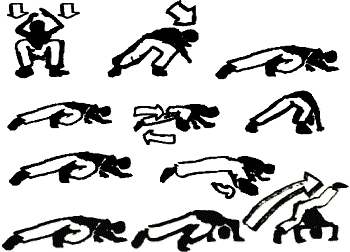
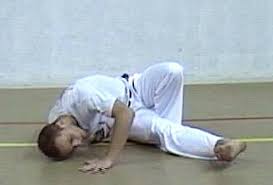
Negativa angola, also known as negativa lateral, is low version of negativa, for evading low kicks. This movement is easily achieved by bending one knee, extending the opposite leg, and leaning at the waist while lowering yourself as much as possible. being an angoleiro myself, it’s the 1st negativa I’ve ever learned.
Below, we have mestre Bola Sete teaching his class this negativa, along with some variations.
Negativa Regional is also a fundamental movement in capoeira, often used as a defensive position. To perform this position, capoeiristas squat on one leg and extend the other leg in front of them, creating a stable base while remaining agile and ready for quick movements. Their supporting hand is placed on the ground on the same side as their extended leg, providing additional balance and support. Meanwhile, their free hand is held up in a guarding position to protect their face and upper body. It is worth noting that although Negativa Regional is also taught in Capoeira Angola, it is more commonly and prominently used in the Regional and Contemporâneo styles of capoeira.
Going to the ground is a common tactic in capoeira, and it can be used to both deceive and attack an opponent. An experienced capoeirista can use their ground skills to lure an opponent into a trap, making themselves appear vulnerable when, in reality, they are about to attack. There are many kicks and takedowns specifically designed to be used from the ground. This aspect of capoeira requires a deep understanding of body positioning and leverage, allowing the practitioner to seamlessly transition between standing and grounded techniques. Being proficient in ground tactics also gives the capoeirista the ability to control the pace of the encounter, creating opportunities to dictate the flow of the game and respond with swift, calculated movements. Furthermore, mastering the art of ground-based attacks enhances the capoeirista’s overall strategy, providing a comprehensive approach to combat that encompasses a wide range of techniques and scenarios.
I’ll post one of these kicks here, because it was billed as “The most powerful kick”.
You saw it on Fight Science, Martelo de Negativa. Lateef Crowder went up against 3 other martial artists and put the science to the test. Although there was one more powerful technique showcased, the martelo de negativa stood out as the most efficient and graceful. With its roots in the art of Capoeira, the martelo de negativa demonstrated how ancient fighting techniques continue to influence and shape modern martial arts, serving as a testament to the enduring legacy of these time-honored practices.
And here, you can see how Negativa can be used as a takedown.
Also from the negativa, a capoeirista can seamlessly transition into maneuvers like amêixia or queda de rins, showcasing a wide range of techniques that enhance the fluidity and deceptive nature of the art. This ability to move with grace and agility while remaining prepared for both offensive and defensive actions illustrates the strategic and dynamic essence of capoeira. The seamless integration of ground movements, acrobatics, and elements of dance makes capoeira a truly unique and captivating martial art, where every gesture and stance has a rich cultural and historical significance.
So, Yesterday was my 11th anniversary in the world of capoeira angola. It’s been a remarkable journey filled with challenges and triumphs, and I feel grateful for the growth and experiences that capoeira has brought into my life. In all my years of training Capoeira Angola, there have been a few fundamental movements that I haven’t mastered yet. These movements require precision, strength, and agility, and I see them as gateways to a deeper understanding of this beautiful art form. So, I’ve made a conscious decision to focus my efforts on mastering these movements, knowing that doing so will elevate my skill set and take my game to new heights. The commitment and discipline required for this endeavor excites me, and I am eager to see the progress and refinement that will come from this dedicated focus.
The Macaco, which is a cool basic move for gymnastics, martial arts acrobatics, and tricking, is a dynamic and impressive technique that requires strength, flexibility, and agility. It involves a rapid transition from a squatting position to a handstand, often performed in a fluid motion. This move is not only visually striking but also serves as a foundational skill for more advanced acrobatic maneuvers.
There are a lot of tutorials out there on how to learn a macaco, but I like this one from the KAHPU Training Method. Be sure to click HERE and check out his Youtube channel, where you’ll find a lot of other useful tips, for those of you capoeiristas out there who want to better understand your game..
I’ve included part of the video description below the video.
This is YOUR BEST prep and training to LEARN MACACO. 7 EASY steps:
1. Prep your shoulder
2. Prep your back and abs
3. Small macaco side jumps
4. Medium macaco jumps
5. High macaco – straight over-
6. Apply that stuff: 3 sequencia’s
7. 4 Week macaco training schedule
Additionally, the Macaco is not only a physical exercise but also an expression of creativity and artistry. As practitioners delve into the intricacies of this movement, they can discover new ways to flow and transition, further enhancing their fluidity and grace. The Macaco is a versatile skill that can be adapted to various disciplines, from dance to martial arts, amplifying its potential benefits for individuals across different domains.
Whether it’s the flexibility and strength required to execute a perfect Macaco, or the discipline and dedication necessary to refine such a complex movement in a training studio, this skill is a beautiful demonstration of the human body’s adaptability and the endless possibilities of movement. From the rhythmic steps leading up to the launch, to the graceful arc of the body in mid-air, every aspect of the Macaco showcases the incredible potential of the human form.



 Jogo Corpo Fechado