THE SURVIVOR SERIES (1/06/26)

Welcome to The Survivor Series: Essential Skills for Urban and Wilderness Resilience

The Survivor Series is a blog series, dedicated to equipping participants with the foundational and advanced knowledge necessary to thrive, not just survive, in any environment, from dense urban settings to remote wilderness landscapes.

Our core focus areas are designed to build a complete profile of resilience:

  • Shelter-Building and Bushcraft: Learn to rapidly construct practical and structurally sound shelters using natural materials in the wilderness, as well as improvised techniques for urban emergency preparedness.
  • Food Sourcing and Water Purification: We explore sustainable methods for identifying, foraging, and preparing wild edible plants, trapping, hunting, and fishing. Crucially, we cover essential techniques for safe water procurement, filtration, and purification in diverse scenarios.
  • Self-Defense and Personal Security: Develop practical, non-lethal self-defense skills and strategies for personal security. This component focuses on de-escalation, conflict avoidance, and maintaining physical safety in high-stress situations.
  • Mental Resilience and Psychological Preparedness: A critical, often overlooked element of survival is the mental game. We explore stress management, overcoming fear, maintaining a positive mindset, goal setting under duress, and developing the psychological fortitude required to make sound decisions during crises.
  • Situational Awareness and Navigation: Enhance your ability to observe your surroundings, anticipate threats, and navigate both natural and man-made environments with confidence using traditional and modern tools. We emphasize the development of an intuitive understanding of your location and potential risks.

By integrating these critical survival skills with the long-term, sustainable strategies of permaculture, The Survivor Series ensures that participants not only possess the immediate know-how to overcome emergencies but also the knowledge to establish self-sufficiency. This powerful combination of knowledge prepares participants to confidently navigate any environment, significantly enhancing their overall survival capabilities and ensuring a sustained capacity for thriving under pressure.

The Humble Acorn: The Food That Saved Humanity

In today’s installment, we’re embarking on a fascinating journey to discuss a single, often-overlooked nut: the acorn. This unassuming seed of the mighty oak tree is far more than just “pig food”; it is, in fact, The Food That Saved Humanity.

For thousands upon thousands of years—a span dwarfing the mere centuries of modern agriculture—humans did not need to toil in monoculture wheat farms. We had the Oak.

Across continents and countless civilizations, the acorn was the undisputed caloric backbone. It was a readily available, nutrient-dense powerhouse, providing essential fat, complete protein, and vital minerals for free, simply for the effort of gathering. Before the widespread adoption of grain cultivation, the vast, naturally occurring oak forests were humanity’s primary pantry. It was a diet of unparalleled nutritional richness and ecological sustainability.

And then, abruptly, we stopped.

The Lost History and the Political War on Wild Food

This is more than just a culinary exploration; it is a deep dive into the “Lost History” of the acorn. How could a food source so central, so ubiquitous, and so nutritious be relegated to the dustbin of history and, more insultingly, branded merely as “pig food”?

In this exposé, we explore the political and economic reasons behind this cultural erasure. We will uncover the intentional campaign to discredit and dismiss wild, perennial foods like the acorn in favor of annual grain agriculture. This is where we meet The Villain: the very structure of agriculture, which inherently hates wild, self-sustaining food sources that cannot be centrally controlled, taxed, or patented. The shift from a perennial, wild food economy to a domesticated, annual grain economy fundamentally changed human civilization, concentrating wealth and power, often at the expense of nutritional diversity and ecological health.

Discovering the Acorn Age

What you will discover within this exploration is a world you never knew existed:

  • The “Golden Age” of California’s Acorn Civilization: We will look closely at the indigenous peoples of California, who are arguably the world’s most sophisticated acorn processors. Their vast, sustainable societies were built upon the meticulous harvesting and preparation of the acorn, proving that complex, flourishing civilizations can be sustained by wild food sources.
  • Why Agriculture Hates Wild Food (The Villain): A detailed look at the systemic pressures that favored domesticating annual grains (like wheat, rice, and corn) over sustainably managing and harvesting wild perennial resources (like acorns). The inability to claim ownership over a freely available forest resource was its ultimate downfall in the economic marketplace.
  • The Simple Science of Tannins and How to Defeat Them: The primary hurdle to consuming acorns is the bitter, puckering taste caused by tannins. We demystify the chemistry of these polyphenols, explaining their protective function in the nut and, more importantly, revealing the simple, age-old methods to neutralize them.
  • How to Perform the “Float Test” and Leach Acorns at Home: A practical, step-by-step guide on how to identify viable nuts (the “Float Test” is a critical first step) and how to safely and effectively perform the leaching process using nothing more than water. This process transforms those bitter nuts found on your driveway into a delicious, nutritious, and versatile flour.
  • Why the Future of Food Might Be Perennial, Not Annual: Finally, we look toward the future. In a world grappling with soil depletion, climate change, and water scarcity, the oak stands as a symbol of regenerative agriculture. We argue that sustainable food security lies not in the endless cycle of tilling and planting annual grains, but in the enduring, deep-rooted stability of perennial food systems, with the magnificent acorn at its heart.

A massive shoutout goes to the creators and moderators of the YouTube channel Ancient Agriculture Mysteries for the production and posting of this truly insightful video. This channel serves as a deep dive into the compelling, often overlooked history of agriculture across various civilizations and epochs. More than just a history lesson, Ancient Agriculture Mysteries is dedicated to uncovering the fascinating, sometimes esoteric, relationship between humanity and the plant kingdom, exploring the “hidden power of plants” and their pivotal role in shaping cultures, diets, and societies from antiquity to the present day. We highly recommend exploring their content for a unique perspective on how our ancestors managed and utilized the earth’s bounty.

The initial search for the term “acorn flower” is ambiguous as it does not correspond to a recognized botanical or common plant name. This suggests the query is likely a phonetic error or a misunderstanding for one of three commercially available products: Aconitum (a plant known as Monkshood), acorn flour (a culinary ingredient), or simply acorns for planting (oak tree seeds). All three items are readily available for purchase online from various retailers and specialty merchants.

Aconitum (Monkshood or Wolfsbane) Plants and Seeds

Aconitum, commonly referred to as monkshood or wolfsbane, is a striking perennial known for its distinctive, helmet-shaped, blue or deep purple flowers that bloom late in the season. These plants are prized by gardeners for their vibrant color and ability to thrive in partial shade.

Important Safety Note: It is crucial to understand that all parts of the Aconitum plant are highly poisonous due to the presence of aconitine alkaloids. It should be handled with extreme caution, and it is strongly recommended that gardeners wear protective gloves when planting, pruning, or dividing these specimens.

Specific Varieties Available Online:

  • Aconitum Royal Flush (Monkshood) Plant
    • Description: This particular variety is notable for its robust, deep maroon stems that offer a striking contrast to the flowers. The plant produces deep indigo-blue flowers that provide late-season interest, typically blooming from mid to late summer.
    • Source: Plants are commonly available from specialized bulb and perennial merchants, such as DutchGrown.
  • Aconitum Carmichaelii ‘Arendsii’ (Monkshood)
    • Description: A valuable addition to the autumn garden, this cultivar sends up tall, stately spikes of luminous azure-blue flowers that often continue their display well into the fall. An additional benefit for many gardeners is that deer generally avoid this plant, making it a reliable choice for areas prone to browsing.
    • Source: This variety can be sourced from well-known perennial nurseries like White Flower Farm and Breck’s.
  • Monkshood (Aconitum napellus) Seeds
    • Description: This represents the classic and most commonly recognized species of the plant. Growing from seed is a cost-effective way to establish a large stand of Monkshood.
    • Source: Seeds for Aconitum napellus can be purchased from various online marketplaces and herbal retailers, including merchants found on Amazon.com and Etsy.

—–Acorns for Planting (Oak Tree Seeds)

If the intent of the search was to find the seeds of the oak tree, acorns are readily available for sale, particularly for those looking to grow specific species of oak or cultivate a large number of saplings. Acorns are the fruit of the oak tree and contain the seed necessary for propagation.

Available Species and Sources:

  • Oak Tree Acorns (Various Species)
    • Description: Acorns are sold for many different types of oak trees, allowing buyers to select based on their regional climate and desired tree characteristics. Common varieties available include Live Oak (Quercus virginiana), known for its evergreen foliage; White Oak (Quercus alba), valued for its strong wood; and Red Oak (Quercus rubra), known for its fast growth and brilliant fall color.
    • Source: A wide selection of acorns is available from agricultural suppliers, hobby seed sellers, and large general retailers on platforms such as eBay, Amazon.com, and Walmart.

—–Acorn Flour (A Gluten-Free Culinary Ingredient)

Acorn flour is a gluten-free, nutrient-dense product gaining popularity among health-conscious consumers and those exploring traditional or alternative flours for cooking and baking. Historically consumed by various cultures, it has a distinct, earthy flavor.

Common Forms and Uses:

  • Premium Acorn Starch Powder
    • Description: This product is typically 100% ground and processed acorns. It is particularly popular in East Asian, specifically Korean, cuisine, where it is the primary ingredient for making the gelatinous dish dotorimuk (acorn jelly). It can also be used as a binding agent or an additive to conventional flours to enhance nutritional value and flavor in baked goods.
    • Source: Available through ethnic grocery stores and large online retailers, including Amazon.com and H Mart.
  • Sustainably Wild Harvested Acorn Flour
    • Description: High-quality acorn flour is often cold-leached—a process used to remove the naturally occurring bitter tannins—resulting in a finely ground flour with an earthy, balanced, and sometimes subtly nutty flavor profile. This type of flour is suitable for inclusion in breads, pancakes, and cookies.
    • Source: Specialty producers and foragers focused on sustainable practices, such as Forestopia and Quercus Collective, offer these premium products.

The Profound Connection: What Does the Simple Acorn Have to Do with Capoeira Angola?

The question, “What does the simple acorn have to do with Capoeira Angola?” might initially sound like a riddle or a whimsical non sequitur. However, within the philosophy, history, and practice of this deeply rooted Afro-Brazilian art form, the humble acorn—the seed of the mighty oak—serves as a potent and profound metaphor.

The core connection lies in the principles of growth, resilience, potential, and the long-view of development.

1. Potential and Power in the Smallest Form

  • The Acorn’s Promise: An acorn is deceptively small, yet it contains the complete blueprint for an enormous, powerful, and long-lived oak tree. This inherent, latent power mirrors the initial stages of a Capoeirista’s journey. A beginner, or calouro, starts with basic, seemingly simple movements—the ginga, the queda de quatro, the negativa.
  • Capoeira’s Seed: These foundational movements, like the acorn, hold the potential for complex, fluid, and masterful sequences. The mastery of Capoeira Angola is not achieved through sudden, dramatic changes, but through the consistent nurturing of these basic seeds of movement and musicality. The greatest Mestres began as novices, their immense skill and wisdom hidden within their early, tentative steps.

2. Growth, Time, and Patience

  • The Oak’s Timeline: The oak does not become a giant overnight. Its growth is slow, steady, and dependent on deep roots. Similarly, Capoeira Angola is defined by its emphasis on patience and slow, deliberate development. It rejects the fast-paced, performance-oriented training sometimes seen in other martial arts.
  • The Angoleiro’s Journey: A true Angoleiro understands that skill, wisdom, and the deep understanding of the jogo (the game/fight) take years, often decades, to cultivate. The roda is not a place for quick fixes, but for continuous, internal growth. The connection emphasizes that the deepest, most resilient strength—both physical and spiritual—is forged slowly, mirroring the slow, unyielding ascent of the oak.

3. Resilience and Rootedness

  • Deep Roots: An oak tree survives storms, droughts, and centuries because of its deep, intricate root system. This rootedness is a core philosophical concept in Capoeira Angola, which values tradition, history, and the ancestral lineage passed down from the slaves and Mestres who preserved the art.
  • Historical Resilience: Capoeira itself is a testament to resilience, having survived brutal suppression by colonial and post-colonial authorities in Brazil. Like the acorn that hides its power until the time is right, Capoeira was often practiced in secret, disguising its fighting techniques within dance and music. The acorn, therefore, symbolizes the enduring spirit and the refusal of a culture to be eradicated.

The acorn, in the context of Capoeira Angola, serves as a powerful and multi-layered metaphor—a silent, yet eloquent, bridge connecting the nascent, seemingly simple beginnings of the Capoeirista to the profound, resilient, and deeply rooted mastery that ultimately defines the art. It is a symbol of immense potential contained within a humble shell.

At its core, the metaphor illustrates the journey of the beginner, who, like the small, unassuming acorn, holds the genetic blueprint for a massive, enduring oak tree. The beginner’s first awkward ginga and tentative movements are the initial, fragile roots taking hold. They are the essence of potential, often underestimated in their present form, but bearing the promise of future strength, wisdom, and complexity.

This symbolic connection is vital because it compels practitioners to respect the process. True mastery in Capoeira Angola is not achieved through sudden, spectacular leaps, but through consistent, dedicated cultivation. The acorn does not become an oak overnight; it requires time, sustenance, weathering of storms, and patient growth. Similarly, the Capoeirista must value the incremental progress, the countless hours of drilling fundamentals, and the quiet internal transformation that occurs over years of practice.

Furthermore, the acorn reminds all students to value the fundamentals. The solid foundation of the ginga, the precise timing of the esquiva, and the deep understanding of the roda etiquette are the “soil and water” necessary for the seed of potential to sprout. Without a firm grasp of these basics—the humble beginnings—the elaborate movements and strategic depth of the art will never fully manifest. The strength of the oak is in its roots, and the strength of the Capoeirista is in the solid, unshakeable fundamentals.

Finally, the metaphor instills profound faith in the vast potential within their own humble beginnings. It encourages the Capoeirista to look past present limitations and to trust in the innate power of discipline and consistent effort. It is a lesson in patience, perseverance, and the understanding that greatness is often concealed in simplicity, waiting only for the right environment and dedication to unfurl. The journey from acorn to oak is a testament to the transformative power inherent in nurturing what begins small.
Restoring Land to Indigenous Peoples: Ecological Benefits

What happens when Indigenous Peoples get their stolen land back

The question of “land back” is one of the most critical and transformative conversations happening globally, representing a powerful movement for fundamental justice, reparations, and environmental stewardship. When Indigenous Peoples successfully reclaim their ancestral territories—a process often undertaken after centuries of dispossession, forced removal, cultural genocide, and colonial violence—the resulting impact is profound and multi-layered, extending far beyond a simple change in property ownership to reshape ecological, governmental, and social landscapes.—–Ecological Restoration and Climate Resilience: A Return to Stewardship

One of the most immediate and significantly positive outcomes of the Land Back movement is the revitalizing effect on the environment. Indigenous communities, drawing on thousands of years of traditional ecological knowledge (TEK), have consistently proven to be the most effective stewards of the land. When management authority is returned, it marks a crucial shift from historically extractive industrial practices (such as unregulated logging, intensive mining, and destructive monoculture farming) to regenerative methods that prioritize biodiversity, ecosystem health, and sustainable resource use.

This fundamental shift in management paradigm results in:

  • Restoring Biodiversity: Reintroducing crucial native plant species, actively managing and removing invasive species introduced by colonial practices, and strategically supporting local wildlife populations to re-establish natural ecological balances. Indigenous-led conservation often focuses on protecting keystone species vital to the entire ecosystem.
  • Climate Change Mitigation: Protecting and expanding natural carbon sinks, particularly crucial old-growth forests, coastal mangroves, and essential wetlands. Numerous independent studies have demonstrated that Indigenous-managed lands consistently have superior conservation outcomes—including lower deforestation rates and greater species density—than state-run or private protected areas.
  • Revitalizing Fire Management: Implementing cultural burning practices, a sophisticated form of applied TEK, to systematically reduce hazardous fuel load, enhance the health of fire-adapted ecosystems, and actively prevent the catastrophic, high-intensity wildfires that have become increasingly common under colonial land management regimes.
  • Water and Soil Health: Employing traditional agricultural and forestry techniques that focus on soil regeneration, natural water filtration, and the protection of headwaters, leading to purer water sources and more resilient agricultural lanSovereignty, Self-Determination, and Governance: Reclaiming Power

The physical return of land is inextricably linked to the restoration of Indigenous sovereignty and political authority. Land provides the essential physical, spiritual, and economic foundation necessary for true self-determination. With land back, Indigenous Nations regain the capacity to govern themselves in accordance with their own laws and values:

  • Re-establishing Traditional Governance: Nations can fully implement and enforce their own systems of laws, cultural protocols, and resource management free from external colonial or state oversight. This can involve restoring traditional court systems, creating Indigenous-led education systems, and establishing unique forms of participatory democracy.
  • Creating Sustainable Economic Stability: Land enables the development of sustainable, community-controlled economies. These often move away from resource depletion and focus instead on culturally-informed ventures such as ecotourism, traditional arts and crafts, small-scale sustainable agriculture, and responsible resource development that ensures all benefits remain within the community.
  • Ensuring Cultural and Linguistic Continuity: The land is the literal and philosophical center of Indigenous identity, language, and spiritual practice. Reclaiming ancestral lands allows for the immediate revitalization of core cultural ceremonies, the establishment of language immersion camps on traditional territories, and the effective transmission of complex traditional knowledge from elders to younger generations.
  • Exercising Inherent Treaty Rights: The return of land often facilitates the ability of Indigenous Nations to exercise rights guaranteed in historical treaties, such as hunting, fishing, and gathering rights, which are often contingent upon access to and control over their traditional territories.

Social, Health, and Spiritual Improvements: Healing Historical Trauma

The devastating historical trauma inflicted by land dispossession—a process that directly led to the erosion of traditional food systems, the breakdown of community structures, cultural suppression, and severe physical and mental health crises—begins a profound process of healing with land back. Access to and control over ancestral territories immediately results in tangible improvements:

  • Improved Food Security and Health: Reconnecting with traditional hunting, fishing, gathering, and growing practices restores culturally appropriate diets, which are typically richer in nutrients and more sustainable, directly addressing diet-related diseases often exacerbated by colonial food systems.
  • Mental and Spiritual Healing: The ability to freely practice culture, conduct ceremonies, and reconnect with sacred sites that were previously inaccessible or desecrated acts as a powerful, collective antidote to intergenerational trauma, leading to measurable improvements in community mental health outcomes and reduced rates of addiction.
  • Enhanced Community Cohesion and Political Agency: The shared, collaborative process of managing, protecting, and governing the returned land strengthens community bonds, reinforces internal political structures, and restores a collective sense of purpose and self-worth that had been undermined by centuries of external control.
  • Better Housing and Infrastructure: With sovereignty and a land base, Nations can direct their own development, creating community-appropriate housing, infrastructure, and services that reflect cultural needs rather than having inadequate, state-mandated solutions imposed upon them.

A Path Toward True Reconciliation and a Just Future

For non-Indigenous societies, the concept of “land back” represents the single most concrete, substantive, and necessary form of justice and the prerequisite for genuine reconciliation. It moves the discourse beyond performative apologies and symbolic gestures to tangible, irreversible acts of restitution and structural change.

This process, while inherently complex and involving intricate legal, legislative, and grassroots efforts across different jurisdictions, is an essential step toward a post-colonial future. The ultimate outcome is the creation of a more just, equitable, and ecologically balanced world where Indigenous rights, self-determination, and their unparalleled expertise in environmental stewardship are prioritized for the benefit of all inhabitants of the planet.

MALANDROS IN ACTION (9/23/25)

This series explores the modern malandro in urban society, highlighting their charm and resourcefulness while tackling economic disparity and social justice. It illustrates their resilience and cleverness in overcoming challenges, portraying them as influential figures in discussions of equity. By interweaving personal stories with societal issues, the series examines the complexities of the malandro’s life, showcasing both their struggles and successes. Ultimately, it invites viewers to reassess their views on success and morality, celebrating the malandro’s significant contributions to urban culture, where defiance can signify solidarity.

In Today’s installment, We follow Conor Woodman in a show named scam city, a series where he gets scammed, so we don’t have to.

As soon as Conor arrives in Bogota, he is warned about a dangerous drug made from a flowering shrub that renders victims helpless to thieves’ requests. This drug, known locally as “la flor de la muerte,” has been the center of numerous alarming reports, with locals sharing chilling stories of unsuspecting tourists who fell victim to its effects. Conor learns that the shrub thrives in the lush landscapes surrounding the city, making it not just a symbol of beauty, but a hidden peril.

He becomes acutely aware of the dangers lurking in unfamiliar alleys and crowded markets, where the whispered warnings of street vendors echo in his mind, painting a vivid picture of both intrigue and caution. With each passing hour, the gravity of the situation intensifies, as he realizes that understanding the local culture and its dangers is as essential as exploring the vibrant sights of the city, which pulse with life and energy yet hide complexities beneath their alluring facades.

Each interaction, each fleeting glance exchanged with strangers, serves as a reminder that the excitement of discovery must be tempered with vigilance, for the vibrant colors of the market can just as easily invite opportunity as they can camouflage potential threats. As he navigates through this maze of experiences, he begins to appreciate the depth of the city not just by its sights, but also by recognizing the unsung rules that govern its rhythm and flow, making him increasingly aware that his journey is as much about understanding the heart of the city as it is about visually consuming its beauty.

LAST NIGHT, I TOOK A JOURNEY INTO THE HEART OF CAPOEIRA

Greetings!!!

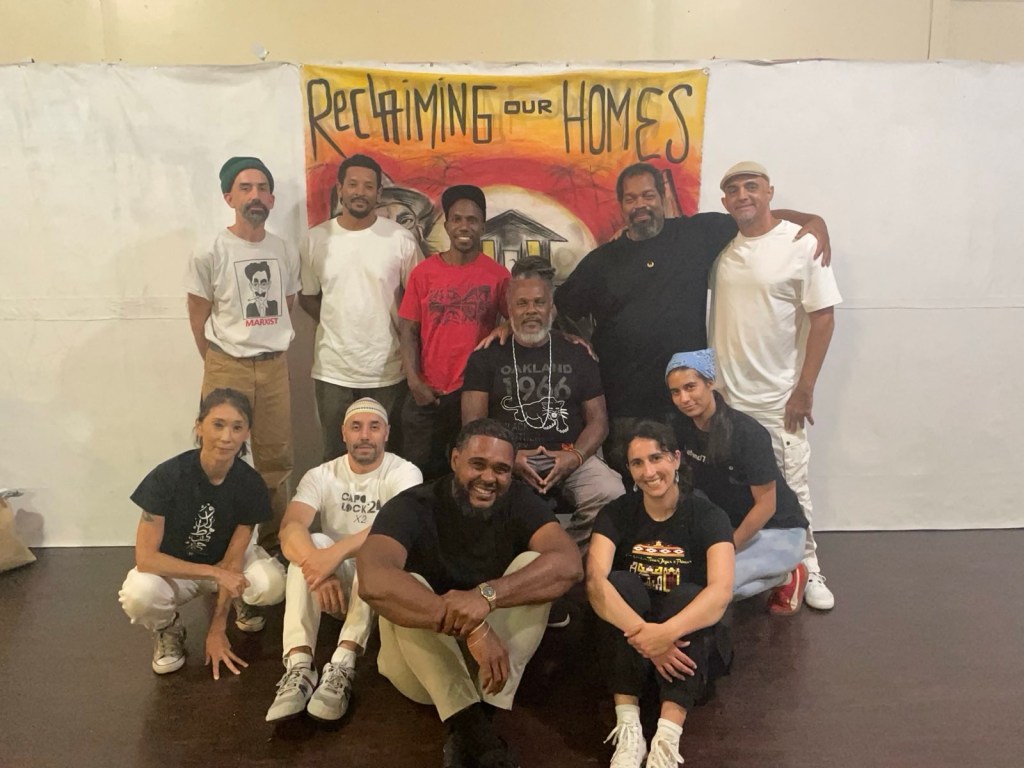
On the permanent section of this website, I referred to the musical side of Capoeira as the HEART of capoeira, a fitting title that encapsulates its essence. Last night, as the sun set and the atmosphere filled with vibrant energy, I embarked on a Journey into the heart of capoeira, immersing myself in its rhythm and soul. During this exploration, I encountered something truly special, a blend of sound and movement that resonated deeply with me. The melodies and beats seemed to tell stories of tradition, struggle, and celebration, offering insights that I believe are essential for anyone looking to understand this beautiful art form. It’s an experience I feel compelled to share with you, as the insights I gained shed light on the profound connections that unite us all through the music and movements of capoeira.

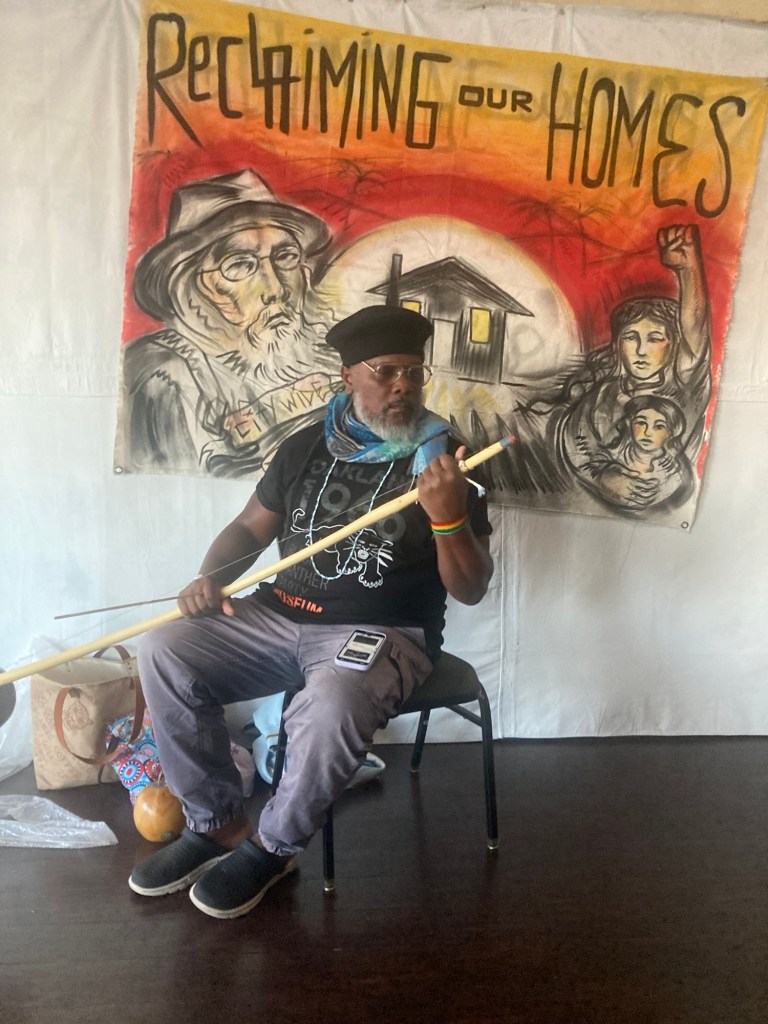
And below, is the conductor of that amazing journey, MESTRE NEGOATIVO.

Mestre Negoativo, a renowned Cultural Activist and Researcher of Afro-Mineira traditions, has dedicated his life to preserving and promoting the rich tapestry of Bantu and Vissungo heritage in Bela Horizonte, a city that pulses with cultural diversity. His unwavering commitment to this cause is vividly showcased in his deeply insightful book “Capoeiragem no País das Gerais”, where he explores the intricate history and significance of capoeira as a form of cultural expression and resistance. Beyond his literary contributions, he founded the Lamparina Cultural Center, a vibrant hub for the community, where workshops, performances, and discussions are held to educate and inspire future generations. Through his passionate efforts, Mestre Negoativo not only honors the legacy of his ancestors but also fosters a renewed sense of identity and pride among those who share these traditions.

And the journey he took us on was a journey of the iconic berimbau, an instrument deeply rooted in the cultural landscape of Brazil, where its rhythmic melodies echo the struggles and triumphs of capoeira’s history.

As we explored the origins of this unique musical tool, we delved into the rich traditions of the African diaspora, revealing the deep cultural heritage that informs the music and practices surrounding the berimbau. The craftsmanship involved in creating each berimbau is not merely a technical process but a profound art form passed down through generations, showcasing the skill and dedication of artisans who honor their ancestors through their work. Each berimbau, with its distinctive sound, serves as a bridge that unites communities in celebration and resistance, resonating with the struggles and triumphs of those who have come before and those who continue the fight for their rights.

Through engaging storytelling and captivating demonstrations, we came to appreciate the berimbau not just as a musical instrument, but as a vibrant symbol of resilience, artistry, and the powerful connection between past and present, illuminating the path of those who have played it for generations. We focused on 2 toques (rhythms) and their variations, intricately crafted and played by the revered Mestres of capoeira from the early 20th century, Mestres such as WALDEMAR, GATO, and TRAIRA, among others. These rhythms are essential to the art form, each carrying its unique stories and significance, creating a musical dialogue that captivates both the body and spirit.

And NO, I’m not gonna tell you what those toques were; you should have attended the class to uncover their mysteries, like we did.

But in case you want to listen to them, click on the video below.

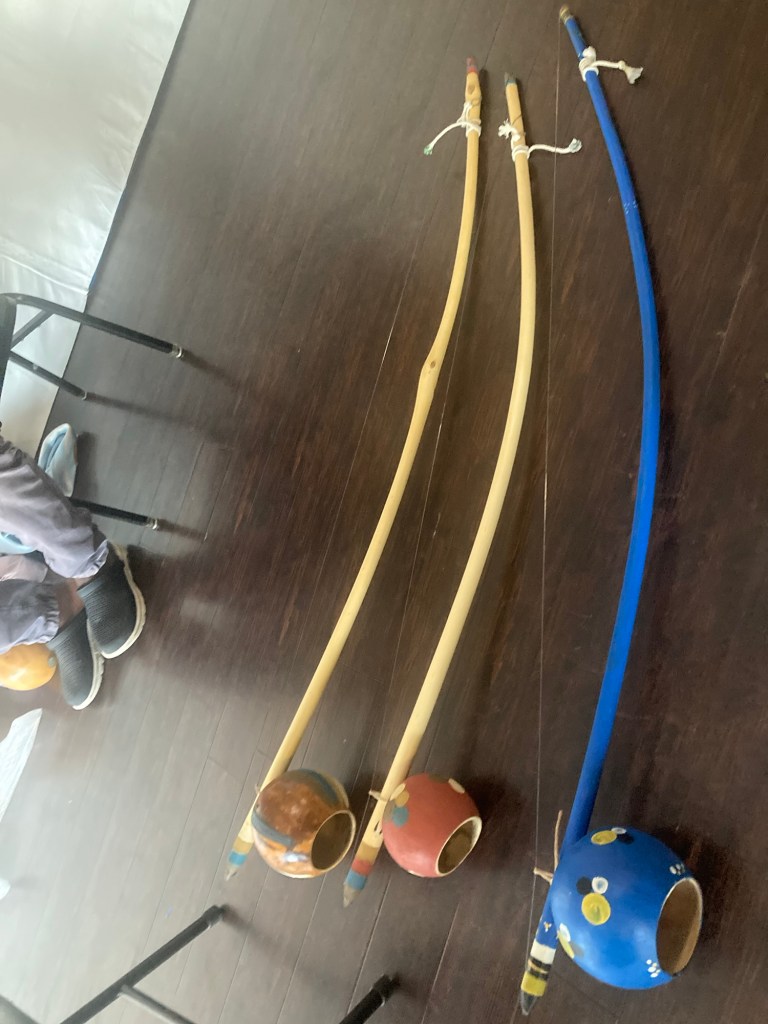
Sidenote: In the picture below, you see 3 berimbaus, each with its own unique story and significance. The 2 on the left are new and belonged to my friend Gigante of Capoeira Batuque. (Shout out to you, Gigante, for translating Mestre Negoativo’s insightful words during our musical journey). These impressive instruments were brought here from Brazil about a month ago, carefully chosen for their resonance and craftsmanship, but they weren’t armed (strung up) until that evening to allow them time to acclimate to the local weather conditions, ensuring they would produce the best sound possible.
The blue berimbau on the right is mine, a cherished part of my capoeira practice. I bought it from Mestre Negoativo a few years ago, and from then until now, it still had a good sound—a strong, rich tone that filled the space around me. A GOOD sound, indeed. However, after Mestre took it and made a couple of adjustments, now it sounds AMAZING, with a clarity and volume that exceed anything I’ve experienced before, resonating in a way that captivates everyone who hears it. It’s incredible to see how a few tweaks from a master can elevate an already beautiful instrument to new heights.

Whenever I take a class with Mestre Negoativo, I am reminded that Capoeira is a profound expression of culture and nature, embodying fluidity and harmony in every movement. The intricate motions reflect animal grace, each gesture teaching a connection to our bodies and the environment that surrounds us. This connection not only fosters community energy but also cultivates a deep appreciation for the diverse elements of nature, helping to understand better our role in the larger tapestry of life. The rhythm of Capoeira serves as a reminder of the importance of balance and unity, resonating with the heartbeat of the earth.

The berimbau is also a manifestation of nature, embodying the rich cultural heritage that is profoundly intertwined with the natural elements surrounding it. Its sound resonates with the rhythm of the earth, evoking feelings of harmony and balance that invite introspection and contemplation. Traditionally crafted from materials such as wood and steel wire, the berimbau showcases the beauty of sustainability and resourcefulness in utilizing what nature provides, highlighting the importance of preserving these traditions while respecting the earth. As it echoes through the air, each note tells a story of community, spirituality, and the age-old connection between humanity and the environment, inviting us to reflect on our shared responsibilities toward the planet and each other while celebrating the art that brings us together in joy and solidarity.

The movements, infused with powerful ancestral narratives, bridge generations, weaving a complex history that honors the struggles and triumphs of those who came before us. Each session becomes a gathering, a ritual where individuals from diverse backgrounds unite, breaking the barriers created by modern society, and reinforcing the idea that our differences are what enrich our collective experience. Moreover, Capoeira transcends mere physicality, evolving into a philosophical journey that urges participants to seek deeper meanings in both practice and life. As we dance and create music, we are reminded of our innate connection to the natural world, celebrating not just the skills we develop, but the wisdom we gain through our ongoing relationship with both Capoeira and the environment.

As I said before, human beings, like various animal species, can be domesticated through societal norms from an early age, which suppress intrinsic qualities that embody our humanity. These norms often mold our behaviors, preferences, and aspirations, leading us to conform rather than explore our true selves. However, Capoeira serves as an antidote to this domestication; it is not merely a martial art but a vibrant cultural expression that encourages individuals to break free from societal constraints and rediscover their authentic selves. By engaging in its rhythmic movements and music, practitioners are given the opportunity to tap into their innate awareness, passion, and joy, ultimately leading to profound personal growth that transcends the boundaries of conventional self-expression. Through the dynamic interplay of dance, acrobatics, and music in Capoeira, individuals are invited to foster a deep connection not only with themselves but also with others around them, cultivating a supportive community that celebrates creativity and individuality. In this rich environment, practitioners learn to embrace their uniqueness and build resilience against societal pressures, allowing them to reconnect with their essence and pursue their dreams with renewed vigor and authenticity. As they immerse themselves in the history and philosophy of Capoeira, they also gain valuable life skills, such as adaptability and collaboration, which empower them to navigate the complexities of modern life with confidence and joy.

To all capoeiristas out there, if you get the opportunity to take one of Mestre Negoativo’s classes, take it! It will be one of the best decisions you ever make, as his teaching style is not only profound but also deeply rooted in the authentic traditions of capoeira. His ability to connect with students, whether you’re a beginner or an experienced practitioner, creates an environment that fosters growth and exploration. Don’t miss out on the chance to absorb his incredible wisdom and passion for capoeira.


Now, I want to switch gears a bit and tell you about a place that is special to Mestre Negoativo’s heart, and the hearts of the community of MARIA GORETTILAMPARINA.

LAMPARINA is a meaningful symbol for Mestre Negoativo and the MARIA GORETTI community, representing their collective memories and shared history that spans generations. It evokes deep emotions and connections through traditions and stories passed down over time, highlighting its vital role in their lives and the cherished significance it holds for everyone in the community. This emblem serves not only as a reminder of their past struggles and triumphs but also as a beacon of hope for the future, fostering a sense of unity and belonging among the members. Each flicker of its light resonates with the laughter, tears, and aspirations of the community, reminding them of their resilience and the enduring spirit that binds them together. The stories woven around LAMPARINA nurture a rich tapestry of identity, pride, and cultural heritage, making it an irreplaceable part of their everyday life and celebrations.

If you would like to learn more about Lamparina, and/or would like to donate, please check out the links below.

https://www.mestrenegoativo.com/

https://www.facebook.com/lamparinacultura/

https://www.mestrenegoativo.com/c%C3%B3pia-alumi%C3%B4-semeei-semente

And for those of you with mobile phones…