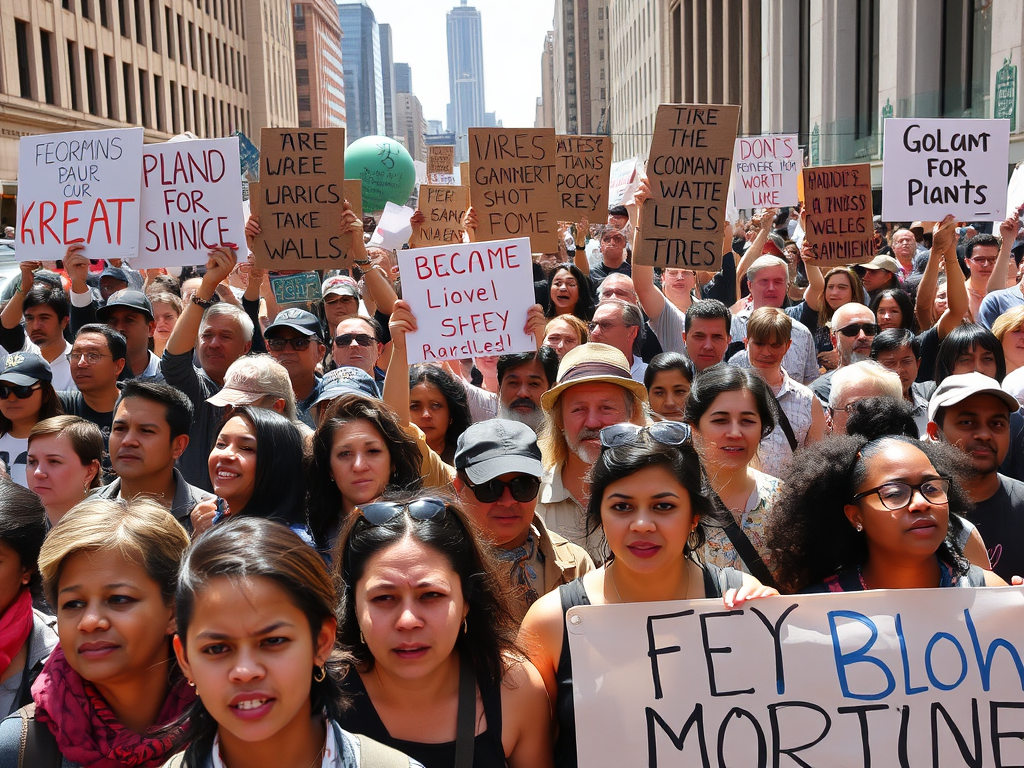
Why? Because although I haven’t had a busy weekend, it seems the “No Kings” protests were going on in LA, and I didn’t know.
The “No Kings” protests represent a significant nationwide movement in the United States, primarily aimed at opposing the actions and policies of the Trump administration. These demonstrations fundamentally frame President Trump’s behavior as authoritarian, drawing direct comparisons to a monarchical rule and expressing deep concern over what participants perceive as a serious erosion of democratic norms and institutions within the country. The movement’s core message revolves around the belief that no single individual, regardless of their elected office, should wield power unchecked, acting as a “king” above the law or the will of the people. This sentiment taps into a historical American distrust of concentrated power and a strong commitment to republican ideals, values that date back to the founding of the nation and have shaped democratic discourse for centuries. Amidst this backdrop, many activists argue that these protests are a necessary response to a perceived threat to civil liberties and social justice, emphasizing the importance of public engagement in safeguarding democratic integrity. Will these protests do any good? Who knows.
However, as a capoeirista, I feel the need to share with you why we Capoeiristas should support these protests—not only because we value freedom and autonomy, which are intrinsic to both Capoeira and the spirit of resistance, but also because standing together against oppression enriches our community, amplifies our voices, and aligns our values of respect, camaraderie, and resilience with the broader fight for justice in society.
The Interplay with Capoeira: A Dance of Defiance and Identity
The connection between the “No Kings” protests and Capoeira might not be immediately obvious. However, the “No Kings” protest signifies a broader movement against systemic oppression and social injustice, themes that resonate deeply within the Capoeira community. Capoeiristas often find their core values and historical struggles reflected in the fight for equality and freedom exemplified by the “No Kings” protest.
This profound connection serves multiple purposes. Firstly, it unites individuals under a common cause, bridging seemingly disparate cultural and political spheres. Capoeira, born from the resistance of enslaved Africans in Brazil, inherently carries a legacy of defiance against oppressive systems and a relentless pursuit of liberation. This historical context makes it a powerful symbol for those protesting against perceived authoritarianism and injustice in contemporary society.
Secondly, this connection highlights the inherent power of cultural expressions like Capoeira as more than just performance. Capoeira embodies a “dance of defiance,” where physical prowess, strategic thinking, and rhythmic expression coalesce to challenge established power structures. It is also a vibrant “celebration of identity,” affirming the dignity and resilience of marginalized communities. Through its movements, music, and philosophy, Capoeira implicitly advocates for a world where no one is ruled by the arbitrary power of kings or oppressive systems.
The interplay between the “No Kings” movement and the spirit of Capoeira illustrates how cultural practices transcend mere entertainment or athletic display. They become living, breathing embodiments of ongoing struggles for dignity, rights, and self-determination that many individuals and communities face today across various contexts and cultures. The rich history of Capoeira, rooted in resistance against oppression, serves as a powerful reminder of how marginalized groups have historically used art as a form of empowerment and expression. The shared commitment to challenging injustice, whether through political protest or the expressive movements of Capoeira, underscores a universal human desire for freedom and respect that resonates deeply within the collective consciousness of marginalized people worldwide.
This echo of resilience can be observed in urban spaces where Capoeira is practiced, creating havens of solidarity and communal strength. Moreover, this connection highlights how the physicality of Capoeira’s movements can serve as a metaphorical language of dissent, advocating for social change and raising awareness of systemic inequities. The synergy between art and activism in this context demonstrates how they can powerfully reinforce each other in the pursuit of a more just and equitable society, inspiring new generations to carry forward the legacy of resistance and to envision a future free from tyranny and oppression.
Welcome to MALICIA AS A GAME OF POWER, a blog series that delves deeply into the intricate strategies of human interactions, encompassing a wide range of topics including communication, conflict resolution, negotiation, and manipulation. This series not only discusses the nuances of leadership and personal branding but also explores the crucial aspect of online reputation management in today’s digital landscape. By providing a rich collection of practical strategies aimed at enhancing influence and fostering meaningful relationship-building, it equips readers with the tools necessary to navigate complex interpersonal dynamics. Moreover, through thorough analysis and a diverse array of examples drawn from real-life scenarios, the series aspires to empower readers, enabling them to master the art of successfully navigating interpersonal relationships and emerging stronger in their personal and professional lives.
In this installment, we will explore the 38th law of power in the book, the 48 laws of power by Robert Greene. You can buy a copy by clicking HERE.
Law 38: Think as you like but behave like others
Expressing individuality can be a double-edged sword. While it’s natural to want to showcase what makes you unique, an overt display of unconventionality can sometimes be perceived negatively by others. Instead of appreciating your distinctiveness, people might interpret it as a deliberate attempt to draw attention, leading to reactions ranging from dismissal to outright hostility. This negative perception can stem from a feeling of inadequacy in others; if your uniqueness highlights their perceived conformity, they might resent you for it. This can easily spiral into a cycle where judgment from one side fuels resentment in the other, creating a barrier to genuine connection and understanding.
Society, with its ingrained norms and expectations, often exerts a powerful pressure to conform. From educational institutions to professional environments, and even within social circles, there are unspoken rules about how to behave, dress, and think. While these norms can provide a sense of order and shared identity, they can also stifle personal expression. When someone deviates too far from these established patterns, they risk facing backlash. This can manifest as social exclusion, criticism, or even professional setbacks. In a world that often rewards blending in – where fitting neatly into predefined categories can open doors and smooth paths – the prospect of facing such consequences can be a strong deterrent to truly being oneself.
Consequently, many individuals find it easier, and at times strategically wiser, to suppress their true selves. This doesn’t necessarily mean abandoning one’s core identity, but rather carefully curating how that identity is presented to the world. It involves making conscious choices about when and where to express certain aspects of one’s personality, and when to adapt to the prevailing social climate. The ultimate goal then becomes finding a delicate balance: one that allows for authentic self-expression without alienating those around you. This nuanced approach recognizes that fostering acceptance among peers and within broader society can sometimes require a degree of adaptation, ensuring that one’s uniqueness is celebrated rather than penalized. It’s about navigating the social landscape with an understanding that while individuality is valuable, its presentation can significantly impact how it’s received.
The 38th Law of Power, as described in Robert Greene’s The 48 Laws of Power, is “Think As You Like But Behave Like Others.”
This law advises individuals to keep their true thoughts, beliefs, and unconventional ideas private, and instead, outwardly conform to the prevailing customs, traditions, and opinions of the people around them. The core rationale is that by openly displaying nonconformity or radical thinking, one risks alienating others, arousing suspicion, and being labeled a troublemaker, which ultimately restricts one’s freedom to operate and advance. The Law encourages adopting a protective social camouflage—a mask of conventionality—to blend in.
How to Use the 38th Law of Power Ethically
Applying the 38th Law ethically centers on using the prescribed outward conformity as a tool for peaceful coexistence, effective communication, and positive influence, rather than as a means of deceit or cynical manipulation. The ethical use recognizes that outward social harmony is often necessary to achieve a greater good, or to simply function in a complex society, without compromising one’s core integrity or independent thought.1. Fostering Respectful Dialogue and Understanding
Ethical Principle: Use conformity to build trust and open doors, not to exploit naivety.
Application: When entering a new social or professional environment with radically different values or deeply entrenched customs (e.g., a foreign culture, a traditional corporation, or a specific community), temporary outward compliance shows respect. By honoring the group’s rituals and avoiding confrontational displays of difference, you establish rapport. This conformity is a necessary prerequisite for genuine, constructive dialogue. Once trust is established, your carefully selected non-conforming ideas will be received as thoughtful input, not as a hostile critique.
2. Prioritizing the Message Over the Messenger’s Ego
Ethical Principle: The true value of an idea or a necessary change is more important than personal recognition for radical thinking.
Application: If you possess a brilliant, innovative, or controversial idea that could genuinely benefit an organization or a community, presenting it in a familiar, conventional framework makes it palatable. Ethical use involves “translating” the radical idea into the group’s existing language, values, and accepted norms. You are conforming the presentation style, not the idea’s substance. This allows the group to adopt the beneficial idea without being threatened by the source’s unconventional nature.
3. Protecting Independence for Self-Improvement
Ethical Principle: Shielding one’s inner world allows for independent moral and intellectual development without societal interference.
Application: The ethical use of “Think As You Like” means preserving the mental space to challenge your own assumptions, engage in critical thinking, and form genuine moral conclusions without the pressure of immediate social judgment. Outward conformity provides a protective shield, conserving mental energy that would otherwise be spent defending unconventional thoughts. This conserved energy can then be directed toward ethical, self-driven growth, enabling you to become a more thoughtful and principled person whose eventual actions, once deemed necessary, are backed by deeply considered independent thought.
4. Avoiding Unnecessary Conflict and Promoting Social Lubrication
Ethical Principle: Choose your battles wisely, saving genuine nonconformity for issues of true moral substance.
Application: Much of social conformity involves minor, morally neutral behaviors (e.g., dress code, small talk topics, scheduling preferences). Ethically, it is acceptable and even beneficial to conform in these superficial areas simply to “lubricate” social interactions and avoid petty, distracting conflicts. This is not deceit; it is social efficiency. By conforming to low-stakes conventions, you preserve your credibility and political capital for the few, critical moments when you must, for ethical reasons, choose to stand apart and risk the consequences of nonconformity.
In summary, the ethical application of the 38th Law is a practice in strategic patience and respectful presentation. It is the conscious choice to meet people where they are (outwardly) in order to eventually lead them to where they need to go (through the gradual, conventional introduction of independent thought).
The 38th Law of Power, often interpreted as “Think as you like but behave like others,” is a complex and often misunderstood principle. In the context of The 48 Laws of Power by Robert Greene, this law advocates for a strategic kind of intellectual detachment. It suggests that while one should maintain their independent, critical thoughts and unconventional beliefs, they should outwardly conform to the prevailing customs, norms, and religious or social dogmas of the community. This dual existence is a tactical maneuver designed to avoid unnecessary conflict, suspicion, or alienation from the very people whose goodwill or obedience one might eventually need. The core idea is that displaying unconventional thoughts or a lack of respect for tradition will only earn one enemies and the reputation of a dangerous eccentric, undermining their ability to exert influence.
…through the eyes of an angoleiro
To interpret this law “through the eyes of an angoleiro” adds a profound layer of meaning, specifically drawing on the philosophy, history, and practice of Capoeira Angola. An angoleiro is a practitioner, and often a master (mestre), of Capoeira Angola, the older, more traditional, and philosophical form of the Afro-Brazilian art.
For an angoleiro, the 38th Law is not just about avoiding trouble; it is a fundamental principle of the game (jogo), survival, and mastery.
The Malandragem of the Game: The angoleiro operates with malandragem—a concept that encompasses cunning, street-smarts, and strategic ambiguity. The core of Capoeira Angola is deception. The body is low to the ground, appearing slow, vulnerable, and non-threatening. This “behaving like others” (i.e., appearing humble, perhaps even weak or merely playful) is a facade. Internally, the angoleiro is “thinking as they like”—calculating, anticipating, and ready to explode with a disruptive movement (golpe) at the perfect moment. They hide their true power and intention behind the smile, the slow rhythm (ginga), and the ritualized obedience to the roda (the circle).
Respect for Tradition and the Mask of Humility: Capoeira Angola is steeped in tradition, ritual, and a strict hierarchy. The angoleiro will show absolute respect for the mestre, the berimbau (the lead instrument), and the specific structure of the roda. This outward adherence to form is essential for credibility and acceptance. If they openly challenged the tradition or displayed arrogance—the opposite of conformity—they would be cast out. Their internal “thought” might be innovative, planning a new combination or subtly challenging a peer, but their external “behavior” is always one of deference and belonging.
Survival in a Hostile Environment: Historically, Capoeira was persecuted and outlawed in Brazil. The capoeiristas had to “think as they liked” (develop a potent, subversive, and beautiful fighting system) while “behaving like others” (disguising their fighting as a dance, a folk-play, or a simple game). This dual nature was their life-saving camouflage. The angoleiro understands this history of necessary concealment deeply. Their art is a hidden weapon, cloaked in song, poetry, and a seemingly playful performance.
The Secret of the Axé (Life Force): The angoleiro knows that true power (Axé) is accumulated slowly, through years of discipline, observation, and internal refinement. They do not advertise their knowledge or seek external validation through flashy displays. The roda is their laboratory for independent thought, but the jogo must be played within the accepted parameters of tradition to preserve the Axé of the art itself.
In essence, for the angoleiro, the 38th Law is not a cynical manipulation but a wise strategy of concealment, allowing the true, unique, and powerful self to develop without the external pressures of immediate judgment or confrontation. They conform on the surface to maintain their freedom to innovate and thrive in the depths.
This series examines indigenous beliefs and religions in Sub-Saharan Africa, emphasizing ancestral worship, Christianity, and Islam. It highlights cultural heritage through various rituals and community gatherings that celebrate identity, providing a rich tapestry of experiences that reflect the depth of these traditions. By showcasing ceremonies that strengthen social ties among diverse ethnic groups, the series also illustrates how these practices create a sense of belonging and unity. Additionally, the series delves into the intricate ways these traditions adapt and evolve within the diaspora, illustrating how they maintain their relevance across generations. Moreover, it underscores the pivotal role of storytelling in preserving oral histories, which serve not only as a means of transmitting cultural knowledge but also as a vital tool for fostering resilience and continuity in the face of global challenges, ensuring that the rich legacies of these communities are honored and remembered for future generations.
First of all, Happy Hoodoo Heritage Month! Yes, we’re going into Hoodoo today, a rich spiritual tradition steeped in history and cultural significance. But before that, I want to show you guys the difference between Hoodoo and Voodoo, as it’s essential to understand that while they share some similar roots, they embody distinct practices and beliefs.
Well, I’ll let the lady below tell you.
Knowing these differences enriches our understanding and appreciation of both traditions as we celebrate Hoodoo Heritage Month (October) and delve deeper into its unique aspects and contributions to our cultural landscape.
So, if Voodoo is not Hoodoo, what is Hoodoo, exactly? Well, let’s delve into a quick explanation of what Hoodoo is, explore its foundational principles, and then offer some recommendations on how to learn more about this fascinating tradition.
Hoodoo, often referred to as “rootwork” or “conjure,” is a folk magic tradition that originated in the African diaspora in the United States. Unlike Voodoo, which is a religion with a defined pantheon of spirits, a priesthood, and a structured cosmology, Hoodoo is primarily a system of practical magic focused on influencing everyday life through spells, rituals, and the use of natural elements. It’s a pragmatic spiritual practice, often individualistic, and deeply rooted in the belief that one can directly interact with the spiritual world to achieve desired outcomes.
The foundational principles of Hoodoo are diverse, drawing from various African spiritual beliefs, European folk magic, and Native American botanical knowledge. Key elements include:
The Power of Nature: Hoodoo practitioners believe that plants, minerals, animal parts, and even dirt possess inherent spiritual properties that can be harnessed for magical purposes. The careful selection and preparation of these natural ingredients are central to Hoodoo spells.
Ancestral Veneration: Honoring and communicating with ancestors is a significant aspect of Hoodoo. Ancestors are seen as guides and protectors who can offer assistance and insight. Offerings and prayers to ancestors are common practices.
Personal Agency and Empowerment: Hoodoo is often sought by individuals looking to gain control over their circumstances, whether it’s for protection, healing, attracting love, prosperity, or even for justice against perceived wrongs. It empowers individuals to take an active role in shaping their destiny.
The Importance of Intention and Focus: The success of any Hoodoo working is believed to be heavily reliant on the practitioner’s focused intention, belief, and the energy they put into the ritual.
Spirit Guides and Intermediaries: While not a religion with a fixed pantheon, many Hoodoo practitioners work with spirit guides, often interpreted through a Christian lens (saints, angels) or as ancestral spirits, to aid in their magical workings.
Ethical Considerations (within the tradition): While often misunderstood, Hoodoo does have its own internal ethical framework, where the intent and potential consequences of a spell are considered, though these can vary among practitioners.
To learn more about Hoodoo, here are some recommendations:
Read Reputable Books: Look for works by respected authors and practitioners who offer authentic insights into the history, practices, and philosophy of Hoodoo. Be discerning, as there’s much misinformation out there.
Seek Out Experienced Practitioners: If possible, connect with individuals who have a deep understanding and experience in Hoodoo. This could be through workshops, cultural centers, or trusted community elders.
Explore Historical Accounts and Folklore: Delve into historical documents, slave narratives, and folklore collections that describe the spiritual practices of African Americans in the South. This can provide valuable context.
Visit Cultural Institutions: Museums and cultural centers that focus on African American history and folk traditions may offer exhibitions or resources related to Hoodoo.
Understand the Distinction: Always remember the crucial distinction between Hoodoo and Voodoo. While they share some historical roots and influences, they are distinct traditions.
We’ll go more into Hoodoo next week, but I wanna end with this video.
Instead of simply posting this video and adding my take on it, I decided to take a different approach by sharing the original video description here for all of you to read. This way, you can get a genuine understanding of the content from the source itself, as it captures the essence and intent of the video more faithfully than my own interpretation ever could. So, without further ado, here it is—ENJOY!
Lawrence Grandpre uses his 15 years of research and policy advocacy experience to work with community organizations and researchers to produce research and drive social change toward community self-determination. Working with the LBS Director of Public Policy, he supports the organization’s legislative advocacy efforts by producing research focused on evaluating best practices for policies that empower community decision-making and control of resources on topics ranging from policy accountability to reparations for the War on Drugs.
https://lbsbaltimore.com/about/leader… City council approves $708K contracts for Minneapolis violence prevention groups https://www.kare11.com/article/news/l… Bill would give $1 million to nonprofit run by violence interrupter whose Minneapolis contract was pulled after shootout, threats https://archive.ph/1p0Oz Minneapolis violence prevention contracts are riddled with red flags as the city tries to clamp down https://archive.ph/BKVGS ‘It’s a Bully Tactic’: Minneapolis Violence Interrupters Stand Off With the City https://www.thetrace.org/2025/08/minn… Critique of Cure Violence https://academicworks.cuny.edu/cgi/vi… ✅Renee Johnston is a registered member and state committee chair for the Green Party of NJ, a member of the Black Alliance for Peace, and a political writer for Public Square Amplified (http://www.publicsq.org). Her many musings and random rabbit hole research can also be found on http://www.isyourlifebetter.com. Renee previously worked as an educator and was a union member for over 20 years.
Youtube features numerous videos discussing “The history they didn’t tell you,” particularly focusing on African and Afro-diasporic culture. These videos uncover neglected narratives that highlight the struggles, achievements, and contributions of these communities to global culture, showcasing their resilience and creativity. The aim is to educate and inspire by revealing a rich tapestry of history often overlooked in mainstream discussions, thus fostering a deeper understanding of the past and its influence on the present.
In today’s installment…
Imagine a different America, one where thriving Black communities, rich with entrepreneurial spirit and cultural vibrancy, stood as beacons of prosperity. These were not mere enclaves, but self-sufficient towns that rivaled their white counterparts in wealth, innovation, and civic pride. Yet, this vision of Black excellence was met with a brutal and systematic campaign of terror.
From the ashes of the Civil War and the Reconstruction era, African Americans, fueled by an indomitable will to succeed, established hundreds of towns across the nation. These were havens from the pervasive racism and oppression of the wider society, places where Black citizens could own land, build businesses, and govern themselves. They established schools, hospitals, banks, and newspapers, creating bustling economies and vibrant cultural scenes. “Black Wall Street” in Tulsa, Oklahoma, is perhaps the most famous example, a testament to Black entrepreneurial genius and collective achievement. Similarly, Rosewood, Florida, and countless other communities flourished, demonstrating the immense potential and resilience of a people determined to shape their own destiny.
However, this success was seen as a direct challenge to the racial hierarchy of the time. White supremacist mobs, often aided or condoned by local authorities, unleashed a reign of terror, meticulously planned and executed. These attacks were not spontaneous acts of violence but deliberate campaigns to dismantle Black prosperity and instill fear. Homes were burned, businesses looted, and entire communities razed to the ground. In some horrific instances, towns were even bombed from the air, a chilling precursor to modern warfare. The residents, often outnumbered and outgunned, fought bravely, but the scale of the attacks was overwhelming. The aftermath was a deliberate attempt to erase these communities from history, their stories buried under a blanket of silence and denial. Maps were redrawn, official records were altered or destroyed, and the truth was suppressed for generations.
Yet, from these devastating acts of destruction emerged an unbreakable spirit. The survivors, though scarred by unimaginable trauma, refused to be defeated. Their faith remained unwavering, their brilliance undimmed. The courage and resilience demonstrated in the face of such profound injustice laid the foundation for the ongoing struggle for civil rights and racial equality. The memory of these lost towns, though suppressed, continued to inspire. The stories of their rise and violent fall, once whispers, are now being brought to light, serving as a powerful reminder of both the depths of human cruelty and the incredible strength of the human spirit. The Black America we know today, with its enduring legacy of activism, artistic expression, and economic striving, is, in part, a testament to the unyielding determination of those who refused to be erased and from whose ashes new forms of hope and progress were forged.
Thank you, Dad, for always being there for me, through every challenge and triumph. Your unwavering support and guidance have shaped who I am today, instilling in me values of kindness, hard work, and perseverance. I appreciate the countless sacrifices you’ve made, the wisdom you’ve shared, and the love you’ve given. It’s your belief in me that motivates me to strive for more in life and to face my fears head-on. Thank you for being my role model and my hero.
I hope you can see me from heaven, dad. Watching over me as I navigate through life, facing each challenge and celebrating every little victory. I often find myself reflecting on the lessons you taught me, the love you gave so freely, and the strength you instilled in me. In moments of doubt or uncertainty, I close my eyes and imagine your reassuring presence beside me, guiding my decisions and enveloping me in warmth.
Your spirit lives on in my heart, reminding me to cherish the good times we shared and to continue striving for greatness in your honor.
Welcome to THE STRUGGLE CONTINUES, which addresses modern-day slavery, a global issue linked to the historical trauma of enslaved Africans and expressed through Capoeira. This art form highlights resilience and serves as a reminder of slavery’s enduring impact. We must confront the reality of ongoing slavery and acknowledge instances like human trafficking and forced labor. By raising awareness, we contribute to efforts to end these human rights violations and promote a more equitable society.
In today’s installment…
The pressing question, “But what will farmers do once their workers have been deported?” often arises in discussions about immigration and agricultural labor. However, this concern overlooks a deeply disturbing pre-existing plan within certain sectors of “America’s farming” industry.
A recent video exposé meticulously details how a specific, insidious practice—slavery—is being leveraged as a civil offense, rather than a criminal one, which significantly mitigates the penalties for those who engage in it. The revelations within this video are nothing short of shocking, laying bare the profound depths of evil and the immense wealth amassed by those who exploit this loophole.
When one truly scrutinizes the reality behind these operations, the sheer audacity and moral depravity of some of “America’s farmers” become horrifyingly clear. They have not only anticipated the potential loss of their existing workforce but have actively structured their business models to legally facilitate and benefit from forced labor, all under the guise of civil infractions. This deeply troubling revelation challenges the romanticized image of the American farmer and exposes a dark underbelly of exploitation and calculated cruelty within a system that has, for too long, turned a blind eye to such egregious practices. The video serves as a stark and urgent call to confront and dismantle these systems of modern-day slavery that are woven into the fabric of certain agricultural enterprises.
The recent and deeply troubling incident in Chicago, where an Indian man not only openly threatened and physically assaulted a group of Black women but then brazenly attempted to mislead law enforcement about his actions, serves as a powerful and distressing clarion call for the urgent implementation of robust anti-Black hate crime legislation.
This event, far from being an isolated occurrence or an anomalous outlier, powerfully illuminates a persistent, often unacknowledged, and deeply entrenched vulnerability that continues to plague Black communities across the nation. It lays bare a reality that demands immediate and comprehensive legal redress.
This particular incident goes beyond merely demonstrating the critical necessity of such a law; it also, and perhaps more unsettlingly, offers a stark preview of where its most vocal detractors are likely to emerge. It suggests that resistance to such vital legislation will not solely emanate from the predictable, historically oppositionary sources. Rather, it reveals that a significant, and perhaps even the most vehement, opposition will tragically come from within the very “people of color” and “minority” communities that are often uncritically presumed to be natural allies in the overarching fight against racial injustice. This unexpected and deeply problematic opposition fundamentally complicates the often-simplified narrative of shared struggle. It compels a critical and uncomfortable examination of how different minority groups perceive and experience racism, and, most crucially, how some within these groups might inadvertently, or even actively, perpetuate and reinforce anti-Black sentiment, thereby undermining the collective pursuit of true equity.
The Chicago incident functions as a stark and undeniable reminder that while all minority groups can, and indeed do, face various forms of discrimination and prejudice, the specific, profound, and enduring history and ongoing reality of anti-Black racism in America are distinct. They are rooted in a unique historical legacy of slavery, Jim Crow, and systemic oppression that demands and necessitates targeted legal protections. The call for comprehensive anti-Black hate crime legislation is not intended, in any way, to diminish or invalidate the deeply painful experiences of other marginalized groups. Instead, its explicit purpose is to specifically address the unique, pervasive, and often life-threatening nature of violence, prejudice, and systemic discrimination that is disproportionately directed at Black individuals. This tragic incident vividly illustrates that the fight for racial justice is not a monolithic struggle with a singular narrative or a universally understood enemy. It underscores that solidarity, while highly desirable, cannot be simply assumed, particularly when confronting the deeply entrenched biases, both overt and subtle, that regrettably lead to horrific acts of violence like the one witnessed so disturbingly in Chicago.
In a related and equally vital note, immense gratitude and a heartfelt shoutout are extended to the insightful professor for generously uploading this profoundly illuminating video. Their unwavering dedication to sharing knowledge, fostering critical understanding, and sparking necessary dialogue around these complex issues is truly commendable and invaluable to the ongoing discourse. For those eager to delve deeper into the professor’s extensive body of work, to explore their rich and diverse collection of educational content, and to gain further insight into these critical societal challenges, a direct invitation is extended: please click HERE to access their comprehensive YouTube channel. This resource offers a crucial avenue for continued learning and engagement with these pressing matters.


 Jogo Corpo Fechado