Welcome to MARTIAL ARTS THEATER, a vibrant community hub for martial arts enthusiasts, where we believe in the transformative power of martial arts. Here, you will find a wealth of resources, including expert interviews that delve into the philosophies behind different techniques, instructional videos that cater to all skill levels, and engaging events designed to foster a sense of belonging and enthusiasm. Explore diverse insights across various styles such as karate, judo, taekwondo, and Brazilian jiu-jitsu in a supportive environment that encourages personal growth, discipline, and camaraderie among practitioners. Our platform not only provides opportunities to learn and refine your skills but also serves as a space for meaningful connections and collaboration. Whether you’re a seasoned martial artist with years of experience or a curious beginner taking your first steps, you will find a welcoming community here. Join us and embark on a rewarding journey of self-discovery, resilience, and empowerment through the art of martial arts, as we inspire one another to reach new heights and celebrate our unique paths.
Today, we watch the SAVAGE Fight between Joe Louis and Vic Moore That Changed Karate History Forever!
Martial arts pioneers Joe Lewis and Vic Moore fought each other twice in 1968, splitting the decisions in a highly competitive series of encounters. These matches, which showcased their exceptional skills and innovative techniques, were among the earliest “professional” tournaments in karate history, taking place at a time when the sport was still in its infancy and before the establishment of modern kickboxing. Both fighters brought their unique styles to the ring, capturing the attention of martial arts enthusiasts and setting the stage for future tournaments. The intensity of their rivalry not only elevated their individual careers but also significantly contributed to the growing popularity of martial arts in the United States. Their landmark bouts laid the groundwork for what would become a dynamic and evolving sport, influencing countless practitioners and paving the way for the professional kickboxing movement that would follow in the years to come.
Welcome to MARTIAL ARTS THEATER, a vibrant community hub for martial arts enthusiasts that offers a wealth of resources including expert interviews, instructional videos, and exciting events that inspire and educate practitioners of all skill levels. Here, you can explore a broad spectrum of diverse insights across various styles like karate, judo, taekwondo, and Brazilian jiu-jitsu, all within a supportive environment that fosters growth and camaraderie. Our platform not only welcomes seasoned martial artists but also invites beginners eager to learn and develop their skills in a warm and encouraging setting. Join us to connect with like-minded individuals, share your experiences, and embrace the rewarding journey of self-discovery in martial arts, where every kick, punch, and grappling maneuver takes you one step closer to achieving your personal best.
In today’s installment, we learn that when MIKE TYSON says that someone is a Monster… BELIEVE HIM.
Naoya Inoue is pound for pound, one of the best boxers to ever step into the ring. Known for his incredible speed, powerful punches, and strategic fighting style, he has captivated fans worldwide with his performances. He has held multiple world championships in four weight classes, showcasing his versatility and skill across different divisions.
As a testament to his remarkable talent, he is one of only three male boxers in history to become the undisputed champion in two weight classes in the “four-belt era,” becoming the second of them to do so. His journey to the pinnacle of boxing is marked by hard work, dedication, and an unyielding desire to be the best, making him an inspiration to aspiring athletes and a formidable opponent for anyone who faces him in the ring. Throughout his career, he has faced some of the toughest challengers, each fight adding to his legacy and further establishing his reputation as a relentless competitor.
With every match, he has not only showcased his exceptional skill and strategic prowess but has also demonstrated the importance of mental fortitude and resilience in overcoming adversity. His ability to adapt and evolve within the sport has inspired countless fans and fellow fighters alike, proving that success in boxing, much like in life, requires a combination of talent, effort, and an indomitable spirit. Moreover, he often engages with younger generations, sharing his experiences and insights, thus encouraging them to pursue their dreams with the same passion and perseverance he exemplifies.
“There are not more than five musical notes, yet the combinations of these five give rise to more melodies than can ever be heard. There are not more than five primary colours, yet in combination, they produce more hues than can ever been seen. There are not more than five cardinal tastes, yet combinations of them yield more flavours than can ever be tasted.” ― Sun Tzu, The Art of War“
Capoeira Angola is a defensive martial art known for its intricate trap-like defenses designed to catch opponents off guard and provide fluidity in movement. It encompasses 8 basic defenses, each with unique unexpected attacks and counter-attacks based on the opponent’s positioning, which are essential for creating opportunities during a confrontation. Mastery of these movements enables capoeiristas to defend against individuals carrying various weapons, including sticks, clubs, knives, and potentially even firearms with the appropriate skills; by understanding the principles of anatomy, timing, and rhythm, practitioners can enhance their ability to react swiftly and effectively. Furthermore, the art form emphasizes not only physical technique but also the mental aspects of strategy and awareness, allowing capoeiristas to anticipate an opponent’s actions and respond accordingly, making it a holistic approach to self-defense that integrates body and mind.
Today, I’m gonna “type” about one of the most fundamental techniques, one of the “trademarks” if you will, of Capoeira Angola, the RASTEIRA.
“When you understand the rasteira you are very close to understanding the philosophy behind the art form known as capoeira. […] The rasteira represents the victory of knowledge over brute force, of shrewdness over strength. It is the weapon of the weak against the strong, of the oppressed against the oppressor.”
Rasteira is a foot sweep technique in capoeira that typically counters high kicks and disrupts the opponent’s balance by using their own force against them. It is fundamental in traditional capoeira and is a hallmark of an exceptional capoeirista, alongside the meia lua de compasso. Developed from the Angolan martial art engolo, rasteira can be executed from various positions.
The rasteira takedown is a defensive move performed by capoeiristas to counter an opponent’s attack, typically targeting their support leg during kicks. It involves instinctively evading the strike while sweeping the leg, often causing the attacker to fall on their back, which can be dangerous if they’re untrained. Mastering the rasteira enables one to effectively deal with aggressive opponents, and it is said, “The harder they come, the harder they fall.”
In friendly contexts, one can feign the move without actual contact, but targeting hands during handstands or cartwheels can result in serious injuries and should be avoided. Engaging in such playful interactions might seem harmless, yet the risk of causing an accident remains significant, especially if the individual performing the maneuver is not fully aware of their surroundings. It is crucial to emphasize safety and proper technique, as even a slight miscalculation during these activities can lead to falls or strains. Therefore, participants should exercise caution and communicate effectively about their intentions to ensure a safe and enjoyable experience for everyone involved.
The rasteira can be performed with one, two, or no hands on the ground. The variations of rasteira include:
crouching sweep (rasteira do chão)
back crouching sweep (rasteira de costas)
standing sweep (banda or rasteira em pé)
back standing sweep (banda de costas)
Crouching sweep (rasteira)
The Crouching sweep, known as rasteira or rasteira do chão, is a fundamental move in capoeira. To execute it, the capoeirista drops to one leg, balancing with their arms, and bends their trunk close to their thigh. They then extend the opposite leg and make a circular motion to sweep the opponent’s foot, aiming to hook their ankle or leg and topple them if they do not react quickly enough.
Back crouching sweep (rasteira de costas)
Rasteira de costas (back sweep) is a quick crouching sweep executed from a backward rotation, aiming at the back of the opponent’s ankle in less than a second. This maneuver resembles a low Rabo de arraia and is referred to as encruzilhada (crossroads) by some authors, found in the game of batuque, while others recognize it in ngolo.
Standing sweep (rasteira em pé)
The standing sweep is primarily used against direct kicks like martelo (roundhouse kick), and is effective when the opponent’s weight is on one leg, though it’s rarely successful. To execute it, position your foot behind their supporting leg and twist to sweep their foot off the ground. This technique is also referred to as banda or banda de frente, with the latter sometimes indicating a different method that involves using the knee of the attacking leg to push the opponent’s legs forward.
Back standing sweep (banda de costas)
Banda de costas (back band) is a takedown technique where the player thrusts forward to land on one foot and performs a back sweep using their heel to trip the opponent, leading to a loss of balance and a fall. It is most effective when sweeping both legs but is challenging against experienced opponents. This technique often serves as a counter against kicks like queixada and armada or during unexpected moments in a game.
Grass cutter (corta-capim)
Corta-capim (grass cutter) is a specific foot sweep technique often used in uneven fights, where one person confronts multiple opponents. The capoeirista lowers their body to one leg and violently extends the other leg to sweep the opponent. From queda de quatro, the fighter sweeps one leg in a semi-circle to target the opponent’s planted foot, similar to a rasteira, also aiming to lock onto the opponent’s foot for effective takedowns.
As a child, Mestre João Grande saw some guys doing corta capim in the street, and heard: “Do that movement to a person and the person will fall.” That sparked his lifelong interest in capoeira.
This very special takedown of old capoeira is used mostly as a floreo today.
Rasteiras de Mao
Rasteira is a simple yet effective capoeira move that involves placing your hands firmly on the ground while using your legs to create momentum. As you rotate your leg at a 180º angle, the objective is to strategically knock down the opponent, creating an opening for follow-up maneuvers. This move not only showcases agility but also requires precise timing and body control, making it a fundamental technique in the capoeira practitioner’s repertoire. Mastering the rasteira can greatly enhance one’s ability to fluidly transition between offensive and defensive postures during a match.
“There are not more than five musical notes, yet the combinations of these five give rise to more melodies than can ever be heard. There are not more than five primary colours, yet in combination, they produce more hues than can ever been seen. There are not more than five cardinal tastes, yet combinations of them yield more flavours than can ever be tasted.” ― Sun Tzu, The Art of War“
Capoeira Angola is a defensive martial art known for its intricate trap-like defenses designed to catch opponents off guard and provide fluidity in movement. It encompasses 8 basic defenses, each with unique unexpected attacks and counter-attacks based on the opponent’s positioning, which are essential for creating opportunities during a confrontation. Mastery of these movements enables capoeiristas to defend against individuals carrying various weapons, including sticks, clubs, knives, and potentially even firearms with the appropriate skills; by understanding the principles of anatomy, timing, and rhythm, practitioners can enhance their ability to react swiftly and effectively. Furthermore, the art form emphasizes not only physical technique but also the mental aspects of strategy and awareness, allowing capoeiristas to anticipate an opponent’s actions and respond accordingly, making it a holistic approach to self-defense that integrates body and mind.
The Cabeçada is a headbutt in capoeira, widely used and considered a fundamental technique. Though easy to perform, it is dangerous and historically deadly in 19th century capoeira carioca, but violent headbutts are now generally avoided in contemporary practice.
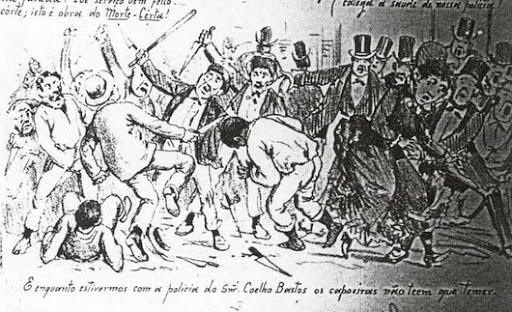
By the 19th century, head butts had evolved into the primary technique used by capoeiras, as documented in police records that highlighted the growing notoriety of capoeira in urban settings. This era saw a remarkable surge in interest and participation, prompting authorities to closely monitor the activities surrounding capoeira schools and the practitioners themselves.
In capoeira carioca, cabeçada was a deadly technique. An English visitor to Rio de Janeiro wrote in 1826 on this lethal technique:
They need no stiletto, ferro de gaiola, or any other weapon. In lieu of all these, they use only the head; and with it, they butt like bulls at the chest of their victim. I saw a field officer who had been murdered in this manner and thrown over the wall into his garden, where his family found him in the morning: the upper part of the body had been flattened as if the implement of death had been a mallet.
Between 1822 and 1824, German painter Johann Moritz Rugendas characterized capoeira as a game centered around headbutting, emphasizing not only the physicality of the movement but also the cultural significance it held within the Brazilian landscape, serving as a form of resistance and identity for enslaved and marginalized communities.
Two contestants face each other, each trying to butt his adversary in the chest with his head and knock the opponent down. They turn cartwheels and pause as they launch into an attack. Sometimes they stand like he-goats, butting at each other. The game often turns into a wild brawl when knives are drawn and blood is shed.[6]
Through Rugendas’ artwork, one can glimpse the vibrant energy and spiritedness of capoeira, which continues to resonate to this day, evolving while maintaining its historical roots in the struggle for freedom and self-expression.
Lethal headbutt techniques were also used in the 19th century Bahia.
On the night of February 22, 1883, the soldier José Raimundo de Souza, standing patrol in the Baixa dos Sapateiros, went to arrest the stevedore Celestino, author of a major conflict on that street, from whom he received a ‘cabeçada’ that caused him almost instant death.
Headbutts, once common in street-fighting capoeira for their effectiveness, are now used less frequently in the game, primarily as a defensive strategy against close opponents.
To execute a headbutt, the capoeirista bends down and strikes the opponent with their forehead, targeting various body regions such as the chest, jaw, or even the temple, depending on the opening and the intended impact. This technique not only serves as a powerful offensive move but also helps create space between the capoeirista and their adversary, allowing for a tactical retreat or a swift counterattack. Moreover, mastering the headbutt requires precise timing and body mechanics, as improper execution can lead to self-injury or ineffective blows. With the evolution of capoeira into a more dance-like performance art, the headbutt has become a less favored option, yet it remains a potent reminder of the martial roots from which this vibrant practice originated.
solar plexus, where one firm headbutt can be enough to bring down the opponent.
As long as there’s an opening in the defense, the possibility of a headbutt remains imminent. In this technique, the attacker rapidly approaches, gliding their head along the opponent’s chest with precision and agility, usually targeting sensitive areas like the chin, nose, or forehead upon contact. The speed and intent behind this maneuver can often catch an opponent off guard, making it a risky yet potentially effective tactic in certain situations. However, it’s crucial to emphasize that this technique should never be fully executed in a game situation due to its serious consequences. Not only can a headbutt lead to severe injuries for both the initiator and the target, but it can also result in disciplinary actions from officials, such as penalties or ejections. Understanding the gravity of this action is essential for athletes to maintain sportsmanship and ensure the safety of all players on the field.
According to mestre Pastinha and mestre Bimba, the headbutt, or cabeçada, is a dangerous technique in capoeira that can be effectively used at close range. It involves cunning application and can target the chest or face, often executed unexpectedly as opponents anticipate a withdrawal. Capoeiristas utilize various strategies to deliver headbutts, such as feigning dodges during ginga or dropping objects to surprise reckless opponents, and can also escape holds by using headbutts.
In capoeira carioca, different headbutts have specific names based on execution, such as caveira no espelho for a standing face strike and cocada for an upward jab under the chin. The cocada is performed by lowering the body to hit the opponent with the head, making it a deceptive move that can catch the adversary off guard. It can disorient and terrify the receiver, similar to the rabo de arraia, which is also known for its unexpected nature and effectiveness in combat situations.
The arpão de cabeça is a powerful headbutt that effectively utilizes the attacker’s body weight, initially shielding with crossed arms to create an illusion of vulnerability before delivering the strike with precision. This strikes not only aims to incapacitate but also serves to assert dominance in the rhythm of the game. Defense against a headbutt includes pulling back to hit the attacker’s head or quickly descending to kick upward, which requires agility and quick thinking. Learning to anticipate and react to these specific moves is crucial for any practitioner wishing to excel in capoeira, as each technique has its place in the fluid interplay of offense and defense that defines this dynamic martial art.



 Jogo Corpo Fechado