
“There are not more than five musical notes, yet the combinations of these five give rise to more melodies than can ever be heard. There are not more than five primary colours, yet in combination, they produce more hues than can ever been seen. There are not more than five cardinal tastes, yet combinations of
them yield more flavours than can ever be tasted.”
― Sun Tzu, The Art of War“
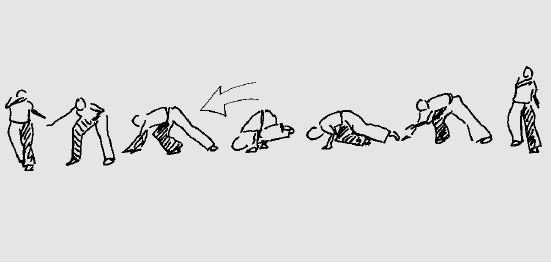
Capoeira Angola is a defensive martial art known for its intricate trap-like defenses designed to catch opponents off guard. It encompasses 8 basic defenses, each with unique unexpected attacks and counter attacks based on the opponent’s positioning. Mastery of these movements enables capoeiristas to defend against individuals carrying various weapons, including sticks, clubs, knives, and potentially even firearms with the appropriate skills.
Today, we’re going to examine a fundamental movement in Capoeira Angola, the QUEDA DE RINS.
Capoeira Angola’s “Queda de Rins,” or “fall on the kidneys,” is an essential ground movement that serves multiple functions in the game, reflecting the intricate blend of martial arts, dance, and music that defines Capoeira. It involves supporting the torso with an elbow and head, forming a 45° angle with the legs, which requires a combination of strength, coordination, and control.
To execute it properly, one must begin with their hands and head firmly on the floor, aligning the body to create a strong foundation, then twist their hips to rest on an elbow while ensuring that the legs remain elevated and engaged throughout the entire movement. It is essential to maintain a steady breathing pattern, as this will help in controlling the balance and flow of the exercise. Eventually, with practice and dedication, one can lift the legs entirely into the air, mastering the art of fluidity that Capoeira demands. Mastery of this movement not only contributes to strength, flexibility, and balance but also provides a solid foundation for exploring the myriad of movements inherent in Capoeira, enabling the practitioner to experience the beauty and rhythm of this dynamic martial art, all while building upper body stability and core strength.
Beginners should practice in stages, starting with proper hand and head placement and gradually increasing their skill level as they gain confidence, while advanced practitioners find the challenge in lifting their feet entirely, continuously refining their technique, adding variations, and enhancing their overall performance in the art of Capoeira, thus deepening their connection to the cultural roots and expressive nature of the discipline.
This technique can act as an esquiva, allowing the practitioner to evade an opponent’s attack gracefully while simultaneously maintaining balance and composure. Additionally, it serves as a crucial starting point for executing various techniques, making it a versatile move that can transition seamlessly into more complex maneuvers, such as flips or spins. This adaptability not only enhances the fluidity of movement but also establishes a connection between defensive and offensive actions. Alternatively, it can be transformed into an artistic flourish that showcases the practitioner’s style and creativity within the roda, creating an engaging spectacle that captivates both audiences and fellow practitioners alike. Ultimately, mastering this technique opens up a world of possibilities, enabling the individual to express their unique approach to the art while effectively navigating the dynamics of a live encounter.
Variations:
Queda de Rins has numerous variations that challenge balance and coordination further, each one designed to enhance physical stability and improve overall body awareness. These variations not only test the limits of one’s strength but also require a keen sense of timing and precision. As practitioners delve deeper into these complex movements, they discover how the interplay between gravity and motion can lead to a greater understanding of their own body’s capabilities. This exploration encourages a more mindful approach to physical activity, as individuals learn to navigate through various positions while maintaining control. Over time, mastering these variations can significantly boost confidence, providing a solid foundation for tackling more advanced challenges in the realm of physical fitness.
Queda de Rins is a versatile and essential movement in Capoeira Angola, adding both defensive and expressive elements to the game. This unique maneuver not only serves as an effective way to evade attacks from opponents but also showcases the fluidity and creativity inherent in Capoeira practice. As practitioners execute the Queda de Rins, they seamlessly transition between defense and counterattacks, demonstrating agility and strength.
Additionally, the movement embodies the rich cultural heritage of Capoeira, allowing players to express their individuality while remaining grounded in tradition. Through strong body control and rhythmic flow, the Queda de Rins encapsulates the spirit of Capoeira Angola, making it a vital component in a player’s repertoire.
 Jogo Corpo Fechado