

Capoeira Angola, often celebrated for its cultural richness, historical significance, and unique blend of movement, music, and ritual. However, a deeper, more ‘realistic’ examination reveals a complex and crucial duality in its practice: its direct applicability to both physical conflict (“violence”) and the cultivation of social harmony and personal well-being (“peace”). This dichotomy is not a contradiction but rather a reflection of the art form’s historical roots and its enduring relevance as a system of self-defense, resistance, and community building.
The Practical Reality of Capoeira Angola: From Clandestine Resistance to Modern Self-Defense
Historically, Capoeira was not merely a dance or an athletic pursuit; it was forged in the crucible of oppression. Developed as a clandestine form of combat by enslaved Africans in colonial Brazil, it served as an absolutely vital tool for survival and armed resistance against the brutal tyranny of their oppressors and the slave-catchers known as capitães do mato. The movements, cloaked in the guise of ritual and folklore, allowed practitioners to train lethal fighting techniques in plain sight, a masterful act of cultural and martial deception.
The Unflinching Reality: Capoeira Angola’s Combative Core

The designation of Capoeira Angola as “realistic” stems from its core philosophy: an unyielding recognition and dedicated mastery of its highly effective combative and tactical methodologies. This profound combat efficacy, however, is frequently veiled by the system’s characteristic, almost deceptive, aesthetics. At a superficial glance, a session of Capoeira Angola within the roda (the circle in which the art is performed) presents an image of fluid, low-to-the-ground grace, deliberate, almost near-meditative pacing, and an appearance that is often playful and non-contact. Yet, beneath this artistic facade, the fundamental movements and principles of the system are deeply rooted in practical, close-quarters fighting, strategically engineered to disable or effectively evade an opponent in a real-world confrontation.
The historical context of Capoeira Angola further cements its “realistic” dimension. Developed by enslaved Africans in Brazil, it was a necessary tool for survival, self-defense, and silent rebellion. It was designed to be inconspicuous—appearing as a dance or a ritualistic game to slave owners—while simultaneously functioning as a devastatingly effective martial art. This dual nature is the very essence of its deceptive power.
Combative Techniques and Strategic Deception
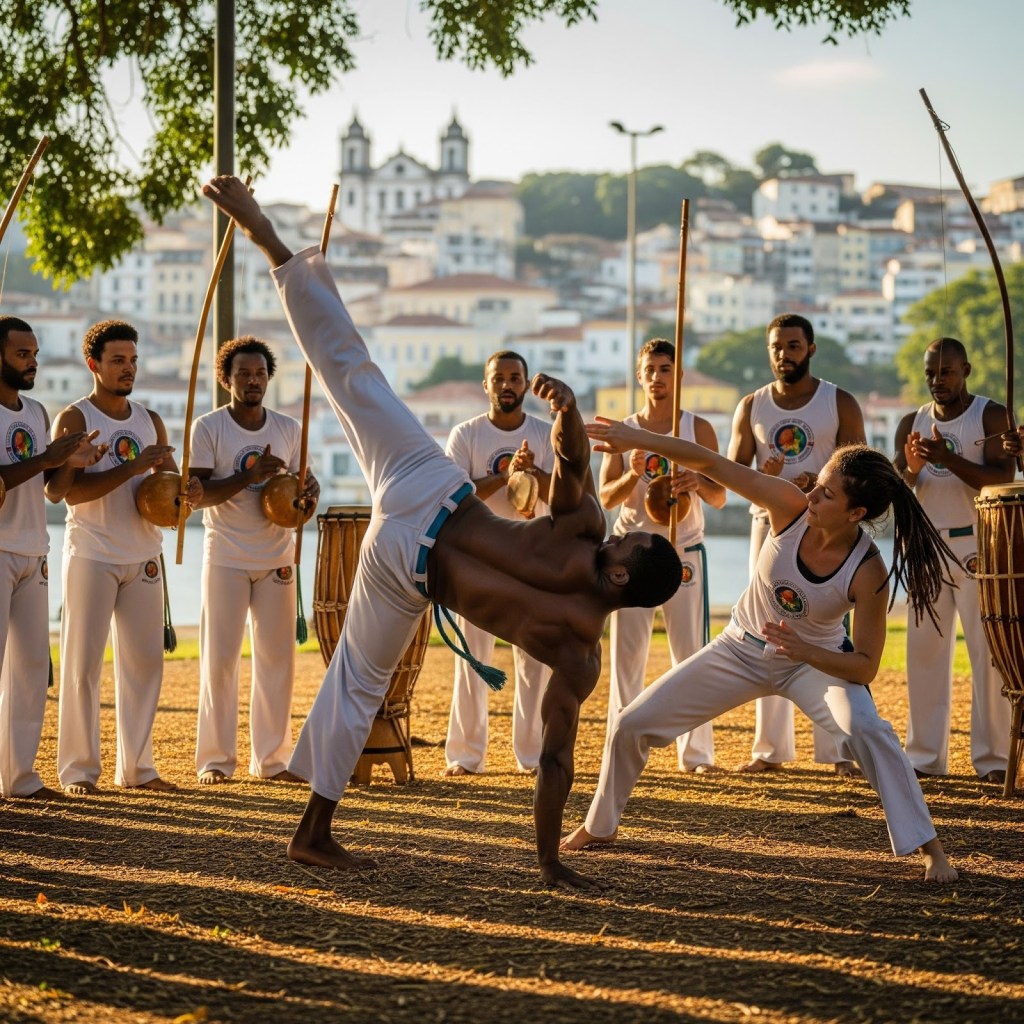
Key techniques within the Angola repertoire are explicitly and unapologetically combative, tailored for maximum disruption and force application.
- Sweeps and Takedowns (Rasteiras and Chapas): The swift, often unexpected sweeps (rasteiras) are not merely for show; they are precision strikes targeting an opponent’s lower body and base. Their goal is to instantly dismantle stability, sending the opponent crashing to the ground and making them vulnerable to follow-up strikes or disengagement. Similarly, the bênção (blessing), often misinterpreted as a simple push, is a powerful, straight-leg thrust kick used to create distance, break an opponent’s posture, or deliver a jarring impact to the midsection.
- Headbutts and Close-Range Strikes (Cabeçadas and Cotoveladas): The powerful headbutts (cabeçadas) are delivered with jarring, concussive force, often following a low dodge or a deceptive close-quarters movement. They are weapons of last resort or sudden opportunity, highly effective in clinching range. Various elbow strikes (cotoveladas) and knee strikes are integrated into the flow, exploiting openings created by the opponent’s overcommitment or momentary lapse in defense.
- Deceptive Ground Maneuvers: The low, ground-based movements—the signature of Angola—are fundamentally strategic. They allow the practitioner to evade high attacks, manage the distance, and transition into clinching, trapping, and finishing maneuvers with explosive speed. These ground movements hide the practitioner’s intent and position the body for powerful, upward-delivered attacks that an opponent may not anticipate.
The Power of Deliberate Pacing
Crucially, the slow, strategic pacing of Angola is not a reflection of weakness or a simple aesthetic choice; rather, it is a highly sophisticated method of psychological and physiological warfare. It functions on multiple levels:
- Energy Management: The slow movements conserve energy, allowing the practitioner to maintain a high level of physical engagement for an extended period, waiting for the perfect opportunity.
- Lulling the Opponent: This deliberate tempo is used to lull an opponent into a false sense of security, encouraging them to be careless, overcommit, or mistake the art for a mere dance. This is the core of the art’s deception (mandinga).
- Disguising Intent: The slow, fluid movements effectively mask the practitioner’s true intentions, making it nearly impossible for an adversary to predict the moment of attack. The transition from a graceful, low-speed motion to an attack is almost instantaneous.
This deliberate slowness allows for a split-second transition into the explosive power and surgical precision required to execute a disabling or fight-ending move. This capability—the seamless shift from passive deception to aggressive force—solidifies Capoeira Angola’s reputation not just as a cultural tradition, but as a formidably deceptive and profoundly effective fighting system.
A truly realistic approach to Capoeira Angola training emphasizes a deep, intuitive understanding of critical combative principles:
- Timing: The ability to move and strike precisely when the opponent is committed or off-balance.
- Distance Management (Jogo de Distância): The mastery of controlling the space between opponents, ensuring maximum defense and optimal offensive opportunity.
- Body Mechanics: The efficient and powerful use of the body as an integrated weapon system, where every movement has the potential for attack or defense.
By focusing on these principles, practitioners understand that the skills learned are potent tools for self-defense and conflict resolution. This combative realism acknowledges that, while Capoeira Angola promotes community, culture, and peace, its foundation is a highly effective fighting art that can and must be deployed for survival in dangerous, real-world scenarios.
The Foundation for Peace:
Conversely, the practice of Capoeira Angola is intrinsically linked to the pursuit of peace, both internal and communal. This aspect is manifested through several key elements:
- Ritual and Philosophy: The roda itself is a microcosm of society, where rules, respect, and mutual understanding are paramount. The art emphasizes malícia (cunning, street smarts) combined with mandinga (a mystical, almost magical quality of deception), which encourages outsmarting an opponent rather than simply overpowering them. This strategic, non-destructive engagement is a fundamental lesson in non-violent conflict resolution.
- Community and Respect: The highly structured nature of the classes, the mandatory use of Portuguese, the singing, and the playing of instruments foster discipline, cross-cultural communication, and deep mutual respect among practitioners (known as capoeiristas). The hierarchy of the school, headed by a Mestre, instills values of mentorship and humility.
- Physical and Mental Discipline: The rigorous training provides a positive outlet for aggression and frustration, channeling potential “violence” into constructive physical expression and artistic performance. The focus on rhythm, balance, and endurance cultivates inner peace, self-awareness, and mental fortitude.
In conclusion, the document titled “Realistic Capoeira Angola for violence and peace” argues compellingly that Capoeira Angola is far more than a mere dance or performance; it is a profound martial art that holds a unique, almost paradoxical, capacity for shaping its practitioners. It masterfully encapsulates the core duality of the human experience: the potential for effective violence and the aspiration for a peaceful existence.
The practice instills in its students the knowledge and physical skills necessary to defend themselves effectively, honoring its historical development as a clandestine, combative system created by enslaved Africans for survival and liberation. The realism of its application in a violent context is never dismissed but is instead embraced as a vital part of the art’s heritage and a foundation for personal security.
Simultaneously, however, Capoeira Angola transcends its combative roots by providing a comprehensive philosophical and cultural framework for living. Through its deeply embedded rituals, music, communal interaction, and respect for the Mestre (master), the art cultivates qualities essential for social harmony: discipline, which guides the relentless pursuit of skill; respect, which governs the relationship between players, the community, and the tradition; and an overarching commitment to a harmonious life, where conflict is minimized and human connection is valued.
Crucially, the art does not attempt to sanitize or ignore its violent lineage. Instead of repressing its potential for conflict, Capoeira Angola transmutes this raw energy—this potential for force—into a powerful, constructive, and culturally rich mechanism. The Roda (the circle in which Capoeira is played) becomes a controlled laboratory where the energies of conflict and cooperation are channeled through a dialogue of movement. This cultural mechanism ultimately promotes social cohesion, turning individual strength into collective resilience and self-defense into a tool for community building and peace. It is in this dynamic interplay—where the lessons of effective violence are used to frame a life dedicated to peace—that the art of Capoeira Angola truly finds its powerful and enduring significance.
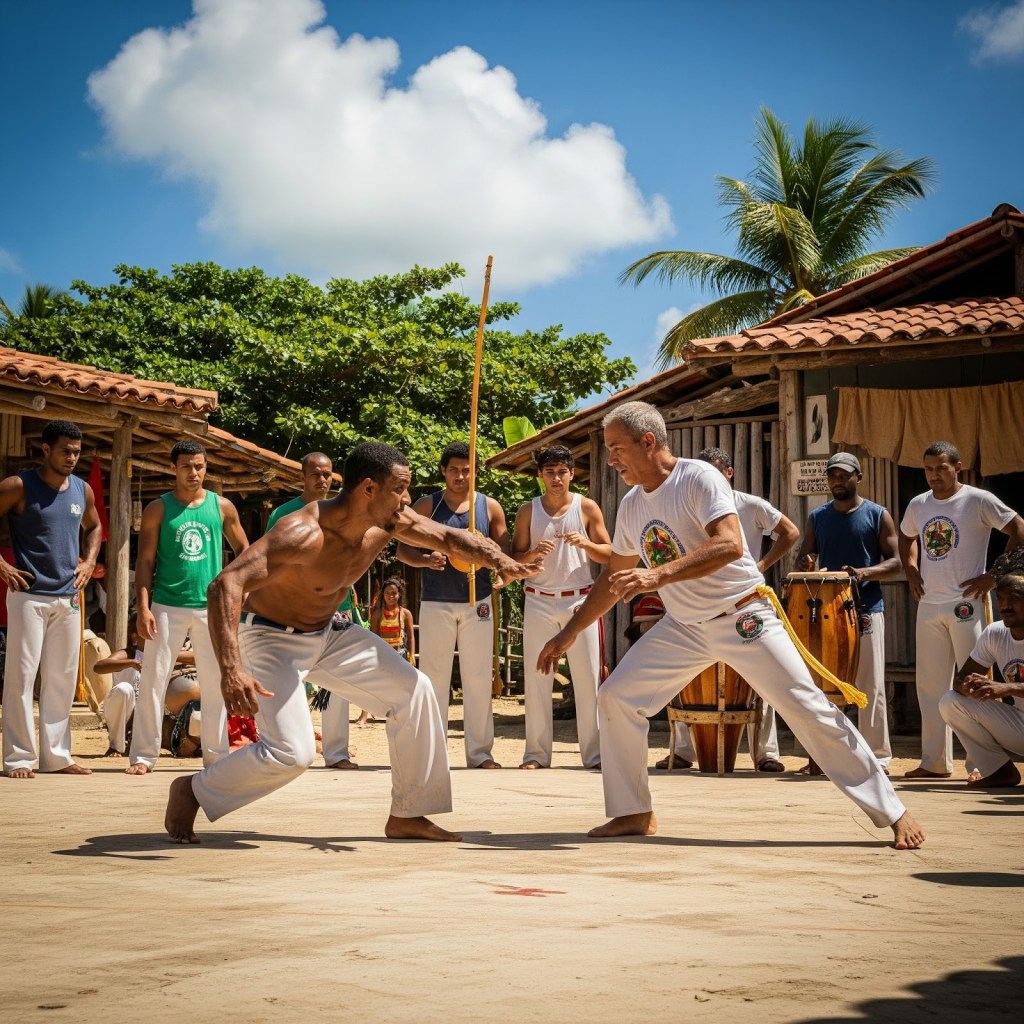
 Jogo Corpo Fechado