
“There are not more than five musical notes, yet the combinations of these five give rise to more than can ever be heard. There are not more than five primary colours, yet in combination, they produce more hues than can ever been seen. There are not more than five cardinal tastes, yet combinations of
them yield more flavours than can ever be tasted.”
― Sun Tzu, The Art of War“
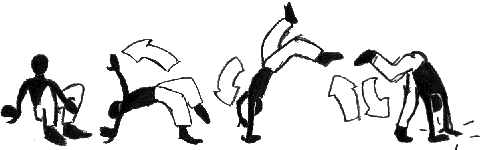
Today, I’m going to introduce you to the MACACO.
The Macaco in Capoeira is an acrobatic movement, often described as a “monkey flip,” involving a handstand and rotation, transitioning from a low crouch to a handstand and back down. In Capoeira, it’s not just a single move but a dynamic transition, often used to evade, attack, or flow into other movements, adding rhythm and creativity to the practice. Capoeira Angola and Capoeira Regional both utilize the Macaco, but the overall style and context of its use can differ significantly, showcasing the artistry and adaptability inherent in this Brazilian martial art. The macaco serves as a building block for more complex movements like the back handspring and can also be used as a launchpad for various attacks and kicks within the Capoeira game, including powerful aerial kicks that demonstrate both skill and agility. It involves an inverted motion where the capoeirista (Capoeira practitioner) places one hand on the ground behind them and swings their legs over, jumping in an arched trajectory that reflects both grace and strength. The macaco bears a strong resemblance to a back handspring but differentiates itself by typically starting from a low crouch and planting one hand behind the player, emphasizing the importance of starting low to gain momentum.
Learning the macaco, particularly the full backward version that showcases advanced skill, takes dedication and consistent practice over weeks and even months, requiring not just physical training but also mental resilience to overcome the challenges intrinsic to mastering this impressive maneuver.
In essence, the macaco is a dynamic and essential element of Capoeira, combining strength, flexibility, and coordination into a fluid and powerful acrobatic move that showcases the unique blend of martial arts and dance inherent to this Afro-Brazilian cultural expression. This acrobatic feat not only demonstrates remarkable physical prowess but also highlights the practitioner’s rhythm and timing, as they gracefully maneuver through the air, executing the move with precision and style. As a crucial component of Capoeira’s repertoire, mastering the macaco allows practitioners to enhance their overall agility and create impressive sequences that captivate audiences, transforming a simple fight into an intricate performance art.

 Jogo Corpo Fechado