
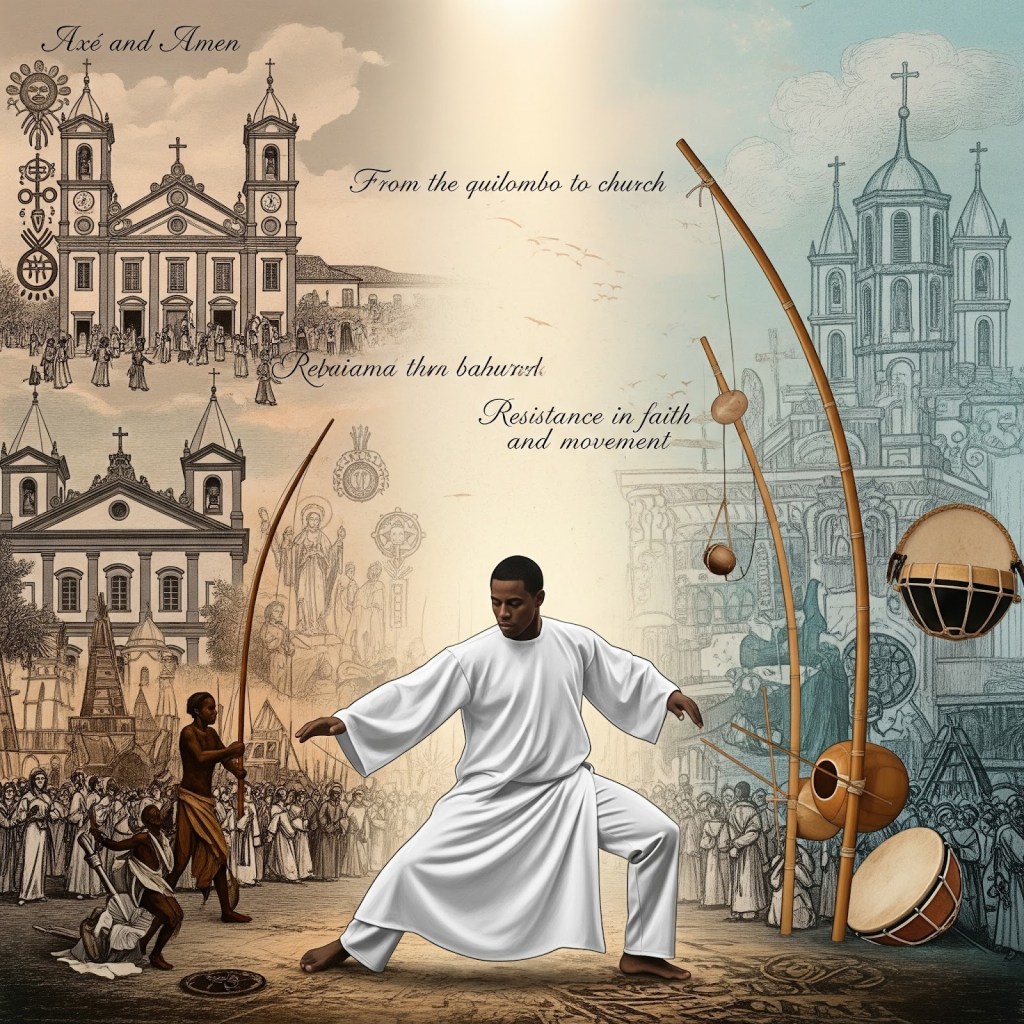
The relationship between Capoeira and Christianity, particularly Roman Catholicism, is complex and deeply rooted in the historical and cultural context of Brazil. Capoeira emerged during the era of slavery, primarily among enslaved Africans who were forcibly brought to Brazil. The Portuguese colonizers were overwhelmingly Catholic and imposed their religion on the enslaved population as a means of control and assimilation. This imposition was not always successful, leading to a syncretic blend of African spiritual traditions and Catholic practices, which is a defining feature of Brazilian culture and is also reflected, albeit subtly, within the practice of Capoeira itself.
During the colonial period, practitioners of Capoeira—primarily enslaved and later freed people of African descent—often had to hide or disguise their cultural and religious expressions to avoid persecution. The Portuguese authorities viewed African traditions as pagan and threatening to their control. Consequently, while the overt practice of Capoeira might not have been a religious ritual in the Catholic sense, the lives and spiritual worldviews of its early practitioners were inescapably linked to the mandated Catholic environment while simultaneously drawing upon deeply held African spiritual beliefs, such as Candomblé and Umbanda, which often syncretized African deities (Orishas) with Catholic saints.
For instance, while Capoeira itself is a martial art, dance, and game, it shares a cultural space where religious syncretism flourished. The rhythms of the berimbau and the songs often reference elements of the Afro-Brazilian world, which itself has a long history of blending with Catholicism. Some historical accounts suggest that the roda (the circle in which Capoeira is played) was an essential community space where all aspects of life, including veiled religious devotion, could be expressed away from the direct gaze of the slave masters and colonial authorities. Over time, as Capoeira moved from the secretive world of the enslaved to a more mainstream (though still sometimes marginalized) Brazilian practice, the influence of Catholicism remained an undeniable part of the national cultural backdrop, impacting everything from national holidays to daily expressions. However, it is crucial to note that Capoeira’s core ethos and movement vocabulary remain profoundly connected to its African heritage, using Catholicism’s presence as a backdrop of the society it developed within, rather than as a primary source of its physical or philosophical structure.
Syncretism and Cultural Survival:
- Forced Conversion: Enslaved Africans were often baptized and expected to practice Catholicism, but they secretly maintained and adapted their traditional African beliefs and spiritual practices.
- Religious Blending (Syncretism): This led to a form of religious syncretism, where African deities and spirits were associated with Catholic saints. For instance, in Afro-Brazilian religions like Candomblé and Umbanda, the orixás (deities) are often paired with Catholic saints, making the African traditions appear superficially Christian.
- Capoeira and Disguise: Capoeira itself served as a form of resistance and cultural survival, disguised as a dance or folklore to deceive the slave masters. While not a religious practice in the same way as Candomblé, Capoeira’s philosophy and worldview were deeply influenced by the spiritual and cultural environment of the senzalas (slave quarters) and quilombos (runaway slave settlements), which were hotbeds of syncretic religious life. The movements, songs, and rituals often carry subtle references or undertones reflecting this cultural and spiritual background.
Catholicism in Modern Capoeira:
- Cultural Dominance: As the dominant religion in Brazil, Catholicism’s presence is pervasive in the national culture, and Capoeira, being a national art form, is not entirely immune to this influence, especially in a historical context.
- The Role of Faith: Many Capoeiristas, being Brazilian, are practicing Catholics, and their personal faith may inform their worldview. However, this is a personal choice, not an intrinsic religious requirement of the art form itself.
- Contrast with African Roots: It is important to distinguish between the influence of African spiritual and religious traditions (which have a more direct, albeit historically suppressed, link to Capoeira’s origins and rituals) and the influence of the dominant Catholic culture. While Capoeira masters may invoke general concepts of God, respect, and morality, its core ritualistic elements (such as the axé or energy, and the spiritual significance of the berimbau) draw more heavily on African cosmology than on official Catholic doctrine.
The relationship between Capoeira and Catholicism is a nuanced tapestry woven from historical necessity, cultural syncretism, and personal belief, rather than a direct theological alignment. Capoeira emerged and evolved within the intensely Catholic-dominated colonial society of Brazil. This environment was fundamentally hostile to overt expressions of African culture, religion, and identity. Consequently, the preservation of Afro-Brazilian spiritual practices, philosophical tenets, and martial techniques demanded strategies of concealment and adaptation.
This historical context is the primary driver of Capoeira’s connection with Catholicism. The art form, in its development, had to operate under the veneer of acceptable European, and specifically Catholic, practices to survive the brutal suppression enforced by the colonial and later imperial authorities. This process of syncretism was not unique to Capoeira, characterizing much of Afro-Brazilian culture, including the major religions of Candomblé and Umbanda. In Capoeira’s case, while there may not be explicit Catholic rituals embedded within the jogo (the game) or roda (the circle), its mere existence in public space was permitted only because its deeper, non-European roots were successfully disguised.
Therefore, while the Catholic faith is undeniably the personal religion of countless Capoeiristas throughout history and in the present day—a natural demographic reality in Brazil—it is crucial to distinguish this personal belief from the spiritual and philosophical core of the art itself.
The deepest spiritual and philosophical roots of Capoeira trace back not to European Catholicism, but to the collective Afro-Brazilian struggle for freedom, dignity, and cultural survival. These roots are embedded in:
- African Cosmologies: Influences from various West and Central African spiritual traditions, which supplied the foundational concepts of energy, community, and the connection between the physical and spiritual realms that permeate Capoeira’s movements and music.
- Syncretism: The forging of a new spiritual and cultural environment where African deities and spirits (the Orixás or Nkisis) were often hidden behind the guise of Catholic saints for protection and continuity.
- Resistance Philosophy: The fundamental ethos of the art form—the cleverness (malícia), the evasiveness, the connection to the land and the enslaved ancestors (or ancestrais)—all stem from the socio-political reality of colonial oppression.
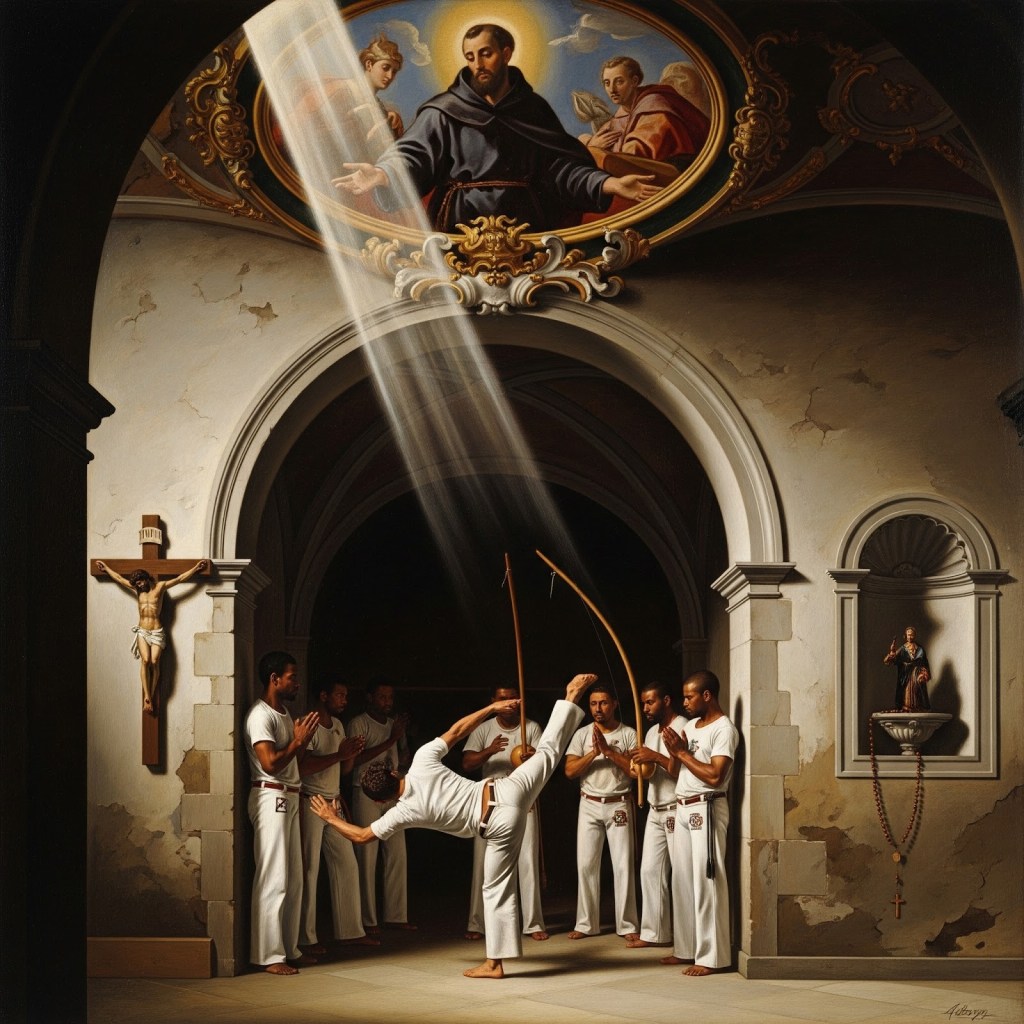
Capoeira’s relationship with Catholicism is fundamentally a historical and contextual one—a direct byproduct of its development and survival within a colonial Brazilian society that was religiously exclusive and dominated by the Catholic Church. The spiritual and philosophical resonance of Capoeira, however, is not derived from this forced association but rather from the rich, syncretic cultural environment forged through the ingenuity, resistance, and sheer resilience of enslaved and free Afro-Brazilians who sought to maintain their identity and traditions against the oppressive colonial regime. This environment allowed African spiritual practices to merge and mutate with Christian forms, a necessary adaptation for cultural endurance.Capoeira and Other Christian Traditions
Beyond Catholicism, the interaction between Capoeira and the myriad of other Christian denominations is significantly less defined, often existing on a spectrum that is highly dependent on the specific denomination’s theological framework, the local congregation’s cultural orientation, and the individual practitioner’s personal convictions.
Sources of Conflict and Condemnation:
On one end of this spectrum are certain conservative or fundamentalist Christian groups. These denominations frequently approach Capoeira with overt suspicion or outright condemnation. Their opposition typically stems from two primary concerns:
- Afro-Brazilian Religious Roots: They often perceive Capoeira as inextricably linked to or a conduit for Afro-Brazilian religious traditions such as Candomblé or Umbanda. This view may focus on real, historical, or perceived symbolism (e.g., specific rhythms, the meaning of certain movements, or the historical association of early capoeiristas with these faiths) which are deemed antithetical to orthodox Christian belief.
- Worldly Activities: Capoeira’s characteristic blending of dance, music, and combat can also lead to its dismissal as a “worldly” or “frivolous” activity that distracts from spiritual focus. The expressive nature of the art, particularly the emphasis on the body, can conflict with ascetic interpretations of faith held by some conservative groups.
Neutrality and Acceptance:
In contrast, a vast segment of the Christian world, including most mainline Protestant denominations (e.g., Methodists, Lutherans, Anglicans/Episcopalians), Orthodox churches, and many non-denominational communities, maintains a much more neutral, and often explicitly accepting, stance toward Capoeira. These traditions generally possess a greater capacity for cultural engagement and a more nuanced view of activities that originate in non-Western contexts.The Personal Negotiation of Meaning
For the Christian practitioner who engages with Capoeira from within these various traditions, the process of reconciling their faith with their art often becomes a deeply personal negotiation of meaning and interpretation. This negotiation frequently manifests in two distinct approaches:
1. Emphasizing the Secular, Cultural, and Physical:
Many Christian capoeiristas choose to interpret the practice primarily through a secular and cultural lens. They actively emphasize Capoeira’s non-spiritual dimensions, seeing it as:
- Legitimate Exercise and Physical Discipline: A robust and comprehensive form of physical training and fitness, akin to any established sport.
- Community Building: A positive social structure that fosters camaraderie, mutual respect, and mentorship.
- Cultural Heritage and Art Form: A valuable and legitimate means of participating in, preserving, and celebrating Brazilian and Afro-diasporic cultural history, similar to learning folk dance, playing traditional music, or engaging in martial arts.
To maintain this distinction, they may consciously downplay or reinterpret any potentially religious elements within the roda. For example:
- The Concept of Axé: The invocation of axé (spiritual energy or positive life force, a term with distinct roots in Yoruba cosmology) might be stripped of its religious connotation and understood instead as merely a secular, generalized expression of positive intent, vitality, or collective energy—a shared “vibe.”
- Songs and Prayers: Certain songs or opening prayers within the roda whose origins might be ambiguous or tied to Afro-Brazilian rituals are treated as historical artifacts—part of the art’s necessary traditional fabric—rather than objects of personal spiritual adherence or worship. The focus remains on the historical context of resistance and survival they represent, not on any theological message.
2. Finding Deeper Complementary Resonance:
Conversely, other practitioners from these same denominations may discover a more profound, complementary resonance between the principles inherent in Capoeira and their established Christian ethical and moral values. They may view Capoeira’s core requirements as being spiritually enriching:
- Ethical Principles: The consistent practice of Capoeira inherently demands discipline, respect (respeito), humility, patience, and perseverance—all virtues that align strongly with Christian spiritual development.
- Community and Support: The structured reliance on the roda for safety, motivation, and learning is seen as a tangible expression of Christian community support and fellowship.
For these individuals, the Capoeira roda functions as a space of shared human experience and cultural exchange that they find entirely compatible with their spiritual life. The art is integrated simply as a cultural activity—analogous to participation in folk music, martial arts, or dramatic arts—without necessitating a theological compromise or the feeling that they are adopting conflicting spiritual practices.
Ultimately, for the vast majority of non-fundamentalist Christians, the acceptance or rejection of Capoeira remains a nuanced matter of individual conscience informed by personal interpretation of cultural practices and their relationship to the core, non-negotiable religious dogma of their faith. This dynamic process involves a deep and often challenging reflection on the ways in which traditions can coexist with, or even enhance, their spiritual beliefs. Many believers find themselves at the intersection of cultural heritage and spiritual integrity, weighing the benefits of engaging in Capoeira against the potential conflicts it might generate with their community’s values. As they navigate this personal journey, the integration of Capoeira can evoke discussions about the importance of cultural expression, the celebration of diversity within the Christian faith, and the potential for enriching one’s spirituality through the embrace of varied practices, ultimately leading to a more profound and personalized understanding of their beliefs.

 Jogo Corpo Fechado