
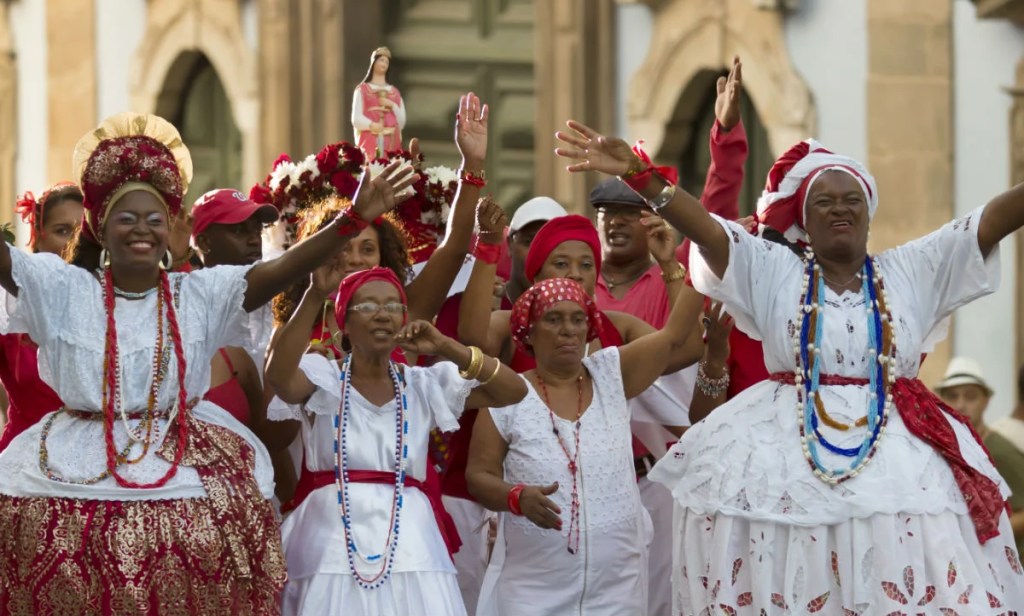
This is a part of my “ROOTS OF CAPOEIRA” series which I started on the Blog section of this website, where I post about certain aspects of Afro-Brazilian culture.
On another PAGE, I typed about hoe certain aspectc of Candomble relates to Capoeira Angola. Now on this page, I decided to focus on the religion itself.
Now this is a very brief introduction into the Afro-Brazilian religion of Candomble. This religion has deep roots in the African spiritual traditions brought to Brazil by enslaved individuals during the transatlantic slave trade. Candomble incorporates a rich tapestry of rituals, music, dance, and spiritual beliefs that are intertwined with the natural world. It encompasses a diverse pantheon of orixas, representing different forces of nature, and each orixa is associated with specific rituals and attributes. The syncretic nature of Candomble reflects the blending of African traditions with elements of Christianity and indigenous beliefs, creating a unique and vibrant spiritual system. If you are intrigued by the complexity and cultural significance of Candomble, you may want to explore the in-depth article HERE, which offers a comprehensive overview of this fascinating religion.
Now, let’s do this.
Candomblé is a religion in Brazil that blends elements from African cultures, Catholicism, and indigenous South American beliefs. It was developed by enslaved Africans and encompasses rituals such as ceremonies, dance, animal sacrifice, and personal worship. The religion, once concealed, now boasts a membership of at least two million people in several South American countries.
Followers of Candomblé believe in a pantheon of gods, each serving a single all-powerful deity, with individuals having personal deities for inspiration and protection in their pursuits.
Candomblé, initially called Batuque, emerged from the culture of enslaved Africans brought to Brazil by the Portuguese Empire between about 1550 and 1888. The religion was an amalgamation of the West African Yoruba, Fon, Igbo, Kongo, Ewe, and Bantu belief systems intertwined with indigenous American traditions and some of the rituals and beliefs of Catholicism. The first Candomblé temple was built in Bahia, Brazil, in the 19th century.Candomblé grew increasingly popular over the centuries; this was made easier by the almost complete segregation of people of African descent.Because of its association with pagan practices and slave revolts, Candomblé was outlawed and practitioners were persecuted by the Roman Catholic church. It wasn’t until the 1970s that Candomblé was legalized and public worship was allowed in Brazil.For several hundred years, the Portuguese transported enslaved Africans from West Africa to Brazil. There, Africans were supposedly converted to Catholicism; however, many of them continued to teach their own culture, religion, and language from the Yoruba, Bantu, and Fon traditions. At the same time, Africans absorbed ideas from the indigenous people of Brazil. Over time, enslaved Africans developed a unique, syncretistic religion, Candomblé, which combined elements of all these cultures and beliefs.Enslaved Africans were assumed to be practicing Catholics, and it was important to maintain the appearance of worshipping according to Portuguese expectations. The Catholic practice of praying to saints was not radically different from the polytheistic practices that originated in Africa. For example, Yemanjá, the sea goddess, is sometimes associated with the Virgin Mary, while the brave warrior Ogum is similar to Saint George. In some cases, images of Bantu gods were secretly hidden inside the statues of Catholic saints. While enslaved Africans appeared to be praying to Catholic saints, they were, in fact, practicing Candomblé. The practice of Candomblé was sometimes associated with slave rebellions.
Many of the enslaved Africans brought to Brazil had been raised as Muslims (malê) in Africa. Many of the beliefs and rituals associated with Islam were thus integrated into Candomblé in some areas of Brazil. Muslim practitioners of Candomblé, like all practitioners of Islam, follow the practice of worshipping on Fridays. Muslim practitioners of Candomblé were major figures in slave revolts; to identify themselves during revolutionary action they dressed in traditional Muslim garb (white garments with skull caps and amulets). Candomblé was practiced freely in African communities, though it was practiced differently in different locations based on the cultural origins of the enslaved groups in each area of Brazil. The Bantu people, for example, focused much of their practice on ancestor worship—a belief they held in common with indigenous Brazilians. The Yoruba people practice a polytheistic religion, and many of their beliefs became part of Candomblé. Some of the most important priestesses of Candomblé are descendants of enslaved Yoruba people. Macumba is a general umbrella term that refers to all Bantu-related religions practiced in Brazil; Candomblé falls under the Macumba umbrella as do Giro and Mesa Blanca. Non-practitioners sometimes refer to Macumba as a form of witchcraft or black magic, though practitioners deny this.
Candomblé has no sacred texts; its beliefs and rituals are entirely oral. All forms of Candomblé include belief in Olódùmarè, a supreme being, and 16 Orixas, or sub-deities. There are, however, seven Candomblé nations (variations) based on location and on the African ancestry of local practitioners. Each nation worships a slightly different set of Orixas and has its own unique sacred languages and rituals. Unlike many Western religions, Candomblé does not have a distinction between good and evil. An individual’s destiny may be ethical or unethical, but unethical behavior does have negative consequences. Individuals determine their destiny when they are possessed by their ancestor spirit or Egum, usually during a special ritual that involved ceremonial dancing. Candomblé is not focused on the afterlife, though practitioners do believe in a life after death. Believers work to accumulate axe, a life force, which is everywhere in nature. When they die, believers are buried in the earth (never cremated) so that they can provide axe to all living things. Candomblé temples, or houses, are managed by groups organized in “families.” Candomblé temples are almost always run by women, called ialorixá, with the support of a man called babalorixá. Priestesses, in addition to running their houses, may also be fortune-tellers and healers.
Priests are admitted by approval of deities called Orixás; they must also possess certain personal qualities, go through a complex training process, and participate in initiation rites which can take up to seven years. While some priests are able to fall into trance, some are not. While all Candomblé nations have similar forms of organization, priesthood, and initiation, they are not identical. Different nations have slightly different names and expectations for priests and initiates.The initiation process starts with a seclusion period of several weeks, after which the priest who leads the initiate’s house goes through a divination process to determine what the initiate’s role will be during their time as a novice. The initiate (also called an iyawo) may learn about Orixa foods, learn ritual songs, or look after other initiates during their seclusion. They must also go through a series of sacrifices in their first, third, and seventh years. After seven years, iyawo become elders—senior members of their family.Candomblé practitioners believe in a Supreme Creator, Olodumare, and Orixas (deified ancestors) which were created by Olodumare. Over time, there have been many Orixas—but contemporary Candomblé usually refers to sixteen.Orixas offer a link between the world of spirit and the human world, and each nation has its own Orixas (though they can shift from house to house as guests). Each Candomblé practitioner is associated with their own Orixa; that deity both protects them and defines their destiny. Each Orixa is associated with a particular personality, force of nature, type of food, color, animal, and day of the week.
In addition to these practices, the role of music and dance holds great significance in Candomblé ceremonies, serving as a means to connect with the spiritual realm and express devotion to the Orixas. The rhythmic beats of the drums and lively movements form an integral part of the religious gatherings, embodying the energy and presence of the deities in the midst of the community. Through these expressions, practitioners honor and communicate with the Orixas, seeking blessings, guidance, and spiritual connection. The vibrant and colorful attire worn during these ritualistic dances also symbolizes the connection with the deities, reflecting the unique attributes and characteristics associated with each Orixa. The captivating blend of music, dance, and symbolic representations adds a profound depth to the religious experiences within the Candomblé tradition, fostering a deeper understanding and reverence for the spiritual entities and their influence on the lives of the practitioners.
Worship takes place in temples with specific spaces for the gods, where worshippers must wear clean clothes and ritually wash before participating in ritual worship services. The service begins with priests and initiates preparing for the event, involving activities such as washing costumes, decorating the temple, preparing food, and making offerings. The worship includes reaching out to the gods, falling into trances, music, dance, and ritualistic choreographed dances. It culminates with the worshippers sharing a banquet after the completion of the ritual.

I hope you enjoyed reading my brief introduction to Candomble. I’ll post more about it and other Afro-Brazilian religions as well as other expressions of Afro- Brazilian culture on the blog portion of this website. And Remember, The root of this art form, as well as capoeira is the Afro-Brazilian People.
 Jogo Corpo Fechado