

This article delves into my personal perspective on the multifaceted relationship between Capoeira and religion. I am keenly aware that this is a subject frequently met with diverse viewpoints, often leading to impassioned discussions and, at times, considerable contention within and beyond the Capoeira community. Therefore, I acknowledge and accept full responsibility for any inaccuracies, misinterpretations, or unintended implications that may arise in my exploration of this inherently complex and sensitive topic.
My primary objective is to embark on an insightful journey, exploring the various profound ways in which spiritual and religious elements have historically intertwined with the fundamental development and ongoing practice of Capoeira. This exploration will trace its origins from its deeply rooted African ancestry, particularly focusing on the rich cultural and spiritual traditions brought by enslaved Africans to the Americas, through its dynamic evolution and transformation within the unique socio-cultural landscape of Brazil. It is crucial to understand that while these connections are significant, individual experiences and beliefs within the global Capoeira community are incredibly varied and personal. This essay will strive to highlight these historical and cultural linkages while respecting the diversity of contemporary practitioners’ spiritual paths.
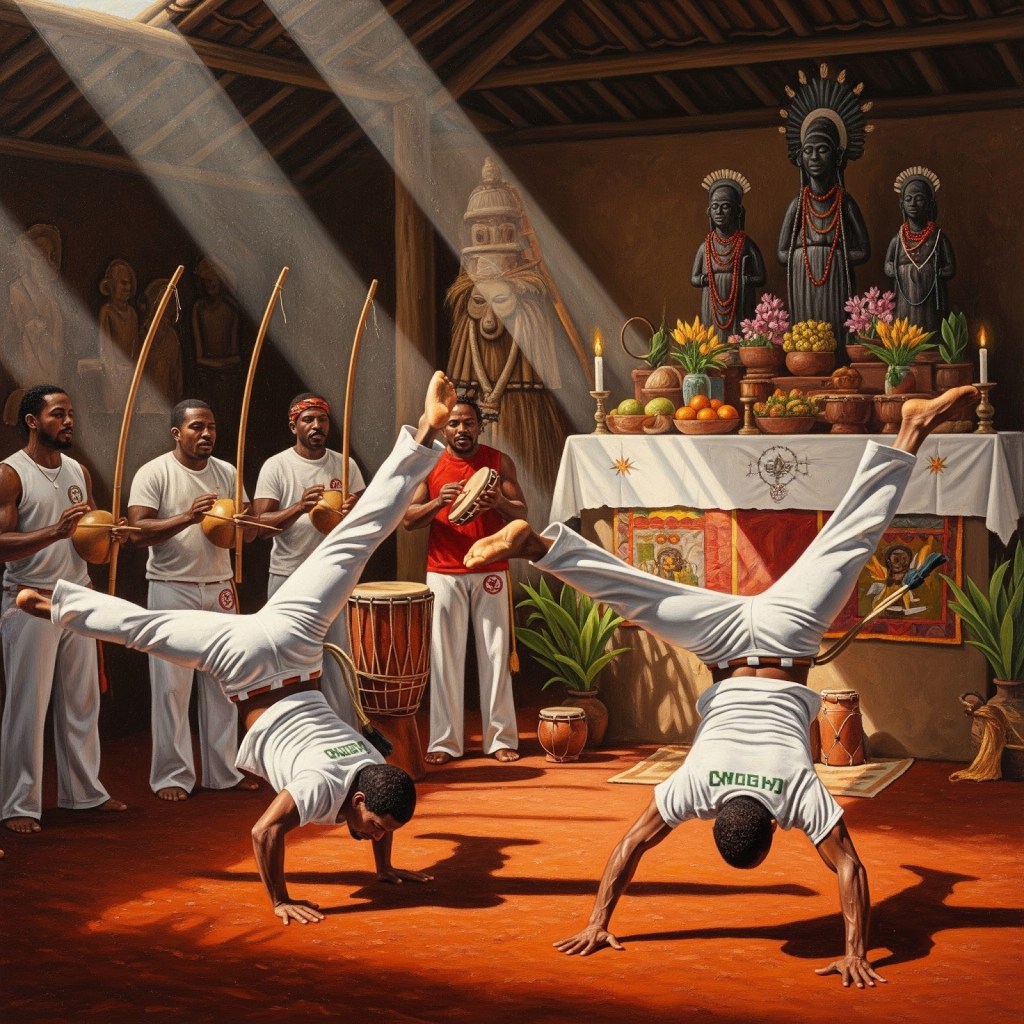
Capoeira, far from being merely a physical discipline, represents a profound and intricate tapestry woven from history, spirituality, and vibrant cultural pride. It stands as a powerful testament to the enduring resilience of Afro-Brazilian communities, a living legacy that continually thrives as a vital element of Brazil’s rich cultural landscape, and a potent illustration of how art can serve as an indispensable vehicle for cultural preservation and expression. The deep and undeniable connection between capoeira and Candomblé is central to understanding its essence. The rhythmic foundations of capoeira are deeply intertwined with Candomblé rhythms and chants, further reinforcing this spiritual and cultural bond. Within the dynamic space of the roda (circle), practitioners engage in a profound dialogue that embodies not only the martial aspects inherent in capoeira but also the profound communal solidarity that Candomblé fervently emphasizes.

As capoeira journeyed through time and evolved, it gradually permeated mainstream Brazilian culture. Yet, despite its broader acceptance, its roots remain firmly and unyieldingly planted in the rich African traditions from which it first emerged. The capoeira roda itself transcends the ordinary, serving as a consecrated space for both spirited performance and profound spiritual expression. Here, practitioners honor their ancestors and celebrate the rich cultural traditions that profoundly influence every movement, every interaction, and every beat of the drum.
This strong bond between capoeira and Candomblé is illuminated by several key aspects:
- Oral Traditions and Ancestry: Both Candomblé and capoeira are vibrant repositories of oral traditions, meticulously passed down through generations. The profound respect for ancestors and elders, a core tenet of Candomblé, finds its direct parallel in the carefully structured hierarchy and deep reverence shown to mestres (masters) within capoeira. These oral traditions ensure the continuity of knowledge, rituals, and the very spirit of both practices.
- Music and Rhythm: Music serves as the pulsating heart of both traditions. The complex rhythms generated by instruments like the atabaque (a hand drum) in Candomblé ceremonies are often strikingly similar, and in some cases, identical to those used to ignite the energy of capoeira rodas. The berimbau, the iconic and central instrument in capoeira, carries a profound spiritual significance. Many believe it acts as a powerful conduit for spiritual energy, connecting practitioners to a deeper, unseen realm. The intricate interplay of music, rhythm, and song in both practices fosters a shared sense of community and spiritual elevation.
- Movement and Symbolism: The fluid, often acrobatic and dance-like movements that define capoeira can be seen as direct reflections of the ceremonial dance movements within Candomblé rituals. These ritualistic dances are meticulously performed to invoke and honor the Orixás (deities). Furthermore, specific movements and gestures within capoeira are imbued with symbolic meanings deeply rooted in Candomblé cosmology. For instance, the ginga, the foundational and continuous swaying movement of capoeira, has been interpreted as a ritualistic dance in itself—a preparatory movement that primes both the body and mind, echoing the preparatory movements found in sacred religious ceremonies. This intricate connection between physical movement and spiritual meaning elevates capoeira beyond mere exercise.
- Community and Resistance: Candomblé historically provided a vital, often clandestine, space for enslaved Africans to gather, practice their culture, and organize amidst brutal oppression. Capoeira, frequently disguised as an innocent dance or game, served a remarkably similar purpose. It allowed practitioners to covertly develop formidable fighting skills essential for self-defense and resistance against their oppressors. Both traditions offered an invaluable sense of community, identity, and empowerment in the face of unimaginable hardship and brutality, fostering a spirit of defiance and resilience.
- Ritualistic Elements: The roda (circle) in capoeira, where the “game” is played, transcends its physical boundaries to be viewed as a sacred space, remarkably akin to the ritual circles central to Candomblé ceremonies. The energetic call-and-response singing, the rhythmic clapping, and the palpable energy generated within the roda collectively create an atmosphere that extends far beyond simple physical exercise. It is frequently described as a form of active meditation or profound spiritual communion, a space where the individual and the collective connect on a deeper, more spiritual plane.
The Orixás are foundational to the Candomblé religion, representing a pantheon of deities with immense cultural and spiritual significance, profoundly rooted in the ancient Yoruba tradition of Ifá. To truly grasp the essence and profound role of the Orixás within Candomblé, it is imperative to first delve into and comprehend the foundational principles of Ifá itself.
What is Ifá?
Ifá transcends a mere system of divination; it is the very essence of existence, the primordial narrative of creation. It encompasses every aspect of reality, both animate and inanimate, from every creature that graces this earth to entities beyond our immediate perception. To truly know Ifá is to unlock the profound mysteries of existence, to grasp the intricate tapestry of the past, present, and future of all beings. It offers profound insights into the origins of the Irúnmọlẹ̀ and Òrìsà, unveiling their inherent strengths, unique qualities, and interconnectedness. Fundamentally, knowing Ifá is to know the origin of ourselves—the divine spark that resides within our consciousness and the portion of our being that still dwells in the celestial realm, connecting us to the source of all creation.
Ifá is more than just a system for predicting future events or understanding the present; it is a holistic philosophy, a spiritual science, and a comprehensive worldview that explains the fundamental nature of the universe. It serves as the foundational wisdom tradition of the Yoruba people and has profoundly influenced various cultural and spiritual practices across the globe, including those within the practice of Capoeira. At its core, Ifá embodies the very breath of existence, the initial blueprint for all that is. It recounts the primordial narrative of creation, detailing the intricate processes through which the cosmos, life, and consciousness came into being. This foundational understanding posits that everything, from the smallest particle to the largest galaxy, from the visible world to the unseen spiritual realms, is interwoven within the grand design of Ifá.
The scope of Ifá is all-encompassing. It permeates every aspect of reality, both the tangible and the intangible. This includes every creature that graces this earth, from the smallest insect to the most majestic animal, each imbued with its own unique purpose and connection to the divine. Beyond our immediate, sensory perception, Ifá also encompasses entities and forces in the spiritual dimensions, the realms of ancestors, spirits, and deities. It provides a framework for understanding their roles, their interactions, and their influence on the human experience.
To truly know Ifá is to embark on a journey of profound discovery, to unlock the deepest mysteries of existence itself. It is to grasp the intricate tapestry of time, understanding how the past shapes the present, and how both converge to forge the future of all beings. Through its sacred texts, known as the Odu Ifá, a vast compendium of wisdom, stories, proverbs, and philosophical insights is revealed, offering guidance for navigating life’s challenges and understanding its inherent complexities.
Ifá, a complex and ancient Yoruba religious and divinatory system, serves as an unparalleled repository of knowledge regarding the Irúnmọlẹ̀ and Òrìṣà. These divine entities, central to the rich tapestry of Yoruba spiritual cosmology, are far more than mere mythological figures; they are understood as primordial spirits and deities, each embodying distinct facets of the divine and natural world.

Through the profound wisdom encapsulated within Ifá, their intricate origins are meticulously unveiled. Ifá illuminates their individual strengths, showcasing the unique powers and attributes that define each Irúnmọlẹ̀ and Òrìṣà. It details their specific qualities, offering nuanced insights into their personalities and characteristics, which are often reflected in their associated natural phenomena, human endeavors, or moral principles. Furthermore, Ifá precisely delineates their individual domains of influence, mapping out the specific aspects of life, nature, or human experience over which they preside. From the oceans to the forests, from justice to creativity, each deity holds sway over a particular realm, guiding and shaping its manifestations.
Crucially, Ifá underscores the intricate interconnectedness of these divine beings, both within the celestial hierarchy and in their relationship with humanity. It reveals how they operate not as isolated entities, but as an elaborate and interdependent system, contributing to the harmonious functioning of the cosmos. This interconnectedness is vital for understanding their roles as intermediaries. They act as essential bridges between Olódùmarè, the supreme divine source, and the earthly realm, translating divine will and energy into tangible experiences and lessons for humanity. Through their guidance, protection, and sometimes challenging interventions, the Irúnmọlẹ̀ and Òrìṣà are believed to steer humanity towards spiritual growth, enlightenment, and the fulfillment of their individual destinies. They are not distant, detached gods, but active participants in human affairs, constantly interacting with and influencing the world.
At its core, the study of Ifá is a journey into the fundamental nature of existence, offering a profound understanding of our own origins and our intrinsic connection to the divine. It is an exploration that transcends mere intellectual comprehension, inviting us to recognize and intimately connect with the divine spark that resides within the very fabric of our consciousness. This divine spark represents the intrinsic, indestructible essence that seamlessly links us to the ultimate source of all creation, an eternal wellspring of wisdom and being.
Ifá’s teachings unveil a powerful truth: a significant portion of our being, our spiritual essence, continues to dwell in the celestial realm. This enduring presence maintains an unbroken, eternal connection to the divine, acting as a constant tether to the cosmic source. Furthermore, this connection extends beyond the individual, linking us to the collective consciousness of all existence. This profound understanding serves as a powerful catalyst, fostering an unparalleled sense of unity, purpose, and spiritual belonging within each individual. It is a constant and gentle reminder of our inherent divinity, an undeniable truth that reverberates through our entire being, and underscores our interconnectedness with all life forms and the universe itself.
Through the dedicated study and consistent practice of Ifá, an individual embarks on a profound and transformative path of self-discovery and enlightenment. This is not merely an intellectual pursuit, but a deeply experiential journey that cultivates a comprehensive understanding of existence itself.
The exploration begins with the intricate complexities of the world around them – a world governed by immutable physical laws that dictate the movement of celestial bodies and the growth of the smallest organisms. It delves into the energetic flows that permeate all things, from the subtle currents within living beings to the grander, invisible forces shaping ecosystems and climates. Furthermore, it encompasses a deep appreciation for the diverse inhabitants of this planet, recognizing the interconnectedness of all life and the unique contributions of each species.
However, and perhaps more importantly, the journey through Ifá leads to an illumination of the spiritual architecture of one’s own being, a profound and intricate structure that governs our existence. It meticulously reveals the inner workings of our consciousness, moving beyond the superficial layers of ego and societal conditioning to uncover the profound depths of our spiritual self. This involves recognizing the inherent divinity within, a spark of the divine creator that resides in every individual, and understanding the ancestral lineages that contribute to our current form, connecting us to a rich tapestry of history and wisdom. Furthermore, Ifá emphasizes acknowledging the subtle energies that define our unique spiritual blueprint, the unseen forces and vibrations that shape our essence and purpose. Through this comprehensive process of self-discovery, Ifá helps individuals to uncover the profound purpose embedded within their existence – a purpose often obscured by the noise of societal expectations, material distractions, and the illusions of modern life. This journey is not merely intellectual; it is an experiential exploration that transforms one’s understanding of self and the universe.
This deep introspection and spiritual excavation ultimately clarify our unique and vital place within the grand, interconnected cosmic order. We begin to perceive ourselves not as isolated entities, adrift and disconnected in a vast, indifferent universe, but as integral, indispensable components of a magnificent and divinely orchestrated tapestry. This realization fosters a profound sense of belonging, an understanding that we are intimately connected to all life, and instills a deep sense of responsibility for our actions and their impact on the whole. It cultivates profound gratitude for the gift of existence and the opportunity to participate in this grand cosmic dance, allowing us to align our actions and intentions with the universal flow. By understanding our unique essence and purpose, we can consciously contribute our individual gifts and talents to the harmonious functioning of the cosmos, playing our part in the ongoing evolution of existence. The path of Ifá, therefore, is not a destination but one of continuous growth, self-realization, and a deepening connection to the spiritual essence of all that is, a journey that perpetually unfolds and reveals new layers of wisdom and understanding.
What Does Ifá Teach?

Ifá embodies both profound wisdom and essential knowledge, serving as a direct conduit to the teachings of Ọrúnmìlà. Ọrúnmìlà, revered as the diviner of the Orixás, received all understanding directly from OLÓDÙMARÈ, the Supreme Being, making Ifá a sacred repository of divine insights. Ifá teaches us that for an individual to lead a truly fulfilling and purposeful life on earth, they must align with their own destiny, which involves understanding the choices made before incarnating in this lifetime.
This crucial alignment is achieved through ÌTẸ́FÁ (Ifá initiation), a profound and transformative ritual lasting several days. During this sacred process, the individual discovers their specific Odù Ifá, which represents the unique vortex of energies that, when combined, shapes their destiny. Each person is born with an Odù Ifá that dictates who they are, what their purpose is, what they should avoid, which Òrìsà are closely associated with them, which Òrìsà offer support and guidance, how their life will unfold, and to which spiritual societies they belong in the Spiritual Realm. This understanding provides a comprehensive roadmap for navigating life’s journey with purpose and clarity.
Moreover, Ifá empowers individuals to actively shape and improve every facet of their lives. It instills core principles of peace, respect, and love, emphasizing the paramount importance of helping others and contributing positively to the collective well-being. Crucially, Ifá teaches that through consistent Ifá divination, one can maintain a harmonious alignment with their personal destiny. This underscores the paramount importance of frequent divination, especially for those who are not yet familiar with their own birth Odù Ifá, as it provides ongoing guidance and ensures one remains on their destined path.
Who Are the Irúnmọlẹ̀?
The Irúnmọlẹ̀ are not merely abstract concepts; they are tangible energies, the very forces of nature that have contributed to and continue to be an integral part of creation. They represent profound powers that human beings can perceive, imagine, and interact with. The Irúnmọlẹ̀ are multifaceted, encompassing not only the Òrìsà and humans but also animals, plants, minerals, and even inanimate objects, signifying their pervasive influence throughout all of existence. They are the fundamental building blocks of the cosmos, present in every aspect of the natural and spiritual world.
The origins of these revered entities trace back to the ancient Yoruba people of West Africa, where they were initially honored as powerful rulers, celebrated heroes, and esteemed ancestors. These figures embodied the ideals and wisdom of their communities. However, it was during their arduous and tragic journey to Brazil, forced upon them by the transatlantic slave trade, that these powerful figures were elevated to the esteemed status of deities, becoming the Orixás as we know them today in the Diaspora. The rich and intricate tapestry of Candomblé itself is inextricably woven with the historical, cultural, and spiritual experiences of the Yoruba people, serving as a living testament to their enduring journey from the vibrant shores of Africa to the heart of Brazil. This profound transformation and resilient preservation of their spiritual heritage in a new land highlight the immense cultural depth, adaptability, and unwavering spirit of the Yoruba tradition.
Indeed, the Orixás are understood as direct revelations of the spiritual power of Olorun (Oludumare), the highest-ranking deity in the Yoruba pantheon. They serve as crucial mediators, bridging the gap between the Supreme Being, Olorun, and the believers, facilitating communication and guidance. More than just abstract divine entities, the Orixás are simultaneously revered ancestors and powerful personifications of the forces of nature, embodying the very essence of the natural world—its beauty, its ferocity, and its life-giving power.
Historically, in Africa, each group or community typically worshipped its own specific ancestors, and every town or city-state was often dedicated to a particular local deity. This deity was frequently an ancestor of the local ruling dynasty, a celebrated leader of a specific clan, or an individual who had uniquely aided and supported the community. This regionalized worship reflected a deep connection to local history and lineage. However, the drastically altered conditions in the Diaspora, particularly in Brazil, necessitated a significant adaptation. This led to the development of a genuine pantheon of deities, meaning that a large number of Orixás were concentrated and worshipped within the same terreiro (a sacred space akin to a church). The terreiro became a vital mythical space, serving as a spiritual sanctuary and a focal point for communal worship. The primary objective behind this consolidation was the preservation of a symbolic heritage that shouldered the immense responsibility for maintaining the African worldview and cultural identity amidst the immense challenges of exile and slavery.
Importantly, the Orixás are not depicted as flawless, ethereal beings; they are acknowledged to possess their own weaknesses and are capable of making errors and mistakes, much like humans. This anthropomorphic quality makes them relatable and approachable, fostering a deeper connection between the divine and the human experience. In his seminal work, Orixas, Pierre Verger meticulously compares the Yoruba deities as they are understood in Africa and in the New World, skillfully assigning distinct human archetypes to each Orixá. Consequently, every believer in Candomblé lives their entire life under the protective guidance of their individually chosen Orixá, forming a deeply personal, enduring, and reciprocal spiritual bond that shapes their identity and path.
However, it is crucial to understand that the Orixás are not entirely equivalent to gods as they are conceptualized in many other Western religious traditions. Rather, they are perceived as powerful beings, each endowed with unique characteristics, domains, and associations. These associations are often intimately linked to natural elements such as water, fire, and wind, embodying the raw power and subtle nuances of the environment. They are also connected to profound human emotions, societal roles, and various aspects of daily life, making them deeply relevant to the human experience. While these deities are capable of providing invaluable guidance, protection, and support to their devotees, they are also known to exhibit human-like traits and fallibility, including passions, flaws, and occasional conflicts. This inherent complexity adds significant depth and nuance to the relationship between believers and the spiritual realm, fostering a sense of connection that acknowledges both divine power and relatable imperfections.
The concept of an individual’s personal connection to a specific Orixá forms a cornerstone of this spiritual tradition. This deeply personal bond profoundly shapes how individuals understand themselves, their unique purpose, and their place within the world. It reflects an intimate and personal relationship with the divine, emphasizing the distinct qualities and pervasive influences that each deity exerts on the lives of their followers. This personalized spiritual guidance is a powerful force, fostering a profound sense of belonging, identity, and purpose, thereby enriching the spiritual experiences of all who revere the Orixás. The Orixá chosen for an individual through divination becomes their spiritual parent, guiding them throughout their life and reflecting their innate qualities and destiny.
The Orixás are intimately connected to the fundamental forces of nature, such as air, water, earth (manifested in mountains and forests), and various animals, each representing aspects of their power and influence. Furthermore, each deity possesses a specific set of attributes that distinctly characterize them: a particular color or combination of colors that symbolizes their essence, a metal associated with their power (e.g., iron for Ogun, copper for Oxum), a designated day of the week for their worship and offerings, a favorite dish offered in their honor, and even a certain drumbeat or rhythm that calls to them during ceremonies. Beyond these symbolic attributes, several Orixás also fulfill concrete tasks and social functions within the spiritual cosmology and the human community. For instance, Xangô is celebrated as a formidable warrior, embodying justice and leadership; Oxóssi as a skilled hunter, representing abundance and sustenance; and Ogun as a masterful blacksmith, symbolizing industry, innovation, and protection. Each Orixá, therefore, represents not only a force of nature but also a vital archetype of human endeavor and spiritual principle, providing a rich and multifaceted understanding of the cosmos and our place within it.
In Brazil and other nations across the Americas, such as Cuba with the Santería tradition, the African deities faced immense pressure. To continue practicing their religion despite its prohibition by colonial authorities, these African deities were cleverly disguised through their association with Catholic saints. This phenomenon, known as syncretism, represented a strategic and resilient blending of African religious beliefs with Catholicism. It led to the merging of deities from both faiths, creating a unique and intricate religious landscape. This cultural blending was a brilliant act of resistance, allowing enslaved Africans and their descendants to covertly maintain their spiritual practices while outwardly conforming to the dominant religion of the time. The resulting syncretic religions, such as Candomblé in Brazil and Santería in Cuba, are incredibly rich in symbolism, ritual, and tradition. They continue to thrive as integral elements of the cultural and spiritual identity of their respective communities. This fascinating cultural phenomenon stands as a profound testament to the extraordinary resilience and adaptability of human belief systems in the face of immense adversity.
Indeed, those enslaved were coercively compelled by their European slave masters to adopt Catholic practices. However, they ingeniously utilized Catholicism as a façade, a protective veil behind which they could secretly continue to practice their own ancestral religious traditions. For example, each orixá of Candomblé was carefully associated with a specific Catholic saint. This clever association meant that a slave could outwardly offer a prayer to a Catholic saint, but in their heart and true intention, they were, in reality, praying to their Orixá.
This syncretic association is clearly illustrated through the following examples:
- Oxalá (the supreme father and creator of the world) is associated with Jesus.
- Iemanjá (the goddess of the sea and mother of other orixás) is linked to the Virgin Mary.
- Oxóssi (the hunter god) finds his counterparts in Saint George and Saint Sebastian.
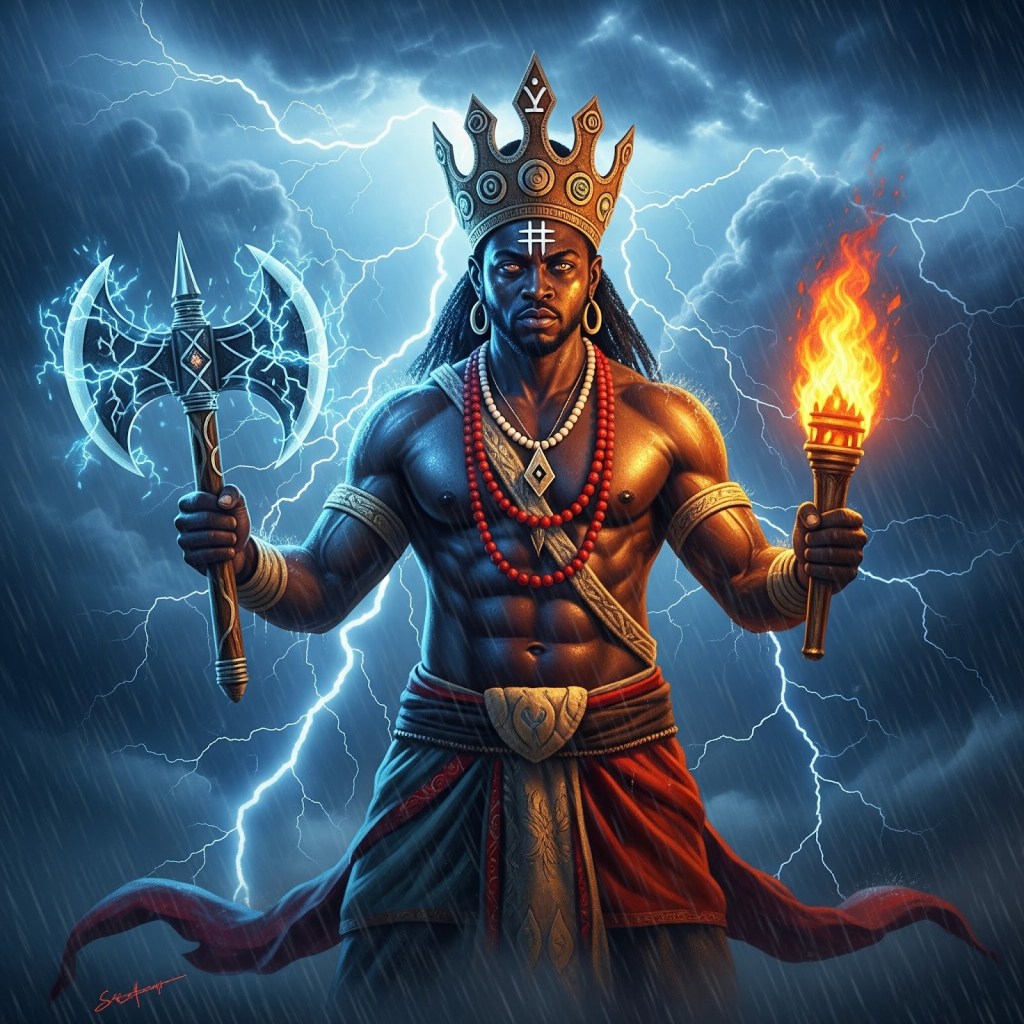
- Xangô (the king, god of thunder and justice) is associated with Saint Peter, Saint John the Baptist, and Saint Francis of Assisi.
- Oxumaré (the god of duality, movement, and perpetual renovation) corresponds to Saint Bartholomew.
- Ogum (the explorer of paths) is aligned with Saint Anthony.
- Nanã (the old goddess, co-creator of the world) is connected to Saint Anna, the mother of Mary.
- Iansã (the warrior goddess) is associated with Saint Barbara.
- Obá (the goddess of suffering) finds her parallels in Saint Catherine, Saint Joan of Arc, and Saint Martha.
- Obaluaiê (the god of life, death, sickness, and health) is linked to Saint Lazarus.
- Ibeji (the twin gods representing dualities) are associated with Saints Cosme and Damien.
Now, in direct reference to how the Orixás relate to Capoeira, their influence is subtle yet profound, shaping the art form in ways that connect its physical expression to deeper spiritual dimensions. The following insights, drawn from a Facebook post by Awo Fasegun in the CAPOEIRA: JOGO DE BOCA group on May 10, 2014, offer a glimpse into this intricate relationship, interpreting the Orixás through the lens of Capoeira’s dynamic movements and philosophical underpinnings:
- IFA and CAPOEIRA ORI – Your own personal style. (Expression) IFA, representing infinite wisdom, highlights the unique and personal expression inherent in each capoeirista’s game. It speaks to the intuitive development of a distinctive style that reflects the individual’s spirit and understanding of the game.
- ORUNMILA – The infinite wisdom of the game. (Intuition) Orunmila’s wisdom translates into the capoeirista’s intuition, their ability to read the game, anticipate movements, and make wise decisions in the heat of the roda. It’s about an innate understanding that goes beyond learned techniques.
- ESU – Your ability to be unpredictable and tricky. (Infinite choices) Esu embodies unpredictability and trickery, crucial elements in Capoeira. This Orixá’s influence encourages capoeiristas to be innovative, to surprise their opponents with unexpected moves, and to maintain an arsenal of infinite choices within the game.
- OGUN – Your ability to cut through your opponent’s defense without hesitation. (Strength & explosion) Ogun, the warrior and blacksmith, represents the raw strength and explosive power needed to penetrate an opponent’s defense. It’s about decisive action, fearless engagement, and the ability to execute powerful movements.
- OSOOSI – Your ability to find your target with speed and accuracy. (Stealth, stalking, persistence) Oshoosi, the hunter, signifies the capoeirista’s precision, speed, and focus in aiming their movements. This Orixá inspires stealth, persistence, and the ability to observe and seize the opportune moment to strike or evade.
- SANGO – Your ability to lead and aggressively control the game. (Extreme confidence) Sango, the king and god of thunder, is linked to the capoeirista’s leadership and assertive control within the roda. It embodies extreme confidence, the ability to dictate the pace of the game, and to dominate the space with a commanding presence.
- OYA – Your ability to adapt to sudden unexpected change. (Adaptive change) Oya, the goddess of winds and storms, represents adaptability. In Capoeira, this means the capacity to respond fluidly to sudden and unexpected changes in the opponent’s movements, to shift strategies instantly, and to embrace the dynamic nature of the game.
- OSUN – Your ability to refine and beautify the game. (Technical perfection) Osun, the goddess of beauty and love, inspires the aesthetic and technical perfection in Capoeira. It’s about refining movements, adding grace and fluidity, and bringing an element of artistry to the game, making it visually appealing and skillful.
- YEMOJA – Your ability to nurture & develop your game. (Birth of movement) Yemoja, the mother goddess of the sea, symbolizes the nurturing aspect of growth and development in Capoeira. This Orixá speaks to the continuous process of learning, refining, and giving birth to new movements and understanding within one’s practice.
- OBATALA – The wisdom, maturity and ethics of the game. Coolness in the heat of the battle. (Creativity) Obatala, the father of all Orixás and creator, embodies wisdom, maturity, and the ethical principles of Capoeira. It’s about maintaining composure (“coolness”) even in intense moments, approaching the game with creativity, and respecting its traditions and philosophical depth.
- EGUN – The collective spirit of those who have come before you. The creators, custodians, teachers. (Innovators) Egun represents the ancestors, the collective spirit of all those who have shaped Capoeira throughout history. This Orixá acknowledges the creators, custodians, and teachers who paved the way, inspiring current practitioners to honor the past while also becoming innovators themselves.
While this interpretation offers a foundational understanding, it is important to acknowledge that there is much more depth and complexity to this subject than can be captured by these basic principles. Nevertheless, commencing with these elementary concepts provides a solid foundation for all who wish to further explore the intricate connections between the Orixás and Capoeira.
Now, I would like to show you this symbol.
The BaKongo people, through their intricate and profound cosmogram, the dikenga dia Kongo, articulate a comprehensive living system that reveres and utilizes the universal vital force, recognizing its intrinsic connection to nature, humanity, and ancestral lineage. This symbol is far more than a mere visual representation; it is a profound ideological and metaphysical framework that underpins the spiritual and religious belief systems of the Kongo culture. For generations, the cosmogram has served as an essential conduit for transmitting cultural values, philosophical concepts, and a deep sense of identity, cementing its enduring importance within the cultural tapestry of the BaKongo people. Its continued relevance stands as a testament to the intellectual and spiritual sophistication of this vibrant and resilient culture, offering timeless wisdom that enriches our understanding of the human experience.
The cosmic interconnectedness embodied within the dikenga dia Kongo reflects a holistic understanding of existence that is central to BaKongo philosophy. The interconnected lines and circles within the cosmogram transcend simple artistic design, conveying a profound sense of unity and harmony within the cosmos. Moreover, they symbolize the dynamic interplay of opposing forces and the inherent balance that governs the natural world. This intricate symbol, with its multifaceted visual and conceptual layers, serves as a powerful visual representation of the complex cosmology and metaphysical understanding embraced by the BaKongo people. It speaks to a worldview where every element is interwoven, where life and death, visible and invisible, past and present, are all part of a grand, unified system.
Beyond its philosophical depth, the cosmogram’s persistent presence within Kongo culture underscores its vital role as a repository of cultural knowledge and spiritual wisdom. Through its rich symbolism and intricate patterns, the dikenga dia Kongo acts as a potent reminder of the collective memory and ancestral wisdom passed down through countless generations. It stands as an enduring legacy of the BaKongo people, a testament to their unwavering commitment to preserving and transmitting their invaluable cultural heritage. Each line, curve, and intersection within the cosmogram holds stories, teachings, and a deep understanding of their place in the universe.
The far-reaching significance of the cosmogram extends into various cultural expressions, finding a particularly captivating manifestation in the world of capoeira. In this dynamic Afro-Brazilian art form, the dikenga dia Kongo serves as a profound representation of interconnectedness and spirituality, mirroring the rich heritage and philosophical underpinnings interwoven within capoeira itself. It is a bridge connecting practitioners to a deeper historical and spiritual context.
Through the interpretive lens of the dikenga dia Kongo, capoeira practitioners discover a profound connection to their roots, embracing an ethos of unity and balance that permeates their movements and interactions. The cosmogram’s symbolism imbues capoeira with a deeper understanding of harmony, rhythm, and the intricate interconnectedness of all elements. This fosters a holistic approach to the practice, where the physical, mental, and spiritual aspects are inextricably linked. The circular movements, the call-and-response in music, and the strategic interplay between players can all be seen as reflections of the balance and interconnectedness represented by the cosmogram.
By incorporating the cosmogram into the very fabric of capoeira, the art form not only honors the venerable traditions of the Kongo people but is also profoundly enriched with a deeper sense of cultural significance and spiritual resonance. It serves as a potent reminder of the enduring legacy of the Kongo people and their invaluable contributions to the diverse and vibrant tapestry of human expression and experience. This integration transforms capoeira from a mere martial art or dance into a living embodiment of ancient wisdom.
In summation, the cosmogram remains an exceptionally powerful and evocative symbol that encapsulates the rich tapestry of beliefs, values, and wisdom inherent within the Kongo culture. Its intricate symbolism and enduring presence serve as a testament to the intellectual and spiritual sophistication of the BaKongo people, offering profound insights into the interconnectedness of humanity and the cosmos. The dikenga dia Kongo stands as a timeless expression of cultural identity and spiritual resilience, inviting all who encounter it to ponder the profound insights it offers into the multifaceted human experience and our place within the grand design of the universe.
Capoeira’s Connection to Christianity
As capoeira evolved and began to gain wider acceptance within Brazilian society, its relationship with Christianity, the predominant religion in Brazil, also took shape, often navigating complex and nuanced pathways:
- Syncretism and Adaptation: Like numerous other Afro-Brazilian cultural expressions, capoeira, to varying degrees, underwent a process of syncretism. This involved a delicate blending or adaptation of elements to allow it to coexist with, or even subtly incorporate, aspects of Christianity. For some practitioners, capoeira could be seen as a primarily secular activity, a form of cultural expression, while for others, their Christian faith remained a distinct and deeply personal spiritual path, existing in parallel with their capoeira practice.
- Social Acceptance and Disguise: During periods when capoeira faced severe repression or was viewed negatively by authorities (often heavily influenced by the prevailing Catholic Church), practitioners might strategically downplay its explicit Afro-Brazilian religious connections. This was a tactical maneuver to gain social acceptance or, more critically, to avoid persecution. Presenting capoeira as a mere “folkloric” dance or a beneficial form of physical exercise served as a protective disguise, allowing the practice to survive and endure.
- Personal Faith of Practitioners: Over time, as capoeira’s popularity and reach expanded, individuals from incredibly diverse religious backgrounds, including a significant number of Christians, began to practice it. For these practitioners, their Christian faith peacefully coexists with their profound dedication to capoeira, without necessarily merging the two spiritually. They often perceive capoeira as a holistic discipline that actively fosters physical health, sharp mental focus, and a strong sense of community—all values that can be highly compatible with their religious beliefs and worldview.
- Moral and Ethical Frameworks: While not directly bound by specific Christian dogma, the inherent moral and ethical framework within capoeira, particularly its strong emphasis on respect, discipline, and community, often aligns remarkably well with broader ethical principles frequently found in Christian teachings. The fundamental values promoted within a capoeira group, such as humility, perseverance, and the strong bonds of brotherhood and sisterhood, resonate across a wide spectrum of spiritual beliefs, fostering a universal sense of upright conduct.
- Modern Interpretations: In contemporary capoeira, discussions surrounding its intricate religious roots continue with open dialogue and exploration. While the historical and spiritual connection to Candomblé is universally acknowledged and widely celebrated, many modern capoeiristas, irrespective of their personal faith, approach capoeira as a comprehensive and holistic practice. This practice integrates physical prowess, mental acuity, and spiritual development, allowing for individual interpretation of its deeper meaning and personal significance.
Capoeira, at its core, embodies a profound and multifaceted religious tapestry, deeply interwoven with the spiritual resilience and traditions of Candomblé. This Afro-Brazilian religion, born from the syncretism of various African animistic beliefs and practices with Catholicism during the era of slavery, provided a covert sanctuary for enslaved Africans to preserve their cultural and spiritual heritage. Within the seemingly innocuous movements of capoeira, practitioners found a coded language, a means to honor their orixás (deities) and maintain a connection to their ancestral lands, all while appearing to merely engage in a dance or game. This subtle yet powerful disguise was crucial for survival in a society that actively suppressed African spiritual expression.
The historical trajectory of capoeira through Brazil’s complex social and religious landscape further highlights its remarkable adaptability. As it evolved, capoeira skillfully navigated and, at times, strategically adapted to the prevailing Christian environment. This intricate interplay between Candomblé and Christianity did not lead to a complete abandonment of African roots but rather culminated in a rich and layered cultural phenomenon. It fostered an environment where traditional African beliefs and rituals could coexist and intertwine with elements of Christianity, forming a unique syncretism that is truly emblematic of Brazil’s wonderfully diverse cultural tapestry. This blending is evident in the inclusion of Christian prayers or symbols alongside African spiritual practices, reflecting a pragmatic approach to survival and cultural preservation.
Beyond its historical and religious evolution, the intricate movements and powerful rhythms of capoeira serve as far more than just a dynamic form of physical expression. They are a profound medium through which practitioners connect with their ancestral past, a living embodiment of memory and heritage. Each spin, kick, and evasive maneuver tells a story, echoing the struggles and triumphs of past generations. This connection allows them to honor their heritage while simultaneously forging a new identity within a constantly evolving spiritual landscape. The music, with its call-and-response chants and the distinct sounds of the berimbau, atabaque, and pandeiro, acts as a spiritual conduit, transporting participants to a realm where the past and present converge.
Furthermore, the diverse rituals, communal gatherings, and shared experiences that accompany capoeira powerfully reflect its crucial role in fostering solidarity and resilience among its dedicated practitioners. The roda (the circle in which capoeira is played) is not just a performance space; it is a sacred arena, a community forged through shared movement, music, and spiritual connection. Within this communal setting, individuals find support, identity, and a sense of belonging that transcends mere physicality. This illustrates unequivocally how this martial art transcends mere physicality to embody a deep and abiding sense of cultural pride and spiritual connection. It is a testament to the enduring power of human spirit and the creative ways in which culture can be preserved and transmitted across generations, even in the face of immense adversity.
For centuries, the intricate dance of capoeira, a unique Brazilian art form, has been profoundly shaped by the interwoven spiritual traditions of Christianity and Candomblé. These foundational influences, particularly within the Brazilian context, have imbued capoeira with a rich tapestry of meaning, ritual, and philosophical underpinnings, reflecting the complex socio-cultural landscape of its origins. The striking syncretism evident in capoeira, where African spiritual practices found clandestine and often nuanced expression through the lens of Catholicism, has been a defining characteristic. This spiritual fusion instilled the art with potent layers of resistance against oppression, fostering a deep sense of community among practitioners, and nurturing a remarkable spiritual resilience in the face of adversity. The historical journey of capoeira is thus inextricably linked to the spiritual struggles and triumphs of its creators, with every movement and rhythm echoing these deeply held beliefs.
However, as capoeira continues its unprecedented global expansion, reaching new continents, embracing diverse populations, and permeating myriad cultural landscapes, its spiritual and cultural interpretations are destined to broaden and evolve in dynamic and exciting ways. This global diffusion marks a pivotal and thrilling phase in capoeira’s history, propelling it beyond its foundational Brazilian influences to embrace a truly international and multifaceted perspective. In the coming years, as individuals from a vast array of cultural and religious backgrounds—including those practicing Buddhism, Hinduism, Taoism, Islam, Judaism, various indigenous spiritualities, and countless others—begin to learn, engage with, and integrate capoeira into their lives, new and fascinating connections are sure to emerge. These practitioners will bring their unique spiritual frameworks, ethical considerations, and cultural lenses to the art, forging fresh interpretations and uncovering universal truths.
These burgeoning interpretations will not, in any way, diminish the profound historical significance of capoeira’s Brazilian roots. Instead, they will serve to immeasurably enrich the art form, powerfully demonstrating its inherent adaptability and universal appeal. Practitioners worldwide will contribute their individual spiritual insights, potentially discovering profound parallels with existing capoeira philosophies, developing new symbolic meanings for its movements, and fostering innovative forms of spiritual expression within the art. This expansive global engagement promises to further deepen and diversify capoeira’s already profound spiritual landscape, showcasing its remarkable capacity to resonate with and be interpreted through an incredibly wide spectrum of spiritual paths. This ongoing evolution will undoubtedly ensure capoeira’s continued growth, relevance, and vibrant presence in an increasingly interconnected and culturally diverse world. The very essence of capoeira’s spiritual future lies in this vibrant and continuous interchange, a powerful testament to its enduring power and its remarkable ability to transcend geographical, cultural, and religious boundaries, becoming a truly global conduit for spiritual exploration and expression.

 Jogo Corpo Fechado