
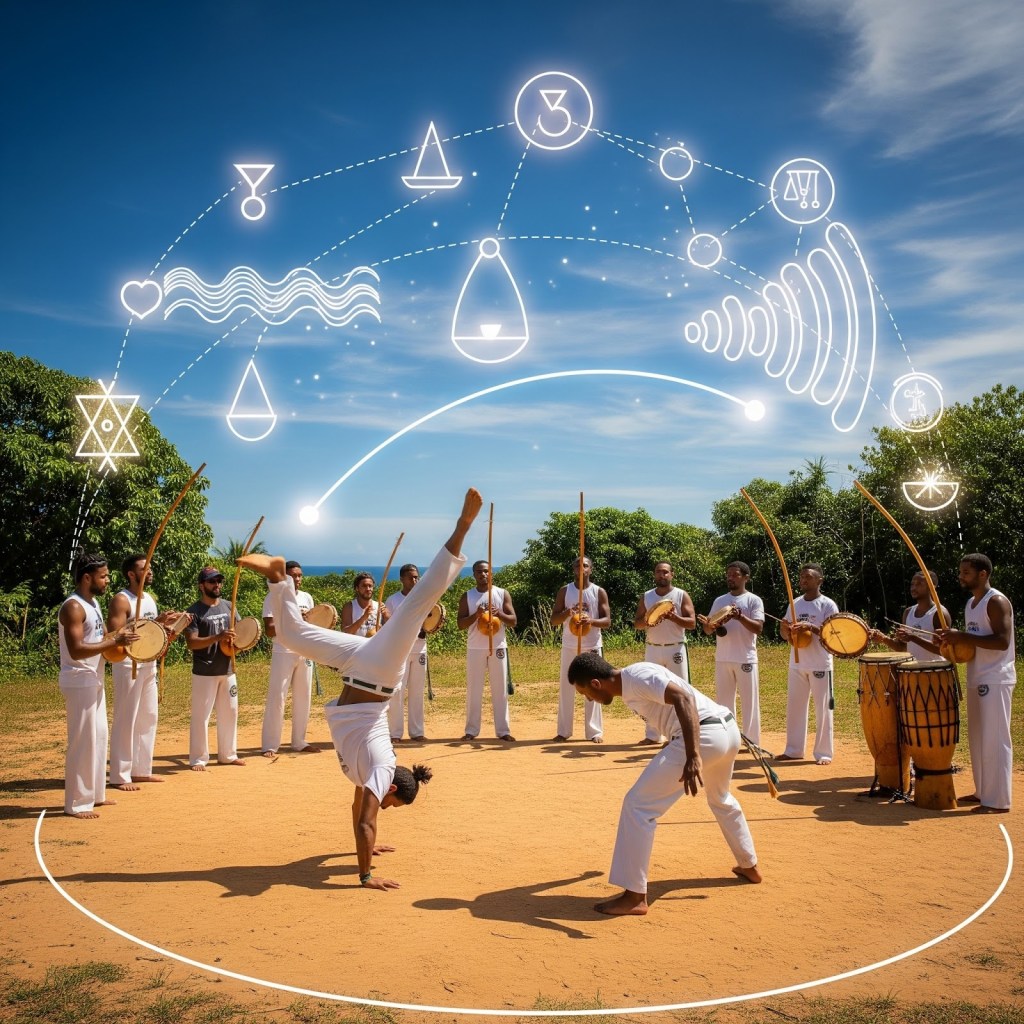
Capoeira, a unique Afro-Brazilian martial art that blends fighting, acrobatics, music, and dance, can be seen as a microcosm where the principles of certain universal laws are constantly at play. Understanding these underlying, fundamental principles can deepen one’s appreciation of the art form and enhance the practitioner’s journey, both inside and outside the roda (the circle in which capoeira is played).
One of the most evident universal laws in Capoeira is the Law of Polarity. This law states that everything in the universe has a dual nature, with two opposing but equally real sides. In Capoeira, this is expressed through the constant interplay between:
- Attack and Defense: Every attack invites a defense, and every defensive move sets the stage for a counter-attack. The energy flows seamlessly between these two poles.
- Malícia (Malice/Cunning) and Jogo (Play/Game): The seriousness of a martial art encounter is balanced by the playful, deceptive, and rhythmic nature of the jogo.
- Music and Movement: The grounding, rhythmic structure of the berimbau (the main instrument) and the accompanying songs (the music) provide the foundation and energy for the explosive, unpredictable movements.
- The Individual and the Community: The individual player showcases their skill within the shared, collective energy and security of the roda.The Law of Rhythm is also central to Capoeira. This law asserts that everything is cyclical and moves in a measured flow, a constant swing between opposites. This is physically manifested in:
- The Ginga: The fundamental, swaying movement is the physical embodiment of rhythm, a constant back-and-forth that keeps the capoeirista prepared to attack, defend, or evade. It is the art’s pulse.
- The Roda’s Energy: The pace and intensity of the game ebb and flow, dictated by the rhythm of the instruments and the energy of the players. The game may slow down for strategic, ground-based movements or escalate into fast-paced, aerial acrobatics, only to return to a more composed rhythm.
The Law of Cause and Effect (Karma) is also in constant operation. Every action in the roda has a direct and proportional reaction:
- A Slow Movement: Can invite an aggressive, fast-paced attack, forcing the player to respond defensively.
- A Well-Executed Move (Cause): Elicits a positive response (Effect) from the surrounding community, perhaps in the form of an appreciative yell or a change in the song.
- A Lack of Focus or Respect (Cause): Can result in a poorly played jogo or a correction from the Mestre (master).
Finally, the Law of Vibration states that everything in the universe is in motion and vibrating at a certain frequency. In Capoeira, the collective vibration of the roda is palpable. The music, the voices singing in harmony, the percussive beat of the atabaque, and the movements of the players all merge to create a unified field of energy. The player’s ability to tune into this collective vibration is crucial for a successful and connected jogo. A high-vibration player is one who moves fluidly, connects with the rhythm, and is completely present in the moment.
By consciously recognizing these universal laws, the Capoeirista moves beyond mere physical technique and begins to engage with the deeper, philosophical underpinnings of the art, transforming a physical practice into a profound study of life itself.
—–Philosophical Parallels: The Twelve Universal Laws and Capoeira
The broader metaphysical context of Capoeira Angola often ties the physical practice to fundamental universal laws, providing a deep philosophical and spiritual framework for the jogo. These twelve concepts function as a complete metaphysical compass, guiding the practitioner not only in the roda but in life itself
:The Twelve Metaphysical Laws of Capoeira Angola
1. Law of Divine Oneness (Tudo Está Conectado)
Core Principle: Everything is connected.
This is the foundational understanding that no entity exists in isolation. In the context of Capoeira Angola, this connection manifests in multiple dimensions:
- The Players’ Connection: It is the palpable, energetic link between the two players in the jogo, where one’s movement instantly informs and influences the other’s, creating a seamless, improvisational dialogue.
- The Roda’s Integral Energy: It acknowledges the holistic connection to the collective energy (axé) of the roda—the rhythm of the berimbau, the songs, the clapping, and the presence of the audience all contribute to a single, unified, living entity.
- The Holistic Self: It demands a holistic view of the self (mind, body, and spirit) functioning not as separate parts but as a single, unified system. A fracture in one area, such as a lack of mental focus, immediately compromises the physical execution of the movement.
2. Law of Vibration (Tudo Está em Movimento)
Core Principle: Everything is in motion, possessing a frequency.
The universe is a field of constant vibration, and the quality of this vibration dictates the experience.
- Cultivating High Vibration: Higher vibrations (love, joy, respect, sincerity, and courage) are intentionally cultivated and maintained in the roda through positive interaction and the sincere, focused practice of the art. This elevation of energy fundamentally enhances the creativity, flow, and spiritual depth of the game.
- Hinders of Low Vibration: Conversely, low vibrations (fear, ego, resentment, laziness, or malice) create dissonance and block the natural flow of the jogo. Such energies hinder the player’s ability to be creative, react spontaneously, and perform optimally. The mastery of Capoeira requires the conscious choice of a high-frequency emotional state.
3. Law of Attraction (O Semelhante Atrai o Semelhante)Core Principle: Like attracts like.
The Law of Attraction: The Magnetic Force of Axé and Intention
A direct corollary of the Law of Vibration, the Law of Attraction is one of the most immediate and tangible universal principles at play within the roda. This principle dictates that one’s inner state—their dominant thoughts, emotions, and intentions—acts as a powerful magnet for external experience. The universe, and specifically the roda, mirrors back the energy that the individual projects.Axé and Intention: The Capoeirista’s Inner Compass
The energy, pure intention, and axé (the vital life force, positive energy, or sacred power) that a player sincerely and wholeheartedly channels into the roda will inevitably be reflected back to them through the quality of the jogo (game) and the response of their partner.
- Positive Projection: If a player enters the jogo with genuine respect for the art, the instruments, the Mestre, and their opponent, coupled with a deep desire for learning and mutual growth, they will attract interactions that are challenging yet supportive. Their opponent will feel encouraged to engage in a dynamic, creative, and flowing dialogue, pushing the boundaries of skill without succumbing to unnecessary aggression or malice. The jogo becomes an elevated conversation, a shared act of creation.
- The Intent of the Movement: This law extends beyond the initial mental state; it is infused into every movement. A movement executed with the intention of dialogue, flow, and expression will be received differently than a movement performed solely with the intention to dominate or injure. The opponent instinctively feels this underlying motive and adjusts their reaction accordingly.
Encouraging Positivity: Guarding the Inner State
This law powerfully encourages the maintenance of positive mental and emotional states before and during the jogo. A capoeirista must become a diligent guardian of their inner world:
- The Pitfall of Fear: A negative, fearful, or overly aggressive disposition will only attract a correspondingly aggressive, dominating, or unpredictable opponent. If a player enters the roda focused on the fear of being struck, or the negative desire to humiliate their opponent, they are unconsciously inviting that exact experience. The environment and the opponent are simply reflecting the player’s internal focus.
- The Power of Confidence and Humility: Conversely, a state of focused confidence mixed with genuine humility and openness creates a magnetic field for quality interaction. The jogo naturally flows toward a more technical, expressive, and profound level when both players are projecting this higher-frequency energy. The Law of Attraction in the roda teaches that the control of the game begins not with the external movements, but with the mastery of the self.
4. Law of Correspondence (“As Above, So Below”) (A Lei da Correspondência)
Core Principle: The inner world is reflected externally.
This law asserts that there is always a correlation between the planes of existence—mental, physical, and spiritual.
- Internal Manifestation: A player’s internal state of mind, self-confidence, emotional equilibrium, and focus will inevitably and immediately manifest in their physical movements, gait, posture, and presence in the roda.
- Inner Chaos, External Struggle: A mind consumed by doubt, fear, or a sense of rush will result in external struggle, disorganized movements, poor timing, and a visible lack of fluidity. True Capoeira mastery begins with internal composure.
5. Law of Action (A Lei da Ação)
Core Principle: Desire requires effort.
While the mental and spiritual laws are vital, the Law of Action emphasizes the non-negotiable need for application and labor in the material world.
- The Necessary Effort: The disciplined, consistent physical training, the repetitive practice of techniques, and the unwavering commitment to the daily grind of practice (ação) are absolutely necessary to manifest the desired skill level and achieve personal growth (metas).
- Beyond Intention: Intention alone is inert; it must be coupled with rigorous, sustained physical and mental effort to bring skill into reality. Capoeira is learned through doing.
6. Law of Cause and Effect (Karma) (A Lei de Causa e Efeito)
Core Principle: Every action has a reaction.
In its simplest form, this is the dynamic exchange of the jogo itself, where every move is both a cause and an effect.
- Immediate Consequences: In the jogo, every movement (cause), whether an attack, an evasion, or a feint, has an immediate, corresponding consequence (effect) from the opponent. The opponent’s reaction is the karmic return of the first player’s action.
- Shaping the Game: This law extends beyond the physical; thoughts, spoken words, and the choice of techniques have consequences that cumulatively shape the unpredictable direction and outcome of the game and the player’s reputation within the community.
7. Law of Compensation (A Lei da Compensação)
Core Principle: Rewards follow effort.
This is the principle of earned return, where what is given out eventually returns, often in a greater measure.
- Return on Investment: The dedication, physical rigor, intellectual study, and positive energy invested in training and respectful interaction within the Capoeira community will be compensated.
- The Rewards: The compensation comes in the form of genuine skill acquisition, the depth of axé received from the community, earned respect from peers and Mestre, and the deep, intrinsic personal fulfillment that comes only from hard work and mastery.
8. Law of Perpetual Transmutation of Energy (A Lei da Transmutação)
Core Principle: Energy can be changed and elevated.
All energy is constantly flowing and changing, and the practitioner has the conscious power to influence this change.
- Transforming the Negative: A player can transform negative energy, physical fatigue, fear, or a challenging, losing situation in the roda by consciously and actively raising their own vibration.
- The Mechanism: This is achieved through focused, deep breath (respiração), a positive shift in internal intent, and disciplined thought—refusing to let the situation degrade the spirit. It is the ability to turn a defensive position into a launching point for a counter-attack.
9. Law of Relativity (A Lei da Relatividade)
Core Principle: Everything is relative.
No experience is inherently good or bad; its value is determined by the context and the observer’s perception.
- Lessons, Not Failures: Challenges, losses, moments of being swept, or perceived humiliation in the roda are not absolute failures but are relative experiences. They offer vital, often painful lessons that push the player to evolve.
- Perceptual Shift: Changing one’s perception of a difficult or traumatic moment—seeing it as a training opportunity rather than a personal defeat—transforms its long-term impact and value, shifting the experience from a stumbling block to a stepping stone.
10. Law of Polarity (A Lei da Polaridade)
Core Principle: Everything has an opposite.
The universe is composed of dualities, and these apparent opposites are necessary for existence and dynamism.
- Dynamic Interplay: Capoeira is the perfect expression of this law: the constant, dynamic interplay of masculine/feminine, hot/cold, attack/defense, light/dark, high/low, and fast/slow movements.
- Creating the Jogo: The tension between these poles is necessary for the creation of a balanced, interesting, and dynamic jogo. The ability to move seamlessly between one polarity and its opposite is a mark of a skilled player
11. Law of Rhythm (A Lei do Ritmo)
Core Principle: Life moves in cycles.
This law recognizes that everything flows in and out; there is a tide, an ebb and flow, a pendulum swing.
- Training Cycles: Training, performance, and skill development follow a natural ebb and flow. There will be periods of rapid growth and periods of plateau or necessary rest.
- Respecting the Cycles: Acknowledging and respecting these inherent rhythms allows the practitioner to avoid burnout, embrace rest and recovery as essential parts of training, and trust the natural cycles of growth, recession, and eventual resurgence.
12. Law of Gender (Yin and Yang) (A Lei do Gênero)
Core Principle: The balance of two energies is required for creation.
While related to Polarity, the Law of Gender focuses on the creative, generative balance of the active (masculine/Yang) and receptive (feminine/Yin) principles.
- The Creative Balance: The mastery of Capoeira lies in the ability to instantly switch and blend these energies: the hard, aggressive, outward-moving, masculine (yang) attacks and the soft, receptive, fluid, inward-moving, feminine (yin) evasions and counter-movements.
- The Complex Art: The fluid and instantaneous union of these two forces—the force of intention and the grace of acceptance—creates the beautiful, unpredictable complexity and depth of the art of Capoeira Angola.
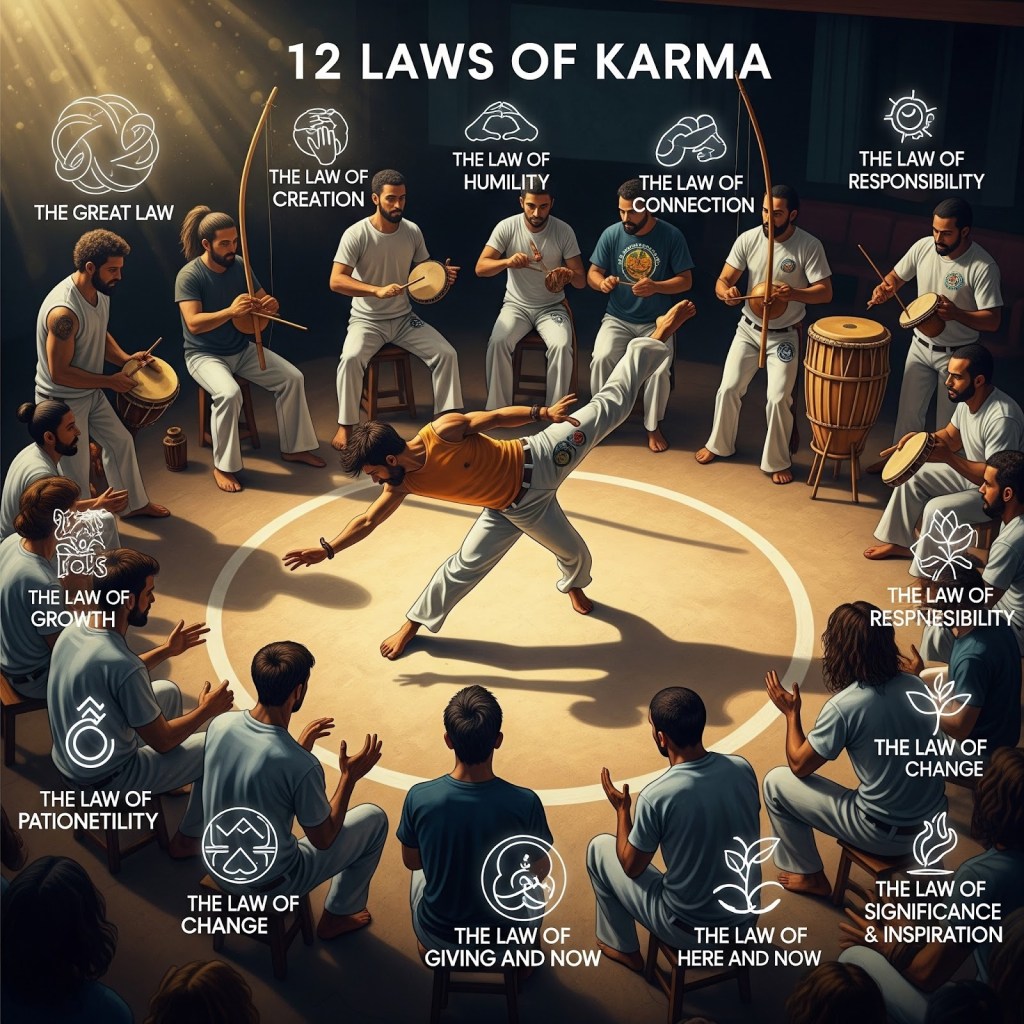
The 12 Laws of Karma in Capoeira Angola: A Framework for Harmony and Growth
Meditations on Nature in Capoeira Angola: The Synthesis of Martial Arts and the Natural World
The practice of Capoeira Angola is far more than a mere collection of physical techniques or a historical relic; it is a holistic philosophy for living (a modo de vida), deeply rooted in ancestral African traditions and a profound, intimate understanding of universal, natural principles. This system posits that human life and the broader cosmos operate according to immutable, self-regulating laws.
Central to this philosophy is the concept of Karma—not as a fatalistic judgment, but as the active, inescapable principle of cause and effect, where a person’s total energetic output shapes their lived reality. In the context of Capoeira Angola, this principle is codified into Twelve Essential Laws. These laws serve as an integrated moral, ethical, and strategic compass, rigorously guiding practitioners (the capoeiristas) not only within the intense, dynamic world of the roda (the circle where the game is played) but also in their daily lives. They emphasize the inescapable cyclical nature of energy, the continuous flow of reciprocity, and the importance of conscious, intentional participation in sculpting one’s own destiny.
—–Part I: The Foundation of Action and Consequence

These first five laws establish the practitioner’s personal accountability and the foundational mechanics of how energy is exchanged in the world.
1. The Great Law (Cause and Effect)
This is the ultimate, foundational law, asserting that the energy, thoughts, intentions, and physical actions a person transmits into the world will, with absolute certainty, return to them in a proportional and relevant form. It is the principle of perfect reciprocity—what you sow, you shall reap. In the immediate, mirrored environment of the Capoeira roda, this law is instantly visible. If a capoeirista approaches the game with malice, a disrespectful attitude, or a rigid, egotistical desire to “win” at all costs, they should expect a similar energetic return. This is often manifested in a tangible lack of flow, harmony, or creative connection with their partner and the collective energy of the roda. This law stresses absolute accountability for one’s energetic output, demanding honesty and self-awareness from the player.
2. The Law of Creation (Participation and Intention)
Life, the roda, and the process of mastery are never passive events; they demand fierce, active participation and focused intention. This law teaches that we must be the conscious architects of our own experience, rather than waiting for circumstances to dictate our path. Harmony, skill, and mastery in Capoeira Angola do not spontaneously appear out of thin air; they are the direct, inevitable result of consistent, intentional practice, persistent presence, and deep, physical, and mental engagement. We must make life happen through sustained effort and conscious, deliberate choice, seeing the creative process as continuous and requiring constant feeding.
3. The Law of Humility (Acceptance and Acknowledgment)
Genuine, lasting change and evolution can only begin once we bravely acknowledge and fully accept our current reality, our present skill level, our limitations, and our immediate circumstances without any trace of resistance, self-pity, or denial. In the roda, a player must display the grace and humility to accept a rasteira (sweep), a counter-attack, or an unsuccessful move before they can begin to truly dissect, learn from it, and develop a more effective defense or counter-strategy. True strength and resilience spring not from arrogance or denial, but from honest, objective self-assessment
4. The Law of Growth (Internal Transformation)
This is a powerful, self-referential law that states all external change—the improvement of one’s 
5. The Law of Responsibility (Ownership and Accountability)
We are, in the deepest sense, the ultimate authors and owners of the reality and experience we inhabit. Every experience, event, circumstance, and relationship in one’s life is a direct or indirect consequence of one’s own past decisions, prevailing thoughts, and previous actions. This law serves as a profound mechanism that eliminates all external blame and victimhood. It empowers the capoeirista to take full, unequivocal responsibility for the quality, challenge, and flow of their game, their personal evolution, and their life journey.—–Part II: The Interconnectedness of Existence
These laws articulate the complex web of relationships that define reality, emphasizing how all elements—past, present, self, and community—are inseparable.
6. The Law of Connection (The Web of Being)
Nothing in the universe, and certainly nothing in the fluid, complex practice of Capoeira Angola, exists in true isolation. Our past experiences, our current actions, our present state of being, and our future potential are all inextricably linked in a continuous, flowing chain of causality. The quality, confidence, and agility of our game today are a direct consequence of the intention and intensity of our training yesterday, and they simultaneously set the foundation for our future mastery. Every single movement executed in the roda is connected to the preceding movement and the subsequent response, forming an unbreakable, holistic dance.
7. The Law of Focus (The Power of Singularity)
Energy that is scattered yields only scattered, mediocre results. This law emphasizes the critical need to direct one’s mental, physical, and spiritual energy with a singularity of purpose and laser-like intent. A capoeirista cannot play a game of depth and presence if their mind is split between anticipating their opponent and worrying about external problems or trivialities. True presence, strategic effectiveness, and technical mastery require complete and undivided attention—a deep immersion in the here and now of the task at hand.
8. The Law of Giving and Hospitality (Alignment and Openness)
This law transcends the simple concept of charity; it is fundamentally about the congruence and harmonious alignment of one’s inner and outer worlds. Actions, spoken words, thoughts, and underlying intentions must all operate as a unified, non-contradictory whole. Furthermore, it speaks to the necessary openness of the practitioner: the spiritual willingness to both give the best of oneself (in the game, in service to the community, in teaching) and the necessary humility to graciously receive the gifts, lessons, critiques, and energy offered by others, thereby enriching the collective.
—–Part III: The Discipline of Time and Effort
The final section addresses the temporal dynamics of Capoeira and life, focusing on patience, learning, and the continuous process of evolution.
9. The Law of Here and Now (Presence and Mindfulness)
The most potent and only true moment of genuine power, strategy, and action is the present moment. Dwelling endlessly on past mistakes (the state of regret) or anxiously projecting one’s energy into future fears (the state of worry) fundamentally prevents a person from being fully engaged, effective, and free. Mastery in Capoeira Angola depends entirely on acute presence—the ability to immediately sense the rhythm of the berimbau, anticipate the micro-movements of the opponent, and execute the complex move now, with perfect timing.
10. The Law of Change (Lessons and Evolution)
Persistent, recurrent patterns and conflicts will relentlessly repeat themselves in life—and inevitably in the strategic challenges of the roda—until the core lesson embedded within the destructive cycle is fully understood, metabolized, and integrated into one’s being. If a player is repeatedly vulnerable to the same type of rasteira or defense, the universe (or the highly effective opponent) will continue to present that exact challenge until the player fundamentally changes their approach, strategy, or internal conditioning. The key to finally breaking these cycles is learning the lesson and committing to evolution.
11. The Law of Patience and Reward (Persistence and Value)
The most profound, meaningful, and genuinely valuable rewards—whether they represent skill mastery, deep character development, or lasting personal fulfillment—are never instant. They require sustained, persistent, and patient effort applied consistently over a significant period of time. The journey of a capoeirista is inherently a marathon, not a sprint, demanding deep, internal dedication that must persist long after the initial excitement and novelty have inevitably faded.
12. The Law of Significance and Inspiration (Energy Output and Return)
The ultimate quality and quantity of the rewards one ultimately receives are a direct, measurable reflection of the total energy, genuine heart, disciplined effort, and profound spirit put into the endeavor. Low, half-hearted effort yields predictable low, insignificant results; whereas passionate, inspired, focused, and dedicated effort yields results of significant and lasting value. The inspiration, joy, and powerful energy a player receives back from the roda and their community is perfectly proportional to the inspiration and spirit they willingly contribute to the collective energy of the art.
In Conclusion:
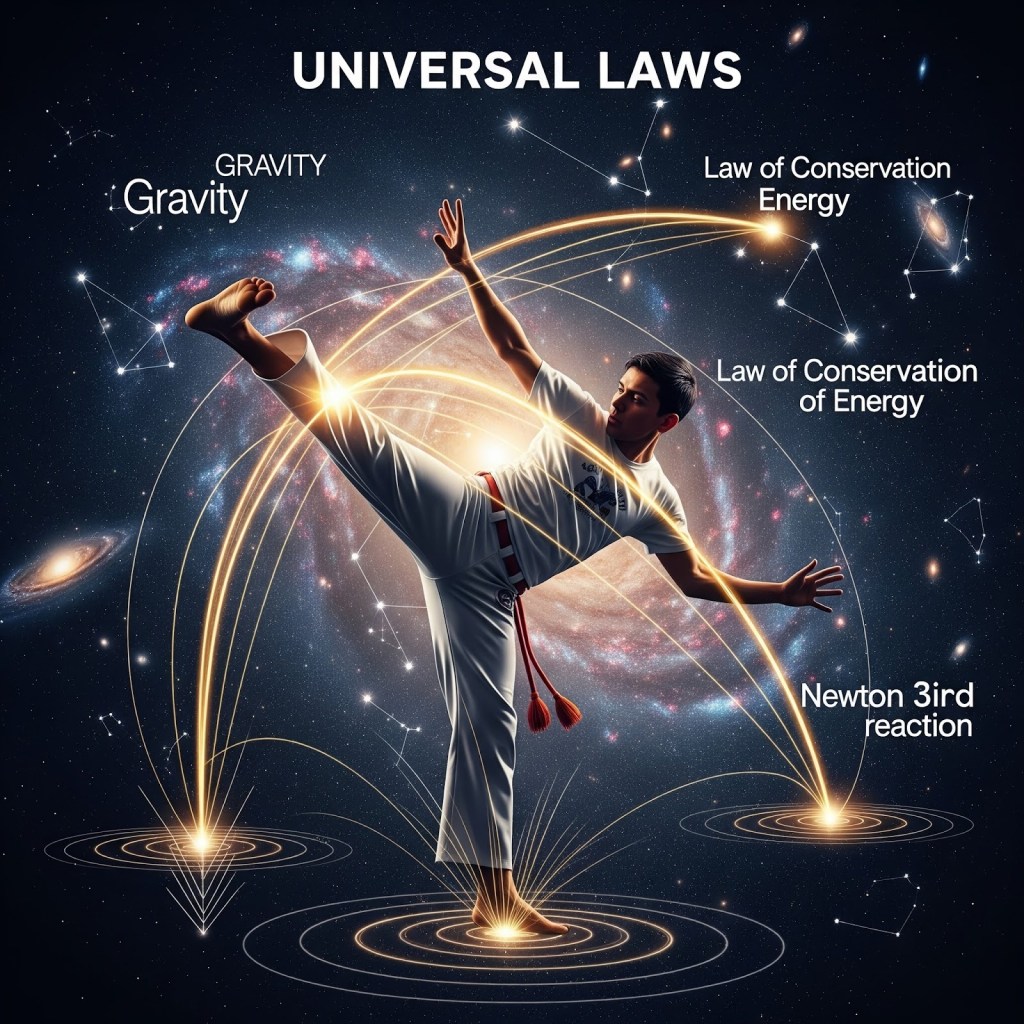
The exploration of universal laws through the lens of Capoeira reveals a profound interconnectedness between physical mastery, philosophical understanding, and spiritual growth. The core principles that govern the cosmos—such as the Law of Vibration, the Law of Rhythm, and the Law of Cause and Effect (Karma)—are not abstract concepts but tangible forces actively demonstrated and utilized within the roda and in the life of a capoeirista.
The jogo (game) itself is a dynamic manifestation of the Law of Vibration. Every movement, every strike, every evasion, and every musical note carries a specific vibrational frequency. A skilled capoeirista learns to control their own vibration—their energy, focus, and intent—to harmonize with or disrupt the rhythm of their partner and the roda. Mastery is achieved not just through brute force, but through the subtle manipulation of energy and timing.
The Law of Rhythm dictates the perpetual flow of energy, the swing of the pendulum from attack to defense, from fast to slow, from tension to release. A successful capoeirista does not resist this rhythm but flows with it, understanding that every moment of recession is a prelude to a moment of advancement. This principle extends beyond the physical interaction, teaching patience and resilience in the face of life’s inevitable cycles of challenge and triumph.
Most importantly, Capoeira is a rigorous, real-time classroom for the Law of Cause and Effect. Every action—a misplaced step, a poorly timed kick, a lack of musical engagement, or a moment of hesitation—produces an immediate and undeniable reaction. The consequences in the roda are swift and honest, forcing the practitioner to take full responsibility for their choices. This continuous feedback loop cultivates discipline, mindful awareness, and the foresight necessary to navigate complex interactions both inside and outside the roda.
Ultimately, Capoeira is more than a fight, a dance, or a sport; it is a holistic methodology for personal transformation. By consciously applying and embodying these universal laws in their training and interaction, capoeiristas move beyond mere technique to achieve a state of fluid, intuitive being. The goal is not merely to win the game, but to achieve malícia (cunning wisdom) and axé (life force/spiritual energy)—to live a life in harmony with the natural, immutable order of the universe. The principles learned while dodging a rabo de arraia are the same principles that guide a well-lived, purposeful life.
 Jogo Corpo Fechado