
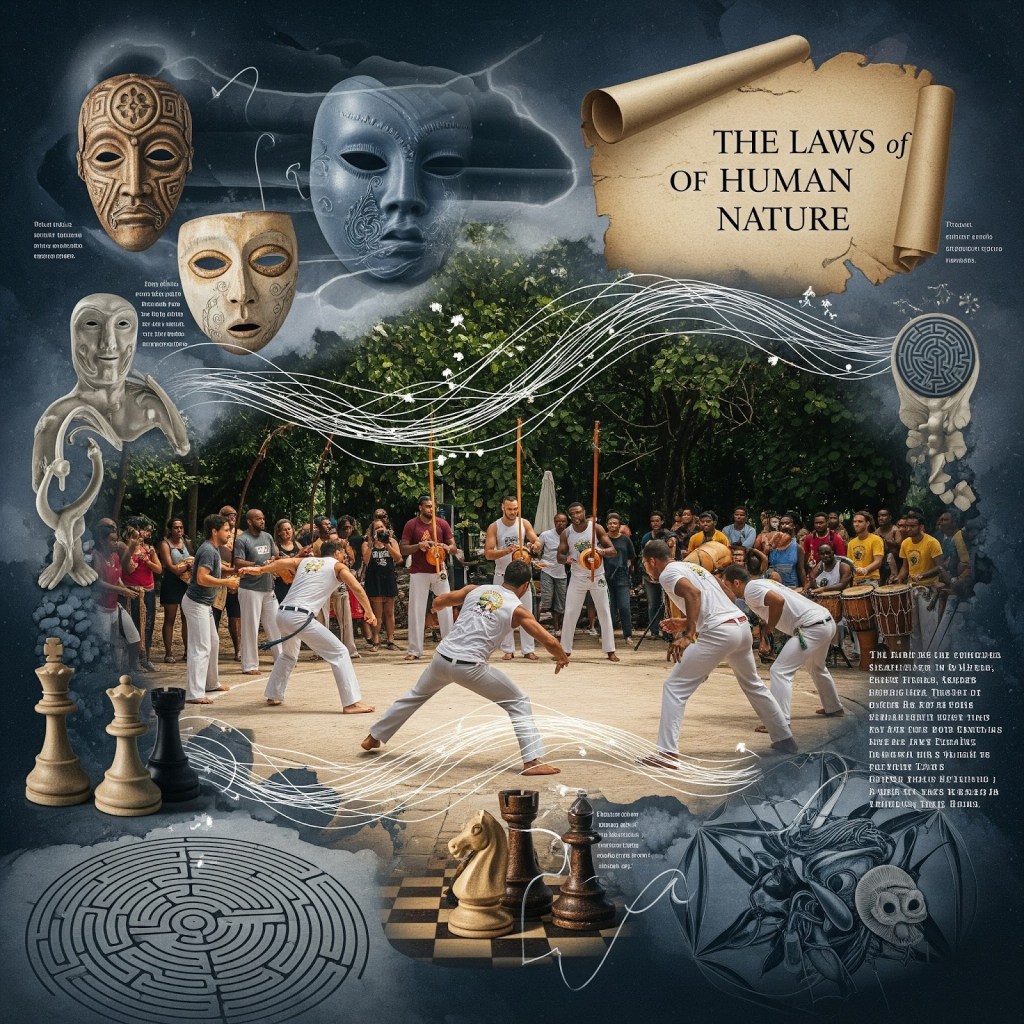
Capoeira Angola is far more than a mere Afro-Brazilian martial art; it is a profound and complex cultural expression that serves as a high-fidelity crucible for understanding the depths of human interaction and the immutable laws that govern social dynamics. Encompassing a rich and interwoven tapestry of music, dance, history, philosophy, and strategic play, it places its practitioners squarely within a dynamic, high-pressure social and psychological laboratory. The roda, the circle in which the game is played, functions as a powerful microcosm of society itself. Within this intense, contained, and theatrical environment, fundamental human instincts, raw emotions, subtle power dynamics, and calculated deception are perpetually in motion and on full display.
For the dedicated capoeirista, Robert Greene’s systematic, historical, and philosophical exploration of human behavior in The Laws of Human Nature provides an indispensable, insightful, and strategic framework. By consciously applying these universal psychological principles, a practitioner can transform their journey from a focus on mere physical technique into a sophisticated mastery of self, others, and the strategic challenges inherent to both the game and the broader landscape of life. The profound, actionable connection between Greene’s theories and the practice of Capoeira Angola offers a master key for understanding and ultimately dominating the art.
Greene’s comprehensive set of laws—including but not limited to the Law of Irrationality, the Law of Envy, the Law of Aggression, and the Law of Role-Playing—are not merely abstract parallels to the complex psychological and strategic challenges encountered within the roda; they provide concrete, actionable keys to anticipating, navigating, and ultimately dominating them.
The true, deep mastery of Capoeira Angola transcends the acquisition of physical skills and technical proficiency; it resides fundamentally in this psychological and strategic depth. A Capoeirista who understands the Law of Irrationality, for instance, can recognize the tell-tale signs when an opponent is reacting from a sudden emotional trigger—such as anger over a near-miss or fear of an unexpected move—rather than from a calculated, coherent strategic plan. This recognition allows for a strategic exploitation of that impulse, leading to a calculated counter-movement. Similarly, applying the Law of Aggression allows a player to acutely sense the underlying tension, fear, or profound desire for dominance in their partner’s jogo (game), enabling them to choose the appropriate counter-strategy, whether to subtly escalate the energy with a surprising maneuver or masterfully deflate the intensity with a disarming, low movement. The Law of Role-Playing is particularly salient, as the roda is inherently a theatrical space where players adopt powerful, deceptive personas—the indifferent vadiagem (tramp), the cunning trickster (o malandro), or the straightforward warrior—which can be meticulously used to conceal true intentions or manipulate the opponent’s perception of the player’s skill and commitment. By viewing the roda through the sophisticated, objective lens of Greene’s human nature, the Capoeirista gains a decisive strategic advantage, transforming what appears to be a physical game into a high-stakes, sophisticated psychological chess match.
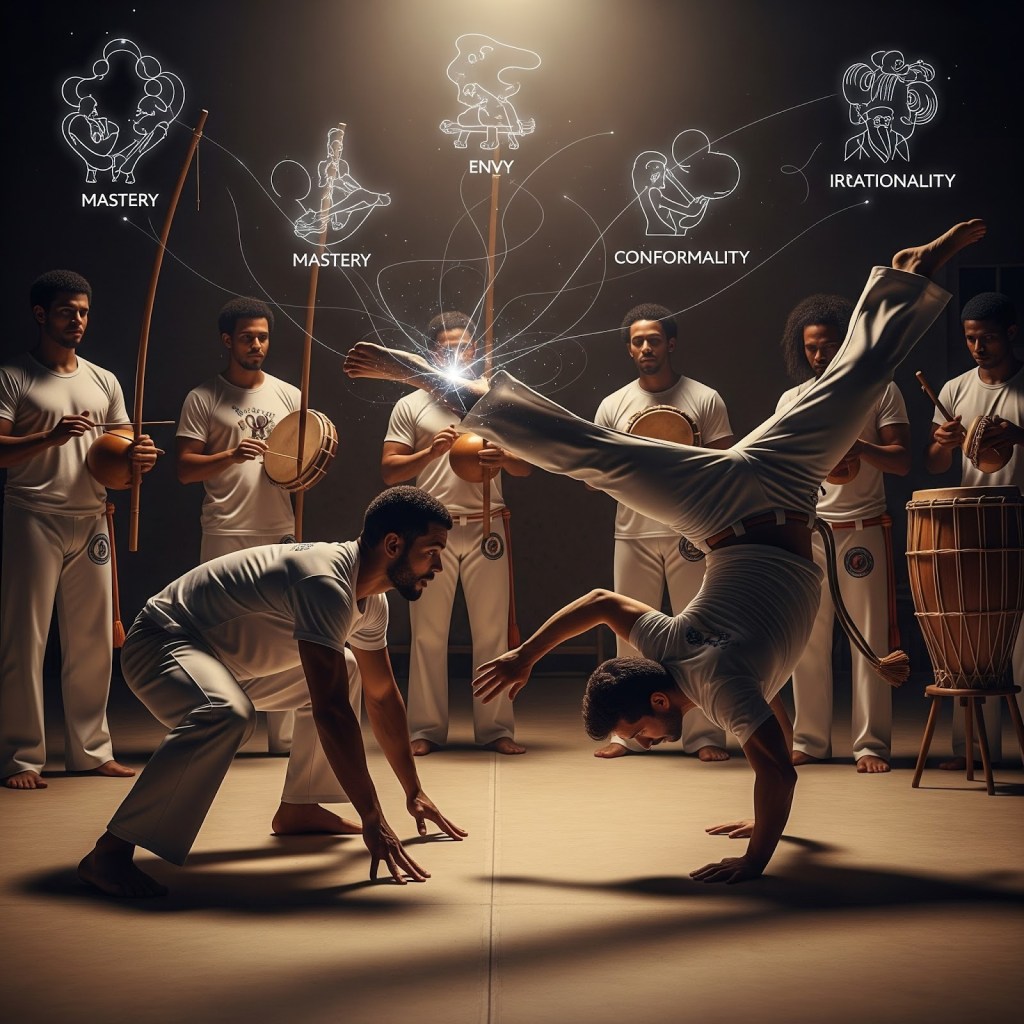
1. Mastering the Game through Self-Awareness (The Inner Roda)
The foundational application of Greene’s philosophy lies in achieving self-mastery, a pursuit deeply aligned with his Law of Irrationality. The capoeirista must first and foremost become an expert in recognizing and managing their own emotional triggers and instinctive, often destructive, impulses. These internal forces—the ‘hot’ emotions of anger, fear, and excessive ego—are what cloud judgment, disrupt the strategic mind, and inevitably lead to critical mistakes or, in the language of Capoeira, a loss of control (descontrole). The oppressive heat of the game, a subtle, disarming taunt from the opponent, a sudden, aggressive shift in the rhythm of the berimbau, or a surprising, high-velocity movement can instantly provoke an immediate, disproportionate, and irrational reaction, creating an unmissable opening for the opponent.
The very act of practicing the ginga—the fundamental, fluid, deceptive, and constant stepping pattern—must be done with profound, meditative mindfulness. It is not just physical conditioning; it is the conscious, moment-to-moment recognition and suppression of the impulse to rush the game, to panic under pressure, to retaliate out of anger, or to concede out of fear. The true, esoteric challenge is to maintain one’s unwavering emotional and physical center (o centro) regardless of external chaos and provocation. By learning to deliberately step back emotionally from the ‘heat’ of the moment, the capoeirista shifts their default setting from a purely reactive state to one that is deliberately responsive, strategic, and calm. This disciplined internal control, rigorously honed in the high-pressure environment of the roda, translates directly into superior emotional regulation, resilient composure, and dramatically better decision-making in all complex personal and professional scenarios outside of the game.
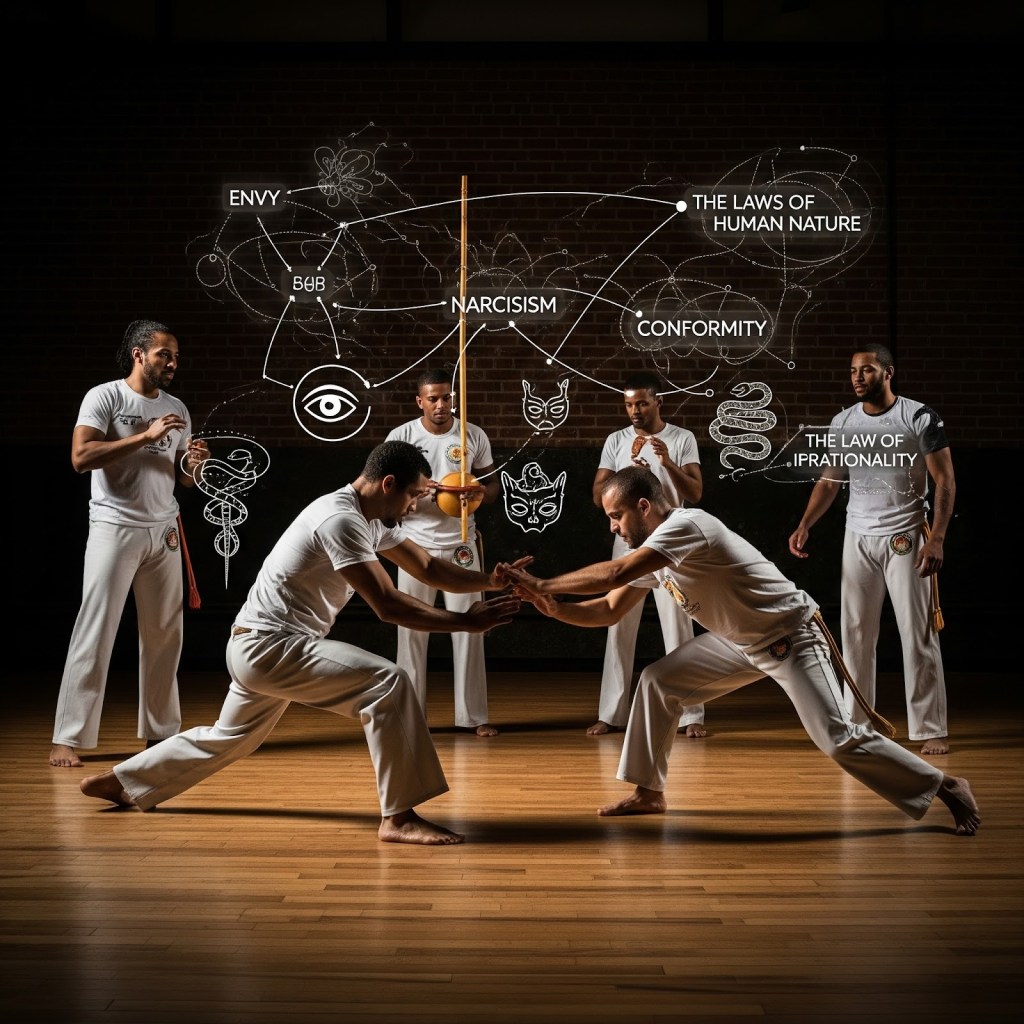
2. Reading and Influencing the Opponent (The Laws of Perception)
The essence of Capoeira Angola is a non-verbal, intimate, and often intense strategic dialogue between two players. This dialogue is entirely reliant on subtle cues, impeccable timing, and psychological warfare, resonating powerfully with Greene’s Law of Role-Playing and Law of Perception. In the roda, players constantly adopt strategic personas—the slow, sleepy, or indifferent player (o vadiagem), the overtly aggressive attack dog, or the unpredictable, fluid trickster (o malandro)—all with the express purpose of concealing their true intentions and provoking an analytical error in the opponent’s read.
A successful capoeirista must cultivate a arte de observar—the art of observation—to an almost telepathic level. They must read and assimilate the opponent’s micro-expressions, subtle body language (the tension in their shoulders, the direction of their gaze, the clenching of a jaw), their breathing rhythm (a key indicator of fatigue or panic), and the subtle shifts in their tempo and commitment. This acute, continuous observation allows them to anticipate movements before they fully materialize and exploit vulnerabilities (a malandragem). Crucially, the capoeirista must also master the impression they project. They use deliberate, calculated shifts in rhythm, pace, and feints—movements that simulate an attack to mask a true defensive posture or vice-versa—to control the opponent’s perception of their skill, intent, and current energy level. Understanding that all people, much like players in the roda, are constantly performing roles and meticulously managing impressions, allows the capoeirista to look past the superficial surface of a social interaction or competitive negotiation and connect with the deeper, strategic, and authentic reality.

3. Understanding Group Dynamics and Power (The Hierarchy of the Roda)
Capoeira Angola is defined by a deeply entrenched and clear social hierarchy, structured by skill, experience, age, and historical lineage (Mestre, Contra-Mestre, Professor, Instructor, etc.). Within this rigid, traditional structure, Greene’s Law of Envy and Law of Leadership are constantly and dramatically played out. Envy, subtle aggression, and social maneuvering frequently manifest—not only in overt challenges during the game but in the nuanced social politics, rivalries, and jockeying for position within the academy and the wider Capoeira community.
A wise capoeirista learns to navigate this intricate social landscape by understanding the necessary performance of humility (humildade), a core value prized in the art, while simultaneously maintaining a relentless, quiet personal drive for excellence. They learn to acknowledge and manage the potent envy they may project onto their superiors (which can become a source of corrosive frustration and reckless, premature challenge) and, conversely, the envy directed at them by those below (which can manifest as subtle disrespect, deliberate lack of collaboration, or unnecessary antagonism). They recognize that true, enduring authority and earned status (o respeito—respect) come not just from a physical belt or rank, but from demonstrated skill, consistency, generosity of spirit, mastery of the instrument and song, and profound historical knowledge. Applying Greene’s principles here means focusing intensely on the quiet, persistent, unglamorous work and the holistic development of one’s own character and unique jogo, thus earning and solidifying status from the ground up rather than merely seeking its superficial trappings.

4. Cultivating Long-Term Strategy (The Law of the Life’s Work)
The journey in Capoeira Angola is inherently a lifelong pursuit, demanding unwavering dedication, profound patience that spans decades, and an internalized sense of purpose that resists fleeting trends. This mirrors Greene’s Law of the Life’s Work, which champions focusing one’s energies on a singular, self-directed path of mastery, creative contribution, and continuous self-reinvention. The ultimate goal is to become an unparalleled master of one’s craft.
For the advanced capoeirista, this imperative means transcending the ephemeral, transient performance of a single roda or an impressive but ultimately shallow acrobatic move. It requires a profound commitment to the slow, steady, holistic development of their personal jogo—a game that reflects their unique personality and philosophical understanding. They realize that true, enduring mastery arises from the seamless integration of all aspects of the art: the intricate songs and their historical narrative, the deep mastery of the instruments, the philosophy, and the physical technique—not just the flashy spectacle. By viewing Capoeira Angola as their personal life’s work—a discipline that evolves as they evolve, and which demands the integration of all their intellectual and emotional faculties—they naturally cultivate the patience, discipline, sustained focus, and profound intellectual and spiritual connection required to apply this highly disciplined mindset to all large, complex goals, creative endeavors, and leadership challenges throughout their lives.

The Convergence of Movement and Mind: Capoeira Angola as a Crucible for Human Psychology
The profound relationship between the physical discipline of Capoeira Angola and the abstract, yet brutally practical, principles governing human interaction is a rich, often-understated area of study. The roda (circle), where the jogo (game) is played, is not merely a stage for movement; it is a meticulously crafted microcosm of society, a dynamic laboratory for testing and understanding the deepest, often hidden, laws of human nature as codified by thinkers like Robert Greene.
The fundamental premise is this: Capoeira Angola forces practitioners, or capoeiristas, into high-stakes, unpredictable situations where genuine intent, momentary weakness, and strategic deception are laid bare. In this environment, Greene’s insightful psychological principles—such as Mastering Emotional Self-Control, Judging Others by Their Actions, Not Their Intentions, or The Art of Misdirection—transition from theoretical concepts to essential survival tools.
By consciously and strategically weaving these principles into their daily training and the spontaneous flow of the jogo, the capoeirista embarks on a dual journey of mastery. Physically, they develop a more formidable presence, characterized by grace, power, and the technical skill requisite for executing complex movements (movimentos) and strategic maneuvers (malícia).
Far more importantly, however, they cultivate a robust psychological and strategic intelligence. The constant negotiation of space, the anticipation of an opponent’s attack or evasion, the calculated use of feints and traps—all serve to hone an intellectual acuity fully applicable to the high-stakes challenges of the roda and, crucially, to the inherent complexity of the world outside of it. The ability to remain calm amidst the aggressive rhythm of the berimbau, to read the subtle body language of a partner, and to adjust a long-term strategy based on a fleeting opportunity are all lessons in human psychology learned through the crucible of physical combat-dance.
The Capoeira Master is not simply an athlete or a dancer; they are, in essence, a master of human nature itself. Their physical skill is merely the outward manifestation of an inner, refined strategic and psychological understanding—a complete intelligence forged at the intersection of body, music, and mind.
The Mastery of Human Nature in Capoeira Angola
The true depth of the Capoeira Master’s proficiency extends far beyond the impressive physical acrobatics and graceful movements witnessed in the roda. To excel in Capoeira Angola is to become a profound student and practitioner of human psychology, strategy, and emotion. The Master understands that the game—the jogo—is fundamentally a dialogue between two intelligences, played out in the ephemeral space of the circle.
Strategic Intelligence and the Laws of Power: The Master must constantly read their opponent, anticipating their moves, exploiting their vulnerabilities, and controlling the tempo of the interaction. This requires an intuitive application of principles akin to the laws of human nature: they must master the arts of deception and camouflage, projecting an image of ease or weakness while maintaining absolute mental clarity and readiness. The physical game is merely the execution of a pre-existing, psychological maneuver.
The Orchestration of the Roda: Furthermore, the Master controls the entire environment of the roda. Through the music—the berimbau, atabaque, and singing—they regulate the energy, emotion, and pace, influencing not only their opponent but also the surrounding participants and spectators. They are the conductor of a complex human orchestra, using rhythm and song to incite excitement, invoke caution, or create moments of intense, concentrated action.
Integrated Intelligence: This complete form of intelligence is a synthesis. It is the wisdom of the body honed through relentless practice, the strategic mind observing and calculating, and the emotional resilience maintained under pressure. The Master’s prowess is proof that the highest forms of physical endeavor necessitate an equally profound level of psychological and strategic sophistication, where the mastery of the self becomes the ultimate tool for mastering the interaction with others.
The ongoing blog series, titled “MALICIA AS A GAME OF POWER,” provides an in-depth exploration of the intersection between the philosophy and application of the Laws of Human Nature, as outlined by Robert Greene, and the fundamental principles of Capoeira Angola. This series is specifically designed to illustrate how the nuanced and strategic principles inherent in Capoeira Angola—such as malícia (a complex blend of cunning, street-smarts, and strategic foresight), jogo de cintura (literally, “game of the waist,” meaning adaptability and quick thinking), and the mastery of rhythm and timing—can serve as practical, real-world mechanisms for applying Greene’s laws.
Future entries (as of 1/3/26) will delve into a specific Law of Human Nature, offering detailed analysis and concrete examples of how a Capoeirista utilizes the lessons learned within the roda (the circle where the game is played) to navigate and master complex interpersonal dynamics. The ultimate aim is to empower readers to transcend the physical aspects of the art and recognize Capoeira Angola as a powerful, holistic discipline for psychological and social intelligence. The series demonstrates that the principles honed in the seemingly playful and deceptive environment of the roda are directly transferable, offering profound insights and strategic advantages not only in the highly charged context of the game itself but also in the broader arena of daily life, professional interactions, and personal relationships.
 Jogo Corpo Fechado