
Greetings! In earlier pages, I posted about the Brazilian Empire only to add context to Capoeira History. However, I think it’s important for capoeiristas to study and learn about this part of Brazilian history, because it is during this pivotal era that Capoeira not only grew and matured but also evolved into a unique cultural expression that reflects the struggles and resilience of the Afro-Brazilian community. Understanding the socio-political environment of the Brazilian Empire allows practitioners to appreciate the layers of meaning embedded in Capoeira’s movements, rhythms, and traditions. By delving into this historical backdrop, capoeiristas can gain a deeper connection to the art form, recognizing it as a powerful symbol of freedom, identity, and cultural heritage that continues to influence contemporary Brazilian society and its diaspora today.
If you don’t want to read this long, boring article, you can watch the video below.
The History of the Empire of Brazil: A New World Monarchy

The story of the Empire of Brazil is a sweeping and unique chapter in the history of the Americas, detailing the transformation of a massive South American territory from a Portuguese colony into an enduring, seven-decade-long monarchy. Established on September 7, 1822, with the iconic “Cry of Ipiranga” by Prince Dom Pedro, the Brazilian Empire emerged not from a brutal, popular revolt against the crown, as was common across Spanish America, but rather as a deliberate political separation from the Portuguese metropolis. Remarkably, this separation was largely orchestrated by the Portuguese royal family itself, lending the independence movement an air of legitimacy and continuity.
The Roots of Independence: The Royal Court’s Exile

The foundation for Brazilian nationhood was laid a generation before independence, propelled by the Napoleonic Wars. In 1807, when Napoleon Bonaparte’s forces invaded Portugal, the entire Portuguese royal court, led by Prince Regent Dom João (later King João VI), performed an unprecedented maritime evacuation. They fled Lisbon and successfully relocated the entire apparatus of the Braganza dynasty to Rio de Janeiro.
This dramatic move fundamentally altered the status of the colony. Brazil was instantly elevated from a distant dependency to the de facto seat of a global empire. This newfound prominence was codified in 1815 when Brazil was formally raised to the status of a kingdom united with Portugal. When the royal family returned to Lisbon in 1821 following Napoleon’s defeat, the Brazilian elite was resolutely loath to relinquish this elevated status and return to colonial subordination.
The Reign of Dom Pedro I (1822–1831): A Fledgling Constitutional Monarchy
After his father, Dom João VI, returned to Portugal, Prince Dom Pedro remained in Rio de Janeiro as regent. Facing mounting political pressure from the Portuguese Cortes (parliament) in Lisbon—which sought to reduce Brazil back to its former colonial status—Pedro chose the path of full independence. He was soon crowned as Dom Pedro I, the first Emperor of Brazil.
Dom Pedro I was styled as a constitutional monarch, yet his reign was marked by profound struggles and the immense task of state-building. The fledgling empire had to secure its borders through a military War of Independence against Portuguese loyalists who resisted the separation. Dom Pedro I quickly promulgated the Constitution of 1824, a document that was relatively liberal for its era, establishing a bicameral legislature. Crucially, however, it granted the Emperor the sweeping “Moderating Power”, a unique concept that allowed him to dissolve the legislature, appoint senators for life, and ultimately act as the supreme balance wheel of the state.
His reign was further destabilized by external conflict, notably the costly Cisplatine War (1825–1828) against the United Provinces of the Río de la Plata. This war resulted in the loss of the Cisplatina province and the subsequent creation of the independent nation of Uruguay. Facing increasing political turmoil, a rapidly dissolving cabinet, and the eventual death of his father (which briefly made him King of Portugal as Pedro IV), Dom Pedro I found his position untenable. In a dramatic move, he ultimately abdicated the Brazilian throne in April 1831 in favor of his five-year-old son, Pedro II, and sailed back to Europe to reclaim the Portuguese throne for his daughter.
The Regency Period and the Coup of the Majority (1831–1840)
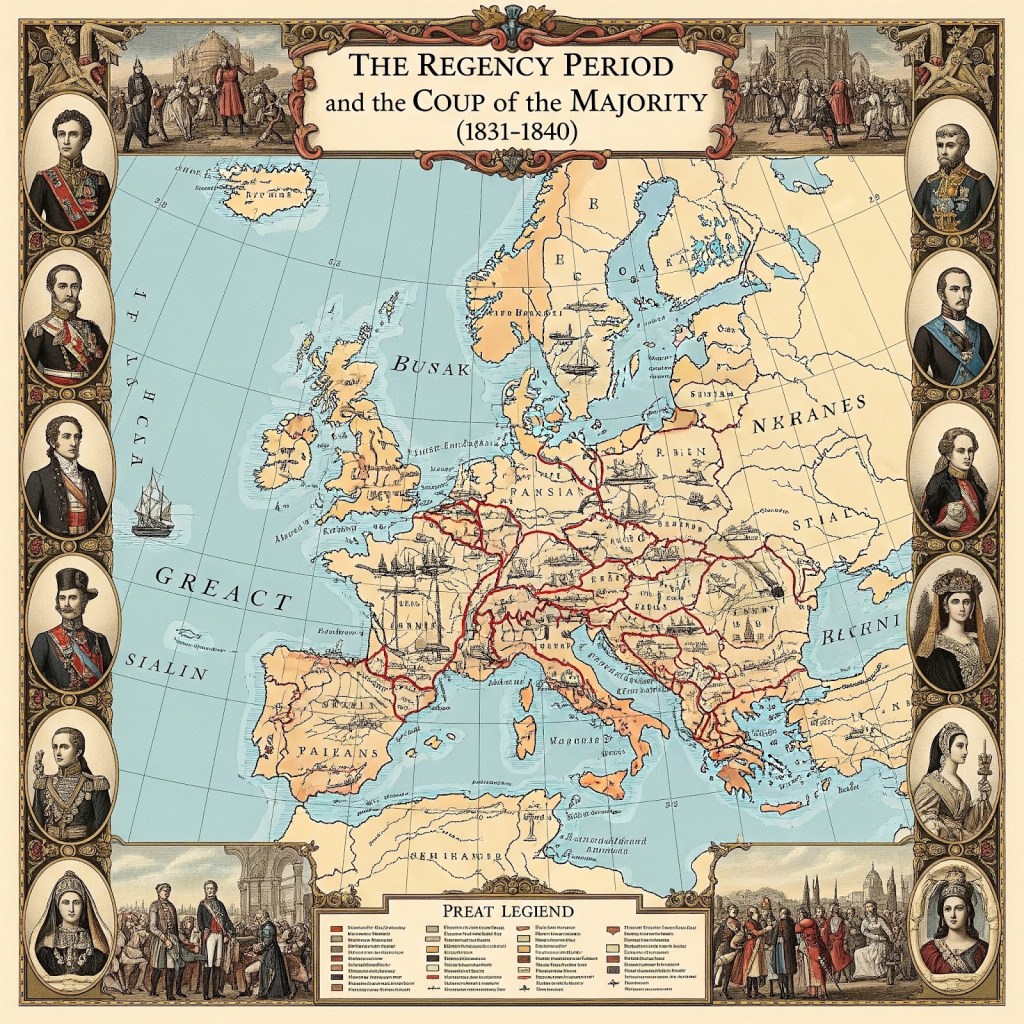
The years following Dom Pedro I’s abrupt departure ushered in the Regency period (Regência). With a minor on the throne, the empire was nominally ruled by a series of appointed regents. This era is historically synonymous with immense internal instability and regional revolts. The centralized authority of Rio de Janeiro was severely challenged by powerful insurrections, including the separatist Guerra dos Farrapos (Rag War) in the south and the Cabanagem revolt in the north. These movements tested the structural unity of the immense and diverse country to its breaking point.
To restore order, quell the widespread revolts, and prevent the empire from fracturing into multiple smaller states, the political elites agreed on a radical solution. They declared Dom Pedro II’s majority five years early in 1840, at the tender age of 14. This event, known as the Coup of the Majority, effectively ended the turbulent regency and ushered in a period of centralized imperial authority under the new emperor.
The Golden Age of Dom Pedro II (1840–1889): Stability and Progress

The nearly half-century-long reign of Dom Pedro II is universally regarded as the golden age of the Brazilian Empire. Under his mature, intellectual, and surprisingly progressive leadership, the country achieved an unprecedented degree of political stability, sustained economic prosperity, and increased international recognition. Pedro II meticulously cultivated an image of an enlightened, constitutional monarch and devoted patron of the arts, sciences, and education.
Economically, the empire flourished on the back of the coffee export boom, which rapidly became its most vital commodity and drove development. This era saw significant infrastructure development, including the expansion of railroads, the installation of telegraph lines, and the initial steps toward industrialization. Brazil effectively asserted itself as the dominant geopolitical power in South America, a position cemented by its victory alongside Argentina and Uruguay in the devastating Paraguayan War (1864–1870). While the conflict affirmed Brazil’s regional primacy, it came at a high human cost and significantly increased the national debt.
The primary moral and political struggle of the late empire was the abolition of slavery. While integral to the plantation economy and the power of the landed elite, a powerful and growing abolitionist movement challenged its existence. The empire enacted key gradualist milestones, including the Law of the Free Womb (1871), which granted freedom to children born to enslaved women, and the Sexagenarian Law (1885), which freed slaves over the age of 60.
The Fall of the Empire (1888–1889): The Fatal Catalyst
The final, definitive abolition of slavery proved to be the ultimate, immediate catalyst for the empire’s downfall. On May 13, 1888, with Dom Pedro II traveling abroad, his daughter and regent, Princess Isabel, signed the Lei Áurea (Golden Law). This momentous decree abolished slavery outright and, crucially, without any compensation whatsoever to the landowning class. While a profound triumph for human rights, this action irrevocably alienated the powerful, landowning elite—the fazendeiros—who had been the traditional economic and political pillar of the monarchy.
The monarchy was already facing other grave existential challenges:
- Rise of Republicanism: A growing urban middle class, professionals, and a significant segment of the military were increasingly influenced by liberal and positivist republican ideals. They favored a decentralized federal system that promised greater autonomy to the provinces, in contrast to the empire’s centralized model.
- Military Discontent: The military felt it had been insufficiently rewarded or recognized for its sacrifices and service in the Paraguayan War. Feeling marginalized by the civilian-dominated political structure, the officer corps became highly receptive to republican ideology.
- The Succession Crisis: As Dom Pedro II had no male heir, and his daughter, Princess Isabel, was married to the French Prince Gaston, Count of Eu (a foreigner), the idea of a third dynasty was unpopular among the nationalist elite.
The Empire of Brazil, a unique and long-lasting experiment in monarchical rule in the Americas, met its definitive conclusion on November 15, 1889. This abrupt termination was orchestrated by a swift and decisive military coup d’état led by Marshal Deodoro da Fonseca, a prominent figure in the Brazilian army. The reigning monarch, Emperor Dom Pedro II, despite being a highly respected figure and patron of the arts and sciences, offered no resistance. Driven by a profound desire to prevent the bloodshed and destruction of a potential civil war, the Emperor chose to accept the end of his reign peacefully.
Following the coup, Dom Pedro II and his entire family were summarily exiled to Europe, marking the definitive close of the Braganza dynasty’s rule in the country. In the wake of the monarchy’s collapse, the Republic of Brazil was officially proclaimed, signaling a fundamental shift in the nation’s political structure and bringing the singular, seven-decade-long experiment of an American monarchy to a permanent close.
Legacy

The historical legacy of the Brazilian Empire remains a complex and often debated subject. It is frequently celebrated for ushering in a long period of political stability and institutional continuity, particularly when contrasted with the turbulent early republican years of many of its Spanish American neighbors. Moreover, the imperial era saw notable cultural achievements, advancements in education, economic modernization, and the eventual peaceful abolition of slavery. Despite these profound positive aspects, the empire’s history is forever and inescapably shadowed by the enduring institution of slavery, which was a fundamental pillar of its economy and social structure until its final abolition a mere year before the monarchy’s fall. This inherent contradiction between progress and human bondage continues to shape the contemporary interpretation of the Brazilian imperial era.
 Jogo Corpo Fechado