

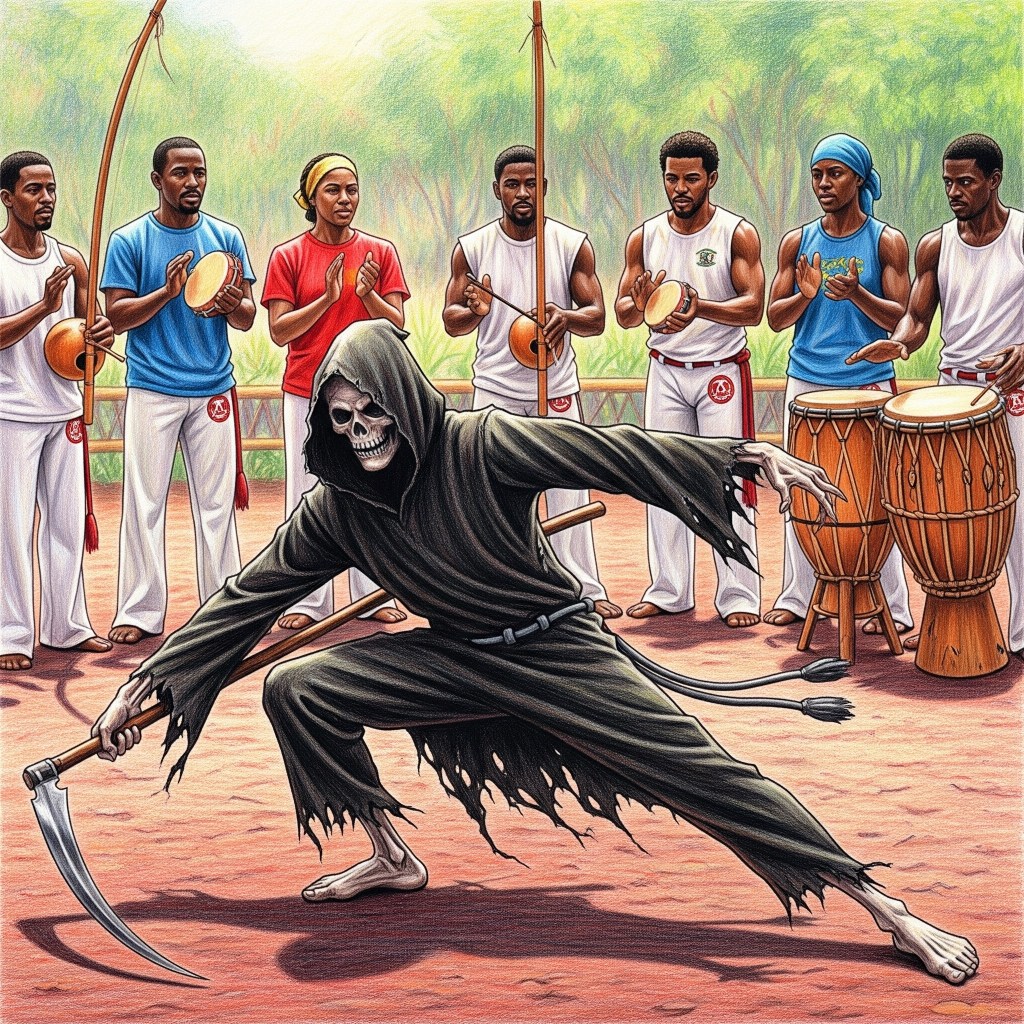
Capoeira, a magnificent and globally revered art form, is celebrated for its profound historical depth, philosophical richness, and fundamentally non-competitive, deeply ritualistic structure. Yet, beneath the vibrant energy of the roda—the circle that defines its heart—Capoeira harbors a less visible, often-unacknowledged “dark side” that demands critical scrutiny.
This concept does not posit malicious intent or inherent evil within the practice itself. Instead, it serves to illuminate the challenging, sometimes detrimental, and frequently complex realities embedded within its tradition, internal politics, historical trajectory, and contemporary practice. It is an unflinching examination of the shadows that fall beneath the radiant light of its performance, an essential counterpoint to the often-romanticized narrative of its origins and evolution.
The shadows manifest in several critical areas. Historically, Capoeira’s journey from a tool of resistance for enslaved and marginalized peoples to a globally marketable martial art has been fraught with challenges, including the appropriation and sanitization of its more aggressive, combative elements, often in the pursuit of mainstream acceptance. This process of refinement has sometimes erased the memory of the violence and oppression that forged it.
In contemporary practice, this “dark side” surfaces through problematic internal politics, including authoritarian leadership structures within some grupos (groups), which can lead to the exploitation of students’ time, labor, and finances under the guise of respect and tradition. Furthermore, issues of abuse of power, unchecked machismo, and, in some unfortunate instances, the enabling of misconduct—all shielded by a culture of unquestioning loyalty to the Mestre (Master)—represent systemic flaws that contradict the art form’s philosophical commitment to freedom and community.
Finally, the philosophical and practical tension between the deeply ritualistic, communal nature of Capoeira and the modern drive toward commodification, certification, and spectacle often introduces complexities that compromise its core integrity. A thorough and honest engagement with these uncomfortable realities is necessary not to diminish the art, but to ensure its ethical and sustainable future.
The Dark Side of Capoeira: An Essential Critical Examination
This examination delves into the “dark side” of Capoeira, a vital practice that does not seek to dismiss the art form but to foster transparency, accountability, and ethical governance within its global community. This difficult truth encompasses several critical, human-driven dimensions that persist beneath the art’s beautiful, idealized facade.
1. The Weight of Tradition and Dogma: A Double-Edged Sword
The necessary preservation of Capoeira ancestral wisdom can, paradoxically, become a profound source of internal conflict and intellectual stagnation, manifesting as a rigid adherence to an idealized, unchangeable past.
Rigidity and Resistance to Change
The imperative to maintain “pure” Capoeira often translates into an uncompromising, inflexible adherence to codified tradition. This dogmatism acts as a powerful inhibitor, actively discouraging innovation, ethical re-evaluation, and stifling the natural evolution of the art. This resistance to change is frequently codified in specific practices—such as refusing to incorporate modern conditioning methods, rejecting any musical or movement variations not explicitly documented from a certain historical period, or demonizing practitioners from different, more contemporary lineages. It risks alienating dedicated practitioners who seek a more modern, contextually relevant, or ethically hybridized approach, viewing their efforts not as evolution but as a degradation of the art.
In its most extreme and debilitating form, this rigidity prioritizes historical accuracy and esoteric knowledge over practical effectiveness, ethical leadership, or the genuine personal growth and well-being of the student. The focus shifts from the student’s holistic development to the mere maintenance of a historical performance. The art, tragically, can become a static monument—a cultural fossil—rather than a living, breathing, adaptive practice of liberation. This creates a cognitive dissonance where an art form born of radical resistance becomes defined by intellectual conservatism.
The Cult of the Mestre (Master)
Within a tradition where the uninterrupted chain of lineage (axé) and the apprenticeship model are foundational, the Mestre holds a position of immense, almost sacrosanct, power. This strict hierarchy is indeed essential for the rigorous transmission of complex physical, musical, and philosophical knowledge, providing necessary structure and depth.
However, the “dark side” emerges when this structure shifts from a guiding authority to an autocratic command. This transition is often subtle, facilitated by the Mestre’s unquestioned control over access to knowledge, rank, and community status. This environment can foster the potential for deep-seated exploitation, including emotional manipulation, financial predation, and the insistence on unquestioning, total obedience. When the Mestre’s personal demands become inseparable from the art’s demands, the student loses their ethical compass. Such dynamics fundamentally undermine the student’s capacity for critical thinking, autonomous development, and ethical agency, effectively transforming the relationship from mentorship to subjugation. The Mestre’s word becomes law, stifling the intellectual and spiritual independence that Capoeira, at its core, is meant to instill.
Secrecy and Exclusion
Capoeira’s origins as a clandestine art of resistance and survival among enslaved people naturally necessitated secrecy. This historical context imbued the art with layers of encoded meaning and hidden practice. While some degree of esoteric knowledge and guarded practice remains vital for protecting the art’s depth and cultural value and maintaining a sense of earned privilege for committed students, this historical necessity can devolve into unnecessary exclusion and elitism.
It frequently manifests as the creation of insular groups and closed-door circles, where “true” knowledge is purportedly withheld from all but the most favored members. This makes the art feel unduly inaccessible, overly esoteric, or deliberately unwelcoming to newcomers and those outside a specific, favored lineage. This gatekeeping often serves less to protect the art and more to inflate the Mestre’s importance and control over a select few. This ultimately impedes the art’s broader cultural transmission, diminishes its community-building potential, and violates its core philosophy of shared liberation and accessibility for the oppressed. The spirit of resistance is replaced by a spirit of petty hoarding.
—–Beneath the art’s graceful, flowing aesthetic are genuine physical demands and the potential for deep psychological burdens tied to the student-teacher dynamic, often rationalized under the guise of “tough love” or “necessary discipline.
“The Unseen Toll: Physical Demands and Injury Profile”.
Despite its beautiful façade of fluidity and dance-like qualities, Capoeira Angola is, at its heart, an uncompromising martial art. The style’s defining characteristic—the constant, low, ground-based movements—places enormous, specific, and often cumulative stresses on the human body. Techniques such as rasteiras (sweeps), cabeçadas (headbutts), and the sudden, often high-impact takedowns and defensive collapses inherent to the game are core to its practice.
These sustained, unique physical demands, particularly during long-duration rodas where practitioners may spend twenty minutes or more in a deep squat or on the ground, create a distinctive injury profile. Without meticulous, modern preparatory conditioning, these factors can rapidly lead to:
- Chronic Joint Degeneration: The primary concern lies in the joints of the lower kinetic chain, particularly the knees and lower back. The deep, repetitive flexion required for the ginga and low-to-the-ground movements—specifically the paralelo and cadeira stances—stresses the meniscus and cartilage, accelerating wear-and-tear and leading to conditions like patellofemoral pain. Similarly, the constant spinal rotation and load-bearing in flexed positions contribute to chronic lower back pain and disc issues, especially L4-L5 and L5-S1.
- Muscle Imbalances: The heavy reliance on certain muscle groups—specifically the hip flexors, adductors, and core stabilizers—often leads to powerful but disproportionate development. The constant anterior pelvic tilt required for low positions shortens the hip flexors. If not counterbalanced by dedicated strength and flexibility work for the hamstrings, glutes (gluteus medius and maximus), and upper back (to counteract the hunched position often adopted), these imbalances can create postural deficiencies (such as swayback) and increase susceptibility to acute injuries like hamstring strains, groin pulls, and chronic tendinopathy.
- Acute Injuries: While chronic issues are slow-burning, the intensity of the roda can lead to sudden trauma. Common acute injuries include ankle sprains from quick changes in direction on uneven surfaces or during abrupt foot planting, concussions from poorly executed cabeçadas or unexpected falls, and shoulder injuries stemming from breakfalls (quedas) performed without proper preparation or technique, which can result in rotator cuff tears or AC joint separation.
These physical risks are exponentially compounded when safety and evidence-based training methods are deliberately or ignorantly sacrificed on the altar of perceived “authenticity.” Mestres whose focus is purely historical may neglect modern understandings of biomechanics, periodization, and injury prevention, prioritizing a historical ideal of “struggle” or “toughness” over the longevity and physical well-being of their students. This neglect can transform an art form into a high-risk activity, revealing the true, unseen physical toll of Capoeira Angola.
Emotional and Financial Exploitation
While certainly not universal, instances of deeply unethical Mestre-student relationships constitute a corrosive and deeply concerning element within the Capoeira community. This exploitation is rarely overt or crudely violent; instead, it often involves a sophisticated, insidious, and subtle manipulation that preys upon the student’s profound commitment, respect, and devotion to the art and the Mestre’s revered status.
The Dynamics of Emotional and Personal Exploitation
This abuse primarily manifests as a continuous, intense emotional demand on the student’s personal time and loyalty, deliberately blurring the lines between legitimate instruction, expected personal service, and genuine friendship. The Mestre often cultivates a persona of a singular, indispensable guide, creating a relationship that is fundamentally transactional beneath a veneer of familial warmth. This process, known as “love bombing” and subsequent withdrawal, is a common technique in cult-like structures.
The student is made to feel an overwhelming, implicit pressure to prioritize the Mestre’s often self-serving needs and the group’s agenda above their own professional career, familial obligations, personal relationships, and overall well-being. This constant pressure can lead to chronic stress, social isolation from non-Capoeira peers, and, most damagingly, fosters a state of codependency where the student’s self-worth becomes inextricably tied to the Mestre’s approval. Furthermore, the dark reality of sexual harassment and abuse of power—often dismissed or covered up by the school’s hierarchy through victim-blaming or silencing—is an unacceptable yet persistent problem in some of these groups, adding a deeply traumatic layer to the emotional toll.
Financial and Labor Exploitation
Beyond this heavy emotional and psychological toll, financial and physical exploitation are distressingly common and often systemic. Students are frequently subjected to a pressure to provide significant unpaid labor for the Mestre or the group, often under the guise of “contributing to the escola (school)” or “showing commitment.”
This can range from performing extensive, menial tasks such as diligently cleaning the academy, managing complex logistics for group travel, or running personal errands for the Mestre (e.g., driving, home repairs, childcare). More insidiously, Mestres often exploit the professional skills of their students—be it graphic design, web development, photography, legal aid, or accounting—for the group’s benefit without offering any compensation or even acknowledgment. This pervasive unpaid service saves the Mestre substantial operational costs, effectively turning the student body, particularly the inner circle, into a free, skilled, and highly devoted labor force, often at the expense of their own professional and financial development.
Exorbitant and Opaque Financial Demands
Furthermore, Mestres may impose exorbitant, non-transparent costs for what are presented as mandatory or essential events. This includes disproportionately high fees for batizados (naming ceremonies), graduation fees for belt/cord changes, participation in required workshops, and the mandatory purchase of specific uniform or equipment items. These fees often appear grossly disproportionate to the actual costs incurred, creating a significant and recurring financial burden on the student that can stretch over years. The money generated frequently flows directly and solely to the Mestre, bypassing any form of public or accountable organizational oversight, creating a profitable, tax-free enterprise hidden under the guise of cultural preservation.
The Culture of Silence and Betrayal
Crucially, the Mestre’s revered and often unquestioned status in the roda (the Capoeira circle) and the academy environment makes it culturally, socially, and emotionally challenging for the student to challenge the demands, question the fees, or push back on the time commitment. The Mestre is positioned as the sole source of knowledge and tradition, and to question him is framed as questioning the integrity of the art itself—a betrayal that risks social ostracism and loss of status within the community, sometimes resulting in outright banishment. This powerful psychological barrier ensures compliance.
This cynical practice takes ruthless advantage of the student’s profound devotion and the Mestre’s entrenched position of power, fundamentally betraying Capoeira Angola’s core philosophy of freedom, integrity, and resilience (malandragem in its positive, insightful, and street-smart sense). This pervasive abuse of power perverts the learning environment into a cult of personality, creating a stagnant and oppressive structure that ultimately hinders the student’s journey toward true mastery, independence, and self-possession.
3. Internal Politics and Fragmentation: The War of Lineages
The Capoeira world, despite its vibrant, global facade, is a complex, often fractured landscape frequently defined by internal strife and destructive rivalries. Far from presenting a unified front, this fragmentation significantly detracts from the art itself, undermining its global influence and community harmony.Lineage Wars and Petty Rivalry
The community is systematically fractured by a rigid adherence to distinct historical lineages, deeply entrenched competing philosophical interpretations, and, most damagingly, acrimonious personal and generational rivalries between influential Mestres. This environment has fostered a culture of corrosive, petty politics that permeates all levels of the Capoeira structure.
This toxicity frequently escalates beyond mere disagreement, often leading to public condemnation, outright verbal attacks circulated through social media and private channels, and the systematic delegitimization of other groups, styles, and schools. Schools are often pressured by their leadership to sever ties with rivals, creating insular silos. The cumulative effect of this infighting is an inability to achieve community unity on critical, existential issues, such as establishing universal ethical standards for teaching, safeguarding minors, or collaborating effectively on cultural preservation efforts. This lack of cohesion ultimately diminishes the art’s reputation in the broader cultural landscape, critically impedes genuine global cooperation, and, most regrettably, distracts practitioners from the core physical, musical, and philosophical practice of Capoeira. The energy wasted on internal battles is energy not spent on growth, innovation, and positive community building.Gatekeeping and the Tyranny of Authenticity
A perpetual and often deeply toxic debate over “authenticity” serves as a primary, powerful tool for exclusion and marginalization within the community. Practitioners and their Mestre’s frequently challenge the legitimacy of others’ training, their philosophical understanding of the art’s deeper meanings, or, most critically, the perceived purity of their Mestre’s lineage and historical connection to foundational figures.
This aggressive gatekeeping creates a hyper-stressful, judgment-filled environment where the focus fundamentally shifts away from the universally valued qualities of personal skill, physical mastery, good character, ethical conduct, and positive contributions to the art’s transmission. Instead, the emphasis is channeled toward an elitist preoccupation with pedigree, origin stories, and a rigidly defined “right way” to play. This “tyranny of authenticity” actively stunts the art’s natural evolution, transmission, and global reach by prioritizing an insular purity and a backward-looking traditionalism over expansive, ethical, and inclusive practice. New innovations are met with suspicion, and practitioners who do not fit a particular mold are quickly labeled as inauthentic or lacking legitimacy, forcing many talented individuals to leave the art or operate on the fringes.
4. The Romanticization of Poverty and Struggle: Misdirecting Heritage
The Dark Side of the Capoeira World: An Unflinching Examination
The practice of Capoeira Angola is fundamentally and inextricably linked to the profound, difficult history of slavery, grinding poverty, and the enduring spirit of resistance in Brazil. This heritage is a sacred trust that demands to be handled with a deep sense of nuance, intellectual honesty, and moral responsibility, rather than being filtered through a romanticized, nostalgic, and ultimately uncritical lens.
—–The Burden of a Tragic Heritage: Romanticizing Suffering and Malandragem
The historical context is not merely a background detail; it is an absolutely vital, foundational component of Capoeira’s identity, providing the profound philosophical and physical underpinnings of the entire practice. However, a significant and insidious danger emerges when certain groups, schools, or individual practitioners inadvertently or, worse, intentionally, engage in the wholesale romanticization of the concept of malandragem.
The malandro is a complex cultural archetype—the trickster, the cunning hustler, the charming rogue—whose existence was necessitated by a brutal, unequal social structure. Similarly, the explicit hardship, the suffering, and the ingenious survival tactics inherent in the art’s origins under the heel of slavery and colonialism can be inappropriately venerated and even fetishized.
This misguided, often superficial focus concentrates purely on the mythologized aspects of struggle, street cunning, and open rebellion. When this focus is critically divorced from its original historical and social necessity, it inevitably leads directly to the glorification or, more troublingly, the conscious emulation of behaviors that are fundamentally outdated, non-productive, or ethically dubious in a modern context. Instead of undertaking the difficult, necessary intellectual work of critically analyzing and transcending the conditions that necessitated the malandro and the original hardship, this shallow approach risks elevating petty thievery, manipulative behavior, or general irresponsibility and lack of discipline to the level of coveted cultural authenticity.
This cultural burden—the uncritical adoption of historical survival tactics as modern, unquestioned virtues—risks fostering a fundamental, self-imposed regression into the past. It actively obstructs the essential, forward-looking mandate of modern Capoeira, which should inherently be promoting a trajectory of holistic personal development, acute critical social consciousness, and constructive, ethical community building.
The contemporary Capoeira world often finds itself trapped in a historical anachronism, prioritizing the romanticized, problematic, or even dysfunctional elements of its past survival struggle over its profound, universally resonant message. This selective focus—a deliberate, or perhaps subconscious, choice to celebrate the tools of the past rather than the spirit that wielded them—fundamentally misdirects the art’s powerful potential.
The genuine, immutable core of Capoeira speaks to an uncompromising self-determination, a fierce and elegant resilience in the face of insurmountable odds, the relentless pursuit of liberation from systemic oppression, and the transcendent power of creative expression as a form of resistance. This essential message is a dynamic, living philosophy—a potent tool for enacting positive social and personal change in the present day.
However, when the focus shifts to the celebration of the mere mechanics of survival, the art is transmuted. It ceases to be a dynamic force and becomes a static, self-limiting cultural performance, an echo chamber that traps its modern adherents in a museum of historical reenactment. The noble why—the pursuit of freedom, justice, and self-possession—is eclipsed by an obsessive focus on the dysfunctional or outmoded how—the specific, often harsh or restrictive, methods necessary for mere survival in a deeply hostile environment. This prioritization of the historical form over the enduring function inevitably diminishes the art’s profound spiritual, philosophical, and social potential, reducing a vital practice of liberation to a mere folkloric spectacle.
Conclusion: A Call for Conscious Engagement and Ethical Evolution
The discourse surrounding “The Dark Side of Capoeira” offers an essential, albeit uncomfortable, critical framework for evaluating the art form. This perspective necessitates a direct and honest confrontation with the human-driven challenges that persist beneath the beautiful, often-idealized facade of the roda and the academy. These challenges are not abstract theoretical concepts but are deeply woven into the lived experience of the community: the inevitable organizational pitfalls, the insidious nature of politics within groups, the complexities of hierarchy and power dynamics, and the difficult realities of abuse, exploitation, misuse of authority, and personal failings that can undermine the integrity and ethical foundation of any human endeavor.The Imperative of Self-Correction and Ethical Scrutiny
Acknowledging and dissecting these challenging aspects is not an attempt to diminish or devalue the profound historical, cultural, or artistic significance of Capoeira. On the contrary, this level of scrutiny represents a vital, self-correcting step toward fostering a more robust, critically engaged, ethically sound, and fully conscious participation with its global practice and its community. Ignoring these issues, or attempting to suppress them, creates a dangerous vacuum where complacency and misconduct can flourish unchecked. True respect for the art form demands an unflinching gaze at its vulnerabilities, particularly those that emerge from the concentration of power in hierarchical structures.Safeguarding Integrity Through Institutional Accountability
By honestly confronting the human element—the inevitable organizational flaws, the political maneuvering for influence, and the personal failings of those in positions of power—practitioners and leaders are compelled to work tirelessly to safeguard the foundational integrity of Capoeira Angola. This persistent, proactive effort is crucial to ensure that its powerful, fundamental message of liberation, community, and self-mastery—a message forged in the crucible of resistance and survival—is not betrayed or corrupted by the very structures and personalities intended to preserve it. The goal is to prevent the institutions designed for transmission from becoming conduits for exploitation.
This process demands a fundamental shift in mindset. The collective goal must be to move beyond a passive, unquestioning reverence for tradition and authority, often encapsulated in the phrase “respect the seniority/hierarchy.” Such passive acceptance can often mask institutional neglect, shield abusers, or enable harmful, anachronistic behaviors. Instead, the community must transition toward an active, discerning, and ethically responsible participation in the continuous, challenging, and necessary evolution of this profound martial art and philosophy.Embracing Ethical Evolution: A Three-Pillar Approach
This ethical evolution is neither simple nor optional; it is a required investment in the art’s future, built upon three interconnected pillars:
- Transparency and Accountability: This necessitates establishing clear, enforced codes of conduct that are universally applied, regardless of rank or history. Crucially, robust and accessible mechanisms for reporting and addressing misconduct must be created, ensuring that those who come forward do so without fear of reprisal, ostracization, or damage to their Capoeira journey. Leaders and masters must be held to the highest standards, and the wielding of power must be consistently coupled with humility, responsibility, and independent oversight. The community must move past an honor system to a system of demonstrable ethics.
- Critical Literacy: Practitioners, from the newest student to the most experienced Mestre, must be actively encouraged to develop a critical lens. This involves questioning dogma, challenging hierarchical rigidity when it stifles growth or enables misconduct, and evaluating practices that conflict with the art’s core values of respect, liberation, and human dignity. A critical community is a resilient community, capable of internal defense against ideological capture or ethical decay.
- Community Dialogue: Fostering open, non-punitive, and facilitated spaces for difficult conversations is essential. These dialogues must address sensitive topics such as the inherent power dynamics in the roda, gender dynamics and sexual misconduct, the complexities of generational change, and how to reckon with the legacy of problematic or abusive figures without erasing the art’s history. These conversations allow the community to collectively define and enforce its contemporary ethical boundaries.
The Path to Preserving Integrity
The path to preserving the integrity and positive legacy of Capoeira is not passive; it demands continuous, active engagement from every member of the community. This sustained commitment to introspection must manifest as a culture of self-critique where Mestre and student alike are encouraged to honestly examine their own practices, motivations, and the inherent power dynamics within the roda and the academy. It requires moving beyond mere acknowledgement of past failings and into a concrete, systemic practice of accountability.
This means establishing clear, accessible, and consistently enforced ethical guidelines and codes of conduct that specifically address issues of abuse, exploitation, financial impropriety, and misuse of authority—the explicit dimensions of the “dark side” of the art form. Furthermore, accountability must be institutionalized through transparent and impartial mechanisms for reporting grievances, mediating disputes, and applying fair, proportional disciplinary action when those guidelines are violated. Such structures signal to both current and prospective practitioners that the community prioritizes the safety and ethical treatment of its members above reputation, seniority, or institutional pride.
Only through this rigorous dedication to introspection, accountability, and ethical growth can the global Capoeira community ensure that the art form remains a genuine force for positive transformation. By actively purging itself of harmful elements and consistently upholding the foundational principles of respect, freedom, and human dignity, the community can secure the art form’s future, fulfilling its profound promise to be a source of strength, cultural enrichment, and ethical guidance for the next generation of practitioners worldwide.
 Jogo Corpo Fechado