
Integrating the Shadow Self in Capoeira Angola: A Path to Holistic Development

The concept of the “Shadow Self,” a cornerstone of analytical psychology, was popularized by the eminent Swiss psychiatrist Carl Jung. It refers to the unconscious aspects of our personality that we, often unknowingly, tend to suppress, deny, or reject from our conscious awareness. These hidden facets are not inherently negative; they can encompass perceived undesirable traits such as anger, jealousy, fear, or insecurity, which society or our upbringing may have taught us to deem unacceptable. However, crucially, the Shadow also harbors undeveloped positive qualities—latent potentials like creativity, spontaneity, authentic power, courage, and intuition—that remain untapped because they haven’t been consciously acknowledged or integrated.
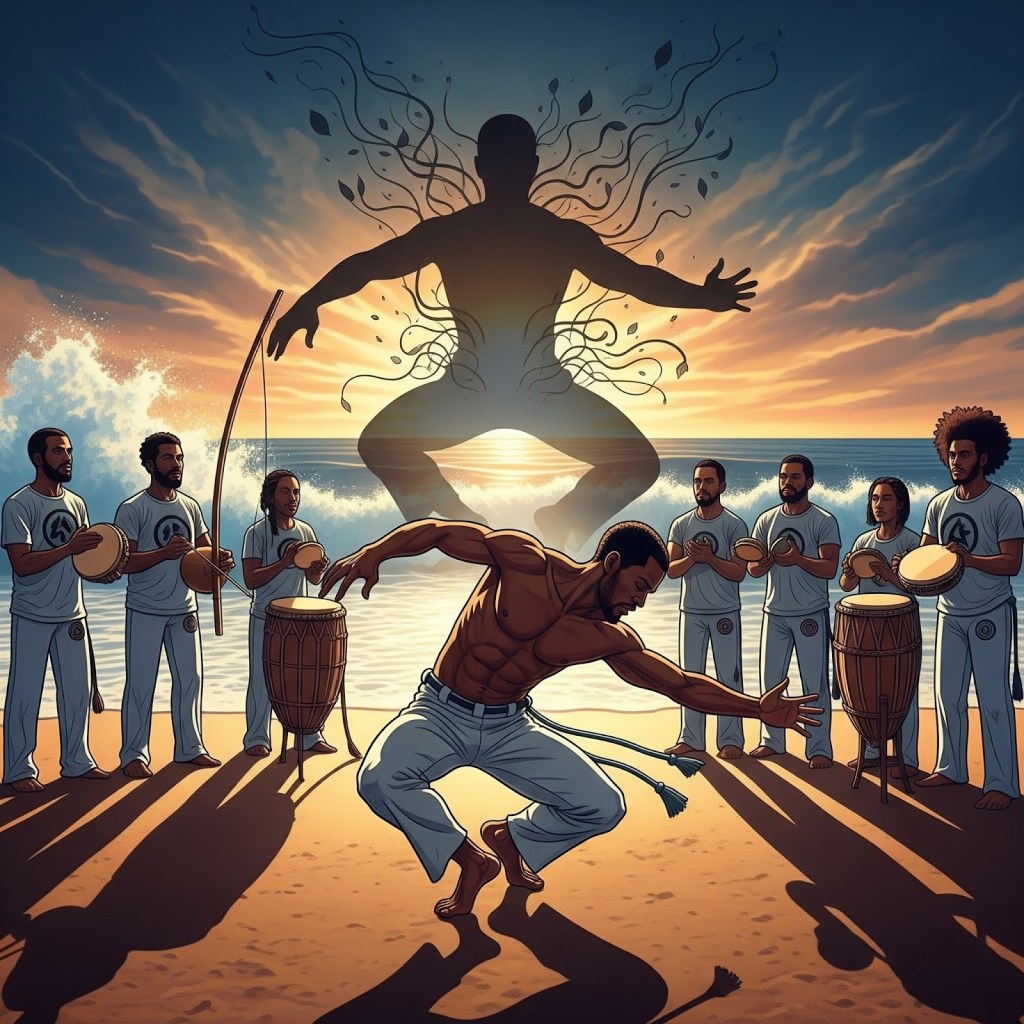
In the vibrant and complex world of Capoeira Angola, the deliberate integration of the Shadow Self offers a profoundly transformative pathway. This journey leads to holistic development, not only within the dynamic and emotionally charged space of the roda (the circle where capoeira is played, a microcosm of life itself) but also, significantly, in the broader context of one’s everyday life. By confronting and embracing these hidden parts of ourselves, Capoeira Angola practitioners can unlock deeper levels of self-awareness, improve their physical and emotional fluidity, and ultimately achieve a more authentic and powerful presence both in and out of the game.
How Do We Integrate the Shadow Self in Capoeira Angola?

Integrating the Shadow Self in Capoeira Angola is a multifaceted process that involves self-awareness, acceptance, and conscious engagement with all aspects of one’s being.
- Self-Observation and Awareness: The first step is to become aware of the aspects of ourselves we typically hide or deny. In the demanding and often unpredictable environment of the roda, capoeiristas are frequently confronted with their limitations, fears, and frustrations. A missed movement, a perceived failure to respond, or the challenge of a more experienced player can trigger these shadow aspects. By observing our reactions without judgment—the anger at a takedown, the fear of engaging, the desire to dominate—we begin to identify what resides in our shadow. Journaling, reflection after training, and honest conversations with trusted mentors or peers can aid in this process.
- Embracing Discomfort and Vulnerability: Capoeira Angola, with its emphasis on flow, improvisation, and the unknown, naturally pushes practitioners out of their comfort zones. This discomfort is precisely where the Shadow Self often surfaces. Instead of shying away from these feelings, integrating the Shadow involves leaning into them. Allowing oneself to be vulnerable, to make mistakes, and to explore movements that feel awkward or uncharacteristic can reveal hidden strengths and break down internal barriers. For example, a capoeirista who always plays defensively might explore more aggressive movements, or one who is overly dominant might practice yielding and listening.
- The Roda as a Mirror: The roda itself serves as a powerful mirror for the Shadow Self. The interactions with other players, the energy of the music, and the dynamic nature of the game reflect back our internal landscape. A capoeirista who struggles with control might find themselves overly rigid in the roda, while someone who fears being seen might play in a way that minimizes their presence. By recognizing these patterns and understanding how they manifest in their game, individuals can begin to consciously work with them.
- Embracing All Roles: In Capoeira Angola, there are various roles—the “comprador” (buyer) and “vendedor” (seller) in the game, the musicians, the singers. Often, individuals gravitate towards roles that align with their conscious self. Integrating the Shadow might involve stepping into roles that feel less natural. For instance, a natural leader might choose to play a more supportive role, or a shy person might take on the responsibility of singing lead. This exploration expands one’s comfort zone and brings forth suppressed aspects of the personality.
- Symbolism and Archetypes in Capoeira: Capoeira Angola is rich in symbolism, drawing from African and Brazilian spiritual traditions. The animal movements, the stories in the songs, and the historical figures revered in capoeira can all be understood as archetypal expressions. By engaging with these symbols, practitioners can gain insight into their own inner archetypes and the aspects of the human experience they embody, including those in the shadow. For example, understanding the cunning of the malandro (trickster) or the resilience of the escravo (slave) can help a capoeirista explore their own capacity for strategy or perseverance, even if these traits were previously suppressed.
Why Should Someone Integrate the Shadow Self in Capoeira Angola?

The profound impact of integrating the Shadow Self within the practice of Capoeira Angola extends far beyond the mere physical acquisition of skills, fostering holistic growth and self-mastery. This integration unlocks a multitude of benefits that permeate every aspect of a capoeirista’s journey, from their presence in the roda to their daily interactions and overall well-being. By confronting and embracing the often-unacknowledged aspects of one’s personality—those repressed emotions, fears, vulnerabilities, and even hidden strengths—the practitioner embarks on a transformative path.
In the context of Capoeira Angola, the Shadow Self manifests in various ways. It can be the fear of failure that inhibits a fluid movement, the frustration that leads to aggression, or the insecurity that prevents a capoeirista from expressing their true individuality in the game. Conversely, it can also encompass dormant creativity, untapped power, and a latent capacity for expression that remains unarticulated due to societal conditioning or personal inhibitions.
The process of integrating the Shadow Self in Capoeira Angola is not about eradicating these facets, but rather about bringing them into conscious awareness and skillfully channeling their energy. Through the demanding physical and mental discipline of the art, practitioners are repeatedly presented with opportunities to face their internal obstacles. The intense focus required during a roda, the need for both vulnerability and resilience in the face of an opponent, and the constant demand for improvisation and self-expression all serve as mirrors to the inner landscape.
This integration fosters a deeper sense of self-awareness and authenticity. As capoeiristas learn to acknowledge and work with their Shadow, they develop greater emotional intelligence, improved self-regulation, and a more profound understanding of their motivations. This leads to a more genuine and powerful presence in the roda, where movements become more authentic, intentions clearer, and interactions more profound. Beyond the physical art, this self-mastery translates into greater confidence, improved relationships, and a more balanced and integrated approach to life’s challenges, enriching their overall well-being and personal development.
Integrating the Shadow Self in Capoeira Angola: A Path to Mastery and Self-Actualization
The integration of the Shadow Self—the unconscious, often disowned aspects of the personality—is not merely a psychological exercise but a powerful, transformative discipline that elevates the practice of Capoeira Angola from a physical art form to a profound journey of self-mastery. By consciously engaging with these hidden facets, the practitioner unlocks deeper levels of skill, presence, and connection, as detailed below:1. Enhanced Authenticity and Profound Self-Acceptance
By fearlessly acknowledging and wholeheartedly embracing every facet of their being—both the admirable ‘light’ and the repressed ‘shadow’—capoeiristas embark on a profound journey toward unshakeable authenticity. This process involves confronting internalized shame, fear, and self-judgment associated with perceived undesirable traits or powerful, yet controlled, emotions like aggression or vulnerability.
- The Liberation from Internal Strife: Deep self-acceptance serves as a powerful antidote to debilitating internal conflict. The enormous psychological energy typically expended on maintaining the façade or suppressing these Shadow elements is immediately freed. This liberation results in a palpable increase in vitality and mental clarity.
- The Uninhibited “Game”: The authenticity gained directly translates into a richer, more expressive, and truly individual “game” (jogo) within the roda (the circle where Capoeira is played). The movements become genuine, the timing intuitive, and the expressions of malícia (cunning) and humor are fully owned. This genuine expression not only revolutionizes the practitioner’s personal experience but also resonates deeply with others, fostering an environment of trust and deeper, more soulful connection within the Capoeira community. The practitioner moves not as an imitator, but as a fully realized self.
2. Unleashed Creativity and Dynamic Spontaneity
The Shadow Self frequently serves as a vast, untapped repository for undeveloped creative potential. It often holds aspects of the self—such as bold self-expression, innovative risk-taking, or disruptive ideas—that have been suppressed or deemed socially unacceptable or “un-Capoeira-like.”
- Accessing Novel Wellsprings of Innovation: When these hidden dimensions are brought into conscious awareness and integrated, individuals gain access to novel wellsprings of creativity that were previously locked away. They begin to see possibilities where they only saw limitations.
- Fluid and Innovative Movement: This integration manifests in Capoeira Angola as movement that is more fluid, innovative, and spontaneously generated in the roda. The capoeirista becomes less reliant on pre-programmed sequences and less predictable in their responses and actions.
- Heightened Adaptability: They exhibit a heightened adaptability that allows them to respond to the continuously evolving dynamics of the game with greater ingenuity, flair, and deceptive simplicity. This newfound creative freedom deepens their engagement with the art form, transforming their participation into a continuous, living meditation that pushes the boundaries of their individual and collective expression. The movement embodies true ginga—a continuous, flowing state of readiness and unpredictable invention.
3. Cultivated Emotional Intelligence and Robust Resilience
The courageous act of confronting and integrating the Shadow Self necessitates a deep, sustained engagement with and processing of complex and often challenging emotions—including anger, fear, inadequacy, and grief—that may have been avoided for years.
- The Crucible of Emotional Intelligence: This introspective journey is a crucible for developing heightened emotional intelligence (EQ). It empowers capoeiristas to gain a more nuanced understanding and more effective management of their own emotional landscape, recognizing the subtle triggers and internal narratives that drive their reactions.
- Indispensable Skill Set: This invaluable skill set proves indispensable not only within the emotionally charged, often intense, and physically demanding environment of the roda, but also in navigating the intricate tapestry of their daily lives, improving communication and conflict resolution.
- Extraordinary Resilience: The sustained effort and psychological endurance involved in this integration process fosters an extraordinary degree of resilience. By having faced their own inner demons and emerging whole, they are better equipped to confront and overcome external adversity—physical setbacks, social challenges, or profound failures—with greater fortitude, emotional balance, and grace. They move beyond reacting to events and begin consciously choosing their response.
4. Strengthened Relationships and Deeper Connections
A common and often destructive pitfall of an unintegrated Shadow Self is the unconscious projection of our own disowned aspects onto others. We see the things we hate about ourselves most clearly and critically in other people, frequently leading to misunderstandings, debilitating friction, and unnecessary conflict in relationships.
- Diminished Projection: By consciously taking ownership and responsibility for their own shadow elements, capoeiristas significantly diminish these habitual, damaging projections. When they own their own capacity for malícia (cunning), for example, they can see it in a partner without automatically labeling it as purely malicious.
- Cultivating Profound Empathy: This self-awareness cultivates a more profound understanding of self and, by extension, a more empathetic understanding of others’ struggles and behaviors, paving the way for more genuine, transparent, and ultimately healthier relationships. They learn to relate from a place of wholeness, not need or judgment.
- Harmonious Community: Within the close-knit, highly interdependent community of Capoeira, where trust, honesty, and mutual respect are absolutely paramount for safety and growth, this ability to engage authentically fosters deeper bonds, enhances collaboration, and creates a more harmonious and supportive training environment (senzala).
5. Profound Understanding of Capoeira and the Self
Capoeira Angola is far more than a mere collection of physical techniques; it embodies a rich philosophy, a distinctive cultural way of life, and an ongoing odyssey of self-discovery—a pursuit of axé.
- Holistic Art Form: The integration of the Shadow Self serves as a powerful catalyst for achieving a deeper, more nuanced, and truly holistic understanding of the art form’s foundational principles. Concepts such as malícia (cunning, intuition, and strategic awareness), ginga (the fundamental swaying movement, symbolizing adaptability, flow, and the dance of life), and axé (the vital life force, energy, and spirit that permeates the art) are no longer abstract, intellectual ideas but become deeply experienced, lived realities.
- A Tool for Self-Actualization: Through this rigorous and rewarding process of integrating the whole self, Capoeira transcends its definition as a mere physical activity or a form of self-defense. It transforms into a potent and transformative tool for unparalleled personal growth and comprehensive self-actualization, enabling the practitioner to embody the highest ideals of the art form both inside and outside the roda.
Unlocking Full Potential: A Journey to Wholeness and Mastery
The ultimate objective in the journey of self-discovery, particularly as it is mirrored in the art of Capoeira Angola, is the profound and conscious integration of the Shadow Self. This integration is not a mere philosophical exercise but a powerful, active commitment to embracing the complete, complex, and multifaceted spectrum of one’s own humanity. It signifies a refusal to live life in fragments, acknowledging that true power resides in wholeness.
The Transformative Power of Awareness
By intentionally bringing the light of awareness to those aspects of the self that were previously relegated to the “shadow”—the parts deemed unacceptable, disowned, suppressed, or hidden—an individual catalyzes a deep, internal transformation. This deliberate act of self-acceptance unleashes a complete and robust potential that was formerly locked away by fear, shame, or societal conditioning. The energy once expended on repression is liberated, becoming a powerful source of life, creativity, and strength.
Beyond the Roda: Molding an Integrated Being
The effects of this integration are not contained merely within the perimeter of the capoeira roda. While it undeniably transforms the practitioner’s game, its true impact is on the development of the individual as a human being. The practitioner is molded, not merely into an exceptional capoeirista, but into a fully integrated, mentally and emotionally robust, and enlightened human being. This inner congruence creates a foundation of unwavering self-trust and authenticity.
These individuals become uniquely equipped to navigate the inevitable challenges, uncertainties, and emotional complexities of life with an augmented sense of wisdom and self-knowledge. They develop an unparalleled inner strength, a resilience forged in the crucible of honest self-confrontation, and an elegant grace that stems from having nothing left to hide or suppress. They operate from a place of authenticity, making their actions and reactions inherently more reliable and grounded.
The Culmination in Capoeira Angola
Within the demanding and highly expressive context of Capoeira Angola, this deep personal integration culminates in a game that transcends technical skill. The jogo becomes not just more expressive and physically powerful, but genuinely masterful. It is a game infused with an authentic vulnerability, a spontaneous creativity, and a profound depth that is impossible for a fragmented self to achieve. The movements, the strategic decisions, and the musicality all authentically reflect the extraordinary richness, inherent complexity, and profound psychological depth of the integrated individual.
The integrated capoeirista plays from a position of inner security, free from the need to prove or hide. Their game becomes a living, breathing testament to the transformative power of self-awareness and radical self-acceptance. Ultimately, this journey elevates the practice of Capoeira Angola from a martial art or a dance into a veritable spiritual path—a profound journey of personal liberation where the mastery of the game is inseparable from the mastery of the self.
 Jogo Corpo Fechado