

Antônio Oliveira Bemvindo, born on 11/03/1950, in Cachoeiro do Itapemirim, in the state of Espírito Santo. He came to Rio de Janeiro at the age of 6, settling in the neighborhood of Penha, initially at the old Rua 3, n° 03 – Vila Cruzeiro.
He left home early to work, initially carrying bags for ladies at the street markets, then he did freight, and then he met Índio (a cabbage seller at the market) and began helping him clean cabbages at the markets on Saturdays in Brás de Pina. He befriended Baixinho do Limão and through him, he met Mr. Raphael, who had a market truck parked at Rua Costa Rica, corner of Rua Conde de Agrolongo, and started sleeping in this truck. Because of the friendships he had in this area, he worked in the markets and on his days off, he played with his childhood friends, only returning home on Sundays. In the month of October, he attended the Penha festivals with his market friends and for the first time, on the second Sunday of October 1957, he saw a capoeira Roda.
The next day, he discovered that among his friends, there were capoeira students, and one of them was Celso Pepe who started teaching them as if it were a game, becoming his capoeira master. So the following year, he was already a capoeirista and played in the Penha festival rodas.
In 1964, he took over the Capoeira Cativeiro Group, which belonged to Mestre Celso Pepe, and later on 04/23/1964, he created his own group, naming it Grupo de Capoeira Corda de Bambas. He continued working in the market until his military service, and gave capoeira classes at Rua Nicarágua, 174 – Penha (Leopoldinense academy) until 1981, as well as in other neighborhoods: Vista Alegre, Irajá, Parada de Lucas, Cordovil, Vigário Geral, Catete, Bonsucesso, Honório Gurgel, and Praça Tiradentes.
After military service, he worked as a stevedore (DTM) for 3 years, where he met Banzo Africano, who introduced him to fight Tele Cath (Cath Can). When the actor José de Arimatéia saw him, he became his godfather, taking him to television. As an actor, he appeared in various TV shows, including Os Trapalhões, Chico City, and Praça da Alegria; he also participated in soap operas such as: Escalada, Memória de Amor, Cambalacho, Escrava Isaura, among others. He also acted in theater and cinema. As his love for Capoeira was greater, he dedicated his life to this art, but there was a need for a steady job. Mestre Touro entered politics when he met councilman Carlos de Carvalho, who employed him at the Municipal Chamber of Rio de Janeiro, where he remains to this day as a Legislative assistant.
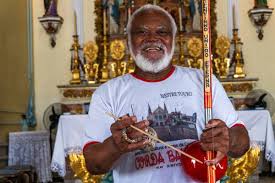
Today, his capoeira work extends to other countries, in North American cities such as: San Diego / CA, Los Angeles / CA, Dallas / TX, Oakland / CA, and Detroit.
In Spain, in the cities of Castellón and Valencia. In Brazil, he teaches boys from the community in his own home. Mestre Touro has become a reference for many capoeiristas in Rio de Janeiro and around the world, not only for preserving the characteristics of capoeira and the carioca capoeiragem, but also for his rich knowledge of Brazilian history, for significant events and dates involving the struggle of capoeiragem for its survival. It is no wonder that he is known as the Living Legend of Carioca Capoeira. To Mestre Touro, all our love and respect.
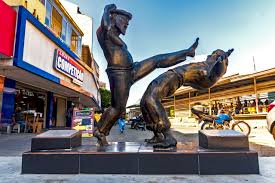
 Jogo Corpo Fechado