
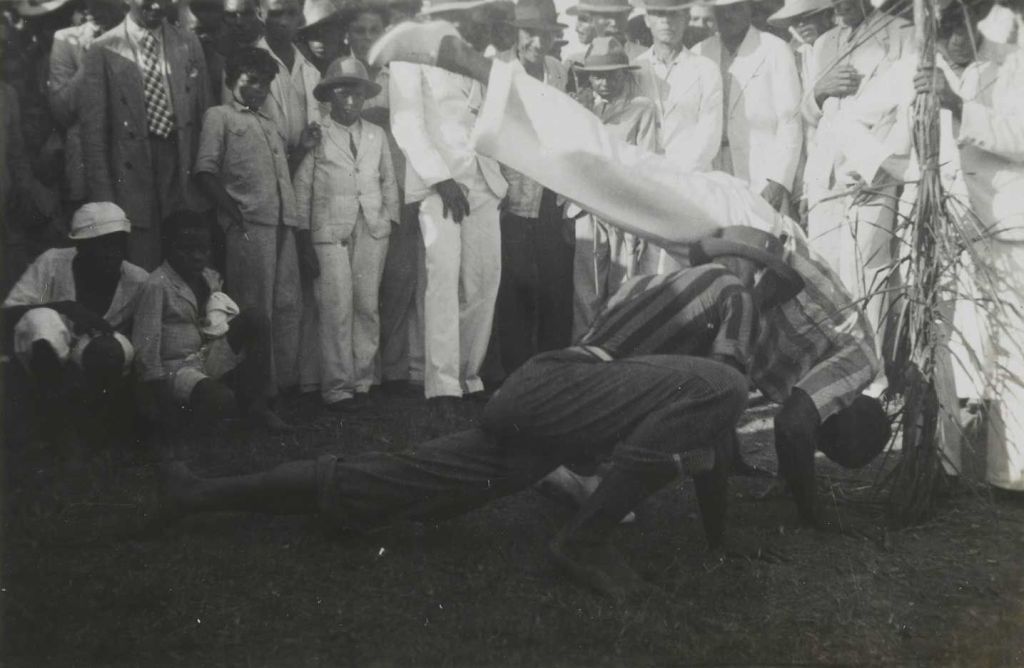
The history of capoeira is rich with tales of legendary figures, and among them stands the formidable capoeirista Samuel Querido de Deus. Despite not garnering the same level of widespread recognition as figures like Pastinha or Bimba, his prowess in the roda and his impact on the capoeira community were truly remarkable. During the 1930s and 1940s, he held a position of awe and respect, leaving a lasting impression on both capoeiristas and the intellectual circles of the time.
Jorge Amado, in his work “Bahia de Todos os Santos”, vividly portrays Samuel Querido de Deus, depicting him as a figure of mystery and strength. Amado’s evocative description captures the enigmatic essence of Querido de Deus, from the strands of gray hair on his face to the riddle of his mixed heritage, sculpted by the sea winds and sun-kissed by days spent fishing on his boat. The image of Samuel Querido de Deus, perpetually youthful despite the passage of more than sixty years, is one that lingers in the mind, a testament to his enduring vitality and skill.
The recollections of renowned anthropologists and scholars play a crucial role in solidifying the legacy of influential figures. For instance, Ruth Landes’s exploration of Candomblé in Salvador in 1938 offers a fascinating account of a capoeira match between Samuel and Onça Preta, shedding light on the artistry and skill involved in this traditional Brazilian martial art. Additionally, Edison Carneiro’s glowing praise of Samuel as “the best capoeirista we’ve ever seen” further cements his reputation as a formidable and revered figure in the capoeira community.
Moreover, we cannot overlook the significance of historical accounts such as the one from “O Estado da Bahia” in 1937, documenting Querido-de-Deus’s leadership of a captivating capoeira presentation at the Second Afro-Brazilian Congress. This account serves as a testament to his esteemed position and influence within his community, highlighting his role in promoting and preserving the rich cultural heritage of capoeira. Furthermore, the intriguing anecdote about his willingness to face the Legendary Mestre Bimba in a fight, albeit under specific musical accompaniment conditions, offers a captivating glimpse into the customs and traditions surrounding capoeira matches during that era. This narrative adds depth to our understanding of the cultural and artistic significance of capoeira, as well as the nuances of honor and tradition within the capoeira community.
It is fitting that his name and contributions are honored in the essential literature of capoeira, such as Waldeloir Rêgo’s “Capoeira Angola,” ensuring that capoeiristas continue to hold him in reverence. May the spirit of Zungu safeguard Samuel Querido-de-Deus from fading into obscurity, preserving his legacy for generations to come. Axe.
 Jogo Corpo Fechado