

Hello,
In the last part of the “CAPOEIRA WAS NOT CREATED IN A VACUUM” PAGE, I posted a video playlist that featured a few videos from a organization called, “The Bantu Project.”
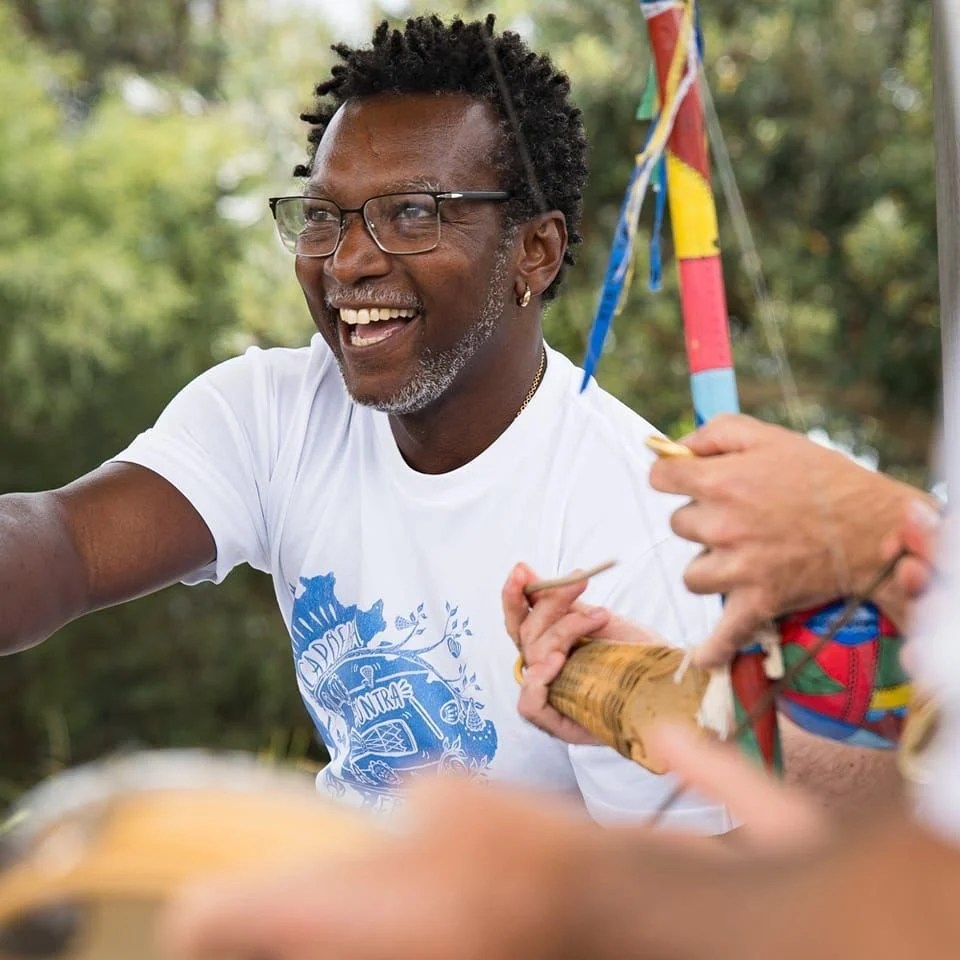
I would like to introduce to you the man who created the bantu project, Mestre Roxinho.
Edielson da Silva Miranda, known as Mestre Roxinho, was born on June 8, 1969, in Ilha de Vera Cruz, Bahia. Growing up in the heart of Bahia, he was immersed in the rich cultural heritage of Capoeira Angola. From a young age, Mestre Roxinho displayed a natural talent for Capoeira and dedicated himself to mastering its intricate movements and rhythms. His passion and commitment led him to become the first Master of Capoeira Angola from Bahia to establish a registered School of Capoeira Angola, the renowned Escola de Capoeira Angola Mato Rasteiro (ECAMAR), in Australia, where he continues to share his expertise with students from diverse backgrounds, fostering a vibrant community of Capoeira enthusiasts.
Mestre Roxinho has dedicated his life to sharing the rich cultural heritage and healing art of Capoeira Angola. His commitment extends beyond the physical practice of the art and encompasses using it as a social cohesion tool to empower marginalized youth from indigenous and refugee backgrounds through Project Bantu. This transformative program, initiated by Mestre Roxinho, aims to provide these young individuals with a sense of community, belonging, and purpose, thereby engendering positive social change.
Project Bantu’s influence extends across multiple regions, including Australia, the Asia-Pacific area, and North Carolina, U.S.A. Through this initiative, Mestre Roxinho strives to leverage the power of Capoeira Angola as a mechanism for instilling confidence, leadership, and resilience in disadvantaged youth, fostering their personal development and promoting cross-cultural understanding.
Mestre Roxinho’s unwavering dedication to the dissemination of Capoeira Angola and its values reflects a profound commitment to cultural preservation, social equity, and youth empowerment. His enduring legacy continues to impact communities far and wide, enriching lives and fostering harmony through the art of Capoeira Angola.
I can type more about his work, but a picture (or a video) is worth a thousand words, so I’m posting this documentary about Mestre Roxinho and his life, along with the video description, so you can see and FEEL more about his work.
LOGLINE
African Brazilian Master Roxinho confronts his traditional views of Africa when he meets a group of young African refugees at a multicultural high school in Sydney. A conflicting master-disciple relationship filmed over six years. SYNOPSIS African Brazilian Master Roxinho comes to Australia in 2006 and starts teaching the art form of Capoeira Angola to a group of troubled young African refugees who go to Cabramatta High School. The school is uncertain of what to make of this program. Some fiercely resist it, arguing it is not helping students improve their behavior and literacy. Others defend it, arguing the program will help African refugees with no prior education to better integrate into Australia. The filmmaker becomes deeply involved with participants as he follows, in a participatory filmmaking style, the unfolding stories of migration and African diaspora that emerge from in between the walls of a multicultural school in the outskirts of Sydney, Australia.
CONTEXT: MULTICULTURALISM AND AFRICAN DIASPORA
Capoeira Angola is an art form rooted in the African culture and spirituality that emerged in Brazil during colonisation. It helped slaves strengthen physically and spiritually to deal with the shackles of oppression. Today, centuries later, Capoeira Angola crosses the oceans by the hands of Mestre Roxinho and meets a group of young African refugees who experience learning and behaviour difficulties in a public school in Australia.
Although they come from diverse cultures, Roxinho and these young African refugees close a kind of circle back to their African roots, in Australia. Curiously, the filmmaker is descendent from the race and culture of those who oppressed the African slaves in Brazil. Film production could reproduce a tension of historical dimensions. But complicity unfolds, as in the Australian context, both the filmmaker and the Capoeira Master are ethnic migrants in an English colony.
The film, both in its production process and its screen content, is situated at the intersection of a complex set of narratives of diaspora and multiculturalism that compete in terms of the perspectives and values in which they are constructed and developed. As a story of diaspora, all participants exhibit particular traces of both their routes (their journeys) and their roots (their origins) and they negotiate these through filmmaking and through the diasporic art forms of Capoeira Angola and Rap. Despite coming from very different cultural backgrounds, participants belong to the same multicultural category in Australia.
THE FILMMAKER
Paulo Alberton is a Brazilian-born (Australian Citizen) independent documentary filmmaker who used to work as an international airline pilot. Over the last 17 years his films have explored issues of racial, cultural, religious and sexual identification. Paulo has lived and worked in São Paulo, New York, Johannesburg, Perth and Sydney. He studied at NYU, in New York, did Queer Film Studies at WITS University in Johannesburg, did an MA degree at AFTRS specializing in documentary directing, and a Doctorate of Creative Arts at UWS, in Sydney. Paulo has taught film at university, certificate and community levels. His broadcast credits include the 10-minutes Going To The Dogs (SBS); the half-hours Give Me A Break (SBS) and Living On (SBS) and one hours’ Swapping Lives (SBS), Drums of Maranhão (TV Cultura – Brazil), and a long running half-hour documentary series on Brazilian instrumental music (Sesc TV – Brazil). Awards include Best Photography for Water and I; Film Australia special commendation and ATOM Best-multimedia award for Mijn Man; and Best Documentary and Best Editing at Western Australian Screen Awards 2004 for Going To The Dogs.
FESTIVALS
As of Nov 2014, the film has just been submitted to the following festivals: Berlin, Rotterdam, Hotdocs, É Tudo Verdade (São Paulo, Brazil)
CONTACT
Paulo Alberton Pauloalberton2@gmail.com
http://www.pauloalberton.com
Recently, on June 18, 2022, my teacher Charles Williams engaged in a thought-provoking conversation with Mestre Roxinho via ZOOM. During their discussion, they delved into various aspects, and Charles candidly shared insights about his new book, “Ginga de Resilência: Capoeira Angola Para Além Da Roda” (Ginga of Resilience: Capoeira Angola For Beyond The Roda). The exchange was filled with enriching discourse on the profound essence of Capoeira Angola, extending its significance beyond the conventional realm of the roda.
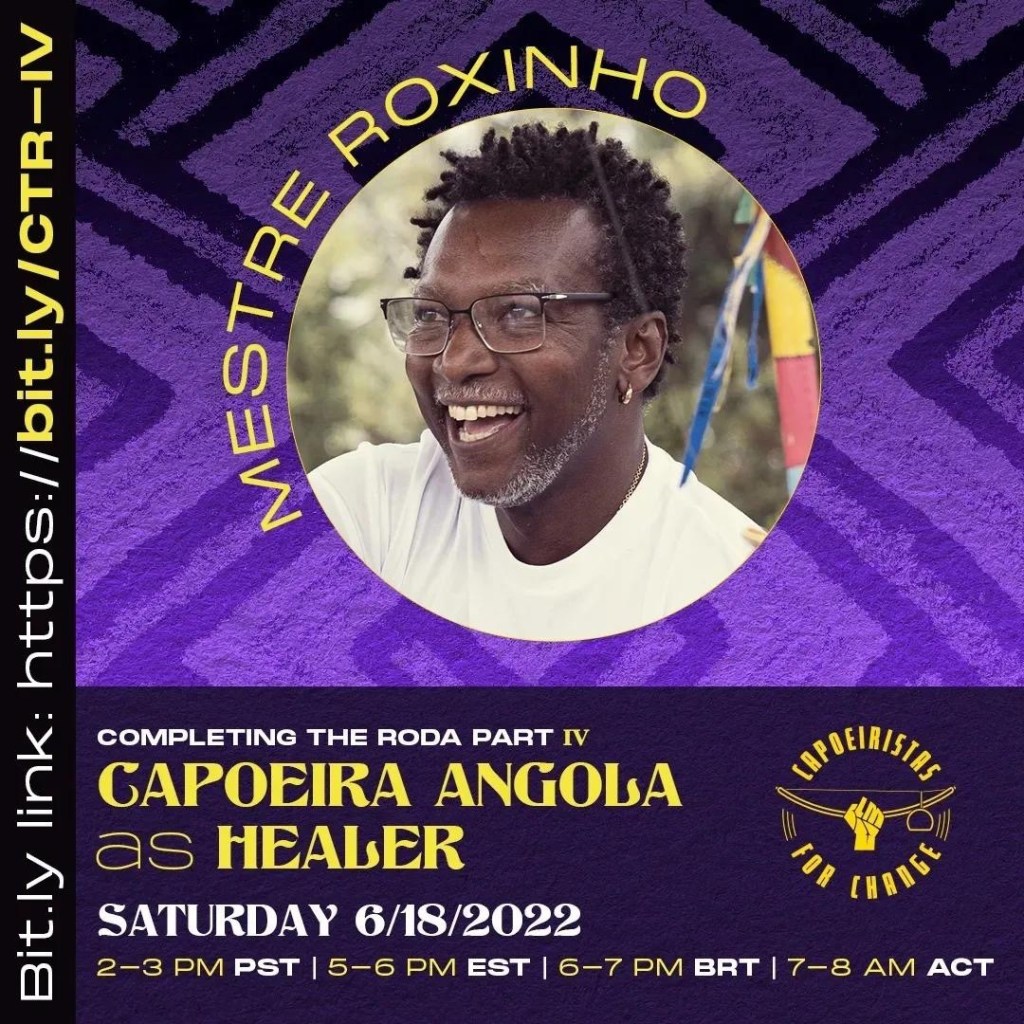
The book delves deeply into the rich and transformative practice of Capoeira Angola, showcasing its remarkable influence in shaping the lives of children, youth, and their surrounding communities. This literary work represents a profound and poignant journey for Mestre Roxinho, and as the pages unfold with powerful narratives and insights, he is poised to open hearts and minds to the enduring impact of Capoeira Angola. Through this book, Mestre Roxinho aims to unravel the profound essence of this art form and its capacity to be a catalyst for positive change, leading readers on a compelling and enriching exploration of a practice that holds the potential to elevate and inspire individuals and communities worldwide.
This conversation was a part of our Juneteenth celebration and healing weekend that we had this year (2022). It was a time for our community to come together, reflect on the significance of Juneteenth, and support each other in our journey towards healing. The weekend was filled with meaningful discussions, storytelling, music, and various activities that brought us closer as a community. This event allowed us to honor the history and heritage of Juneteenth while also looking towards the future with hope and determination. The shared experiences and conversations during this weekend served as a reminder of the importance of coming together to acknowledge and commemorate our collective history.

Now, here are some professional resources for supporting those with mental health issues, as well as links to Mestre Roxinho’s ongoing and future projects.
https://nami.org/Home: NAMI (National Alliance on Mental Illness): The nation’s largest grassroots mental health organization dedicated to educating, advocating, supporting, and building better lives for the millions of individuals & families affected by mental illness.
https://www.namiurbanla.org/resourcesHeadspace: Headspace is the National Youth Mental Health Foundation. Since 2006 they provide early intervention mental health services to 12-25-year-olds in over 145 communities across Australia, our online and phone counseling services, our vocational services, and our presence in schools.
https://headspace.org.au https://www.clinicaapice.com.br: Clinica Apice Located in Salvador da Bahia, specializing in mental health, with an interdisciplinary proposal and a project built from the dialogue between professionals, patients and their families.
Project Bantu is a non-profit, that effectively works with children and young people utilizing the music, movements and play of Capoeira Angola as well as other cultural activities as tools for empowerment helping young people overcome poverty, trauma, as well as other complex behaviors that are rooted in violence or brought about by social inequality. If you want to know more about Mestre Roxinho and his work, or would like to make a donation, please go to his websites:
https://chuffed.org/project/bantu-institute-fight-poverty-social-inequality
 Jogo Corpo Fechado