

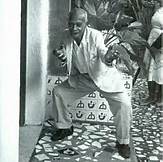

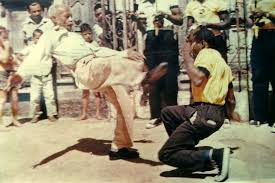


Angola, mother capoeira. Sorcery of slaves in the longing for freedom; its beginning has no method and its end is inconceivable to even the most knowledgeable capoeirista.
– Mestre Pastinha.
Hello Everyone,
As I’m writing this web page, it is April 5th, 2019, which was the illustrious Mestre Pastinha’s birthday! So, who was he?
Vicente Ferreira Pastinha, or commonly called Mestre Pastinha (April 5, 1889 – November 13, 1981), is best known as the great traditionalist who preserved capoeira angola, the traditional style of capoeira. Mestre Pastinha’s contribution to capoeira was immense, as he dedicated his life to the preservation and promotion of the art form. He founded the first official capoeira school, the Centro Esportivo de Capoeira Angola (CECA), in 1941, in Salvador, Bahia, Brazil.
Mestre Pastinha was not only a skilled capoeirista but also a great teacher and historian of capoeira angola. He emphasized the importance of preserving the traditional roots and rituals of capoeira, which set capoeira angola apart from the more contemporary styles. His passion for capoeira angola inspired many to embrace and continue the tradition, ensuring its survival and continuity for future generations.
Beyond his role as a practitioner and promoter of capoeira angola, Mestre Pastinha also played a significant part in documenting the history and philosophy of this art form. His legacy extends beyond his lifetime, as his teachings and influence continue to shape the practice of capoeira angola around the world.
Mestre Pastinha’s dedication and impact on capoeira angola have left an indelible mark on its development and recognition as a cultural treasure. His commitment to preserving the traditional style and values of capoeira angola has earned him widespread respect and admiration within the capoeira community and beyond.
Vicente Ferreira Pastinha, born on April 5th, 1889, was truly a remarkable figure in the world of capoeira. His early life was marked by the influence of his parents: José Senor Pastinha, a hardworking Spanish immigrant making a living as a pedlar, and Eugênia Maria de Carvalho Ferreira, a dedicated black Bahian homemaker. It was at the young age of 8 that Pastinha’s journey into the world of capoeira began, under the guidance of an African man known as Benedito. This skillful teacher imparted the art of capoeira to Pastinha with the purpose of enabling him to defend himself against an older boy who was bullying him in the streets of his neighborhood.
The story of Pastinha’s early days in capoeira is a testament to the transformative power of this martial art. After being trained by Benedito, Pastinha not only defended himself successfully against his tormentor but also gained the admiration of the very boy who had previously sought to intimidate him. This early triumph laid the foundation for Pastinha’s lifelong dedication to capoeira.
Following this formative experience, Pastinha continued to refine his skills and knowledge of capoeira, ultimately becoming a respected teacher. From 1902 to 1909, he shared his expertise by teaching capoeira to his peers at the School of Sailor Apprentices. However, in 1912, he made the decision to step away from teaching, embarking on a hiatus from capoeira that lasted nearly thirty years.
This period of departure from formal teaching was not an end to Pastinha’s connection to capoeira; rather, it was a time of introspection and preparation for his later pivotal role in the preservation and promotion of this cherished art form. During this hiatus, Pastinha’s deep understanding of capoeira continued to evolve, ultimately leading to his pivotal role in the establishment of the first capoeira academy in Brazil.
In 1941, by Aberrê’s (Pastinha’s former student) invitation, Pastinha went to a Sunday roda at ladeira do Gengibirra located at bairro da Liberdade, where the best Capoeira mestres in Bahia would play. This gathering proved to be a pivotal moment in the history of Capoeira, as it brought together the finest practitioners of the art form in an event that inspired and elevated the practice of Capoeira in Bahia and beyond.
The exchange of knowledge, skills, and techniques among these esteemed mestres not only enriched the Capoeira community but also contributed to the preservation and evolution of this cherished cultural tradition. The camaraderie and competition that characterized the roda at ladeira do Gengibirra showcased the beauty and diversity of Capoeira, reflecting the rich tapestry of Bahian culture and heritage.
After spending the afternoon there, one of the greatest mestres of Bahia, Amorzinho, asked Pastinha to take charge of Capoeira Angola. And so, Mestre Pastinha opened a center for the teaching and practice of traditional capoeira. His students wore black and yellow, the colors of Ypiranga, his favorite soccer team, for public demonstrations. During regular training at the academy, his students trained in their everyday street clothes.
The life of Mestre Pastinha, a well-educated and articulate master of his time, stands in stark contrast to many others who were often poor and illiterate. His ability to write coherently allowed him to record his daily experiences, thoughts, and deep philosophical reflections in a journal titled “Quando as pernas fazem mizerêr,” subtitled “metafísica e prática da capoeira.” This journal, comprising around 200 pages, has played a crucial role in preserving his life experiences from falling into oblivion and destruction.
These valuable manuscripts not only provide insights into the practice and ethics of capoeira, but also contain poetry, songs, and several drawings that depict various aspects of capoeira angola, which couldn’t be adequately expressed through words alone. It’s fascinating to note that Mestre Decânio preserved these manuscripts for decades, and in 2003, Hilton Bruno de Almeida Sousa, a dedicated capoeira practitioner known as “Teimosia,” undertook the digitization of these precious documents, ensuring their preservation for future generations.
You can ownload the PDF for free by clicking here.
Mestre Pastinha’s dedication to the preservation and promotion of Capoeira Angola was unparalleled. He not only taught the physical techniques of the art but also instilled in his students a deep understanding of its cultural and historical significance. The center he established became a hub for the exchange of knowledge and traditions, attracting students and enthusiasts from far and wide.
Under Mestre Pastinha’s guidance, the center flourished as a vibrant community where individuals from diverse backgrounds came together to celebrate the rich heritage of Capoeira Angola. The rhythms of berimbau and atabaque echoed through the halls as students honed their skills, embodying the essence of this revered martial art.
Despite the challenges he faced, Mestre Pastinha remained steadfast in his commitment to upholding the authenticity of Capoeira Angola. His unwavering dedication and pioneering spirit continue to inspire practitioners worldwide, ensuring that the legacy of his teachings endures for future generations to embrace and cherish.
The story of Mestre Pastinha and his students is truly remarkable. Their passion for capoeira led to them sharing their art with the world, starting with demonstrations for tourists in the hotels of Salvador, Bahia’s capital city. These demonstrations not only introduced capoeira to a wider audience but also allowed them to showcase the captivating music that accompanies this art form. As a result, they gained the support and friendship of influential figures, including the renowned writer Jorge Amado, who recognized Pastinha’s role in preserving and promoting black culture. This support was invaluable, as it helped sustain Pastinha in his dedicated pursuit of preserving Capoeira Angola.
Furthermore, the impact of Mestre Pastinha’s teaching is evident in the legacy of his students. Many of them went on to become influential figures in the world of Capoeira Angola, leaving a lasting imprint on the tradition. Names like Joao Pequeno, Joao Grande, Bola Sete, Curio, Gildo Alfinete, Bigo, Boca Rica, and others stand as a testament to the enduring influence of Mestre Pastinha and his commitment to passing down the art of capoeira to the next generation.
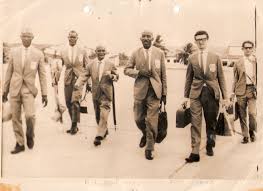
One pivotal moment in the history of capoeira angola was the participation of Mestre Pastinha and his students in the First Festival of Black Arts in Senegal in 1966. Their presentation of capoeira angola on this global stage showcased the richness and significance of this art form, contributing to its recognition and appreciation on an international scale. This historic event not only solidified the global presence of capoeira angola but also honored the legacy of Mestre Pastinha and his dedication to preserving this treasured aspect of black culture.
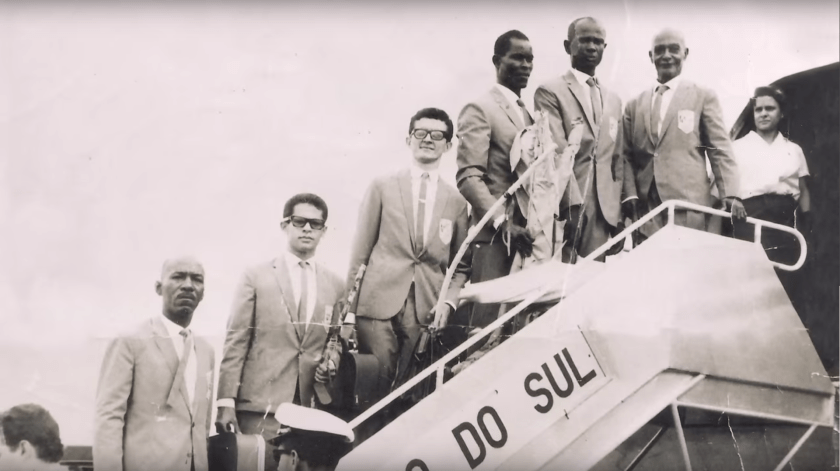
The legacy of Mestre Pastinha, revered as the “philosopher of capoeira,” continues to resonate through the world of martial arts and beyond. His profound wisdom regarding the art of capoeira and the essence of life itself has left an indelible mark on generations of practitioners. Despite his monumental efforts in preserving the traditional form of capoeira known as Capoeira Angola, his final years were marked by adversity and neglect.
It is deeply saddening to think that a figure of such significance was forced to endure such hardship in his later years. The fact that he, in his old age, sick and almost completely blind, was asked to vacate his own building for renovations by the government, only for the space to be repurposed into a restaurant and entertainment outlet, speaks volumes about the mistreatment he suffered. Subsequently abandoned in a city shelter, Mestre Pastinha’s poignant story serves as a reminder of the importance of honoring and respecting the pioneers and guardians of cultural heritage.
Nevertheless, even in the face of such adversity, Mestre Pastinha’s teachings and legacy live on through his devoted students. Two of his most esteemed disciples, Joao Pequeno and Joao Grande, along with others who were mentioned previously, dutifully carry forward the timeless art of Capoeira Angola, ensuring that his invaluable contributions to the art form are perpetuated and shared with the world. It is through their unwavering commitment and passion that Mestre Pastinha’s spirit endures, inspiring countless individuals to embrace the beauty and philosophy of capoeira.
 Jogo Corpo Fechado