
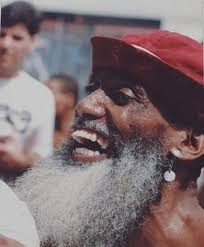
Alcino Oliveira Bemvindo was born on June 25, 1952, in Espírito Santo. He started practicing judo at the age of 2, then moved on to jiu-jitsu, and only later began practicing capoeira, where he became known as “Dentinho.”
Mestre Dentinho gained recognition in Brazil and around the world with his style of Angola da Penha capoeira – named after the Penha neighborhood where he lived in Rio de Janeiro. He developed a distinct style of play, presenting a fearless and joyful capoeira. He was an authentic and true capoeirista, never allowing his opponent to predict his next move. Moving swiftly between high and low stances, he spun almost imperceptibly. He incorporated cunning, slyness, and agility to attack and defend. He never stayed in one place for long, leaving little room for his opponent to think. He only swayed when necessary, using dance to strike and improvise sequences within the fundamentals. Possessing enviable endurance, he played tirelessly, training to exhaustion.
In the 1960s, Mestre Dentinho became the first capoeirista to perform a somersault in capoeira circles in Rio de Janeiro. This novelty occurred in the Roda da Quinta da Boa Vista and caused some conflict with other capoeiristas who tried to catch him mid-flight! In the 1970s, Mestre Dentinho was a prominent and regular presence at the famous Roda de Zé Pedro on Sundays in Bonsucesso. In 1973, Mestre Dentinho was part of the “unbeatable team” – the Guanabara team, which won the 1st Brazilian Capoeira Championship, triumphing in both individual and team competitions. In 1975, he ranked 3rd in the Rio de Janeiro Toque and Chula Festival. He was the founder of the capoeira groups Auê, with activities in Rio de Janeiro and Italy, and Cinamar, in São Paulo and the United States.
Mestre Dentinho was a man who survived the repression against capoeira, earned recognition for his talent, but was unable to make a living exclusively from capoeira. In the 1970s, for example, he worked as a longshoreman at the port in Rio de Janeiro, as he explained, “because it was difficult for a capoeirista to find formal employment. When he did find one and the company discovered he was a capoeira practitioner, they would fire him.”
He also participated in various performance modalities. Despite having limited knowledge of acrobatics, the Master stood out for his physical prowess. For instance, he made a point of demonstrating his talent in presentations, where he executed the somersault from a seated position or even while tied with ropes. In the 1960s, Dentinho began practicing cross-country running. Throughout his life, he participated in over five thousand competitions, such as the International São Silvestre Race in the 1970s, and the Marathon that was part of the United Nations Conference on Environment and Development held in 1992 in Rio de Janeiro, the Eco-92. Always running barefoot and dressed in his well-known tattered attire, Dentinho’s presence in races caught the attention of journalists who featured him in several articles.
His game was characterized by spontaneity, expressiveness, and a great deal of cunning, yet this did not prevent Mestre Dentinho from receiving institutional recognition for his talent: On May 15, 1976, the Carioca Boxing Federation formalized his title of Capoeira Mestre, with a green and white cord. On April 16, 1988, the City Council of Rio de Janeiro offered him a commendation “for outstanding services to capoeira in Rio de Janeiro.” The Legislative Assembly of Rio de Janeiro honored him with the Zumbi dos Palmares Diploma in 2009. A profound connoisseur of the history and art of capoeira, Mestre Dentinho was invited to give lectures at various universities such as UFRJ, UERJ, and Estácio.

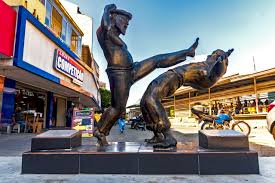
The Penha neighborhood received the Homens de Fibra monument on October 30, 2021, in honor of the “giant figures of Rio de Janeiro’s capoeira,” Mestres Touro and Dentinho.
 Jogo Corpo Fechado