
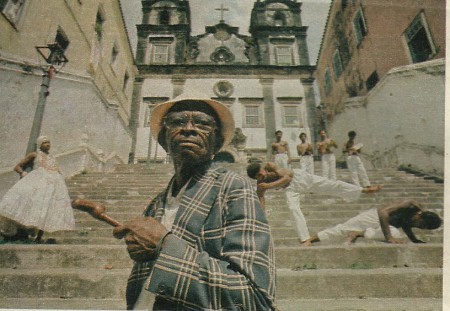
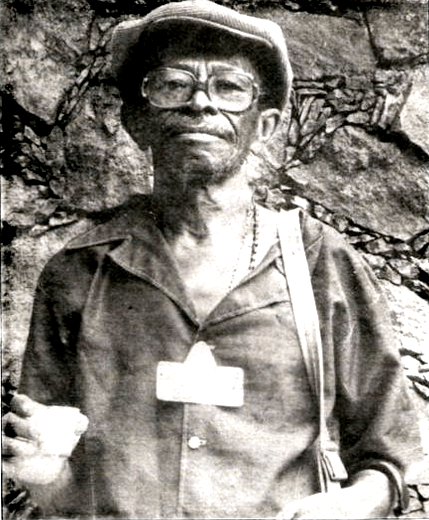
Rafael Alves França, Master Cobrinha Verde, lived between 1917 and 1983 and was one of the most feared and respected capoeiristas of his time.
Born in the city of Santo Amaro da Purificação, the birthplace of Bahian capoeira, he claimed to be a legitimate relative of the legendary capoeirista Besouro Mangangá, more precisely his cousin. It was with him that at the age of four he began the art of capoeiragem. In addition to his cousin, he also had the opportunity to learn from the most famous capoeiristas of that time, such as Siri de Mangue, Canário Pardo and Doze Homem. The nickname “green snake” was given by Besouro Mangangá himself, due to his agility and dexterity with his legs. He was one of the few experts in the “Santa Maria” game, a challenging play where capoeiristas engaged with razors between their toes. Despite its risks, he mastered this game which showcased his extraordinary skill and fearlessness.
Later in life, he became the oldest active capoeirista, embodying the rich tradition and history of the art form. His dedication and contributions to capoeira earned him admiration and respect within the community. Not only was he revered for his exceptional technique, but he was also known for his wisdom and guidance to younger practitioners. His experience and knowledge were invaluable in preserving the authenticity and spirit of Bahian capoeira.

Beyond his achievements in the realm of capoeira, he also made significant contributions to his community and country. Rising to the rank of 3rd Sergeant in the former CR Barracks in Campo Grande, and taking part in the revolution of 32, he demonstrated his commitment to service and his country. His multifaceted life serves as an inspiration, leaving behind a legacy that continues to inspire and influence the world of capoeira and beyond.
After leaving the army, he began teaching capoeira classes at Fazenda Garcia. He also taught at the Centro Esportivo de Capoeira Angola Dois de Julho, located in the northeast of Amaralina. He even shared the work with Mestre Pastinha, where he passed on his knowledge to his students, which included the future masters, João Grande and João Pequeno.
Cobrinha Verde always taught capoeira for free. As he himself said, his cousin Besouro made him promise that he would never charge money to teach the art of capoeira. And this promise was kept until the end of his life.
At a certain time in his life, Mestre Cobrinha Verde left the Recôncavo region of Bahia and traveled a large part of the northeast, getting involved in various adventures, including accompanying Horácio de Matos’ band of cangaceiros. In one of these adventures, he said that on one occasion, armed with an 18-inch machete, he faced eight police officers who opened fire on him, and with the said machete, he managed to deflect all the bullets.
The tales and adventures of Mestre Cobrinha Verde are renowned, and his dedication to teaching capoeira for free reflects the deep respect and commitment he held for the art. His journey through the northeast and his encounters with cangaceiros and law enforcement added layers of intrigue and mystique to his legacy, making him a legendary figure in the capoeira community. The stories of his bravery and agility are passed down through generations, inspiring awe and admiration for his remarkable feats.
Mestre Cobrinha Verde’s impact on the world of capoeira goes beyond his exceptional skills; his steadfast adherence to his promise to his cousin Besouro signifies the profound values and principles that guided his life. His unwavering commitment to sharing the art of capoeira without financial gain embodies the spirit of generosity and selflessness, leaving a lasting impression on all who hear of his extraordinary life.

Throughout his lifetime, Mestre Cobrinha Verde became a symbol of capoeira, not only for his exceptional skills, but also for the intriguing stories that surrounded his persona. His mastery of the art was often attributed to not only his agility and dexterity, but also to enigmatic “mandingas” known only to the Bahians from the Recôncavo region. It was believed that these mystical practices were passed down by an African neighbor named Pascoal, who imparted his knowledge to Mestre Cobrinha Verde’s grandmother.
Among the tales that circulated about Mestre Cobrinha Verde, one of the most captivating was the legend of his “patuá” with magical powers. This enchanted amulet was said to possess the ability to protect him from adversaries and extricate him from perilous predicaments. According to the master, the patuá was alive and would even exhibit movement by jumping when placed on an empty plate. However, an unfortunate misstep led to the departure of the patuá, marking a turning point in his life’s adventures.
After a series of remarkable escapades and experiences, Mestre Cobrinha Verde eventually returned to Bahia, where he remained until his final days. His influence extended beyond his lifetime, as evidenced by his invitation in 1963 by the renowned film actor Roberto Batalin to collaborate on a groundbreaking capoeira album titled “Traíra Capoeira da Bahia,” alongside masters Traíra and Gato.
This pioneering album is celebrated as a masterpiece of capoeira, laying testament to Mestre Cobrinha Verde’s enduring impact on the art form.
In 1983, Mestre Cobrinha Verde bid farewell to this world, leaving behind a legacy that honored the traditions of the venerable capoeira masters of Bahia. His contributions and enigmatic persona continue to capture the imagination of those enthralled by the rich history and mystique of capoeira.
 Jogo Corpo Fechado