

DEVAGAR, DEVAGAR
Não sou corte de machado
Eng: I’m not a axe cuter
mais derrubo de mansinho
Eng: I bring it down gently
techo o meu pé afiado
Eng: I have my foot
que nem dente de cupim
Eng: as sharp as a termite’s tooth
Sou amante sou amado
Eng: I’m a lover I’m loved
sou gostoso que nem vinho
Eng: I’m tasty like wine
no verão sou temperado
Eng: in summer I’m temperate
no inverno eu sou quentinho
Eng: in winter I’m warm
onde chego estou chegado
Eng: where I get to I’m gotten close
devagar, devagarinho
Eng: Slowly, very slowly
devagar, devagar, devagar
Eng: Slowly, Slowly, Slowly
bem de mansinho
Eng: very softly
devagar devagar
Eng: Slowly, Slowly
devagar devargarinho
Eng: Slowly, very slowly
devagar devagar
Eng: Slowly, Slowly
que nem cobra coral bem rasteirinha
Eng: like a corral snake that crawls around
devagar devagar
Eng: Slowly, Slowly
eo pedir pra jogar devagarinho
Eng: and ask him to play slowly
devagar devagar
Eng: Slowly, Slowly
eu e voce nois dois juntinhos
Eng: you and I, the two of us together
devagar devagar
Eng: Slowly, Slowly
devagar devargarinho
Eng: Slowly, very slowly
devagar devagar
Eng: Slowly, Slowly
devagar bem de mansinho
Eng: very slowly, very softly
devagar devagar
Eng: Slowly, Slowly
In Capoeira Angola, the deliberate incorporation of slow, measured movements is not merely an aesthetic choice but a profound pedagogical strategy. This intentional pacing, reminiscent of contemplative disciplines like Tai Chi and certain forms of meditation, serves multiple essential purposes that are fundamental to understanding the depth and efficacy of Capoeira Angola. Far from being a simplified or rudimentary aspect of training, slow movement is a sophisticated method for cultivating a holistic understanding of the art form, integrating physical prowess with mental acuity and spiritual connection. It is the crucible in which mastery is forged, where the ephemeral becomes tangible, and where the practitioner truly internalizes the profound wisdom embedded within the art.
Cultivating Body Awareness and Control
The deliberate emphasis on slow movement in Capoeira Angola serves as a cornerstone for cultivating a profound and immediate sense of body awareness, coupled with meticulous control. This pedagogical approach is not merely about reduced speed; it is a fundamental methodology designed to dissect and understand the intricate mechanics of the human body in motion. By executing movements at a significantly reduced pace, practitioners are compelled to direct their attention to an almost microscopic level of detail. This includes the precise engagement of every muscle, from major movers to subtle stabilizers, the nuanced articulation of each joint—how it opens, closes, rotates, and shifts—and the subtle, yet critical, shifts in their center of balance. This intensely detailed focus fosters a deeper, more intimate understanding of one’s own biomechanics. It allows the practitioner to feel and internalize the interplay of gravity, momentum, and muscular effort in a way that is impossible at faster speeds. This heightened awareness promotes unparalleled efficiency and precision in movement.
Slowing down movements in Capoeira Angola serves as a profound diagnostic tool, revealing inefficiencies that might otherwise remain hidden. This meticulous approach benefits not only the individual practitioner but also provides invaluable insights for their instructors. Together, they embark on a systematic process of identifying and correcting ingrained inefficiencies. These can manifest as awkward transitions between movements, unnecessary tension in specific muscle groups, or compensatory movements where one part of the body attempts to overcompensate for a weakness or restriction elsewhere. For example, a subtle lean during a movement or an unnecessary tensing of the shoulder might indicate an underlying imbalance in core strength or an inefficient weight transfer.
This deliberate process of refinement is critical for building a stronger, more stable foundational structure, which in turn enables the safe and effective execution of faster, more dynamic, and potentially more dangerous techniques. By meticulously breaking down and rebuilding movements at a slow pace, practitioners develop a robust internal map of their body and its capabilities. This deep understanding of one’s own biomechanics is paramount for minimizing the risk of injury when progressing to more complex and explosive actions.
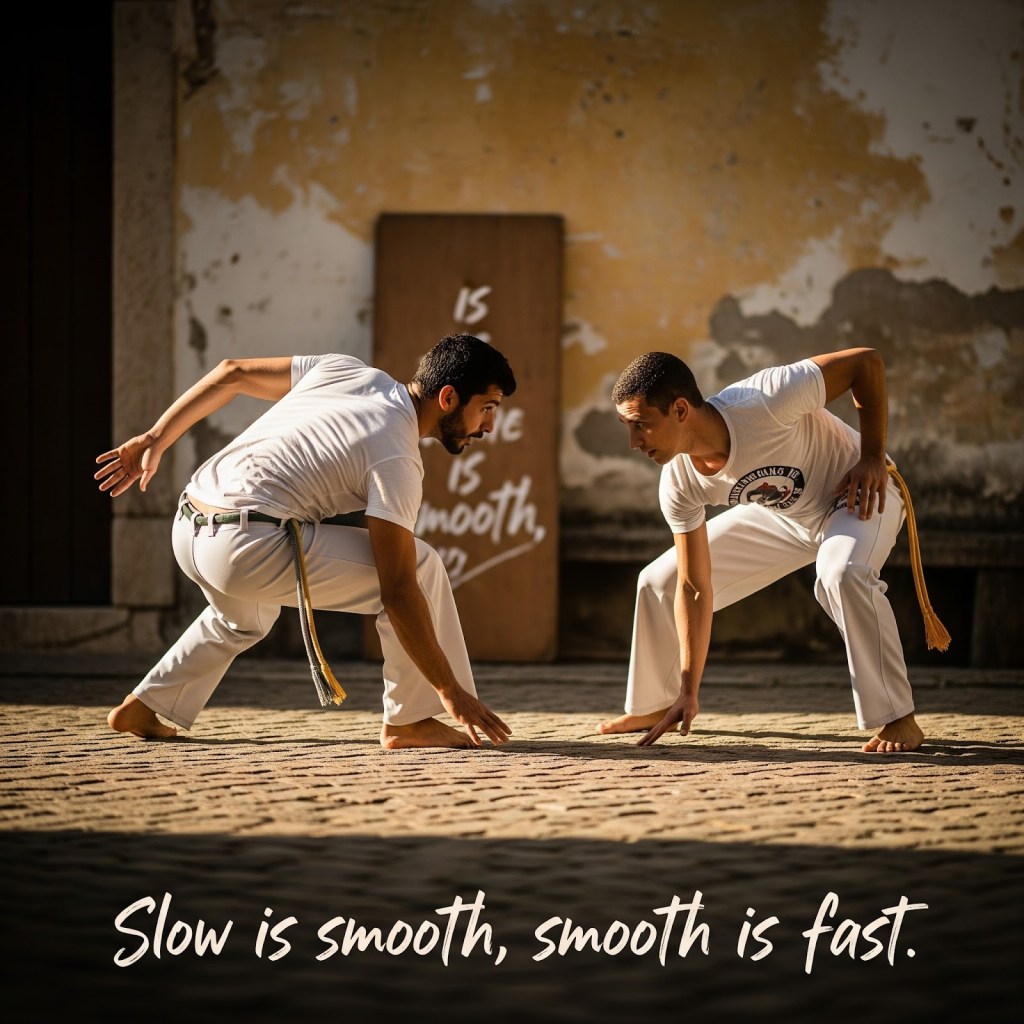
Furthermore, this cultivated body awareness maximizes expressive potential. When a practitioner truly understands the full range and control of their movements, they can imbue their capoeira with a greater sense of fluidity, creativity, and personal style. This elevates mere technique into an art form, allowing for a unique and personal expression within the traditional framework. The adage “slow is smooth, smooth is fast” thus transcends a simple technical instruction; it becomes a holistic philosophy that ensures mastery is built upon a solid bedrock of understanding, control, and efficiency. This foundational strength and self-awareness are not merely about preventing injury; they are about unlocking a deeper, more nuanced level of performance, where every movement is imbued with intention and grace, transforming the practitioner into a true artist of motion.
Furthermore, slow movement in Capoeira Angola is absolutely crucial for the development of acute sensitivity and refined perception. It rigorously trains the practitioner not only to feel the intricate nuances of their own body in three-dimensional space but also, and perhaps more critically, to sense and anticipate the movements, intentions, and energy of their partner or “opponent.” This heightened sensory awareness – a blend of kinesthetic, proprioceptive, and empathetic perception – is the cornerstone of the improvisational and highly responsive nature of the roda (the circle where Capoeira is played). It allows for a more intuitive and almost telepathic understanding of distance, timing, and an opponent’s potential next move, fostering a more intelligent, adaptable, and fluid game. This is where the true “dialogue” of Capoeira begins, a conversation of bodies in motion, guided by intuition and honed by deliberate practice. The ability to read subtle cues – a shift in weight, a momentary glance, a slight tensing of a muscle – all become amplified and decipherable through the lens of slow movement, allowing for more informed and strategic responses. This perceptive acuity extends beyond the physical, touching upon an understanding of the opponent’s emotional and mental state, further enriching the depth of the interaction within the roda.
Connecting to Philosophy and Spirituality
Beyond the purely physical and tactical, slow movement deeply connects to the philosophical and spiritual underpinnings of Capoeira Angola. It actively encourages virtues such as patience, introspection, and the cultivation of a meditative state, all of which are crucial for a profound understanding and practice of the art form. In a contemporary world often dominated by the relentless pursuit of speed, instant gratification, and constant external stimulation, the deliberate, unhurried pace of slow movement offers a vital opportunity to decelerate, to reflect deeply, and to reconnect with the rich historical and cultural roots of the art form. This intentional slowness is not merely an absence of speed; it is a conscious engagement with every moment, allowing the practitioner to savor the nuances of each movement, to feel the subtle shifts in balance, and to anticipate the intentions of their partner. It provides the necessary mental space for practitioners to internalize and truly embody the concepts of malicia (cunning, trickery, and strategic guile) and mandinga (mystical power, charisma, and the ability to influence or deceive). These are not merely abstract concepts or physical techniques to be learned by rote, but rather profoundly embodied principles that inform every aspect of their game and their being, both inside and outside the roda. Through slow movement, the capoeirista develops a heightened sense of awareness, becoming attuned to their own body and the environment around them. This deep self-awareness allows for a more authentic expression of the self within the game, transcending mere physical prowess to embrace a more holistic and spiritual dimension. It is through this slow, deliberate internal work, this quiet contemplation and mindful practice, that the “spirit” of Capoeira Angola truly takes root, blossoming into a deep understanding that permeates every aspect of the practitioner’s life. The slow pace becomes a pathway to mastery, not just of movement, but of self. It is a journey inward, a dialogue with one’s own capabilities and limitations, and ultimately, a profound connection to the ancestral wisdom that imbues Capoeira Angola with its enduring power.
Enhancing Endurance and Stamina
The profound effectiveness of slow, deliberate movement in Capoeira Angola, despite its seemingly counter-intuitive nature, lies in its capacity to cultivate superior endurance and stamina. Unlike the immediate, overt strain associated with explosive, rapid motions, sustained slow execution demands an unwavering, continuous engagement of muscular control and an intense, uninterrupted mental focus. This meticulous approach to training offers a unique array of physiological benefits that extend far beyond superficial strength.
Firstly, it specifically targets and strengthens the deep stabilizing muscles—the intricate network of smaller muscles often overlooked or underutilized in faster, more dynamic training regimens. These muscles are crucial for maintaining proper posture, protecting joints, and ensuring efficient movement. By engaging them consistently and precisely, practitioners develop a foundational strength that supports all subsequent movements, making them more resilient and less prone to injury.
Secondly, this deliberate practice significantly enhances joint mobility and flexibility. Through controlled, extended ranges of motion, the connective tissues surrounding the joints become more pliable, and the synovial fluid, which lubricates the joints, is stimulated. This fosters a greater range of motion, allowing for more expressive and fluid movements in the roda, while simultaneously reducing the risk of strains, sprains, and other common injuries that can plague capoeiristas who solely focus on speed.
Furthermore, by demanding prolonged, controlled effort, slow movement elevates the body’s capacity for sustained work. This is not simply about building large, visible muscles; it’s about developing the internal fortitude and muscular endurance necessary to maintain a high level of performance over extended periods. This foundational strength transcends mere superficial power, creating a deep well of resilience that can be drawn upon during intense training sessions or lengthy rodas.
The unparalleled control and heightened stamina cultivated through this method are not isolated benefits; they seamlessly integrate into faster movements, transforming them in profound ways. Quick actions become more potent, imbued with a deeper sense of power and intention. They become more graceful, as the underlying control allows for smoother transitions and more refined execution. They become more accurate, as the heightened proprioception—the body’s awareness of its position in space—enables more precise targeting and placement. Remarkably, these transformed faster movements become significantly less susceptible to injury, as the body is better prepared to absorb and distribute forces.
Ultimately, this foundational strength, refined control, and enhanced endurance contribute to a longer, more sustainable, and profoundly more expressive Capoeira journey. Practitioners are empowered to explore the art form with greater depth and longevity, pushing their boundaries without compromising their physical well-being. This deep endurance allows a capoeirista to maintain a high level of performance throughout an extended roda, making their movements not only efficient but also sustained, impactful, and truly captivating for both participants and observers. It’s a testament to the idea that true mastery in Capoeira Angola isn’t just about how fast you can move, but how well you can control every single movement, no matter the pace.
In Capoeira Angola, the deliberate integration of slow movement transcends mere physical exercise; it embodies a profound philosophical and pedagogical approach. Far from being a mere warm-up routine, a simplified version, or a less demanding alternative to the art’s more dynamic expressions, slow movement is, in fact, a fundamental, sophisticated, and indispensable training methodology. This systematic approach is meticulously designed to cultivate a comprehensive array of physical, mental, and spiritual attributes within the practitioner.
Physically, slow movement refines body awareness, proprioception, and control. It allows for a meticulous deconstruction of each posture and transition, enabling the practitioner to understand the intricate mechanics of their own body in relation to space and their opponent. This deliberate pace strengthens smaller stabilizing muscles, improves balance, and develops a deep understanding of weight distribution and energy flow, which are crucial for the seamless execution of complex movements at speed.
Mentally, the practice of slow movement fosters an elevated state of mindfulness and concentration. It demands sustained focus, patience, and a heightened sense of presence. This mental discipline translates directly into improved decision-making, strategic thinking, and the ability to anticipate and respond to the nuances of the game (jogo). It cultivates a calm and centered mind, essential for navigating the unpredictable and often intense exchanges characteristic of Capoeira Angola.
Spiritually, engaging in slow movement connects the practitioner to the deeper roots and traditions of Capoeira Angola. It encourages introspection and a profound connection to the historical and cultural significance of each movement. This deliberate pace allows for the internalization of the art’s philosophical tenets, fostering humility, respect, and a sense of continuity with the lineage of masters who have preserved and evolved this rich tradition. It transforms the physical act into a meditative practice, linking body, mind, and spirit.
Through this deliberate and measured approach, the practitioner’s comprehensive understanding and masterful execution of this vibrant and culturally significant Afro-Brazilian martial art are profoundly enriched. What might appear on the surface as a series of individual movements is, in fact, transformed into a profound and living tradition. This methodology is a powerful testament to the enduring wisdom embedded within Capoeira Angola, an art form that inherently recognizes and teaches that true power does not reside in speed or haste, but rather in the profound and deliberate cultivation of every single facet of the self – physical, mental, and spiritual.
 Jogo Corpo Fechado