

The relationship between Capoeira Angola and the concept of meditation, specifically “moving meditation,” is a compelling and profound area for exploration within the study of embodied spiritual and physical practices. The initial inquiry into this connection poses two key questions that guide a deeper investigation:
- Is there an inherent connection between the practice of Capoeira Angola and meditation? This question probes the philosophical and structural elements of Capoeira Angola, seeking to identify core principles, rituals, and mental states that align with traditional definitions of meditative practice. It suggests that the roda (the circle in which capoeira is played), the gunga (the lead berimbau), and the deliberate, often slow and grounded movements of Angola may function as catalysts for focused awareness and introspection. The historical and cultural roots of Capoeira Angola, which intertwine African diasporic spirituality, resistance, and artistry, may intrinsically embed a contemplative dimension.
- Can practicing Capoeira Angola slowly achieve the same contemplative and mental-centering effects as other forms of moving meditation? This second question shifts the focus to the experiential and therapeutic outcomes. It proposes that the intricate coordination, breath control, spatial awareness, and deep engagement with the present moment required in the jogo (the game) can serve the same function as practices like Tai Chi, walking meditation, or certain forms of yoga. The ginga, the fundamental swaying movement, demands continuous, non-linear attention, forcing the practitioner’s mind to remain anchored in the physical action and the rhythm of the music, effectively stilling the “monkey mind” through perpetual, rhythmic motion. The slow, intentional nature of Angola is often cited as the key element that facilitates this transition from physical exercise to mindful, centering practice.
Capoeira Angola as a Meditative Practice
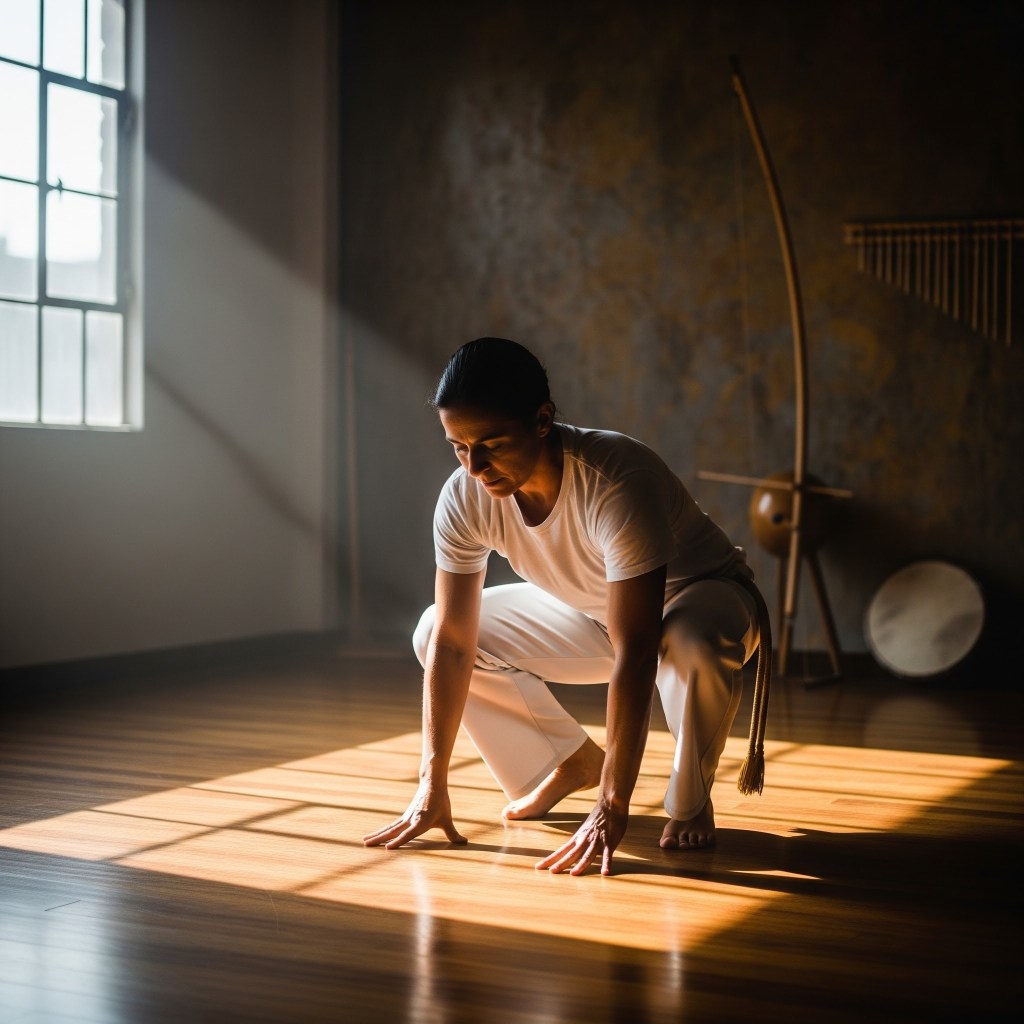
While Capoeira Angola is a complex, Afro-Brazilian art form that encompasses elements of fight, dance, music, history, and philosophy, many practitioners recognize a profoundly meditative quality inherent in its jogo (the game) and its core movements.
- Focus and Presence: At the heart of both meditation and Capoeira Angola is the requirement for complete present-moment awareness. In the roda (the circle where Capoeira is played), distraction is dangerous. The capoeirista must be utterly focused on the music, the movements of the opponent, and their own body’s position. This intense, undivided attention mirrors the single-pointed concentration cultivated in mindfulness meditation.
- The Ginga and Flow State: The ginga, the foundational swaying movement of Capoeira, is a continuous, rhythmic motion. When performed correctly and with intent, it can induce a “flow state”—a feeling of energized focus and full involvement in the activity. This state is often cited as a key objective in active forms of meditation, where the mind is calmed and integrated with the body through repetitive, intentional movement.
- Mind-Body Integration: Capoeira demands an extremely high level of coordination and control. To execute a queda (takedown), an esquiva (escape), or a rabo de arraia (kick) smoothly requires a deep, non-verbal dialogue between the mind and the physical form. This constant, intricate communication serves as a form of active self-inquiry and embodiment, similar to the goal of many Eastern martial arts and moving meditation systems like Tai Chi or Qigong.
The Role of Tempo: Slowing Down for Deeper Effect
The second question—whether practicing Capoeira Angola slowly can replicate the effects of moving meditation—is particularly relevant to the style of Capoeira Angola.
- Capoeira Angola vs. Capoeira Regional: Unlike its faster, more acrobatic contemporary, Capoeira Regional, Capoeira Angola emphasizes malícia (cunning, strategy) and a jogo that is often played closer to the ground and at a deliberately slow pace. This measured tempo is not a sign of weakness, but a tool for deeper engagement.
- Intentionality and Breath: Slow movement forces the practitioner to become acutely aware of their balance, the transition between movements, and, crucially, their breath. By consciously linking movement to inhalation and exhalation, the slow ginga transforms into a rhythmic, moving prayer or contemplation. Each action is performed with greater intentionality, allowing the mind to quiet down and observe the internal experience rather than reacting externally.
- Cultivating Patience and Observation: Moving slowly in the roda against an opponent requires immense patience and keen observation. It teaches the capoeirista to wait for the opportune moment rather than rushing into action. This mental training—the ability to hold a difficult posture or observe a developing situation without immediate physical reaction—is a direct parallel to the non-reactive awareness fostered in sitting meditation.
The assertion that Capoeira Angola is deeply connected to principles of moving meditation is supported by a close examination of the practice’s core characteristics. The style is marked by a deliberate, low, and often slow-paced execution, demanding a high degree of malícia (cunning, intuition) and mandinga (mystique, spiritual/technical mastery) that goes beyond mere physical movement. This sophisticated and intentional nature aligns strongly with the tenets of established moving meditation disciplines.
At its heart, Capoeira Angola cultivates a profound state of presence. The rhythm of the berimbau and the call-and-response structure of the roda (the circle in which Capoeira is played) function as an anchor, drawing the practitioner’s focus entirely into the immediate moment. Every movement—the low, sweeping rabo de arraia, the deceptive queda de rins, or the seemingly passive aú—must be executed with absolute conscious effort and awareness of the partner’s intention and the collective energy of the roda.
This sustained, measured tempo facilitates a powerful integration of mind and body. Unlike fast-paced, high-impact activities, the measured rhythm of Angola requires the mind to guide the body with precision, forcing a synergistic coordination of breath, balance, and spatial awareness. The slow, controlled execution strips away the reflexive, automatic nature of movement, transforming each posture and transition into a deliberate choice—an active form of contemplation.
When approached with this level of conscious effort and a focus on internal state rather than external performance, Capoeira Angola truly functions as a powerful form of active contemplation, mirroring the principles of moving meditation. The sustained engagement within the roda (circle) is not a simple physical workout but a deeply mindful practice.
Capoeira Angola: An Embodied Pathway to Moving Meditation

Capoeira Angola, a sophisticated and deeply traditional Afro-Brazilian art form, offers a unique and potent framework for embodied consciousness that can be profoundly understood through the lens of moving meditation. While often viewed simply as a dance or a martial art, its practice is a holistic discipline where intense physical engagement serves as a conduit for profound internal mastery, aligning it seamlessly with established contemplative practices.
The Dynamics of Focused Presence
The core of Capoeira Angola’s meditative quality lies within the jogo (the game) and its foundational movement, the ginga. This repetitive, yet infinitely varied, dance-fight creates a dynamic, high-stakes loop of attention and immediate response. The practitioner must constantly strive to remain baixo (low) in the ginga, a posture that demands significant and sustained physical stamina, mental resolve, and a heightened state of alert relaxation. This sustained concentration is absolutely critical—not only to maintain the physically demanding low stance and conserve energy, but also to instantaneously read, predict, and counter the opponent’s movements, and to express oneself creatively and strategically through improvised attacks, evasions, and flourishes.
The Rhythmic Anchor
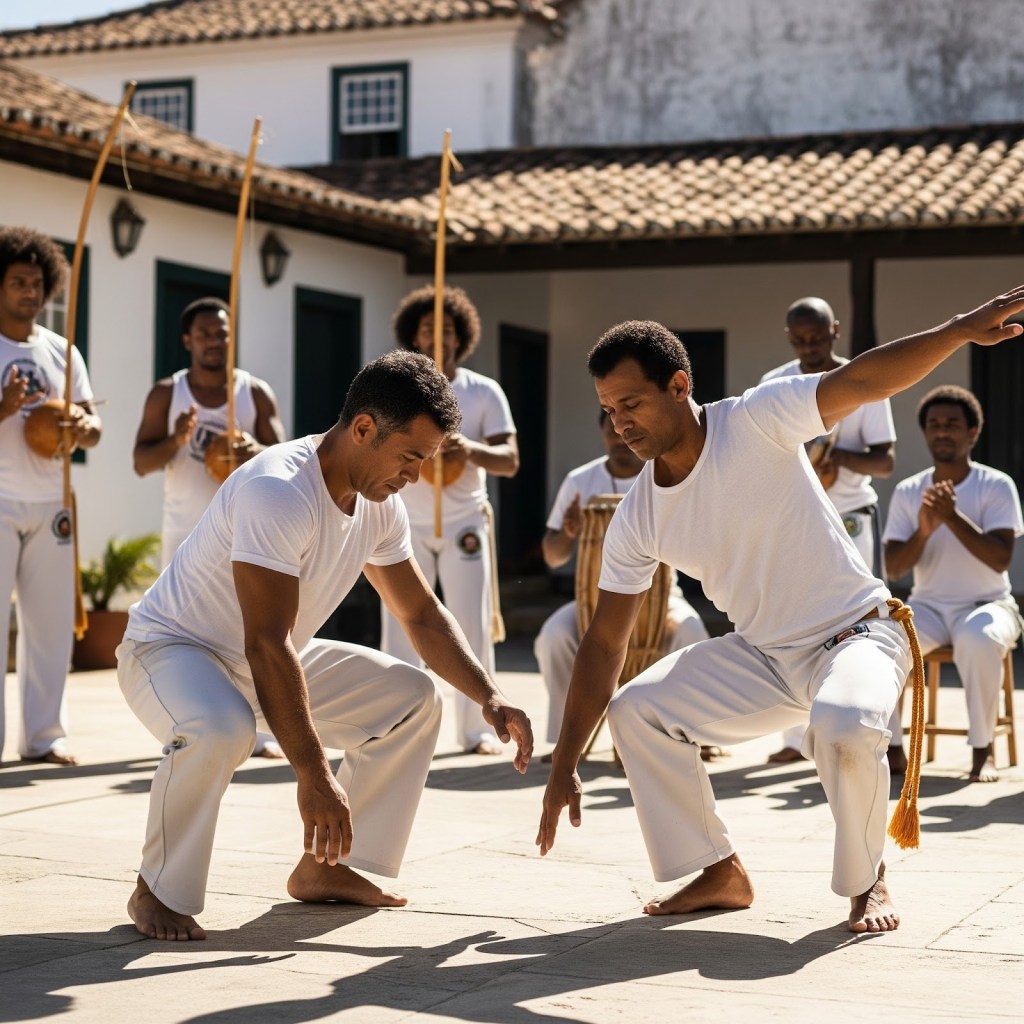
Crucially, this intense focus is anchored by the rhythmic environment of the roda (the circle). The distinct sound of the berimbau (the single-stringed musical bow), the soul of the art, along with the accompanying instruments—atabaque (drum), pandeiro (tambourine), reco-reco, and agogo—provides an unwavering rhythmic foundation. This music acts as a constant, hypnotic pulse, drawing the practitioner’s awareness back to the present moment, much like the focused attention on the breath in seated Vipassana or Samatha meditation. The music does not merely accompany the game; it dictates its speed, energy, and emotional tone, effectively guiding the meditative state of all participants.
Physical Integration and Mental Clarity
The benefits derived from this intense, focused engagement are profound and mirror the psychological and cognitive gains sought in practices like Tai Chi, Qigong, or walking meditation. The regular engagement leads to a significant reduction in chronic stress and anxiety, enhanced clarity of thought, and marked improvement in concentration and sustained focus. Furthermore, the successful navigation of the complex, often unpredictable, dynamics of the jogo cultivates a palpable increase in a sense of self-mastery and resilience.
The physical demands of the art necessitate a total, non-negotiable integration of mind and body. The fluid evasions (esquivas), the controlled falls (quedas), the expansive acrobatic movements, and the explosive attacks (golpes) require the body to move as a unified, conscious whole. This process transforms the physical body from a mere object to be trained or conditioned into a highly refined vehicle for heightened consciousness. In the heat of the game, thought becomes movement, and movement becomes pure, unadulterated presence.
The Communal Contemplation of the Roda
What distinguishes Capoeira Angola from many individual meditation techniques is its vital social and communal dynamic. The structure of the roda—with its reliance on call-and-response songs (chulas), shared energy, and mutual respect among players, singers, and musicians—cultivates a sense of deep connection and emotional intelligence. This interdependence elevates the experience beyond simple individual self-reflection. It is a shared contemplation—an embodied, non-verbal dialogue where the energy and intention of each participant contribute to a collective, resonant state. The vulnerability required to play the game, to express oneself creatively, and to trust one’s partner fosters an expansive emotional landscape that deepens the meditative experience through community.A Holistic Discipline for Embodied Consciousness
Ultimately, the practice transcends its historical origins as an ingenious form of disguised self-defense or a simple folk dance. It is a meticulously integrated, holistic discipline. By seamlessly weaving together dynamic movement, complex music, strategic thinking, and profound community interaction, Capoeira Angola offers a potent and unparalleled pathway to embodied consciousness. In this state, the practitioner is entirely present, mentally agile, emotionally attuned, and deeply connected to their physical self, their cultural heritage, and their environment. The jogo becomes the lived meditation, a powerful expression of inner harmony realized through external action.

 Jogo Corpo Fechado