
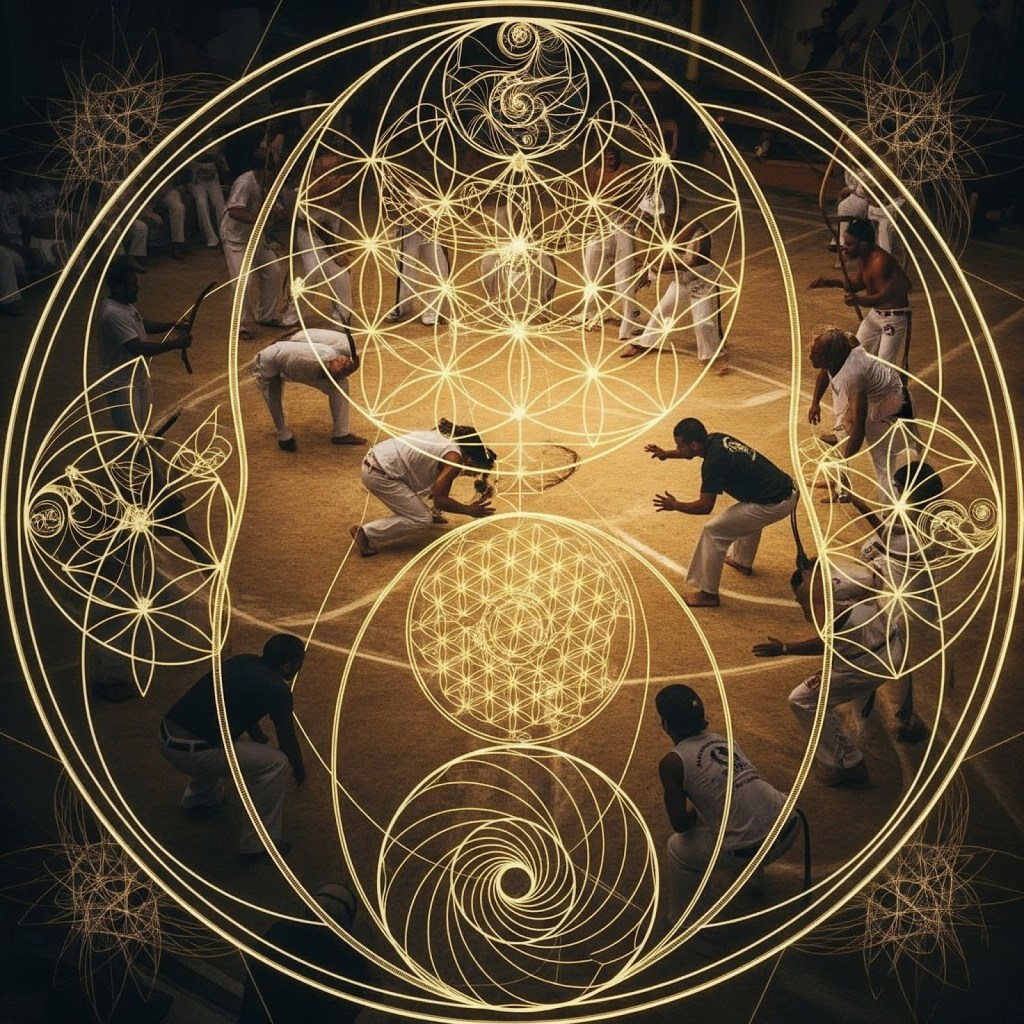
This work delves into the profound, yet often overlooked, relationship between the Afro-Brazilian art form of Capoeira Angola and the universal principles of Sacred Geometry. We aim to draw clear and compelling parallels between the fundamental movements, the structure of the roda (the circle in which capoeira is played), and the underlying mathematical and spiritual patterns found in nature and ancient wisdom traditions across the globe. By viewing Capoeira through this lens, its status is elevated from a mere cultural practice to a dynamic, embodied philosophy.Connecting Capoeira with Sacred Geometry
The practice of Capoeira Angola, at its deepest level, transcends the simple categorization of a martial art, a dance, or a game. It emerges as a dynamic, moving meditation, intricately linked to the universal principles of creation and harmony, the very principles codified in the study of Sacred Geometry. The art form is not merely a collection of techniques; it is a physical manifestation of continuous flow, balance, and interconnectedness. But first, What is Sacred Geometry?
Sacred geometry is the study of geometric shapes and proportions believed to have profound spiritual and symbolic meaning. It posits that certain patterns are not arbitrary but are the fundamental building blocks of the universe, representing universal blueprints and divine order. This discipline seamlessly blends precise mathematical principles with deep philosophical and spiritual interpretations.
Its influence is not limited to theory, finding concrete expression in nature, art, and architecture across virtually every human culture, from the precise planning of ancient Egyptian temples and the complex stained-glass work of Gothic cathedrals to the thoughtful proportioning found even in modern minimalist design. Key concepts underpinning this study include the intrinsic symbolism of foundational shapes like the perfect circle (representing unity, infinity, and the container of all creation) and the stable triangle (symbolizing foundation and trinity). Crucial to this field are also the use of the Golden Ratio ($\Phi \approx 1.618$), the Fibonacci sequence, and complex, interlocking patterns like the all-encompassing Flower of Life and Metatron’s Cube. These elements are not just aesthetic; they are seen as a visual vocabulary to represent the underlying structure and vibration of the universe, promoting harmony, balance, and a deeper understanding of existence.
The Roda as the Circle of Creation: The Geometry of Community

The Capoeira Angola roda is far more than just the physical arena where the game is played; it is a profound ritualistic container, a crucible of shared energy, history, and community. From a geometric perspective, the circle is the most fundamental and perfect shape. It possesses no beginning and no end, inherently representing wholeness, infinity, and the cyclic nature of existence—concepts that lie at the very core of Sacred Geometry.
Within the confines of the roda, a microcosm of the universe is created. The perimeter of the circle defines a sacred space, separating the profane world outside from the concentrated, intentional energy within. The dynamic interplay of attack (ataque) and defense (defesa), of challenge and acquiescence, directly mirrors the ancient philosophical concept of complementary opposites—the necessary tension between light and shadow, life and death, yin and yang. This perfect balance can be visually analogized by the Vesica Piscis, the foundational shape created by the intersection of two circles (often representing the spiritual and the material, or two individuals). This simple, elegant intersection forms the basis for more complex patterns like the Flower of Life, symbolizing that the community of the roda is a unified, singular entity born from the harmonious and intentional interaction of its individual members. The circularity ensures that all participants, from the players in the jogo to the musicians and the spectators, are equally important, contributing their unique energy to the whole and receiving the collective energy in return. The roda thus becomes a geometry of inclusion and energetic reciprocity.Sacred Geometry and the Flow of Movement: Efficiency and Intention
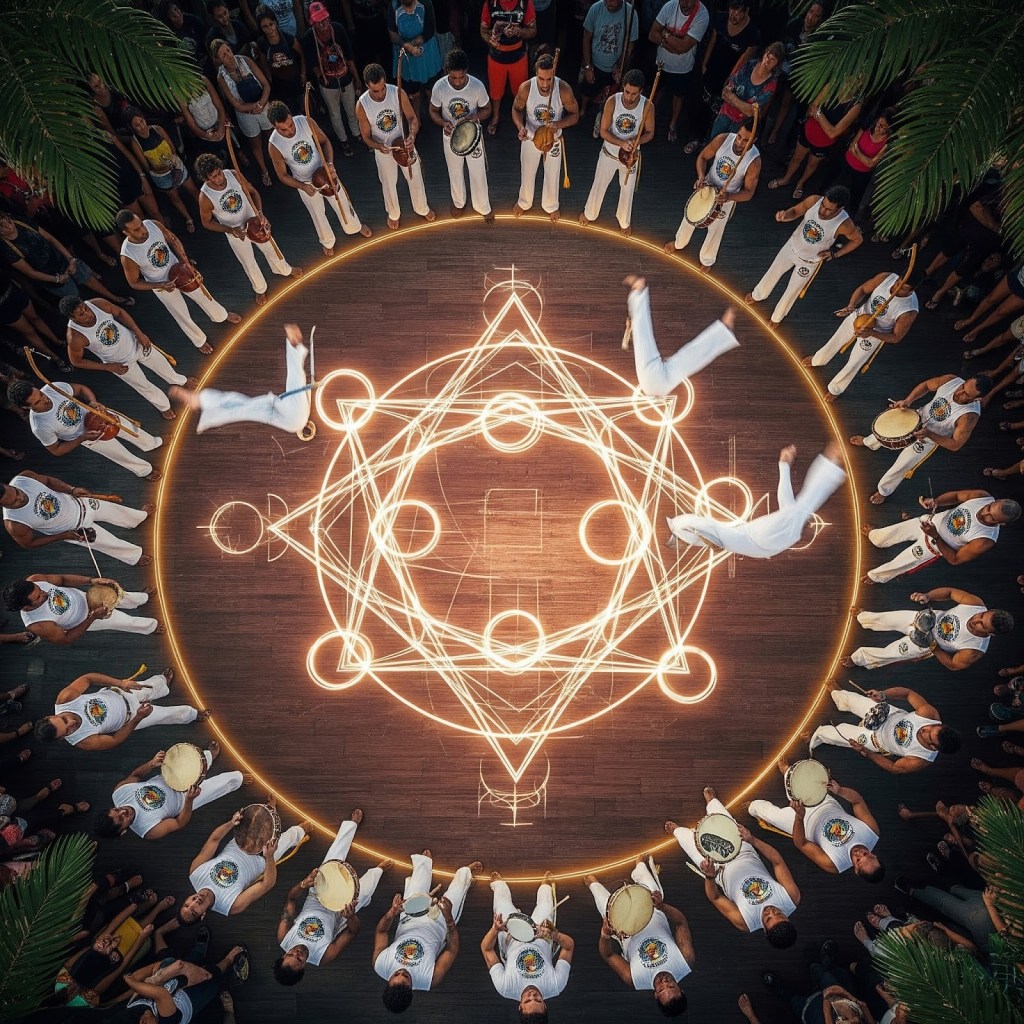
The entire movement vocabulary of Capoeira Angola—its circular, spiraling, and oscillating motions—can be interpreted through the rigorous lens of Sacred Geometry. These movements are not randomly generated or arbitrary; they are guided by principles of efficiency and natural motion that align with universal laws, maximizing power while minimizing wasted energy.
- The Ginga and Oscillation: The basic, foundational rocking movement (ginga) is a continuous side-to-side oscillation, a constant shift of weight that avoids stasis and prepares the body for any immediate action. This fluid movement embodies the concept of eternal energy flow and constant change. It mirrors the sinusoidal wave patterns and rhythmic undulations found in nature and mathematical principles, such as the movement of water or sound waves, suggesting a deep, intuitive connection to universal principles of motion and energy conservation. The ginga is the rhythm of life itself, constantly seeking equilibrium in motion.
- Spirals and Curves: The sweeping kicks (rasteiras, chapas), powerful spinning attacks (aú batido), and evasive dodges (esquivas) inherently follow circular and spiral paths. The spiral is a signature form in Sacred Geometry, found in everything from the structure of DNA to the arms of a galaxy and the growth pattern of a seashell. These curved and vortex-like movements in Capoeira are often the most effective because they utilize the body’s natural momentum and the principle of the vortex, generating and conserving kinetic energy efficiently. A straight-line attack can be met with an equally powerful block, but a spiraling, circular evasion allows the momentum of the attack to be safely redirected or absorbed, demonstrating a mastery over the physics of motion.
The continuous, flowing nature of the jogo (the game) reflects the concept of tessellation—the endless tiling and interlocking of geometric patterns without gaps—suggesting a blueprint for seamless, perpetual movement where one action logically and spatially gives way to the next, maintaining an unbroken chain of energy exchange.
The Flower of Life and Capoeira’s Blueprint: Interconnectedness
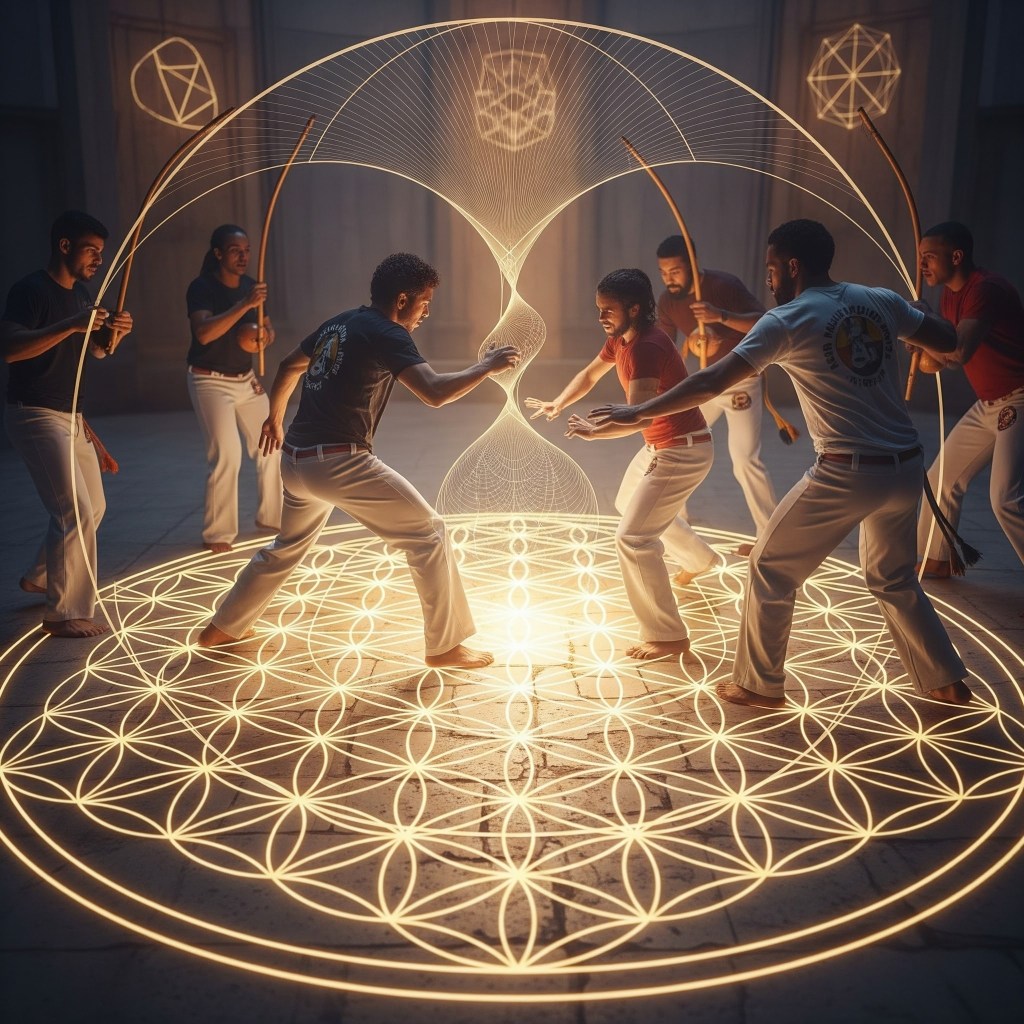
The Flower of Life is perhaps the most recognized and profound geometric motif, composed of multiple overlapping circles forming a flower-like pattern. Across numerous traditions, it is revered as the ultimate template, believed to contain every formula, every law of physics, every musical harmony—the fundamental geometric blueprint for all life and existence.
In the context of Capoeira Angola, this pattern serves as a powerful metaphor for the practice’s inherent structure and social organization:
- Community as the Sphere: The multiple, overlapping spheres of the Flower of Life represent the profound interconnectedness of all players, musicians, and spectators within the roda. Each individual circle is a player bringing their unique history and skill, and the point where the circles overlap represents the shared history, the energy exchange, and the mutual influence between them. The combined energy creates a field greater than the sum of its parts.
- The Web of Interaction: The complex web of Capoeira movements—one movement building upon the last, one player’s action dictating the next player’s response—creates a living, breathing geometric form in motion that mirrors the pattern’s structural growth. The game is a constant negotiation of space and intent, an illustration of how individual elements combine to form a cohesive, powerful, and evolving whole, moving together within the larger geometric framework of the roda.
The Golden Mean and Aesthetic Perfection: The Pursuit of the Ideal

The Golden Mean (or Golden Ratio, represented by the Greek letter Phi, $\Phi \approx 1.618$) defines a unique proportion that is consistently deemed aesthetically perfect and structurally optimal. This ratio is found repeatedly in the structures of life and the cosmos, from the spirals of a seashell and the branching of trees to the proportions of the human skeleton and the arrangement of seeds in a sunflower head. It is the signature of natural harmony and maximized efficiency.
In Capoeira Angola, the Golden Mean can be identified in the tireless pursuit of optimal proportion and distance:
- Optimal Spacing: The effective distance (distância) maintained between players is not random; there is an ideal separation—the “sweet spot”—that maximizes the potential for both immediate offense and safe defense. When players instinctively achieve this balance of proximity (to threaten and engage) and distance (to evade and recover), they are, in essence, aligning with this principle of natural proportion.
- The Perfect Arc: The graceful and powerful circular kick, the meia lua de compasso (“compass half-moon”), when executed perfectly, often traces an arc whose proportions adhere to the Golden Ratio in the relationship between the grounded leg, the sweeping leg, and the body’s torso. This ratio dictates the most efficient and visually arresting distribution of mass and momentum.
- Dynamic Balance: The overall visual spectacle of Capoeira—its dynamic balance, its sudden shifts in gravity, and the proportions of the human body in movement—achieves its inherent beauty because it unconsciously adheres to this fundamental rule of natural harmony. Movements that feel right and look beautiful are often those that follow this divine proportion.
Achieving the ideal timing and distance in the jogo is, therefore, far more than a simple execution of learned physical technique; it is a profound, ephemeral moment of spontaneous alignment with this universal principle of natural proportion. This mastery of tempo and distância transforms the physical exchange from a mere combat drill into a dynamic, flowing conversation—a living embodiment of the golden ratio and fractal geometry found throughout the natural world. The resulting movements are not only supremely effective in their immediate goal—evasion, defense, or attack—but are also inherently beautiful and aesthetically pleasing, carrying the undeniable stamp of natural harmony.

By exploring these profound, interconnected dimensions—the physical, the philosophical, and the spiritual—the Angoleiro and the observer alike can begin to appreciate the art form not merely as a dance or a fight, but as a powerful, physical philosophy, a complete system for engaging with the world. Capoeira Angola emerges as a living meditation on the fundamental, universal laws of creation and harmony, much like a moving Zen practice. Every subtle movement, every feint and counter-movement, is steeped in the historical memory and ancestral wisdom passed down through generations.
The jogo, the game played within the roda, becomes a microcosm of the larger universe, a laboratory where the student constantly seeks equilibrium between opposing forces. This tension is evident in the dynamic interplay of attack (ataque) and defense (defesa), the shifting between high (alto) and low (baixo), and the constant calibration of fast (rápido) and slow (devagar) movements. This mirroring of universal dualities—order and chaos, light and shadow, stillness and action—is not merely accidental; it is the deliberate structure of the art. The capoeirista learns to embrace the unpredictability, knowing that stability is found not in stasis, but in perpetual, fluid adaptation.
This relentless search for perfect balance within the ever-changing, unpredictable rhythm of the roda and the guiding energy of the berimbau is the core spiritual lesson of Capoeira Angola. The practice cultivates malícia, a street-wise, philosophical cunning that allows the practitioner to see beyond the surface of a situation and respond with instinctive, informed action. Ultimately, every session is transformed from a mere physical exercise into an active, embodied prayer of movement—a holistic dialogue with the self, the opponent, the music, and the deeper forces of nature and existence that govern the flow of the roda and, by extension, life itself.

 Jogo Corpo Fechado