

Capoeira Angola, more than a martial art or a dance, is a profound cultural expression deeply interwoven with the environment and the natural world, particularly the concept of Mother Earth, or Mãe Terra. The connection is multifaceted, emerging from the historical context of its genesis and manifesting in the philosophy, movement, and music of the art form.
Historical Roots and the Natural Environment:
Capoeira Angola, a profound and multifaceted art, was not merely born but was cultivated in the crucible of colonial Brazil’s brutal, yet ecologically vibrant, environment. For the enslaved Africans who practiced it, Capoeira Angola was a vital tool for survival, resistance, and cultural preservation. Because the practice was strictly forbidden by the colonial authorities, it was necessarily a clandestine activity, often developed and refined in deep synergy with the surrounding natural landscape.
The beaches, dense forests (mata), and sprawling cane fields (canaviais) served not only as concealed training grounds but also as sanctuaries—places where the practitioners could temporarily reclaim their identity and autonomy. This continuous necessity to engage with and utilize the natural world fostered an innate, almost spiritual, appreciation and deep understanding of nature’s rhythms, formidable power, and silent resilience.
The early practitioners of Capoeira Angola drew literal and metaphorical strength, camouflage, and strategic advantage from the earth itself. Their deep connection to the ground is a hallmark of the style; the movements are inherently grounded, utilizing low stances and sweeping motions that keep the player connected to the chão (ground), a source of stability and power.
Furthermore, the movements of Capoeira Angola often mimic the fluidity, unpredictable nature, and sudden explosive power found throughout the animal kingdom and the elements. The coiling, uncoiling, and swift kicks may echo the strikes of a serpent; the quick dodges and evasive footwork, the movements of a small prey animal; and the powerful sweeps, the sudden turbulence of the wind or water. This mimicry was not merely decorative but functional, allowing the practice to be disguised as a traditional dance, a playful game, or an animalistic ritual—a subtle but potent form of cultural cryptography that preserved its combative core. This profound intertwining of the art with the natural world underscores Capoeira Angola’s identity as a deeply ecological and embodied practice.
The Philosophy of Gingado and Groundedness:
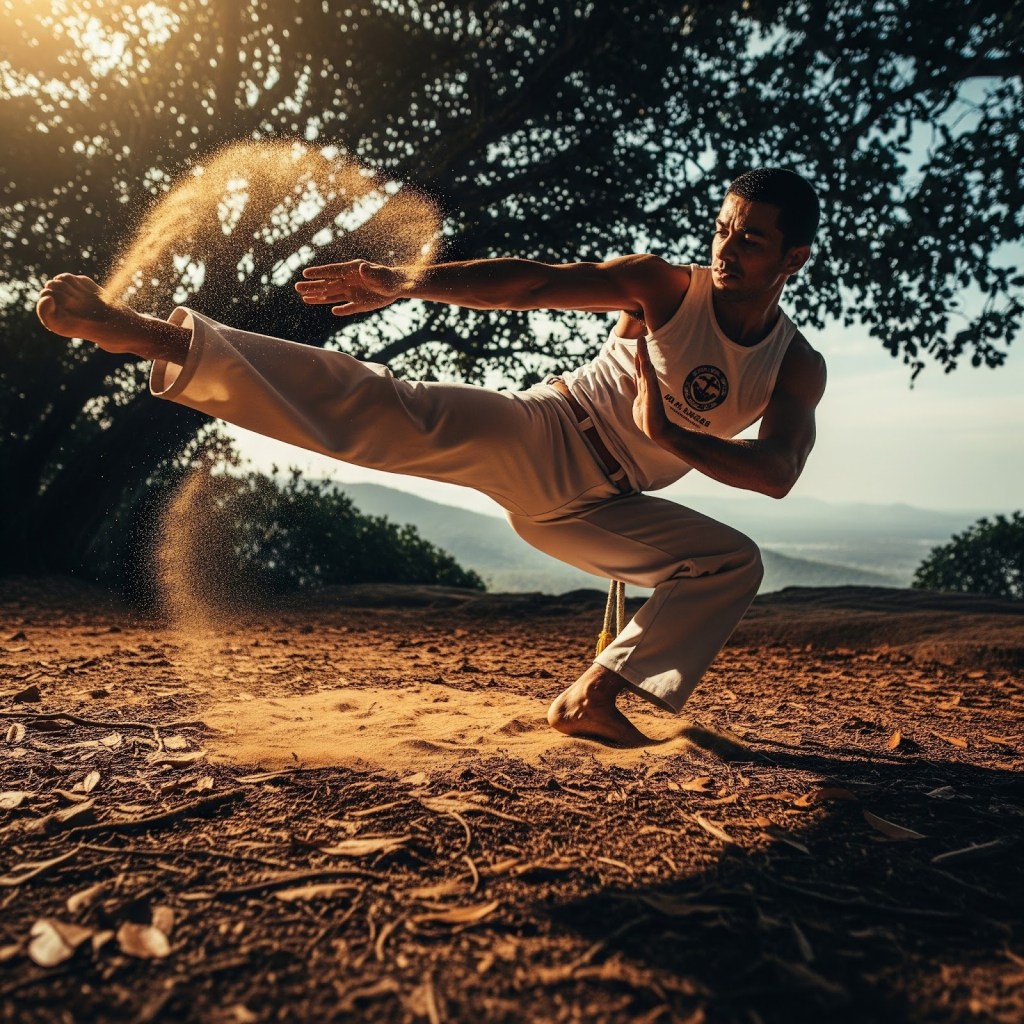
The fundamental movement of Capoeira Angola is the ginga, a constant, flowing, swaying motion that serves as the dance-fight’s perpetual core. This rhythmic, almost hypnotic ginga is far more than a mere ready-stance; it is the physical embodiment of life’s perpetual flux and the deep, intrinsic rhythm of nature. It mirrors the reliable, yet ever-changing, movements of the natural world—the steady, inescapable ebb and flow of the ocean tide, the gentle and continuous rustling of leaves in the wind, and the subtle, powerful undulation of the land itself.
Crucially, the ginga emphasizes being perpetually grounded and low to the earth. This low posture is a deliberate symbol of humility before the forces of nature and the wisdom of the ancestors, but it is also a posture of profound readiness and physical power. It establishes a direct, intimate physical connection to Mãe Terra (Mother Earth), the ultimate source of stability and strength. The continuous low stances (cocorinha, negativa), the sweeping leg motions, and the frequent, intentional emphasis on the hands touching the ground (such as in the aú or cartwheel, and the essential defensive move, the queda de rins) all underscore this profound respect for and reliance upon the earth. This connection is not just symbolic; the earth is viewed as the wellspring of stability, the anchor that allows for explosive movement and resilient defense.
To be “out of sync” with the ginga—to become rigid, static, or disconnected from the flow—is to be disconnected from the ceaseless, protective rhythm of nature itself. This state of dissonance is more than a momentary lapse in technique; it is a profound philosophical failure within the practice of Capoeira Angola. When the body locks, arresting the continuous, wave-like motion, it turns potential energy into exposed stillness. This vulnerability is akin to a tree refusing to sway in the wind, inviting the risk of snapping rather than bending. The Capoeirista who loses their ginga sacrifices their ability to adapt, transforming a dynamic, guarded posture into a fragile, fixed target.
The ginga, therefore, transcends its function as a mere physical technique; it is the fundamental vocabulary of the body’s conversation with the earth. It is a sustained, physical meditation on the constant necessity of adaptation, resilience, and maintaining a harmonious relationship with the ground beneath one’s feet. The motion acts as a vital conduit, channeling the energy of the earth up into the body while simultaneously grounding the individual’s spirit and movement. The rhythmic back-and-forth swing mirrors the tides, the seasons, the breath, and the heartbeat—all cyclical, regenerative, and inherently protective forces.
By continually shifting weight and maintaining a fluid readiness, the ginga ensures the Capoeirista is always preparing for the next moment, never committed to a single, static point in space. It is the physical embodiment of the maxim: the only constant is change. This unbroken flow creates a protective aura of unpredictability and kinetic energy, making it difficult for an opponent to anticipate a strike or defense. Ultimately, the ginga is the language through which the body speaks to the earth, asking for stability, drawing power from the environment, and responding with the unbroken wisdom of nature’s rhythm.
The Capoeira Roda: A Rhythmic Dialogue with Mother Earth

The experience of Capoeira Angola is fundamentally and intrinsically linked to the Earth, a connection most powerfully realized and sustained through the complex, governing music of the roda (the sacred circle in which the practice unfolds). This music is far more than simple accompaniment; it is the vital, rhythmic pulse of the entire practice, a sonic manifestation literally and philosophically rooted in the natural world from which it is derived.
The Berimbau: An Organic Instrument of the Land
The central, most revered, and most indispensable instrument in the Capoeira ensemble is the berimbau. Its very physical construction is a profound testament to the art form’s deep history, its reliance on indigenous, organic resources, and its reverence for nature. Every component is a direct, tangible gift from the earth:
- The Wood (Verga): The long, curved staff forms the essential frame and provides the necessary tension for the instrument. It is traditionally sourced by respectfully harvesting the wood of specific, resilient, and enduring trees native to Brazil, symbolically linking the berimbau to the strength, stability, and enduring nature of the forest and its ancient, deep-rooted heritage.
- The Gourd (Cabaça): Serving as the acoustic resonating chamber, the dried and painstakingly hollowed-out gourd amplifies the delicate vibration of the string. This natural resonator is what gives the instrument its unique, unmistakable, and deeply earthy timbre. It is a powerful symbol of the bounty of the harvest, the cyclical nature of life, and the generous, life-giving properties of the plant world.
- The Metal String (Arame): While historical versions utilized natural fibers, the modern berimbau most commonly uses a steel wire, frequently salvaged from the rim of a discarded car tire. This adaptation speaks to a remarkable resilience and resourcefulness—a symbolic transformation of man-made waste and industrial residue back into a spiritual and cultural tool, integrating the modern reality into a tradition rooted in nature. The percussive strike against this taut wire generates the instrument’s signature sound.
The other essential instruments complement the berimbau‘s rhythm. The atabaque, a tall, conical drum, provides the deep, grounding heartbeat. Historically, its body would be carved from a tree trunk, and its head covered with stretched animal skin. The pandeiro, a frame drum similar to a tambourine, adds a sharp, percussive layer, often featuring jingles made from metal. The agogo, a double bell, typically metal today but originally made from gourds or wood, adds a distinct, high-pitched counter-rhythm. Finally, the reco-reco, a scraped instrument, is often a notched piece of bamboo or wood, sometimes with a gourd resonator.
The entire orchestra, made up of these simple, naturally derived instruments, symbolizes the profound connection between the practice, the rhythms of nature, and the resourcefulness of its founders. The materials themselves—wood, gourds, metal, and skin—are drawn from the environment, making the music not just an accompaniment to the movements, but an audible manifestation of Capoeira Angola’s rooted philosophy.
The Sonic Metaphor: Echoes of the Natural World
The entire sonic landscape of Capoeira Angola, generated by this organic instrumental ensemble, transcends the simple collection of musical notes. This intricate, rhythmic architecture is widely and deeply understood as a direct, resonant echo of the vibrant, ever-present natural world and the essential, foundational rhythms that govern all existence.
At the very heart of this soundscape lies the berimbau. Its rapid, pulsating, and vibrating tones create a multifaceted sonic metaphor that speaks to various elements of the Brazilian landscape:
- The Insect Chorus: In the humid, thick stillness of a tropical forest environment, the berimbau‘s high, characteristic, and relentless sound is often vividly likened to the pervasive, high-frequency buzzing of countless insects—a constant, vital sound representing the unstoppable, intense force of life itself in the jungle.
- The Wind’s Whisper: When the tones skillfully dip, shift, and accelerate, they powerfully evoke the unpredictable, sweeping howling and whispering of the wind as it courses through dense forest canopies and weaves among scattered tree trunks. It is the sound of an unseen, dynamic force of nature, powerfully felt by all.
The Deepest Pulse: Heartbeat of the Earth
However, the most profound and universally resonant interpretation connects the rhythmic pulse of the music to the deepest, most foundational beat imaginable: the deep, steady heartbeat of the community itself. This synchronous communal pulse, which instinctively coordinates the movements, breathing, and energy of the practitioners, is extended outward, transforming into a metronome for the entire human-earth relationship—the fundamental, resonant heartbeat of the Earth. This foundational sound, therefore, serves to bind the players not just to each other in a temporary circle, but irrevocably to the deep, telluric, and enduring energy of the planet itself.Capoeira: Born from the Soil
This simple yet profound, organic construction of the instruments—crafted from the essential elements of gourds, wood, and metal wire—continuously and fundamentally reinforces a central philosophical tenet of the art form: Capoeira Angola is not an imported, abstract, or purely intellectual practice passed down through texts. Rather, it is an art form that is indelibly born directly from the soil of Brazil, utilizing its indigenous, readily available resources, and arising from the specific, ancestral landscape and cultural history of its people. The very tools required for its practice are tangible, powerful tokens of the land.
This essential, profound connection fosters a deep-seated reverence for the musical instruments, which is, at its very core, a simultaneous and continuous reverence for the natural world that so generously provides them. The ritual act of playing, listening, and moving in response to this organic sound forges an unbreakable, cyclical bond: the hands and spirit of the practitioner shape the sound, the sound articulates the history and poetry of the music, and the music whispers of the sustaining power of Mother Earth. The entire ritual of the Capoeira Angola roda thus becomes a continuous, kinetic, and living dialogue between the human spirit, the cultural memory, the rhythmic music, and the sacred, sustaining power of the Earth itself.
The Roda as a Microcosm:
The roda itself can be viewed as a profoundly sacred circle, a temporary sanctuary where the deepest elements of the natural order and ancestral wisdom are honored and made manifest. It is a defined yet permeable space—a crossroads where the physical and the spiritual converge—allowing practitioners to move in a highly complex and rhythmic harmony. Participants are engaged in a constant, dynamic dialogue, responding not only to the overt cues of the music, such as the berimbau’s guiding rhythm and the community’s collective singing, but also to the subtle, almost telepathic movements of their opponent. This dance is equally driven by the palpable energy, the axé, of the surrounding community, whose hand-clapping and singing actively shape the intensity and direction of the game.
This remarkable state of interconnectedness mirrors the delicate balance and interdependence of a healthy, functioning ecosystem. Every element—the ground, the music, the players, and the onlookers—is essential and influences every other. The game itself becomes a microcosm of life, showcasing fluid adaptation, strategic resistance, and profound respect for the opposing force.
The earth is not merely a stage for Capoeira Angola; it is the foundation and the first Mestre (master) upon which this communal ritual of life, resistance, and artistry unfolds. It is the solid, constant element that absorbs the force of every strike and kick, yet remains unyielding, mirroring the resilience required for cultural survival. This connection grounds the high-flying acrobatics, the deceptive malícia (malice/cunning), and the low-to-the-ground movements (rasteiras and cabeçadas), rooting the capoeira performance in the reality of its origins—a powerful act of self-expression and cultural survival born from the very land its enslaved founders toiled upon.
The ground teaches patience, balance, and humility; every player must constantly acknowledge and interact with it. The hands often touch the earth in the aú (cartwheel), the queda de quatro (fall of four), or the negativa (negative position), not just for movement, but as a silent salute to the life-giving soil. This physical, constant contact transforms the practice from a simple exercise into a meditation on connection and stability.
The roda, therefore, is not merely a performance area; it is a sacred, living circle that regenerates community, preserves the embodied history of the African diaspora, and teaches the profound, enduring lesson of harmony within conflict. Encircling the players, the roda acts as a microcosm of the world, where the energy flows from the instruments, through the hands and voices of the participants, and is ultimately anchored by the earth beneath their feet, creating a powerful, regenerative loop of cultural memory and sustained life force.

 Jogo Corpo Fechado