

Introduction: Capoeira Angola as a Lens for Social Dynamics
Capoeira Angola, more than just a martial art or a dance, is a deeply philosophical and strategic game of life played within the roda. Its emphasis on patience, strategic movement, reading the opponent’s intentions, and maintaining control under pressure—often through deceptive slowness and subtle shifts—provides a powerful metaphorical framework for navigating complex and challenging social interactions. The skills honed in the roda—the ability to anticipate a malicious rasteira (takedown), to evade a predictable attack, or to use an opponent’s momentum against them—are surprisingly applicable to the difficult task of dealing with a personality type defined by self-absorption and manipulation: the narcissist.
This guide uses the principles of Capoeira Angola to help the discerning individual, the Angoleiro, recognize the narcissistic personality pattern and employ thoughtful, strategic, and protective measures—the martial arts of emotional self-defense—to preserve their own axé (life force, energy) and well-being.
Part I: Recognizing the Opponent – The Narcissist in the Roda
Just as an Angoleiro must study their opponent’s stance, rhythm, and habitual movements to predict their game, one must learn to identify the key markers of a narcissist. This is the first step in creating a defense strategy, understanding the nature of the challenge before engaging.
1. The Flamboyant Aú of Grandiosity
A narcissist often presents an inflated sense of self-importance, entitlement, and uniqueness. This is their grand, attention-seeking move—their flashy, high-arcing aú (cartwheel) that dominates the space and immediately draws the gaze of the roda (the circle of players). They do not merely participate; they aim to steal the spotlight with a performance of superiority. They genuinely believe they are superior or “special,” a cut above the rest, and their behavior reflects this underlying conviction.
Manifestation and Recognition:
- Exaggerated Achievements: This grandiosity manifests in the constant exaggeration of achievements, talents, and even personal associations. A minor professional success is framed as a world-changing triumph, and casual acquaintances are presented as intimate, high-status friends. Listen for narratives that relentlessly circle back to their own accomplishments, their perceived intellectual, moral, or financial superiority, or their association with “high-status” people or things.
- The Expectation of Adoration: They not only desire but expect constant and effusive admiration. In the roda of life, they believe the music should only be played for their movements. Any critique, or even simple lack of enthusiastic praise, is often met with indignation, as it threatens their carefully constructed self-image.
- Entitlement as a Stance: This belief in their specialness translates into an unshakeable sense of entitlement. They feel they deserve preferential treatment, that rules do not apply to them, and that others should automatically defer to their wishes and needs. They may push boundaries without acknowledging the impact on others, seeing any resistance as an affront to their rightful position. This attitude forms a rigid stance in the roda—a refusal to bend or yield the space to anyone else.
2. The Emotional Rasteira of Exploitation
Narcissists fundamentally operate from a position of lacking genuine empathy. They do not perceive others as autonomous individuals with a rich inner world of feelings, needs, and experiences. Instead, they view people primarily as objects or, in a relational context, as opponents—tools to be used for a specific purpose: validation, emotional supply, acquisition of resources, or advancement of their own social or professional standing.
This objective, self-serving perspective makes them masters of the emotional rasteira (a Capoeira Angola move meaning a swift, ground-level takedown). This is not a random attack but a strategically executed emotional maneuver aimed at exploiting the vulnerability of others for personal gain, all without a hint of internal remorse or guilt. Their actions are calculated to secure their desired outcome, whether it’s attention, pity, resources, or maintaining control.
- Recognition: The Pattern of Dismissal
The most telling sign of this exploitation is a recurring, consistent pattern where your needs, feelings, accomplishments, or struggles are habitually dismissed, minimized, or outright ignored. The narcissist only shows interest or addresses these aspects of your life if, and only if, it directly or indirectly serves their pre-determined agenda. They might offer superficial support to maintain their ‘caring’ image, but the moment your issue requires genuine effort or takes the focus off them, the empathy vanishes. This conditional engagement is the core of their emotional rasteira: they only lift you up to the degree that it keeps you in their orbit and available for future exploitation.
3. The Calculated Negaça of Manipulation
The negaça is one of the most intellectually compelling maneuvers in Capoeira Angola. It is not merely a defensive posture, but a masterful form of deceptive hesitation, a controlled feint designed to disrupt the opponent’s rhythm, create an opening, and ultimately control the tempo of the jogo (the game). It is an act of calculated vulnerability that masks underlying intent.
A narcissist, similarly, employs a repertoire of sophisticated psychological negaças to maintain their position of power, avoid genuine accountability, and keep their targets perpetually off-balance. These maneuvers are subtle, insidious, and specifically engineered to erode the victim’s sense of reality and self-worth.Core Narcissistic Negaças:
- Gaslighting: This is perhaps the most destructive of the negaças, as it is an outright attack on your cognitive and emotional stability. The narcissist systematically denies, distorts, or fabricates reality to make you question your own memory, perception, and sanity. Like a feint that makes a Capoeirista doubt their own attack, gaslighting makes you doubt your own experience. The goal is to install a permanent internal censor that causes you to apologize for or retract your truth before it is even fully articulated.
- Projection: A classic defensive move where the narcissist attributes their own intolerable faults, insecurities, and behaviors onto you. If they are dishonest, they accuse you of lying; if they are being critical, they claim you are being sensitive. This psychological maneuver functions as a perfect defense: by keeping you preoccupied with defending against their projected flaws, they never have to confront their own. It is a strategic diversion that shifts the battleground entirely onto your territory.
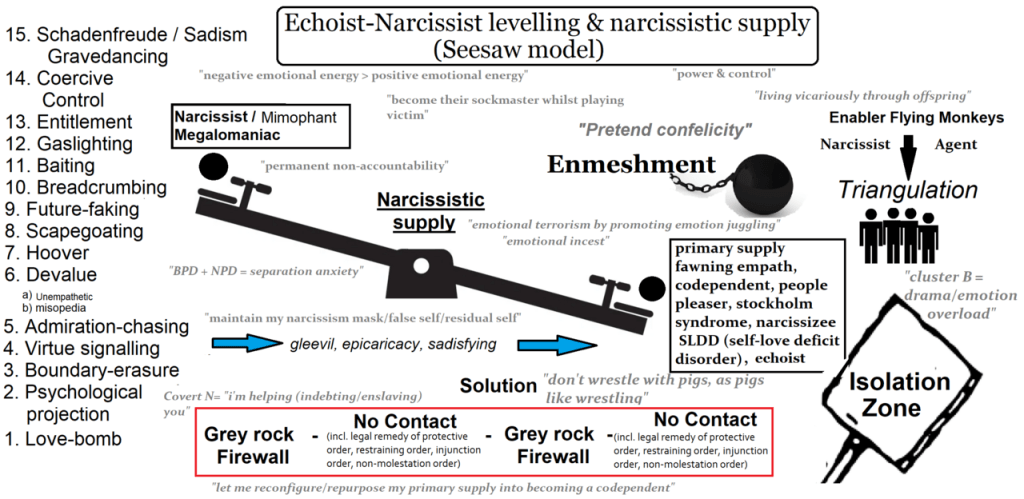
- Triangulation: This tactic involves introducing a third party (or multiple parties) into a conflict to control the communication and outcome. This could be a friend, a family member, a colleague, or even a therapist. The narcissist uses the third party to validate their version of events, to create a sense of competition or rivalry, or to isolate you further. By pitting people against each other, they stand in the middle as the seemingly rational, objective, or victimized party, diffusing direct conflict and cementing their own perceived moral superiority.
Recognition and the Path to Saída (Escape):
If you find yourself constantly navigating a fog of confusion, experiencing undue or pervasive guilt, or routinely offering apologies for actions you genuinely did not commit, these are critical flags. These emotional states are the direct psychological fallout of being subjected to a cycle of narcissistic manipulation.
Recognition is the first step toward the saída(escape). Understanding that the confusion is manufactured, and the guilt is projected, allows you to begin disentangling your authentic reality from the narcissist’s carefully constructed illusion. The goal is not to engage in their distorted jogo, but to recognize the negaça for what it is—a calculated psychological trick—and refuse to fall for the feint.
Part II: Playing the Game – Strategic Responses from the Angoleiro
The fundamental philosophy of Capoeira Angola—a martial art disguised as a dance—offers a powerful, non-confrontational framework for navigating the manipulative dynamics inherent in relationships with a narcissist. The true strength of an Angoleiro is not brute force but rather the strategic deployment of slowness, masterful evasion, and the nuanced application of counter-force. An expert practitioner understands that meeting kinetic energy with immediate, opposing force is often inefficient and exhausting. Instead, they seek to artfully redirect, dissipate, and utilize the attacker’s own momentum, ultimately turning the perceived weakness of patience and yielding into a decisive advantage. This echoes the psychological strategy required to deal with narcissistic abuse: not a direct fight, but a subtle, sustained repositioning of self.1. The Defensive Ginga of Emotional Detachment (Gray Rock)
The Ginga (literally, “to swing”) is the pulsating, foundational movement of Capoeira Angola. It is the continuous, rhythmic rocking motion that never settles, preventing the opponent from locking onto a target. It is the art of perpetual defensive preparedness, keeping the body fluid, balanced, and utterly unpredictable.
In the context of managing a narcissist, your Ginga translates directly into the practice of emotional detachment, famously known as the “Gray Rock” method. This strategy requires you to metabolize yourself into the psychological equivalent of a dull, unremarkable, and inert object—a gray rock on a vast beach.
Narcissists thrive on emotional supply, feeding voraciously on the dramatic energy—whether it is adoration (positive supply) or outrage, tears, and defense (negative supply). When you transform into the “Gray Rock,” you deliberately cease to provide any stimulating emotional reaction. You eliminate the rewarding feedback loop they seek, causing their predatory interest to wane naturally, much like a hunter abandoning terrain devoid of game.
The Strategic Implementation:
- Communication: Offer responses that are ruthlessly short, bland, and purely factual. Aim for the communication equivalent of a flat, monophonic tone.
- Example: When provoked with an accusation, instead of defending, respond with: “Noted,” “That is one way to look at it,” or “I will consider that.”
- Information Diet: Practice a strict information diet. Avoid sharing any personal information, feelings, opinions, goals, or vulnerabilities. These are the tools a narcissist collects and later weaponizes.
- Affect: Maintain a neutral, non-reactive facial expression and body language. Be as exciting, animated, and communicative as an actual gray rock. This strategic emotional starvation is the core evasive maneuver, preparing you for the next stages of psychological defense.
2. The Evasive Esquiva of Non-Engagement (Boundary Setting)
An esquiva is more than just a simple defensive move; it is the essence of Capoeira Angola’s strategic philosophy—an elegant, fluid evasion that allows a powerful attack to pass harmlessly by, conserving one’s own energy while leaving the aggressor overextended. When dealing with a narcissist, the esquiva is your most crucial tool for psychological self-defense: the strategic art of non-engagement.
The narcissist thrives on engaging others, demanding attention, provoking emotional reactions, and consuming their time, energy, and resources. Your primary objective must be to become an unrewarding target. This is achieved by establishing, communicating, and rigorously enforcing firm personal boundaries that serve as an invisible shield against their invasive maneuvers. This maneuver is not about engaging in a debate or a futile argument; it is a declaration of your sovereign territory and an unwavering commitment to holding your emotional and psychological ground.
The Strategy of the Esquiva
- Define Your Limits (The Stance): Before the interaction begins, you must have an absolute clarity on what you will and will not tolerate. This involves setting tangible, quantifiable limits on the narcissist’s access to you.
- Time Limits: “I can only discuss this specific topic for five minutes.”
- Emotional Limits: “I will not participate if the tone becomes disrespectful or accusatory.”
- Resource Limits: “I am unable to lend any money/time/favors at this time.”
- The Smooth Evasion (The Move): When the narcissist inevitably tests or attempts to violate one of your defined boundaries, you must execute the esquiva—disengage calmly, smoothly, and without drama. Your voice should remain even, and your statement should be factual, not emotional.
- The Calm Disengagement Phrase: “I see this conversation is straying from the issue/becoming disrespectful/going nowhere, and as I stated, I am ending the conversation now.”
- The Physical and Psychological Follow-Through: The key to the esquiva‘s success is the immediate and consistent follow-through. Once the boundary is stated, you must withdraw your attention, time, or presence. This might mean physically leaving the room, hanging up the phone, or simply ceasing all interaction until the narcissist respects the stated limit.
The Power of Consistency: Every time you successfully execute the esquiva, you reinforce the boundary. The narcissist learns that attacking your psychological space is met not with a gratifying confrontation, but with a frustrating, elegant absence of response. This deliberate non-engagement breaks the destructive cycle, conserving your vital energy and preventing the narcissist from siphoning your life force.
3. The Counter-Move (Contragolpe) of Limited or No Contact: Strategic Retreat
The most potent and self-preserving counter-move in dealing with a narcissistic dynamic is often avoidance. The philosophy of Capoeira Angola teaches a profound lesson here: you are not obligated to engage in, much less win, every single exchange or confrontation. True mastery lies not in perpetual combat, but in strategic withdrawal. Sometimes, the wisest and most powerful move is to simply exit the roda—the circle of conflict—entirely.The Principle of Strategic Retreat
If the narcissistic individual is a chronic source of stress, manipulation, or emotional exhaustion, the strategy of “limited contact” or, ideally, “no contact” becomes the ultimate technique for self-preservation and psychological defense. This is not a surrender; it is a tactical disengagement that deprives the narcissist of their primary source of supply: your attention, reaction, and energy.Strategy Implementation
- Minimize Communication Channels and Frequency: Drastically reduce the avenues through which the narcissist can reach you (phone, email, social media, mutual acquaintances). Keep interactions brief, infrequent, and emotionally neutral. Think of every communication as a necessary chore, not a dialogue.
- Keep Interactions Purely Transactional (Grey Rock Technique): When contact is unavoidable (e.g., co-parenting, work environment), adopt the “Grey Rock” method. Your goal is to be as dull, unreactive, and uninteresting as a grey rock. Respond to their attempts at manipulation or baiting with the most basic, factual, and emotionally flat responses possible. Stick rigidly to the topic at hand (e.g., “Yes,” “No,” “The payment is due on Tuesday,” “I received your email”). Do not offer personal information, opinions, or emotional fuel.
- Execute No Contact Cleanly and Without Explanation: If a total cut-off (No Contact) is feasible, it must be executed with swiftness, clarity, and, critically, without explanation or fanfare. A farewell note, a final confrontation, or an attempt to logically explain your decision will invariably be interpreted by the narcissist as a challenge—a final, irresistible opportunity to draw you into a destructive battle for their ego. They will use your explanation against you, prolonging the conflict and ensuring a painful, drawn-out exit. Silence is your shield and your strongest boundary.
Conclusion: Protecting Your Axé in the Roda of Life
The core philosophy of Capoeira Angola teaches that the ultimate triumph in the roda is not a brutal knockout, but the preservation of one’s spirit, integrity, and physical well-being. For the Angoleiro, survival with one’s axé (life force and spiritual energy) intact is the true measure of mastery. This same principle is profoundly applicable to the taxing, ongoing emotional jogo (game) of dealing with a narcissist.
A narcissistic dynamic is a continuous cycle of manipulation, mirroring the relentless, deceptive movements within a roda of Capoeira. The narcissist constantly seeks to drain your energy, provoke a reaction, and force you into a position of vulnerability—essentially, trying to steal your axé.
By adopting the strategic, patient, and deeply observant mindset of Capoeira Angola, you equip yourself with the tools to navigate this toxic relationship without becoming a casualty. This involves several critical movements:
- Patience and Malícia (Mischief/Cunning): The Angoleiro never rushes. They wait, observe the opponent’s patterns, and allow the other person to exhaust their own energy. In dealing with a narcissist, this means refusing to engage in their manufactured crises or emotional theatrics. You wait for the moment of their predictable overreach, using their own momentum against them. This is the application of malícia—cunningly avoiding the fight while maintaining control of your own space.
- Observation and Toco (Stop/Block): Capoeira is a dialogue of movement. A good Angoleiro learns the opponent’s “language”—their favorite attacks, their tells, and their weaknesses. Similarly, you must meticulously observe the narcissist’s manipulation patterns, noting their triggers and preferred tactics (gaslighting, pity plays, rage). By recognizing the pattern before the attack lands, you are able to execute a mental and emotional toco, a clean block that denies them the reaction they seek.
- Evasion and Aú (Cartwheel): Not every attack requires a direct block or counter. Often, the wisest move is to evade, to move so smoothly that the attack passes harmlessly by. This is the emotional equivalent of the aú—a fluid escape. When a narcissist launches an insult or a false accusation, your evasion is refusing to defend yourself or argue. You sidestep the emotional trap, not allowing their reality to become yours.
- The Ultimate Saída (Exit): The most powerful move in Capoeira Angola is the conscious decision to cease the game. Knowing when to simply walk away, to step out of the roda entirely, is the final, definitive act of self-preservation. When the game becomes too costly, when your axé is consistently under threat, the masterful move is to refuse to play by their rules any longer. This exit is the ultimate protection of your personal power and peace.
The true artistry in this lifelong jogo is maintaining your inner composure while the chaos of the narcissist swirls around you. By practicing this Angoleiro mindset, you ensure the protection of your most vital assets: your self-respect, your spiritual energy, your personal power, and your fundamental peace. The narcissist desires a win; your goal is simply to retain everything they wish to take. The most masterful game is the one where you refuse to enter their manipulative arena.
Resources:Dealing with a Narcissist with Capoeira Angola
The intricate and often frustrating challenge of interacting with a narcissist can be approached through a lens inspired by Capoeira Angola, the traditional, more grounded, and strategic form of the Afro-Brazilian martial art. Capoeira Angola is characterized by its low-to-the-ground movements, slower pace, deceptive subtlety, and a focus on malícia (cunning, trickery, and strategic awareness) rather than pure force or aggression. This philosophy offers a powerful metaphorical framework for managing narcissistic behavior.
1. The Low Game (Jogo de Baixo)
In Capoeira Angola, maintaining a low profile—literally staying close to the ground in the Ginga (the continuous, rocking base movement)—is essential for both defense and opportunity.
- Application to Narcissism: When dealing with a narcissist, the “low game” means lowering your emotional profile and expectations. Avoid engaging in their drama, arguments, or attempts to provoke a reaction. Narcissists feed on emotional supply, positive or negative. By remaining emotionally grounded, neutral, and unimpressed, you deny them the energy they seek.
- Tactics: Use the “Gray Rock” method—become as dull and uninteresting as a gray rock. Keep interactions minimal, factual, and devoid of personal information or emotional responses.
2. Evasion and Flow (Esquivas e Balanço)
Capoeira Angola emphasizes evasion (esquivas) over blocking. The goal is not to meet force with equal force, but to flow around it, redirecting the opponent’s momentum.
- Application to Narcissism: Do not directly challenge the narcissist’s grandiosity, distorted reality, or need to be right. A direct challenge often results in a defensive “narcissistic injury,” leading to explosive rage or aggressive retaliation. Instead, evade the argument.
- Tactics: Use non-committal phrases: “That’s an interesting perspective,” “I’ll consider that,” or “We’ll have to agree to disagree.” Allow them the temporary win of the verbal exchange while you preserve your mental and emotional energy for the long game.
3. Strategic Subtlety (Malícia)
Malícia is the soul of Capoeira Angola. It is not malice but strategic awareness—the ability to read the opponent’s intent, mask your own, and act at the precise moment of maximum advantage.
- Application to Narcissism: Develop a deep understanding of the narcissist’s patterns: their triggers, their favorite manipulations (gaslighting, projection, guilt-tripping), and their vulnerabilities. Use this knowledge to predict their moves.
- Tactics: Pre-emptively set firm, quiet boundaries. For instance, if you know they always use calls to argue, switch to text-based communication for documentation and emotional distance. The malícia lies in setting up a system that protects you without alerting them to your strategic defense.
4. The Counter-Move (Contra-Ataque)
In Capoeira Angola, a counter-move is often initiated from a defensive posture. It is small, precise, and aimed at the opponent’s imbalance.
- Application to Narcissism: Your “counter-move” is not a public confrontation but a quiet assertion of your independence and reality. This is achieved primarily through maintaining strong personal boundaries and seeking external validation.
- Tactics:
- The Documentation Block: Keep a private record of manipulative incidents (the date, what was said/done). This protects you from gaslighting and serves as a reality anchor.
- The External Anchor: Maintain strong connections with supportive friends, family, or a therapist who can validate your experience and confirm that the narcissist’s reality is false.
5. Exit Strategy (Saída)
The most powerful move in any difficult roda (the circle in which Capoeira is played) is knowing when to leave.
- Application to Narcissism: The ultimate goal of using this strategic framework is to minimize contact or, if possible and safe, to execute a clean exit from the relationship. Narcissists rarely change; the strategy is about changing your interaction with them.
- Tactics: Develop a clear, structured plan for reducing contact (if possible) or fully detaching. This may involve a “silent fade” or, if necessary, a decisive but calm “no-contact” boundary. The focus remains on self-preservation and protecting your own mental health, treating the narcissist as a challenging but ultimately peripheral factor in your life.
Resources:
Professional and Peer Support for Narcissistic Abuse Recovery
Recovering from narcissistic abuse is a complex journey that often requires external guidance and validation. It is highly recommended that survivors seek support from both professional mental health experts and peer-led communities to navigate the emotional turmoil and long-term effects of the abuse. Engaging with therapists who specialize in trauma can provide essential tools and coping strategies, while participating in peer-led groups can foster a sense of understanding and shared experience.
Additionally, incorporating self-care practices such as mindfulness and journaling can aid individuals in processing their experiences, helping to rebuild their self-esteem and sense of identity. Creating a strong support network composed of empathetic friends and family who understand the challenges of recovery can further enhance resilience and promote healing over time.
Professional Support:
- Therapists and Counselors specializing in Narcissistic Abuse/Trauma: Look for licensed professionals (psychologists, clinical social workers, licensed professional counselors) who have specific experience and training in trauma-informed care, complex PTSD (C-PTSD), and personality disorders, particularly Narcissistic Personality Disorder (NPD). They can provide:
- Validation: Confirming that the abuse was real and that the survivor’s feelings and reactions are valid.
- Psychoeducation: Teaching survivors about the dynamics of narcissistic abuse, manipulative tactics (like gaslighting, projection, and Hoovering), and the trauma bond.
- Therapeutic Modalities: Employing techniques like Cognitive Behavioral Therapy (CBT), Dialectical Behavior Therapy (DBT), Eye Movement Desensitization and Reprocessing (EMDR), or Somatic Experiencing to process trauma, regulate emotions, and re-establish a healthy sense of self.
- Boundary Setting and No Contact/Gray Rock Strategy: Assisting the survivor in establishing and maintaining firm boundaries, which often includes implementing the No Contact rule or the Gray Rock method for necessary co-parenting or workplace interactions.
- Rebuilding Self-Worth: Working to dismantle the negative self-beliefs instilled by the abuser and fostering genuine self-esteem and autonomy.
Peer Support:
- Support Groups and Online Communities: Connecting with other survivors who share similar experiences is a powerful antidote to the isolation and self-doubt created by narcissistic abuse. Peer support offers:
- Shared Experience and Normalization: Hearing similar stories reduces the feeling of being “crazy” or alone. This shared understanding provides profound emotional relief.
- Practical Advice: Peers can offer tips and strategies that have worked for them in navigating custody battles, managing post-separation contact, and handling public smear campaigns.
- Accountability and Encouragement: Group members can provide a safe space for processing difficult emotions and offer encouragement to stay committed to the recovery path and maintain boundaries.
- Reduced Stigma: Support groups foster an environment where survivors can speak openly without fear of judgment, counteracting the secrecy often enforced by the abuser.
It is crucial for survivors to understand that recovery is not linear and that a robust support system, combining the clinical expertise of professionals with the empathy of peers, significantly increases the chances of healing and building a future free from emotional manipulation.
 Jogo Corpo Fechado