

In the profound art form of Capoeira Angola, a rich and multifaceted tapestry of philosophical inquiry and practical application emerges from the intricate interplay of life, death, and trauma. This exploration seeks to delve deeply into how the core principles and established practices of Capoeira Angola can serve as an exceptionally powerful and transformative guide for its practitioners. By engaging with this dynamic Afro-Brazilian martial art, individuals are empowered to not only confront but also to skillfully navigate the inherent complexities of human existence, the undeniable and universal inevitability of death, and the often-hidden, yet deeply impactful, wounds of psychological and emotional trauma.
Capoeira Angola, more than just a physical discipline, is a living philosophy that offers a unique framework for understanding and engaging with the most fundamental aspects of the human condition. Its emphasis on fluidity, adaptability, and the constant negotiation of power dynamics within the roda—the circle where the game is played—mirrors the unpredictable nature of life itself. Practitioners learn to anticipate, react, and improvise, developing a resilience that transcends the physical realm and extends into their mental and emotional landscapes. This constant engagement with uncertainty fosters a heightened awareness, allowing individuals to approach life’s challenges with greater presence and equanimity.
Capoeira Angola, at its core, presents a profound and often overlooked engagement with the concept of death. Unlike many societal constructs that relegate discussions of mortality to the periphery, Capoeira Angola implicitly integrates this fundamental aspect of existence into its very fabric. The jogo, the game itself, with its fluid and unpredictable movements, its ebb and flow between connection and separation, harmony and conflict, mirrors the transient nature of life. This constant state of flux within the roda serves as a powerful metaphor, inviting practitioners to confront their own impermanence and the fleeting quality of all things. This heightened awareness of mortality is not intended to instill fear, but rather to cultivate a deeper appreciation for the preciousness of the present moment. By acknowledging the inevitable conclusion of life, individuals are encouraged to re-evaluate their priorities, shedding superficial concerns and embracing a more authentic and purposeful way of living. The discipline acts as a crucible, encouraging the practitioner to shed their fears, particularly the fear of the unknown, and to embrace the full spectrum of human experience, including its ultimate, inescapable conclusion. This acceptance, rather than denial, fosters a sense of liberation and a more profound connection to life itself.
Beyond its philosophical engagement with death, Capoeira Angola also offers a potent and holistic avenue for addressing and healing the often-unseen wounds of psychological and emotional trauma. The physical expression inherent in the art form—the dynamic movements, the resonant rhythms, and the evocative songs—provides an incredibly cathartic outlet. Individuals can externalize internalized anger, fear, and sadness, transforming these powerful emotions into expressive movements rather than allowing them to fester internally. The supportive and communal environment of the roda is paramount in this healing process. It offers a safe and non-judgmental space where individuals can openly process their experiences, find solidarity with others who may have faced similar struggles, and feel a profound sense of belonging. The act of moving, singing, and playing together transcends individual isolation, building trust within the community and fostering a renewed sense of self-esteem. This collective engagement can help to reintegrate fractured aspects of the self, allowing individuals to reclaim a sense of wholeness and inner harmony. The historical context of Capoeira Angola further amplifies its healing potential. Born from the crucible of oppression and resistance among enslaved Africans, it is inherently imbued with a profound sense of resilience, strength, and empowerment. This powerful narrative of triumph over adversity deeply resonates with those who have experienced trauma, offering a beacon of hope and a tangible pathway towards overcoming personal struggles. Through its multifaceted and holistic approach—encompassing physical expression, emotional release, communal support, and a rich historical legacy—Capoeira Angola transcends mere physical development. It emerges as a profound tool for personal growth, deep psychological and emotional healing, and a more nuanced understanding of the intricate and inseparable dance between life, death, and the extraordinary journey of human experience..
The path of a capoeirista, particularly one dedicated to Capoeira Angola, extends far beyond the physical movements and musical rhythms of the roda. It is a philosophy, a way of life that, ideally, equips its practitioners with tools to navigate not only the joys and challenges within the art form itself but also the profound and often traumatic experiences that life outside the roda can present. A critical, yet frequently underexplored, aspect of this journey is how a capoeirista grapples with the long-term effects of violence inflicted upon them – experiences such as a mugging, a physical assault, or even an attempted murder.
These deeply disturbing events leave indelible marks, not just physically, but emotionally, psychologically, and even spiritually. For someone dedicated to Capoeira Angola, with its emphasis on resilience, self-awareness, and the interplay of vulnerability and strength, these experiences present a unique set of challenges and opportunities for integration and healing.

Immediate and Lingering Impacts of Violence:
- Physical Manifestations: Beyond the initial injuries, chronic pain, heightened startle responses, and a general sense of physical unease can persist. The body, which in capoeira is a vessel of expression and defense, can become a source of discomfort and a reminder of the trauma.
- Emotional and Psychological Scars: Fear, anxiety, hypervigilance, depression, anger, and a sense of betrayal are common emotional responses. Post-traumatic stress disorder (PTSD) can develop, leading to flashbacks, nightmares, and avoidance behaviors. Trust can be shattered, making it difficult to form or maintain relationships.
- Spiritual and Existential Questions: Such experiences can force a re-evaluation of one’s understanding of safety, justice, and the inherent goodness of humanity. For a capoeirista, who often draws strength from community and ancestral wisdom, a sense of isolation or a questioning of one’s own internal resilience can emerge.
How Capoeira Angola Principles Can Aid in Healing:
Despite the profound challenges, the very principles and practices of Capoeira Angola can offer a framework for healing and reintegration:
- Ginga as a Metaphor for Life’s Fluctuations: The constant, fluid movement of the ginga is not merely a warm-up or a defensive stance; it embodies the dynamic nature of life itself. Learning to ginga through the emotional and psychological aftermath of trauma – moving with the fear, adapting to the anxiety, and finding moments of respite – can be a powerful coping mechanism. It teaches adaptation, balance, and the importance of continuous, albeit sometimes slow, progress.
- Malandragem and Navigating Deception: While often associated with trickery in the roda, malandragem in a broader sense involves cunning, adaptability, and the ability to read situations and intentions. In the context of trauma, it can translate to developing a heightened awareness of one’s surroundings without succumbing to paranoia, understanding potential threats, and re-establishing personal boundaries with a discerning eye.
- Community (A Roda as a Support System): The roda is a microcosm of society, a space of shared experience and mutual support. A strong capoeira community can be an invaluable resource for a capoeirista dealing with trauma. The shared struggle, the non-judgmental acceptance, and the collective rhythm can provide a sense of belonging and safety that helps counteract feelings of isolation. Mentors and fellow students can offer empathy, guidance, and a space to simply “be.”
- Ritual and Expression (Music, Song, and Dance): The music, songs (cantigas), and dance in Capoeira Angola are powerful outlets for emotional expression. The rhythmic drumming can be grounding, the singing can release pent-up emotions, and the physical movements, when performed intentionally, can help reconnect the mind and body. This ritualistic aspect can provide a safe container for processing difficult feelings without the need for verbal articulation.
- Resilience and Self-Defense (Both Physical and Mental): While the physical self-defense aspects of capoeira are evident, the training also cultivates mental resilience. The ability to fall and get back up, to endure discomfort, and to face challenges within the game can translate to a greater capacity to navigate the emotional “falls” and “hits” of life. Re-engaging with physical training, under careful guidance, can also help survivors reclaim a sense of agency and control over their bodies, which may have felt violated or out of their control during the traumatic event.
- Paciência and the Long Road to Healing: Healing from trauma is not linear; it is a process that demands immense patience. Capoeira Angola, with its emphasis on respecting the journey and understanding that mastery is a lifelong pursuit, reinforces the idea that healing takes time, effort, and self-compassion.
The Role of the Mestre/Teacher:
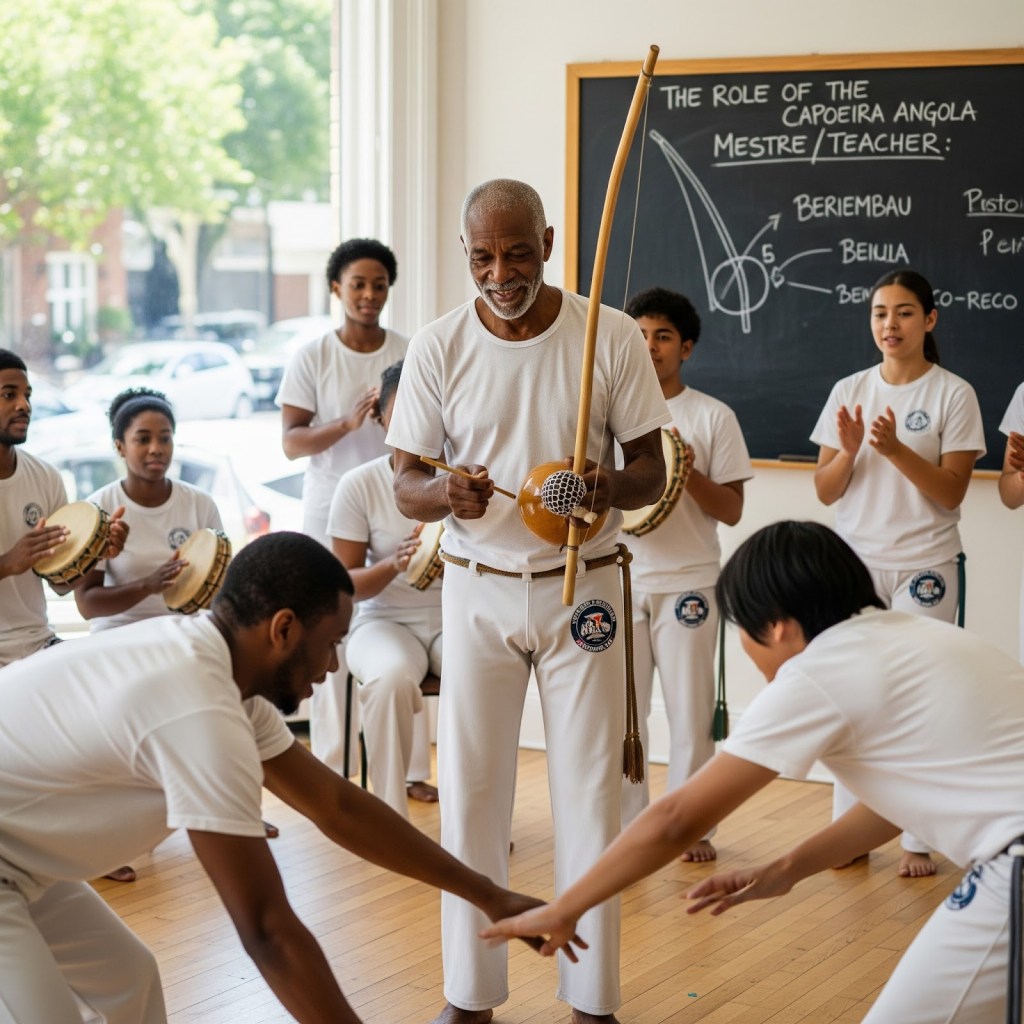
The mestre or teacher plays a crucial role in supporting a student through such a crisis. Their guidance extends beyond teaching movements to encompassing a holistic understanding of the student’s well-being. A sensitive mestre can:
- Create a safe and understanding environment within the academy.
- Encourage open communication, if the student chooses to share.
- Adapt training to accommodate physical or emotional limitations.
- Emphasize the therapeutic aspects of capoeira without pathologizing the student.
- Recognize when professional psychological help is needed and encourage the student to seek it.
While Capoeira Angola does not offer a magical cure for the long-term effects of violence and trauma, its rich tapestry of philosophy, movement, music, and community provides a unique and powerful framework for coping, healing, and ultimately, thriving. By embracing the fluidity of the ginga, the resilience of the body, the support of the roda, and the wisdom embedded in its traditions, a capoeirista can find strength to navigate life’s most profound challenges and transform experiences of vulnerability into sources of profound personal growth and wisdom. It is a testament to the depth of this art form that it can not only teach us to play and fight but also to heal and rebuild, even after facing the darkest aspects of human experience.
How does a Capoeirista live a good life, and accept his or her own death at the end of their time?
A Capoeirista’s journey toward a “good life” is deeply and inextricably intertwined with the discipline’s profound emphasis on balance, resilience, and connection. Through the constant and dynamic interplay of attack and defense within the jogo (the game or dance), the fluid and improvisational movements that define it, and the rhythmic call and response of the roda (the circle in which Capoeira is played), a Capoeirista learns to adeptly navigate uncertainty, gracefully adapt to constant change, and ultimately find harmony even amidst chaos. This continuous and rigorous engagement with physical and emotional challenges fosters a profound sense of self-awareness and an acute presence in the moment, actively encouraging the practitioner to live fully and authentically in each passing second.
The acceptance of one’s own death, while a universal human struggle that transcends cultures and beliefs, is approached in Capoeira Angola through the lens of impermanence and the cyclical nature of all life. The very movements of Capoeira—its evasions, escapes, and feints—can be seen as powerful metaphors for confronting the inevitable and moving with it gracefully, rather than resisting it. The historical context of Capoeira, born from oppression, resistance, and the fight for freedom, also imbues it with a visceral sense of the fragility of life and the profound importance of leaving a meaningful and lasting legacy. For a Capoeirista, living a good life might therefore mean living authentically, contributing actively and positively to their community, upholding the rich traditions of Capoeira, and ultimately, facing the end of their time with a spirit of equanimity and acceptance. This understanding comes from the deep knowledge that their energy, influence, and spirit will continue to resonate within the roda and ripple out into the world beyond. The legacy is not just in physical actions, but in the transmission of knowledge, spirit, and the communal bond.
The Capoeirista’s Journey Through Life’s Ultimate Challenges
Capoeira is far more than just a martial art; it is a comprehensive philosophy, a holistic way of life that instills unwavering discipline, profound resilience, and a deep, intuitive understanding of the human spirit. But how does this intricate dance-fight, with its layers of physical, mental, and spiritual training, truly prepare an individual for the most profound and traumatic experiences life can inevitably throw their way? The constant negotiation of physical threats, the emotional control required to maintain composure in the roda, and the collective support of the community all build a formidable inner strength that can be leveraged when confronting life’s deepest wounds. It is in the roda that one learns to fall and rise again, to be struck and to recover, mirroring the resilience needed to face the blows of life itself. The music, the camaraderie, and the historical struggle embedded in every movement provide a framework for processing pain and finding solace in shared experience.
Coping with Loss: The Capoeirista and Grief
The death of a loved one – a parent, a child, a spouse, a close friend – is an inevitable part of the human experience, a profound rupture that can shake the very foundations of one’s being and leave an indelible mark on the soul. It is a universal truth that grief, in its myriad forms, will touch every individual, forcing a confrontation with loss, vulnerability, and the often-unsettling impermanence of life. This journey through sorrow is rarely linear, characterized instead by a complex interplay of emotions: denial, anger, bargaining, depression, and ultimately, acceptance. Each person’s path is unique, shaped by their relationship with the deceased, their personal history, cultural background, and individual coping mechanisms.
For a Capoeirista, however, the deep-seated principles of adaptability, rhythm, and community, so central to their dynamic art form, might offer a unique and powerful framework for processing the intricate and often overwhelming emotions of grief. Capoeira, more than just a martial art or a dance, is a philosophy in motion, a way of life that instills resilience and fosters a profound connection to oneself and others.
Adaptability (Ginga and Fluidity): The fundamental movement of Capoeira, the ginga, is a constant, rhythmic sway that allows the practitioner to maintain balance, evade attacks, and prepare for new movements. It embodies the essence of adaptability – a continuous state of readiness to respond to changing circumstances. In the context of grief, this principle can translate into a conscious effort to flow with the unpredictable waves of emotion, rather than resisting them. Just as a Capoeirista learns to adjust their body to the rhythm of the game, a grieving individual might learn to adapt to the shifting landscape of their feelings, understanding that some days will be more challenging than others, and that progress is not always linear. The fluidity of Capoeira also encourages letting go of rigid expectations and embracing the organic, often messy, nature of healing.
Rhythm (Music and Movement): Music is the heart and soul of Capoeira, dictating the pace, energy, and mood of the roda (the circle where Capoeira is played). The call-and-response songs, the pulsating beat of the berimbau, and the rhythmic clapping create a powerful, immersive experience. In grief, engaging with rhythm, whether through music, dance, or even repetitive, meditative movements, can be deeply therapeutic. The structured yet expressive nature of Capoeira’s rhythm can provide an outlet for emotions that words cannot always capture. It offers a way to externalize internal turmoil, to channel sorrow and frustration into a physical expression, and to find a sense of grounding amidst the chaos of loss. The communal aspect of the music also reinforces connection, reminding the grieving individual that they are not alone in their experience.
Community (Roda and Support): The roda itself is a powerful symbol of community and mutual support. Within the circle, Capoeiristas challenge each other, learn from each other, and protect each other. It is a space of trust, respect, and shared experience. For someone grappling with grief, the presence of a strong, supportive community is invaluable. The Capoeira community, with its emphasis on camaraderie and collective spirit, can offer a safe haven where vulnerability is accepted and emotional support is readily available. Sharing stories, participating in rituals, or simply being present with others who understand the complexities of human connection can alleviate feelings of isolation and provide a sense of belonging during a time when one might feel utterly alone. The shared journey of Capoeira, with its ups and downs, mirrors the shared human experience of navigating loss, fostering empathy and collective resilience.
Ultimately, while Capoeira cannot erase the pain of loss, its embedded principles offer a powerful lens through which to approach grief. By fostering adaptability in the face of change, embracing the cathartic power of rhythm, and leaning on the unwavering support of community, a Capoeirista might find a unique and profound pathway towards healing, transforming their profound rupture into a testament of their enduring spirit.
Finding Solace in the Familiar Rhythm of Change:
Capoeira, at its core, is a constant and intricate ebb and flow, a captivating dance between attack and defense, creation and destruction, challenge and response. This ingrained understanding of cycles, transitions, and the impermanence of all things could provide a Capoeirista with a profound perspective, allowing them to acknowledge and even accept the natural order of life and death. While the searing pain of loss is undeniably profound and deeply personal, the rhythmic pulse of life continues its relentless progression. The Capoeirista, through years of training, is adept at finding their balance and their place within this ongoing rhythm, even when it feels discordant. This inherent resilience, born from the constant negotiation o
movement and stillness can be a surprising source of strength during times of mourning.
The Roda as a Sacred Space and Support System:
The roda (the circle in which capoeira is played) is far more than just a performance space; it is a vibrant community, a sacred space of shared energy, mutual respect, and unwavering support. In times of intense grief, this communal aspect of the roda can provide immense solace and a vital lifeline. Within the protective embrace of the circle, sharing stories, singing evocative corridos (songs that often speak of hardship and resilience), and moving together – even in a subdued, contemplative way – can offer a powerful and much-needed outlet for raw emotions. This collective experience fosters a profound sense of belonging that actively counters the isolating nature of grief, reminding the individual that they are not alone in their suffering. The shared physical and emotional energy of the roda can become a conduit for healing, allowing emotions to be expressed and acknowledged without judgment.
Discipline and the Imperative of Self-Care:
The rigorous and demanding training of a Capoeirista instills a formidable sense of discipline and self-awareness. This cultivated discipline can prove invaluable in translating into practical self-care routines during the disorienting haze of grief. It can provide the structure necessary to ensure that basic needs – nourishment, rest, hydration – are met, even when emotional pain feels utterly overwhelming and all motivation seems to dissipate. Furthermore, the physical outlet of training, when approached with sensitivity and self-compassion, can be a remarkably powerful tool for releasing pent-up emotions, alleviating stress, and restoring a sense of agency. The structured movements and the focus required in capoeira can offer a temporary respite from intrusive thoughts, allowing for a healthy release of tension and a reconnection with one’s physical self.
Beyond Personal Loss: Reflecting on the Death of an Adversary:
Dealing with the death of an enemy, while perhaps not carrying the same intimate emotional weight as the loss of a loved one, still prompts a profound opportunity for reflection on the transient nature of all life and the intricate complexities of human relationships. The Capoeirista’s perspective, which often emphasizes respect, even for an opponent within the roda, can lead to a surprising sense of closure or a deeper, more nuanced understanding of the shared human condition. This philosophy encourages a move beyond animosity, fostering a recognition of the inherent humanity in all individuals. In facing the death of an adversary, a Capoeirista might find an unexpected path towards forgiveness, a release from past conflicts, and a renewed appreciation for the precious and fleeting nature of every life.
The Unthinkable Act: When a Capoeirista Takes a Life

The idea of a Capoeirista taking a life, especially outside the context of self-defense or war, presents a profound moral and psychological challenge. Capoeira, at its core, is not about killing, but about movement, deception, and control.
- The Weight of Intent: A Capoeirista’s training emphasizes precise control and the ability to incapacitate without necessarily inflicting lethal harm. If a life is taken, the circumstances and intent would be paramount. Was it an act of last resort in self-preservation? Was it accidental? The internal struggle would likely be immense.
- Philosophical Reckoning: Capoeira’s roots are steeped in resistance and liberation. Taking a life, even in defense, would force a deep philosophical reckoning with the values and ethics of the art form. The individual would likely grapple with concepts of justice, consequence, and their own moral compass.
- Isolation and Guilt: Unlike the shared experience of grief, the act of killing is often a solitary burden. The Capoeirista might experience profound guilt, isolation, and a shattering of their self-identity. The physical and mental discipline honed through capoeira might be turned inward, used to cope with the immense psychological stress.
War, Combat, and Post-Traumatic Stress Disorder (PTSD)
When a Capoeirista is forced to take up arms in a conflict, they are confronted with an environment diametrically opposed to the playful yet disciplined nature of the roda. This is where the deeper elements of capoeira’s resilience are truly tested.
- Adapting to a New “Game”: The “game” of capoeira is about outsmarting, anticipating, and reacting. In combat, these instincts become amplified and deadly. The Capoeirista’s ability to read an opponent, move with agility, and exploit weaknesses could be invaluable in a combat situation. However, the stakes are immeasurably higher, and the rules of engagement are brutal.
- The Physical and Mental Toll: Prolonged exposure to combat can lead to significant physical and psychological trauma. The intense physical conditioning of a Capoeirista could offer some resilience, but it cannot prevent the mental scarring. The constant state of hyper-vigilance, the witnessing of violence, and the acts of violence committed can all contribute to PTSD.
- The Aftermath: Battling PTSD: PTSD can manifest in flashbacks, nightmares, anxiety, and emotional numbness. For a Capoeirista, the coping mechanisms might include:
- The Healing Power of Movement: Returning to the roda could be a form of therapy. The structured movement, the focus required, and the release of energy can help to process trauma and re-regulate the nervous system. The familiar rhythms and music could offer a sense of grounding and safety.
- Community and Connection: Re-engaging with their Capoeira community can provide vital social support and a sense of belonging. Sharing experiences (when ready), or simply being present in a supportive environment, can aid in the healing process.
- Mindfulness and Focus: The meditative aspects of Capoeira, the focus on breath and body awareness, can be powerful tools for managing anxiety and intrusive thoughts associated with PTSD. The discipline of training can help to re-establish a sense of control and purpose.
- Redefining Purpose: After experiencing the horrors of war, a Capoeirista might find renewed purpose in their art, perhaps teaching, mentoring, or using their experiences to advocate for peace or support other veterans.
Capoeira, far more than just a martial art or a dance, embodies a philosophy of life that offers a profound framework for confronting the multifaceted challenges of the human experience. At its essence, the core principles woven into the very fabric of capoeira—adaptability, resilience, community, discipline, and a deep understanding of self—coalesce into a potent, though not infallible, arsenal. This comprehensive toolkit equips individuals to navigate the most profound and challenging aspects of the human condition, from the pervasive sorrow of loss and the gnawing anxiety of uncertainty to the acute trauma of combat and the complex struggles of everyday life.
Adaptability is perhaps the most immediate and visible principle. In the roda (the circle where capoeira is played), practitioners constantly adjust to their partner’s movements, anticipating, reacting, and flowing seamlessly between attack and defense. This physical fluidity translates directly to mental agility, fostering a mindset capable of embracing change and finding innovative solutions in the face of unexpected obstacles. When confronted with personal setbacks or professional shifts, the capoeirista’s trained adaptability allows for a quicker reorientation, minimizing the paralysis of surprise and maximizing the potential for forward momentum.
Resilience, closely intertwined with adaptability, is forged through the continuous practice of overcoming physical and mental challenges. The falls, the near misses, the moments of exhaustion—all contribute to building an inner fortitude that enables individuals to bounce back from adversity. Capoeira teaches that setbacks are not failures but opportunities for growth, pushing practitioners to persist, learn from their experiences, and emerge stronger. This mental toughness is invaluable when confronting grief, disappointment, or any situation that demands sustained effort and an unwavering spirit.
The concept of community is central to capoeira’s identity. The roda itself is a collective endeavor, where each participant, from the musicians to the players and the observers, contributes to the energy and rhythm. This emphasis on mutual support, shared purpose, and collective encouragement extends beyond the training space. It cultivates a sense of belonging and interdependence, highlighting the importance of human connection in times of struggle. In moments of profound loneliness or despair, the lessons of capoeira remind us that we are not alone and that strength can be found in the embrace of a supportive community.
Discipline underpins every aspect of capoeira practice. From the rigorous training of movements and acrobatics to the consistent dedication required to learn songs and rhythms, discipline instills a sense of order and commitment. This self-mastery extends beyond the physical, fostering mental focus, emotional regulation, and the ability to set and achieve goals. Such discipline is crucial for navigating long-term challenges, whether it’s the sustained effort needed to overcome an illness, the methodical approach required to achieve personal growth, or the unwavering resolve to pursue a difficult path.
Finally, a deep understanding of self emerges from the introspective nature of capoeira. Through the demanding physical and mental engagement, practitioners gain a heightened awareness of their own strengths, weaknesses, and emotional responses. The art form encourages self-reflection, pushing individuals to confront their fears, limitations, and aspirations. This profound self-knowledge becomes a compass, guiding individuals through moments of confusion and empowering them to make choices aligned with their authentic selves. It is this inner clarity that can illuminate the path forward even in the darkest of times, allowing individuals to process complex emotions like loss and trauma with greater self-compassion and resilience.
Capoeira Angola, at its core, presents a comprehensive and profound methodology for engaging with the multifaceted aspects of human existence. It’s more than just a martial art or a dance; it’s a philosophy in motion, a living embodiment of resilience and adaptation. While it would be a disservice to suggest that capoeira can entirely eradicate suffering or provide an unbreachable defense against the inevitable hardships of life, it meticulously cultivates a powerful internal scaffolding.
This robust framework empowers individuals to develop an array of critical inner resources. Through its intricate movements, its communal singing, and its rich historical and cultural tapestry, capoeira fosters self-awareness, discipline, and a deep understanding of one’s own capabilities and limitations. It challenges practitioners to confront fear, embrace discomfort, and find strength in vulnerability.
Ultimately, the interwoven principles of capoeira, from the fluid dance of the ginga to the strategic counter-attacks and the unifying rhythm of the roda, equip individuals to:
- Confront: To face challenges directly, without avoidance or denial, recognizing that acknowledging difficulty is the first step towards overcoming it.
- Adapt: To adjust to changing circumstances, demonstrating flexibility in thought and action, understanding that rigidity can lead to breakage.
- Ultimately Transcend: To move beyond the immediate pain or obstacle, transforming adversity into growth, finding new perspectives, and emerging stronger and more integrated.
In essence, Capoeira Angola does not promise an easy path, but rather provides the tools and the spirit to navigate life’s most formidable challenges with grace, strength, and an unwavering belief in one’s own capacity for transformation. It’s a journey of continuous learning and profound self-discovery, preparing its adherents not just to survive, but to thrive amidst the complexities of the human condition.

 Jogo Corpo Fechado