
Greetings!
This is the 1st installment of a new series I like to call, BASIC ELEMENTS OF CAPOEIRA go over the basic movements of Capoeira Angola.
“There are not more than five musical notes, yet the combinations of these five give rise to more melodies than can ever be heard. There are not more than five primary colours, yet in combination, they produce more hues than can ever been seen. There are not more than five cardinal tastes, yet combinations of
them yield more flavours than can ever be tasted.”
― Sun Tzu, The Art of War“
Capoeira Angola, is a defensive Martial Art Par Excellence in which each defense is a sprig trap laid out for the unsuspecting opponent to trigger. There are 8 basic defenses (more or less), ad each has it’s own unexpected attacks and counter attacks depending on the position of the opponent. When these movements are mastered, they are more than sufficient for the capoeirista to defend his/her self from persons armed with sticks, clubs, knives, or (with the proper mandinga) even firearms.
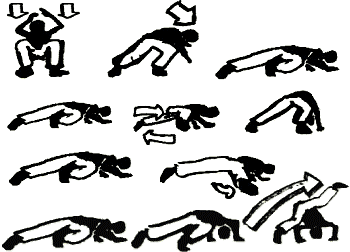
What you see below is the Negativa, One of the most Fundamental movements in capoeira angola. Although the word “negativa” is portuguese for the english word, “negative”, My teacher Charles Williams describes this movement as the most POSITIVE thing you can do in Capoeira Angola.
Negativa, also known as negaça, is a fundamental element in the practice of capoeira, the Afro-Brazilian martial art. It represents a key defensive move, allowing the practitioner to effectively counter and nullify incoming attacks by swiftly maneuvering low to the ground. With its roots deeply intertwined with the cultural and historical context of Brazil, the negativa embodies the grace and agility of capoeira, serving as a testament to the art’s rich heritage. It is an intricate form of movement that requires dexterity and finesse, enhancing the fluidity and dynamism of capoeira as a martial art form.
It’s easy to quickly descend into the negativa, a graceful and evasive movement that is deeply rooted in the art of capoeira. The player who employs the negativa skillfully can effortlessly evade their opponent’s attacks, swiftly shifting their weight to dodge incoming strikes with fluid agility. Furthermore, they consistently deliver their kicks with precision and finesse, always targeting the intended part of the opponent’s body, showcasing impeccable timing and remarkable control of the art form.
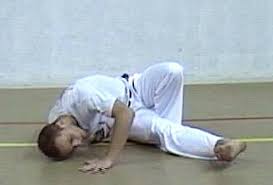
Negativa angola, also known as negativa lateral, is low version of negativa, for evading low kicks. This movement is easily achieved by bending one knee, extending the opposite leg, and leaning at the waist while lowering yourself as much as possible. being an angoleiro myself, it’s the 1st negativa I’ve ever learned.
Below, we have mestre Bola Sete teaching his class this negativa, along with some variations.
Negativa Regional is also a fundamental movement in capoeira, often used as a defensive position. To perform this position, capoeiristas squat on one leg and extend the other leg in front of them, creating a stable base while remaining agile and ready for quick movements. Their supporting hand is placed on the ground on the same side as their extended leg, providing additional balance and support. Meanwhile, their free hand is held up in a guarding position to protect their face and upper body. It is worth noting that although Negativa Regional is also taught in Capoeira Angola, it is more commonly and prominently used in the Regional and Contemporâneo styles of capoeira.
Going to the ground is a common tactic in capoeira, and it can be used to both deceive and attack an opponent. An experienced capoeirista can use their ground skills to lure an opponent into a trap, making themselves appear vulnerable when, in reality, they are about to attack. There are many kicks and takedowns specifically designed to be used from the ground. This aspect of capoeira requires a deep understanding of body positioning and leverage, allowing the practitioner to seamlessly transition between standing and grounded techniques. Being proficient in ground tactics also gives the capoeirista the ability to control the pace of the encounter, creating opportunities to dictate the flow of the game and respond with swift, calculated movements. Furthermore, mastering the art of ground-based attacks enhances the capoeirista’s overall strategy, providing a comprehensive approach to combat that encompasses a wide range of techniques and scenarios.
I’ll post one of these kicks here, because it was billed as “The most powerful kick”.
You saw it on Fight Science, Martelo de Negativa. Lateef Crowder went up against 3 other martial artists and put the science to the test. Although there was one more powerful technique showcased, the martelo de negativa stood out as the most efficient and graceful. With its roots in the art of Capoeira, the martelo de negativa demonstrated how ancient fighting techniques continue to influence and shape modern martial arts, serving as a testament to the enduring legacy of these time-honored practices.
Click HERE for the FIGHT SCIENCE video.
And here, you can see how Negativa can be used as a takedown.
Also from the negativa, a capoeirista can seamlessly transition into maneuvers like amêixia or queda de rins, showcasing a wide range of techniques that enhance the fluidity and deceptive nature of the art. This ability to move with grace and agility while remaining prepared for both offensive and defensive actions illustrates the strategic and dynamic essence of capoeira. The seamless integration of ground movements, acrobatics, and elements of dance makes capoeira a truly unique and captivating martial art, where every gesture and stance has a rich cultural and historical significance.
 Jogo Corpo Fechado